We’d like to remind Forumites to please avoid political debate on the Forum.
This is to keep it a safe and useful space for MoneySaving discussions. Threads that are – or become – political in nature may be removed in line with the Forum’s rules. Thank you for your understanding.
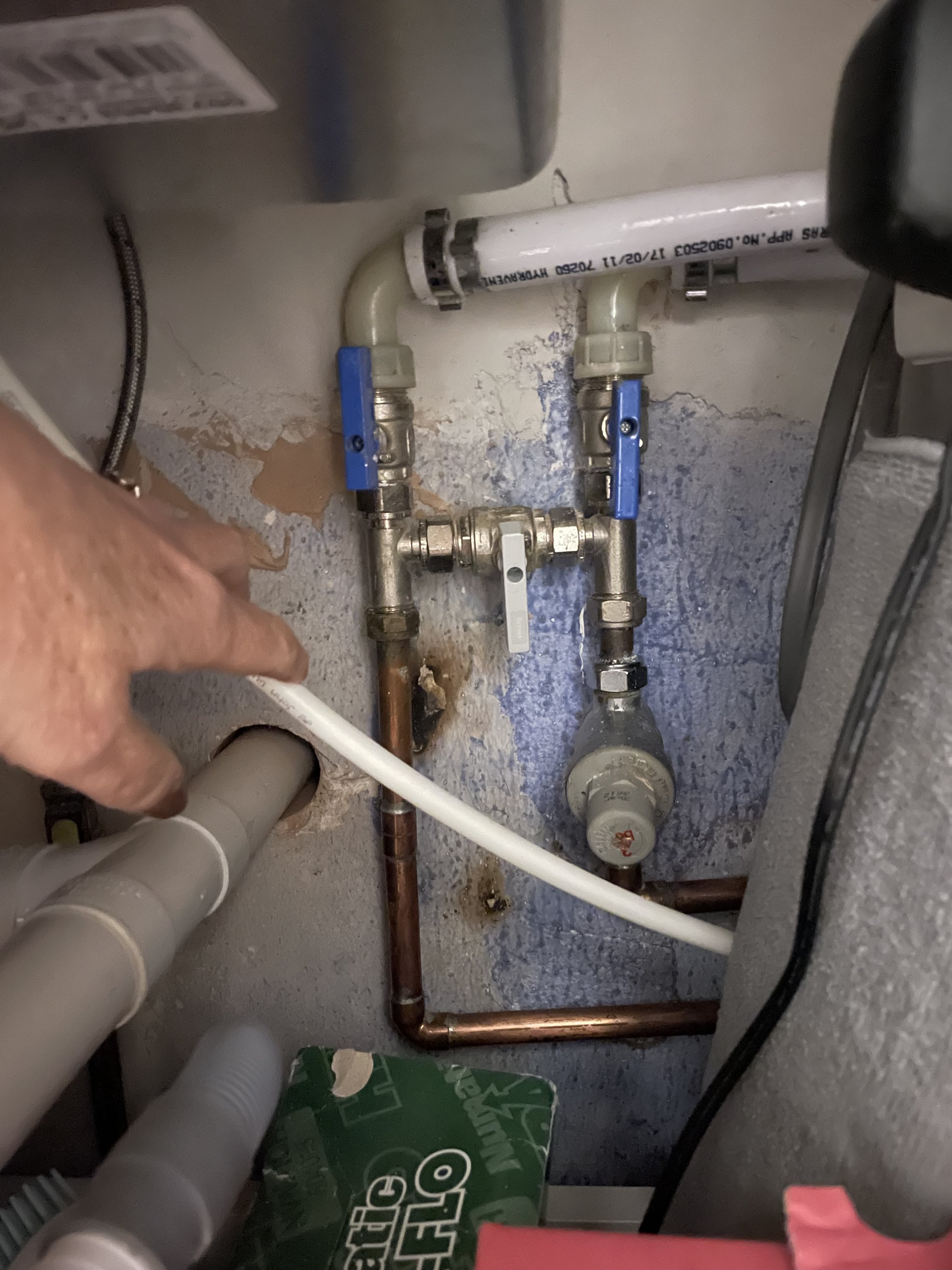
Please remind me which lever turns the water off.





I know this is the way to turn the water off, I just want to check which levers to turn. A water softener is in the cupboard next to this under sink cupboard. All the taps in the house, except the garden tap have softened water so go through these pipes. (I’ve turned the water off before so know this works, it’s just a question of which levers.
I think the grey lever in the middle is the diverter to be used if I don’t want the water to go via the softener.
Do I turn both the blue levers to turn the water off and leave the grey one alone? Or is it just one of the blue ones?
Comments
-
The RH copper pipe, with the grey thing - a pressure reducing valve - is almost certainly your main supply.
As you say, the grey lever is the by-pass, and if you open this - get the handle in line with the fitting - it'll be 'open', so your softener will be by-passed.
The blue levers are the isolating valves to your softener, the RH being the supply to it, and the LH being the softened return.
So, to turn off the supply to the house, leave the grey bypass closed, and shut off either of the two blues.
Close both if you like - it won't make any difference.
If you want to remove the softener machine, then close both blues, and open the grey to allow unsoftened flow to bypass.
2 -
Thank you. I thought it was something like that, I couldn’t remember if it was one or both.
I'm a Forum Ambassador on the housing, mortgages & student money saving boards. I volunteer to help get your forum questions answered and keep the forum running smoothly. Forum Ambassadors are not moderators and don't read every post. If you spot an illegal or inappropriate post then please report it to forumteam@moneysavingexpert.com (it's not part of my role to deal with this). Any views are mine and not the official line of MoneySavingExpert.com.0 -
Doesn't that depend on why and what you want to turn off or isolate?
The main stopcock is the only one which shuts off the whole house. The OP states that the outside tap isn't connected to the water softerner system so there must be a main stopcock somewhere.
1 -
The main stopcock is unreachable behind the dishwasher! There is also something on the driveway by the meter, This one under the sink will turn all but the garden tap off. It’s enough for my purpose tomorrow, which is to allow the plumber to fix the dripping toilet flow on a toilet fed from the CWT in the loft.
I'm a Forum Ambassador on the housing, mortgages & student money saving boards. I volunteer to help get your forum questions answered and keep the forum running smoothly. Forum Ambassadors are not moderators and don't read every post. If you spot an illegal or inappropriate post then please report it to forumteam@moneysavingexpert.com (it's not part of my role to deal with this). Any views are mine and not the official line of MoneySavingExpert.com.1 -
All good then. 😊 Just didn't want you to have a flood x
When we did the plumbing here (old cottage ) we put stop valves on everything. Being able to isolate individual areas has definitely been useful.
1 -
in general, putting those levers at right angles to the pipe turns them off.
No reliance should be placed on the above! Absolutely none, do you hear?0 -
Thanks, I didn’t know if “off” meant off to the water softener or off to the supply.
I'm a Forum Ambassador on the housing, mortgages & student money saving boards. I volunteer to help get your forum questions answered and keep the forum running smoothly. Forum Ambassadors are not moderators and don't read every post. If you spot an illegal or inappropriate post then please report it to forumteam@moneysavingexpert.com (it's not part of my role to deal with this). Any views are mine and not the official line of MoneySavingExpert.com.0 -
There’s only about 8cm of pipe visible between the bottom of the cistern and the top of the boxed in pipe work. Not sure if that is room enough for an isolator to be fitted. Will ask the plumber today. Most of the rest of the house has isolators on it, including the sink right next to the toilet. I’m now wondering if the isolator under the sink also isolates the toilet, I will check.
I'm a Forum Ambassador on the housing, mortgages & student money saving boards. I volunteer to help get your forum questions answered and keep the forum running smoothly. Forum Ambassadors are not moderators and don't read every post. If you spot an illegal or inappropriate post then please report it to forumteam@moneysavingexpert.com (it's not part of my role to deal with this). Any views are mine and not the official line of MoneySavingExpert.com.1 -
8cm should be enough, but the plumber will confirm.
Always good to have isolating valves on individual items like this for situations where they - a tap, a toilet, a shower, a storage tank - continues to run or fill due to a fault. What do you do if you cannot isolate that one device to prevent water loss? Yup, shut off the whole house until it's fixed 😐️
For your current job, it isn't an issue, as no water is being lost. So you just shut off the whole house for the duration of the fix.
Assuming that the valves there do shut off everything other than the garden tap, then simply turn the RH blue handle thro' 90o. Leave the others as they are. That should do it.
0 -
silvercar said:
I know this is the way to turn the water off, I just want to check which levers to turn. A water softener is in the cupboard next to this under sink cupboard. All the taps in the house, except the garden tap have softened water so go through these pipes. (I’ve turned the water off before so know this works, it’s just a question of which levers.
…
The kitchen sink cold tap should also be non-softened. If it isn't, you might want to ask the plumber about the feasibility of changing that.
In terms of fitting isolating valves to everything, I'd acknowledge the convenience of being able to isolate things individually and that building regs and/or bylaws might require it. On the other hand, adding isolator valves increases the number of potential points of failure in the system - and there's not much point in adding an isolator valve if, when you first use it 10 years after fitting it, you discover that it is either seized or starts leaking. There's also not much point fitting isolators which - similar to silvercar's main stoptap - are inaccessible when you want/need to use them.
My personal view is it is better to arrange things so the use of a few good-quality valves in accessible locations will isolate parts of the system on a zonal basis (i.e. one valve to isolate all the cold in the kitchen) rather than having each appliance/outlet fitted with a poorer quality valve which is only Ok so long as it never actually gets used. If you have a cold water storage tank in the loft then having a good-quality isolator valve on each outlet pipe is probably as much isolation as anyone practically needs.
0






Confirm your email address to Create Threads and Reply

Categories
- All Categories
- 355.6K Banking & Borrowing
- 254.8K Reduce Debt & Boost Income
- 456.1K Spending & Discounts
- 248.2K Work, Benefits & Business
- 605.7K Mortgages, Homes & Bills
- 179K Life & Family
- 263.5K Travel & Transport
- 1.5M Hobbies & Leisure
- 16.1K Discuss & Feedback
- 37.7K Read-Only Boards