We’d like to remind Forumites to please avoid political debate on the Forum.
This is to keep it a safe and useful space for MoneySaving discussions. Threads that are – or become – political in nature may be removed in line with the Forum’s rules. Thank you for your understanding.
📨 Have you signed up to the Forum's new Email Digest yet? Get a selection of trending threads sent straight to your inbox daily, weekly or monthly!
Overpaying into pension and universal credit



Hi,
I currently pay into a workplace pension, with pretty decent employer contributions and a smaller % from myself. I am also in receipt of universal credit.
I became a single parent around 5 years ago and prior to this, I was never in a financial situation where I could afford to pay into a workplace pension and opted out. By comparison, my ex-partner has an excellent pension. It wasn’t until around 2 years ago months ago that I became financially able to start paying into a workplace pension. I am now in my late 30’s and thinking about how I need to plan better for my financial future. I have full contributions towards my state pension from 16 years old to now.
I would like to buy additional ‘blocks’ of pension from my employer and they offer a contract whereby you can choose to pay an additional sum each money over 2,3,5,10 years etc to purchase £x amount per year towards a workplace pension.
I wanted to ask how this would affect my Universal Credit as it would be regular payments for a sustained period of time (probably around £250-£300 per month reductions to my salary) and if I simply need to inform them that this is what I am doing so that they are aware of this when calculating my entitlement as I assume I will receive less UC as this is a personal choice to overpay.
Many thanks for any advice
Comments
-
Is the scheme simply an increased employee pension contribution, or is it a salary sacrifice scheme?
If it is an employee pension contribution, then it is fine, and your UC should increase by 55% of whatever you pay into your pension.
This is because the rules explicitly allow for pension contributions, and there is no legal way for them to fight that.
If it is a salary sacrifice scheme, then there is a potential route for them to disallow it - something called 'notional earned income'. However, in my opinion they are exceedingly unlikely to argue this, even for relatively large pension deductions.
It is also worth noting that if it is a salary sacrifice scheme, then you have to watch the earnings thresholds, as a lower salary could take you below the CET or AET levels, and possibly mean increased conditionality being placed on you. This should not be an issue if it's an employee contribution.
1 -
Just to add to this — it’s worth checking with payroll whether those “blocks” are treated as standard employee contributions or via salary sacrifice in practice, because employers sometimes use the wording interchangeably. If it’s taken from gross pay as salary sacrifice, UC can look at notional income, but in reality they rarely challenge pension contributions that are reasonable and long-term. If it’s a normal employee contribution, it’s fully disregarded and UC adjusts automatically. Either way, it’s sensible planning, not deprivation, and you don’t need permission — just make sure UC see the correct earnings figure.
1 -
Hi and thank you both for replying. I really need to read up on my workplace pension scheme, I feel really uninformed as I don't fully understand how it all works.
I've looked online and this is the information I have found:The scheme is made up of a ‘defined benefit’ section and a ‘defined contribution’ section.
PensionsPlus is a new way to make pension contributions, which reduces payment of National Insurance deductions, meaning you take home more pay than you would by contributing to your pension outside of PensionsPlus. PensionsPlus launched on 1 February 2020. All salaried staff are automatically opted in to PensionsPlus unless they chose to opt out.
I am currently opted into this but looking online on my employers website, I can opt out of this at certain points in the year. I am not sure if the pension scheme is salary sacrifice or not (it's the SAUL pension scheme) as a rule.
With regards to buying CARE blocks to earn additional pension, the information is as follows:
You can pay more than 6% of your salary in to SAUL to give yourself more money when you retire.
If you do, you’ll buy units of extra income and lump sum – called Additional Pension.
Each unit will give you £250 of extra income a year and £750 of extra tax-free lump sum when you retire. And your dependants will get more income from SAUL if you die.
You can buy up to 21 units – or £5,250 a year of extra income and £15,750 extra lump sum.
If you’d like to know how much Additional Pension would cost for you, you can ask your employer to get in contact with SAUL for you.
If you then decide to go ahead and buy Additional Pension with monthly payments, you’ll need to tell your employer, so they can make sure the extra money comes out of your pay each month.
Thank you again for your advice, I think I will contact the pensions team and payroll team at my workplace and ask them about how the additional payments are viewed so that I can make an informed decision. I'd have to take a careful look too at the AET earnings as I know I am currently well above them but will need to calculate what impact this would have. The contract to pay additional money into my pension can be cancelled at any time, so if this did cause any issues down the line, I could always cancel it. I really just want to ensure I am being careful about my financial future whilst I am still relatively young (in working years anyway!).0 -
"
PensionsPlus is a new way to make pension contributions, which reduces payment of National Insurance deductions, meaning you take home more pay than you would by contributing to your pension outside of PensionsPlus"
That means the scheme must be operating under Salary Sacrifice so the result is a reduced salary in exchange for the increased employer pension contributions in lieu of the original element of salary that has now been sacrificed.
(The rules for SS are due to be changed in a couple of years.)
From a UC perspective, the reduced salary will mean reduced earnings reported through RTI and that should be picked up in the calculation of UC for the AP once the change is implemented.
You cannot SS below NMW.
1 -
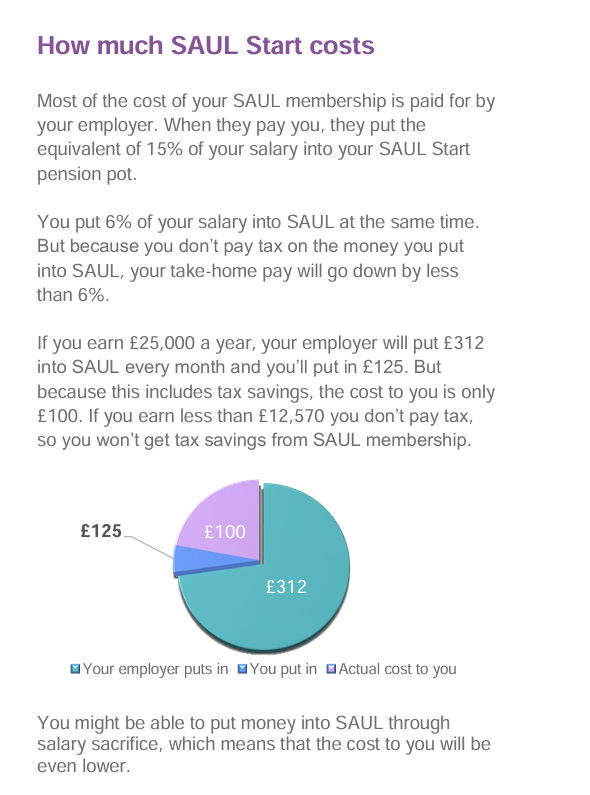
If this is your scheme, it's compelling.
PensionsPlus is not another pension scheme - it is simply a more effective way of paying into your pension scheme. Through the PensionsPlus scheme, almost all QMUL employees in the SAUL or USS pension schemes will make National Insurance (NI) savings on contributions to their scheme.
PensionsPlus
PensionsPlus is a salary sacrifice scheme which allows both the University and its staff to make savings in the amount of National Insurance contributions they pay. As a member of the Universities Superannuation Scheme (USS) or the Superannuation Arrangements of the University of London (SAUL) you are automatically enrolled into this scheme.
Participating in PensionsPlus
By paying into a pension scheme through PensionsPlus, you agree to give up an amount of your contractual gross pay equal to your standard member pensions’ contribution. In return the University will increase its employer contribution by a corresponding amount. This is known as a “salary sacrifice” or "salary exchange".
My reading of this is that 'PensionsPlus' is their mechanism for using SalSac on a DB scheme.
The other contributors will be able to assist with how this dovetails with UC, but solely from a personal finance perspective, this is a 'gold plated' option :)
1 -
Thank you, it is a very good pension scheme and it’s a huge regret that I couldn’t pay in when I started at my workplace 10 years ago but it was money we simply didn’t have so here I am.
I think I understand that the pensions plus element is where the salary sacrifice kicks in. This you can opt out of once a year for one calendar month and then if you wanted to opt out or in again you would have to wait until next year to do so.
On that basis it sounds like opting out and overpaying into the pension over a period of time might be a good option as that might not reduce my UC but again that may also depend on whether purchasing additional pension falls into salary sacrifice too? And so wouldn’t be beneficial short term. I’m not fantastically well off on a single salary with two children so it’s a real balancing act of what I can afford now vs what Id ideally like to retire with, whilst following UC rules! I’ll have to investigate further and see what the additional pension means in terms of how my pay is broken down.
0 -
Just to clarify some points:
- Your UC will certainly not go down, The question is only whether it would go up, as your take-home pay reduces due to the increased pension contributions.
- As standard, either sort of scheme will 'work' in that the increased contributions would mean that your UC entitlement goes up.
- The question is only whether UC will subsequently look into it and try to argue that you have 'notional earned income'. As I said earlier, they can only possibly argue this with a salary sacrifice scheme (which yours seems to be), but even then they are very unlikely to do this, unless you do a ridiculous level of contribution, which won't be the case here.
0 -
It's also a DB scheme. So there is no pot of cash. Just a calculated transferrable value, which is in the real world only notional, as it's now virtually impossible to convert into a pot. The scheme is so lucrative that (outside of the UC scenario), I would be encouraging maximum allowable additional contributions.
There should really be a definitive way of getting an answer to this from the DWP. Can I make AVCs to a DB pension scheme when receiving UC. I appreciate that in practice it unlikely to be a problem.
0 -
"
There should really be a definitive way of getting an answer to this from the DWP. Can I make AVCs to a DB pension scheme when receiving UC. I appreciate that in practice it unlikely to be a problem.
"
UC will not comment on proposed actions but will only determine based upon actual actions that have occurred.
0 -
Yes, I have found that out in my recent research! It's pretty jarring when we are so used to common law, everything is legal unless it specifically isn't. Benefits/UC uniquely appear to be on the whim of a DM. Or, at least, the risk of getting into a legal battle. I live for binary :)
0







Confirm your email address to Create Threads and Reply

Categories
- All Categories
- 355.8K Banking & Borrowing
- 254.9K Reduce Debt & Boost Income
- 456.2K Spending & Discounts
- 248.3K Work, Benefits & Business
- 605.9K Mortgages, Homes & Bills
- 179K Life & Family
- 263.8K Travel & Transport
- 1.5M Hobbies & Leisure
- 16.2K Discuss & Feedback
- 37.7K Read-Only Boards