We’d like to remind Forumites to please avoid political debate on the Forum.
This is to keep it a safe and useful space for MoneySaving discussions. Threads that are – or become – political in nature may be removed in line with the Forum’s rules. Thank you for your understanding.
📨 Have you signed up to the Forum's new Email Digest yet? Get a selection of trending threads sent straight to your inbox daily, weekly or monthly!
Understanding flooring insulation

Possiblyretired
Posts: 45


 Forumite
I've just started taking up some old carpets.
The base is concrete, then hardboard, then plastic sheeting, then insulation and finally the carpet.
The plan was to leave the hardboard add new insulation and top with engineered wood.
Does anyone know if the plastic sheeting is important? I presume it's there as a moisture barrier. Can't figure out if I should reuse the plastic or if flooring insulation has that covered these days. Any thoughts?
The base is concrete, then hardboard, then plastic sheeting, then insulation and finally the carpet.
The plan was to leave the hardboard add new insulation and top with engineered wood.
Does anyone know if the plastic sheeting is important? I presume it's there as a moisture barrier. Can't figure out if I should reuse the plastic or if flooring insulation has that covered these days. Any thoughts?
0
Comments
-
Just thinking...surely if it was used as a moisture barrier then they would have put it directly on the concrete with the boards going on top. Very confused!1
-
Do you have photos? Agree with possibly that any moisture barrier would be between concrete and hardboard.1
-
Hi Pr.
Could you describe the layers more accurately, please? The existing 'insulation' layer - what is it, and how thick?
What overall thickness do you have available to you above concrete level?
What thickness of engineered flooring did you have in mind?
And, quite importantly, what type of concrete floor do you have - is it 'solid' (is a poured slab) or suspended (with a void under)?
Oh, and what condition was the hardboard in - any signs of damp or mould? Warped? Or, clean and dry?
As you say, it's seems unusual to have the polythene sheet above the hardboard, but very reassuring if the hardboard was still fine!1 -
The base is concrete, then hardboard, then plastic sheeting, then insulation and finally the carpet.
Do you mean 'underlay' rather than 'insulation'
No doubt a good and thick underlay will provide some insulation, but it is primarily there to give a nicer feel underfoot and helps the carpet last longer.2 -
@pramsay13 good idea, I'll take a couple photos tomorrow.
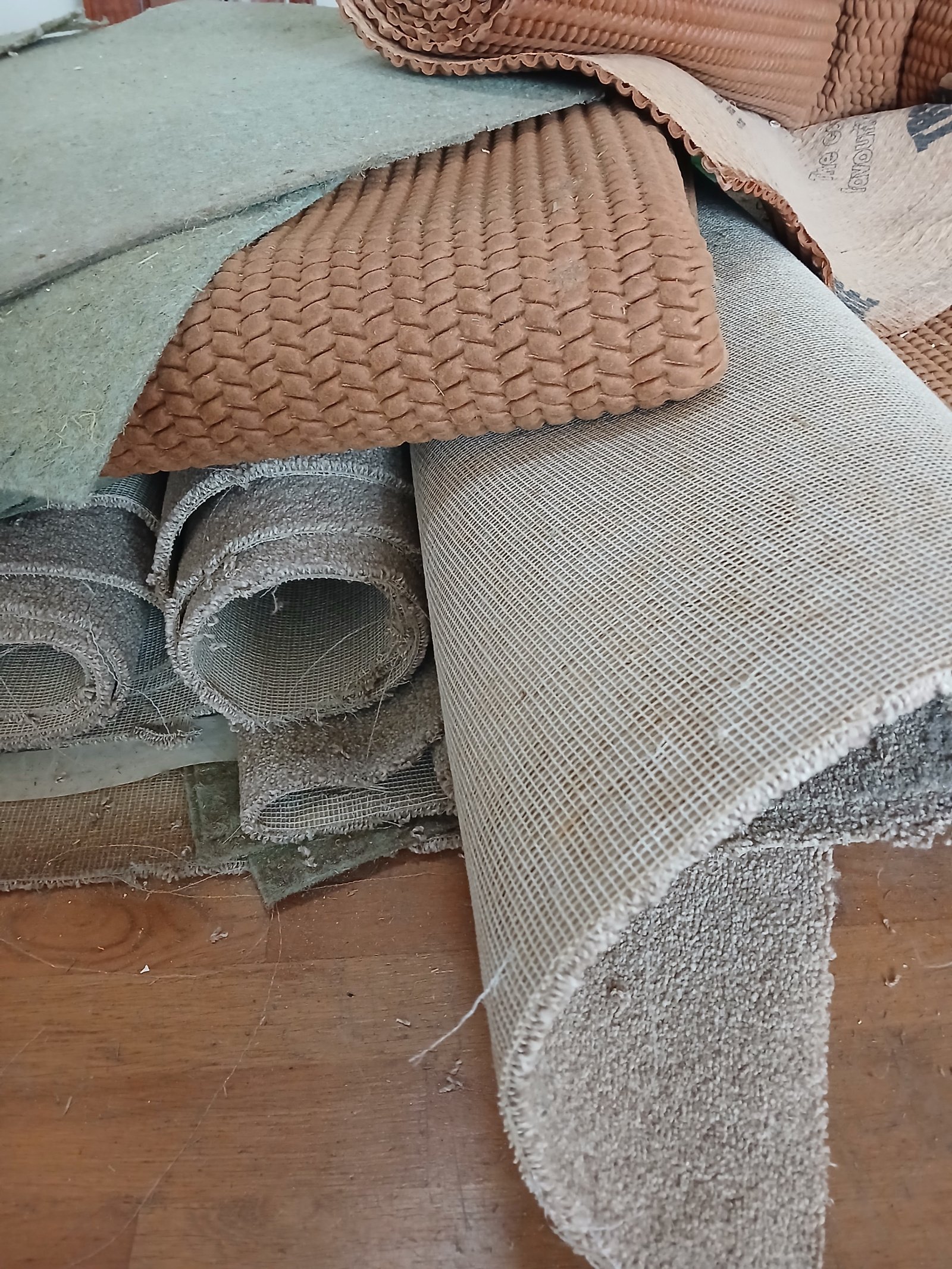
@WIAWSNB solid concrete, hardboard solid condition apart from a couple of wall edges showing slight damp and there is quite a gap between the hardboard & skirting which maybe should be filled, then the plastic, then thin green insulation/underlay, then brown insulation/ underlay, then carpet. I'll take a pic tomorrow. And find out thickness available.
@Albermarle I forgot a layer! There are two layers of insulation/ underlay underneath the carpet. Going to take a pic tomorrow.
1 -
What total thickness do you have available, and what thickness of engineered flooring are you considering?
Since it's a solid floor, I'd be looking to lay the polythene sheet first, tho' you'd need to ensure it isn't pinholed. I assume that's why the hardboard went down first.
Are you taking the skirting boards up as part of the job?1 -
For carpet underlay, it is typically 6 to 10 cms thick.Possiblyretired said:@pramsay13 good idea, I'll take a couple photos tomorrow.
@WIAWSNB solid concrete, hardboard solid condition apart from a couple of wall edges showing slight damp and there is quite a gap between the hardboard & skirting which maybe should be filled, then the plastic, then thin green insulation/underlay, then brown insulation/ underlay, then carpet. I'll take a pic tomorrow. And find out thickness available.
@Albermarle I forgot a layer! There are two layers of insulation/ underlay underneath the carpet. Going to take a pic tomorrow.
Thermal underlay or top of the range normal underlay is 12 cms thick.
However for engineered wood the underlay is normally only about 3mm, so I guess its insulating properties will be limited.1 -
This is what was on top of the plastic.
1.To find out the thickness I have available do I just measure these or something else?
2. Should I relay the plastic and then add a thermal underlay and then wood flooring or am I missing a step?
@WIAWSNB why do you ask about the skirting boards? I hadn't decided but I could take them up. And plastic being pinholes, what difference does that make please?1 -
Whoops, forgot to add pic.
 0
0 -
Yes, to work out what total thickness you have available, you could add up everything you currently have, or look at things like door bottom clearances.Possiblyretired said:This is what was on top of the plastic.
1.To find out the thickness I have available do I just measure these or something else?
2. Should I relay the plastic and then add a thermal underlay and then wood flooring or am I missing a step?
@WIAWSNB why do you ask about the skirting boards? I hadn't decided but I could take them up. And plastic being pinholes, what difference does that make please?
It's really to see how much you have available for insulation, once you've taken the actual flooring and any required underlay into account.
The polythene is a DPM - a damp proof membrane. It shouldn't actually be required, since there should already be one buried under the concrete slab. And since the hardboard was dry, it would appear there is, so that's good.
A DPM, wherever it's located, must be intact, or any tear or hole would allow through the damp.
I asked about the skirtings in case it had something to do with the hardboard around the perimeter being potentially damp - is it? I'd want to know why there were slightly damp sections.
Removing the skirtings would allow you to check the concrete floor is good right to the edges, and that there is no gap that could, perhaps, be allowing a draught through, which could make the edges cooler. Removing the skirtings also allows you to fit the new flooring right up to the edges (allowing for a small expansion gap), and the skirtings are replaced over it, giving the neatest finish.
1





Confirm your email address to Create Threads and Reply

Categories
- All Categories
- 355.7K Banking & Borrowing
- 254.9K Reduce Debt & Boost Income
- 456.1K Spending & Discounts
- 248.3K Work, Benefits & Business
- 605.9K Mortgages, Homes & Bills
- 179K Life & Family
- 263.7K Travel & Transport
- 1.5M Hobbies & Leisure
- 16.2K Discuss & Feedback
- 37.7K Read-Only Boards