We’d like to remind Forumites to please avoid political debate on the Forum.
This is to keep it a safe and useful space for MoneySaving discussions. Threads that are – or become – political in nature may be removed in line with the Forum’s rules. Thank you for your understanding.
📨 Have you signed up to the Forum's new Email Digest yet? Get a selection of trending threads sent straight to your inbox daily, weekly or monthly!
Expansion vessel pressure keeps dropping

dharm999
Posts: 778


 Forumite
As the title says, the pressure drops by half a bar every day. Had a plumber out who changed a valve under the pressure gauge, and checked the vessel, it was ok. I’ve bled radiators to get rid of any air, and checked all radiators for any signs of a leak. Plumber says it could be a number of other things and it’s a matter of elimination, but each thing to try is going to cost a lot of money, which could be wasted. When the boiler is on, the pressure gauge on the vessel only ever gets up to a max of 1.2 - 1.3 bar.
For full info, the boiler is around 10 years old, had a heat exchanger changed relatively recently, before we bought the house, 18 months ago. The pump under the boiler, stops working when the pressure on the expansion vessel gets too low, but the boiler keeps working, and the temperature gauge for the boiler gets in to the 80s, when it’s normally in the 60s. This causes the pump to get really hot. If I increase the pressure and unplug and reconnect the pump, it works ok. The pump is a Grundfos one, and I set it to 2, max is 3, and it has an Auto adapt function.
Is there anything else I should be asking my plumber to look at before I get in to a lot of cost?
Thanks
For full info, the boiler is around 10 years old, had a heat exchanger changed relatively recently, before we bought the house, 18 months ago. The pump under the boiler, stops working when the pressure on the expansion vessel gets too low, but the boiler keeps working, and the temperature gauge for the boiler gets in to the 80s, when it’s normally in the 60s. This causes the pump to get really hot. If I increase the pressure and unplug and reconnect the pump, it works ok. The pump is a Grundfos one, and I set it to 2, max is 3, and it has an Auto adapt function.
Is there anything else I should be asking my plumber to look at before I get in to a lot of cost?
Thanks
0
Comments
-
The symptoms strongly point to either a failing expansion vessel or a leaking PRV, with sludge as a secondary contributor. Both are common at the 8–12 year mark.
Do these checks in this order:-
Expansion vessel pre-charge checked properly with system depressurised.
-
PRV discharge pipe monitored during heat cycles.
-
System water condition checked for sludge or magnetite, including the filter if fitted.
-
Confirmation that boiler pressure and temperature sensors are reporting sensibly.
1 -
-
dharm999 said:As the title says, the pressure drops by half a bar every day. Had a plumber out who changed a valve under the pressure gauge, and checked the vessel, it was ok. I’ve bled radiators to get rid of any air, and checked all radiators for any signs of a leak. Plumber says it could be a number of other things and it’s a matter of elimination, but each thing to try is going to cost a lot of money, which could be wasted. When the boiler is on, the pressure gauge on the vessel only ever gets up to a max of 1.2 - 1.3 bar.
For full info, the boiler is around 10 years old, had a heat exchanger changed relatively recently, before we bought the house, 18 months ago. The pump under the boiler, stops working when the pressure on the expansion vessel gets too low, but the boiler keeps working, and the temperature gauge for the boiler gets in to the 80s, when it’s normally in the 60s. This causes the pump to get really hot. If I increase the pressure and unplug and reconnect the pump, it works ok. The pump is a Grundfos one, and I set it to 2, max is 3, and it has an Auto adapt function.
Is there anything else I should be asking my plumber to look at before I get in to a lot of cost?
ThanksHi Dharm. There are a few things you can check and try which should help to ID where the loss is taking place.First, it would help to know the make, model, and type of boiler. Photo? And, what do you mean by "the pressure gauge on the vessel"?The 'exchanger' that was replaced - which one is this? (If your boiler is a 'system' type - ie also heats a hot cylinder - then the exchanger must be the 'Main' one - the 'Heat Engine'. That remains a suspect.Is the EV built in to the boiler, or separate? I'm going to surmise that the EV is 'external' and is actually working fine, or else the system pressure would soar very obviously as the boiler heats up; yours only goes up an expected tad.I'm taking it that the pump is a separate item? I don't know why it would stop working when the boiler pressure drops - it shouldn't (unless it's very smart...). What is the system pressure when the pump stops? (I'd personally have the pump on Auto Adapt, as this is the 'Smart' setting which means is varies its speed according to actual demand. Only if this doesn't do the required task for your system would I consider a fixed speed.And, why doesn't the boiler also shut down when the pressure drops?! That should!I'm guessing that the 'valve' the plumber changed is a 'safety release valve', and these 'blow' open if the system pressure reaches around 3 bar, which it could/would do if the boiler overheated, or the EV isn't doing its job. When it opens to release the excess pressure, it dumps the system water out via a 15mm copper pipe to the outside of your house.Your first task, then, is to find the end of this discharge pipe outside, and check to see if it is wet. It shouldn't be. If in doubt, rubber-band a wee clear plastic bag over the end to monitor it. If the PRV has been activated at some point, then they do tend to keep on leaking as they don't reseal very well. This can allow continued pressure losses. However, your plumber has replaced yours, so it seems unlikely to be the candidate here. But, please do check the end.That then narrows the loss - and it's a significant one which should make it easier to trace - down to from within the boiler, or from the rest of the system - pipes and rads, mostly.There's a 'simple' way to check this. Underneath your boiler are the pipes - the larger 22mm copper ones toward each end will almost certainly be the CH flow and CH return. They will have identical isolating valves on them which require a quarter-turn to shut them off. Once off, the system water inside the boiler is isolated; if the pressure continues to drop, then the leak is from within the boiler. If the pressure does not drop, then you monitor the pressure gauge as you reopen these valves - if it now drops, then the loss is from the rest of the system. That means pipes (say under the floor) or possibly from the heating coil inside the hot cylinder.Are you up for trying that? If so, does your boiler lose pressure even when off, say overnight? Cool - that's when to do this. You turn off the power supply to the boiler, so it cannot come on. You shut off these two valves only, and you note the pressure. Next morning you compare readings. Then reopen, power up, and continue to sue the boiler as before.One other thing to try since the boiler will be off - rubber-band a second bag over the white plastic condensate pipe outside, which is likely close to the discharge pipe. If any water comes out of there when the boiler is turned off, that suggests a damaged Main exchanger. I wonder why the first one failed?
1 -
Boiler is a Worcester Greeenstar 40cdi. It has no pressure gauge on it that I can see.
The pressure gauge is one that is below the expansion vessel, it’s on a valve that has a red twisty knob at the bottom of it - this is what my plumber replaced as when he took apart the old one, there was water, which he said there shouldn’t have been
The exchanger replaced was one in the boiler. There is a separate megaflo hot water tank.
The EV is separate to the boiler.
The pump is a Grundfos one and is below the boiler, which I understand pumps hot water to radiators and the hot water tank. It had two horizontal dashes on it, which when googled suggested an electric problem with it or air in the system. I noticed the pressure on the gauge below the EV was low, below a half, so put the pressure up, unplugged and reconnected the pump, and it started working again. It’s set to a ‘II’ setting not Auto adapt as when I set it to the latter, the radiators didn’t get very hot ( it’s a three story house, with radiators at ground and second floor levels, as well as 3 towel radiators).According to my plumber, because the boiler is relatively old, low pressure doesn’t stop it working.
Plumber checked the discharge pipe outside, and it was dry, with no indication that any water had come out - the wall it is on has a light coloured render, so any release of water would have left an obvious sign.
Am happy to try switching off the boiler and isolating it, to see if that’s the problem or it’s something else. .Will try it and report back
Outside there is only one white pipe, is that unusual?1 -
Thanks.dharm999 said:Boiler is a Worcester Greeenstar 40cdi. It has no pressure gauge on it that I can see.
The pressure gauge is one that is below the expansion vessel, it’s on a valve that has a red twisty knob at the bottom of it - this is what my plumber replaced as when he took apart the old one, there was water, which he said there shouldn’t have been
The exchanger replaced was one in the boiler. There is a separate megaflo hot water tank.
The EV is separate to the boiler.
The pump is a Grundfos one and is below the boiler, which I understand pumps hot water to radiators and the hot water tank. It had two horizontal dashes on it, which when googled suggested an electric problem with it or air in the system. I noticed the pressure on the gauge below the EV was low, below a half, so put the pressure up, unplugged and reconnected the pump, and it started working again. It’s set to a ‘II’ setting not Auto adapt as when I set it to the latter, the radiators didn’t get very hot ( it’s a three story house, with radiators at ground and second floor levels, as well as 3 towel radiators).According to my plumber, because the boiler is relatively old, low pressure doesn’t stop it working.
Plumber checked the discharge pipe outside, and it was dry, with no indication that any water had come out - the wall it is on has a light coloured render, so any release of water would have left an obvious sign.
Am happy to try switching off the boiler and isolating it, to see if that’s the problem or it’s something else. .Will try it and report back
Outside there is only one white pipe, is that unusual?
Picture of boiler, please? And of EV and associated bits too, please.
Not clear about the EV part replaced - any chance of a pic? I suspect it's a pressure safety valve.
The 'water' that he found - again, detail is important. Was it from the Schrader air valve?
However, he has checked the discharge pipe outside, and found it dry. There's no harm in bagging this as I suggested - it doesn't appear to the cause, but why not eliminate it fully?
Yes, one white 22mm plastic pipe outside, in addition to the discharge pipe above.
This is the 'condensate' pipe, and will produce regular slugs of slightly acidic water when the boiler is running - so it should be 'wet'. However, after the boiler has gone off and is cooling down, these slugs should stop. So, you check that - wee baggy on end - only when you know the boiler will be off for hours.
Pump - that's fine, you've tried it on auto, and found it lacking. That could be because your system ain't balanced properly, but big deal - most pumps are set to a fixed speed.
0 -
Pics of boiler and EV
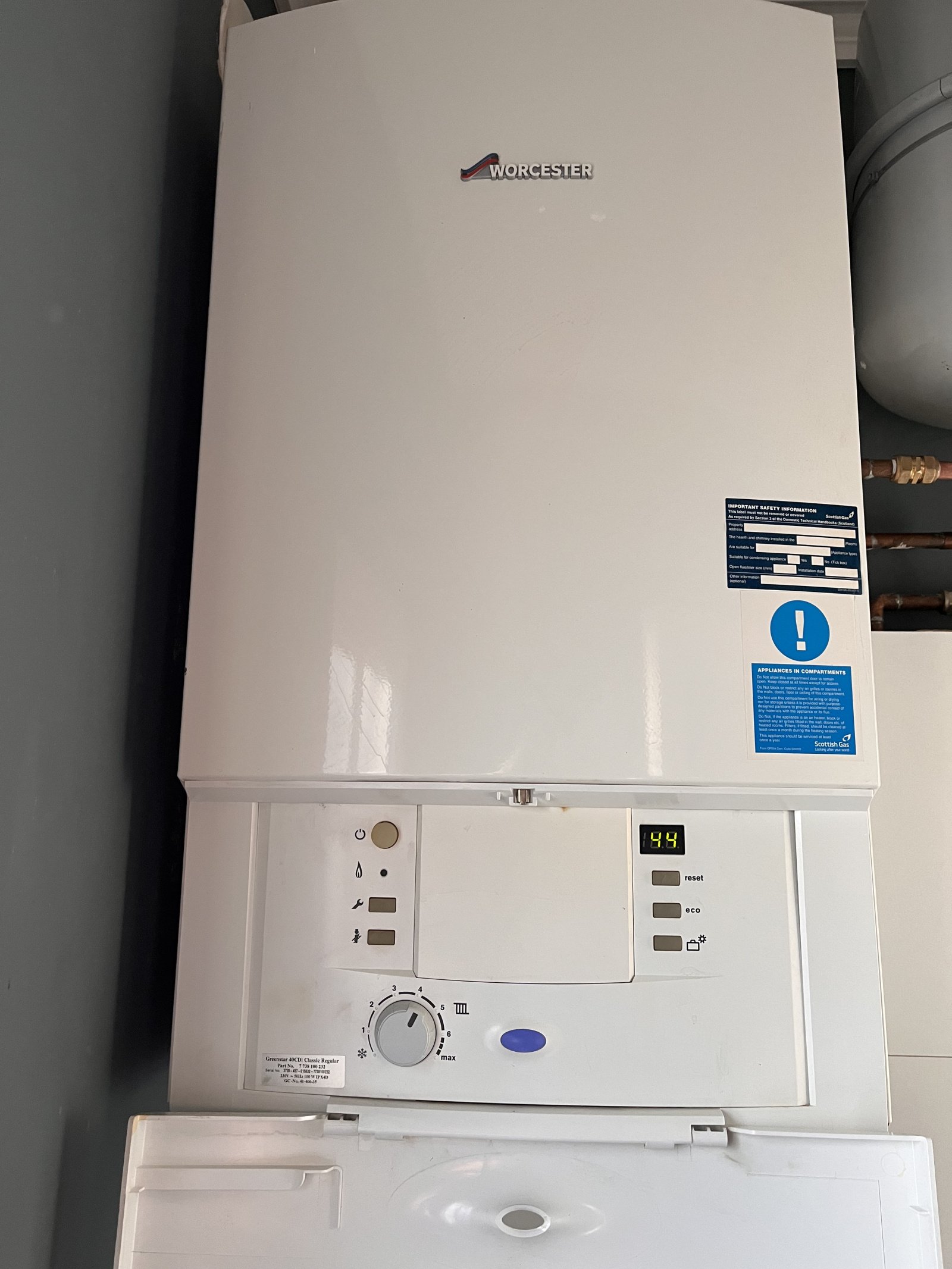
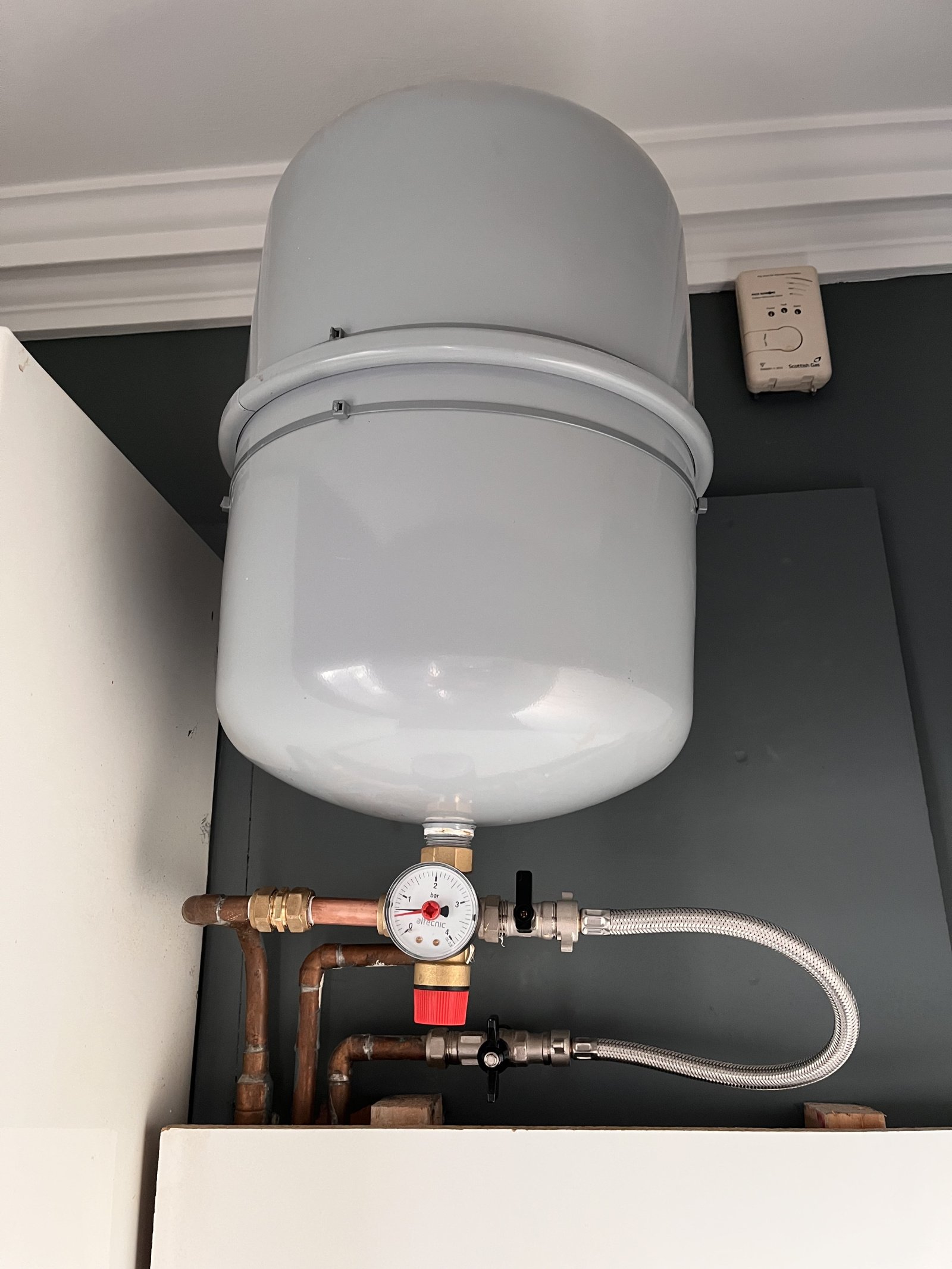
1 -
OP
I do not want to confuse things too much as you are getting good feedback already. However you have a very similar set up to mine, and a couple of things you said stood out.
It is a 40KW boiler, which is far more powerful than you normally need for a system boiler in a normal sized house.
For example I have a Greenstar 18 KW, also about 10 years old. The Grundfos pump is set at 2 - auto adapt.
Also it is a three storey house ( Ground, First and Loft extension) 13 radiators. The boiler copes fine and all radiators get hot ( assuming the TRVs are open of course) . So the fact yours is struggling under the same settings when the boiler is twice as powerful is telling us something maybe ?
The pump under the boiler, stops working when the pressure on the expansion vessel gets too low, but the boiler keeps working, and the temperature gauge for the boiler gets in to the 80s, when it’s normally in the 60s.
I am not an expert but I am sure that should not be happening, especially the boiler temperature going up so much.
Despite the boiler being 10 years old I am pretty sure it should shut off if the water pressure is too low, not get a lot hotter.
2 -
1. Are you sure that expansion vessel is for the boiler?
2. Boiler EV's are usually red, whereas those for unvented cylinders are normally white, sometimes blue.
3. The unvented hot water cylinder should have what is called a tun dish in the pipework from the temperature and pressure relief valve (side of cylinder) which may be shared with that from the combination valve (cold water into cylinder).
4. I'm aware the Megaflow has an internal expansion space and does not normally need an external EV. However, external EVs are somtimes fitted if the internal space is compromised.2 -
We have 15 radiators, including 3 towel radiators as well as underfloor heating to three bathrooms and to the middle level of the house, in total there are 10 UFH zones as well as 15 radiators.Albermarle said:OP
I do not want to confuse things too much as you are getting good feedback already. However you have a very similar set up to mine, and a couple of things you said stood out.
It is a 40KW boiler, which is far more powerful than you normally need for a system boiler in a normal sized house.
For example I have a Greenstar 18 KW, also about 10 years old. The Grundfos pump is set at 2 - auto adapt.
Also it is a three storey house ( Ground, First and Loft extension) 13 radiators. The boiler copes fine and all radiators get hot ( assuming the TRVs are open of course) . So the fact yours is struggling under the same settings when the boiler is twice as powerful is telling us something maybe ?
The pump under the boiler, stops working when the pressure on the expansion vessel gets too low, but the boiler keeps working, and the temperature gauge for the boiler gets in to the 80s, when it’s normally in the 60s.
I am not an expert but I am sure that should not be happening, especially the boiler temperature going up so much.
Despite the boiler being 10 years old I am pretty sure it should shut off if the water pressure is too low, not get a lot hotter.1 -
dharm999 said:Pics of boiler and EVThanks for these. One more pic, please - lift the boiler flap up, and take a slightly-upwards shot of the pipes as they depart the boiler.Yes, that a powerful boiler, but it's fully modulating, and I imagine your house has a large demand at times!As NFLO asks, could you confirm that the white EV is on the boiler circuit, and not supplying a hot cylinder?I suspect it is for the boiler, as the black 'set' needle it's set at a very low 0.6bar. That is particularly low for a house with three stories, unless the boiler is on a higher level? But, if it's on the ground floor, I can imagine the top rads struggling a bit - the pressure up there won't be far off zero!What do you tend to top it up to?The EV is large, but then your system volume is commensurately big.Ok, the same first tests as before; bag over the copper discharge pipe. Also, when you turn the boiler fully off at night, place a ditto bag over the white plastic condensate pipe outside. Top up the pressure to a recorded figure - say 1.5 bar. Note the reading the following morning before you turn the boiler back on.Report back.The next step will be to repeat this, but with the boiler isolated via the two valves - hence the photo of the underside.
0 -
"The pressure gauge is one that is below the expansion vessel, it’s on a valve that has a red twisty knob at the bottom of it - this is what my plumber replaced as when he took apart the old one, there was water, which he said there shouldn’t have been"Just for your info, the red twisty knob is the 'safety discharge valve' - turning the knob opens it manually. The only problem is, once opened, they rarely close off again fully - they tend to dribble. That is presumably why your plumber replaced it.When that valve opens - either manually or under 3+ bar pressure - the system water is ejected out the copper pipe outside.
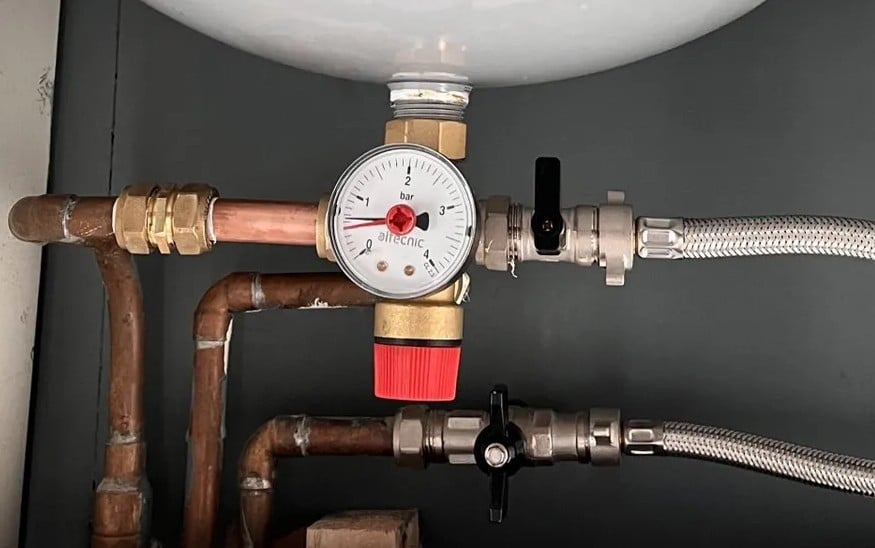 Just a couple of other general things to add; with all the water loss and top-ups, it's very likely that the inhibitor level in your system water is no longer concentrated enough, so once this is hopefully sorted, make sure it is replenished - a £15 bottle. And, if you do not have a magnetic filter fitted to the boiler return pipe, then I'd strongly recommend having one added if the system is drained down as part of the repair. They are around £100, and should catch any sludge flying around your system.0





Confirm your email address to Create Threads and Reply

Categories
- All Categories
- 355.8K Banking & Borrowing
- 254.9K Reduce Debt & Boost Income
- 456.2K Spending & Discounts
- 248.3K Work, Benefits & Business
- 606K Mortgages, Homes & Bills
- 179K Life & Family
- 263.8K Travel & Transport
- 1.5M Hobbies & Leisure
- 16.2K Discuss & Feedback
- 37.7K Read-Only Boards