We’d like to remind Forumites to please avoid political debate on the Forum.
This is to keep it a safe and useful space for MoneySaving discussions. Threads that are – or become – political in nature may be removed in line with the Forum’s rules. Thank you for your understanding.
📨 Have you signed up to the Forum's new Email Digest yet? Get a selection of trending threads sent straight to your inbox daily, weekly or monthly!
The Forum now has a brand new text editor, adding a bunch of handy features to use when creating posts. Read more in our how-to guide
Vaillant condensing boiler freezing - minimising condensate?
Comments
-
Right, I have a couple of photos to show you and several points kindly made that I want to address - I've made a list of points, rather than try and multi-quote - I hope that I haven't missed anything important. Sorry, it must have defaulted to re-save my resized photos as PNGs, not JPEGs, but I think they're still clear enough, I can't be bothered to re-do them.
Whole external height of condensate pipe, between the downspout and my water butt. It goes into a grate at the bottom - I'd moved the leaf cover to see if I could see ice coming out, but haven't put it back properly. There's a grate over the drain and the pipe goes right up against it and is usually under the leaf cover.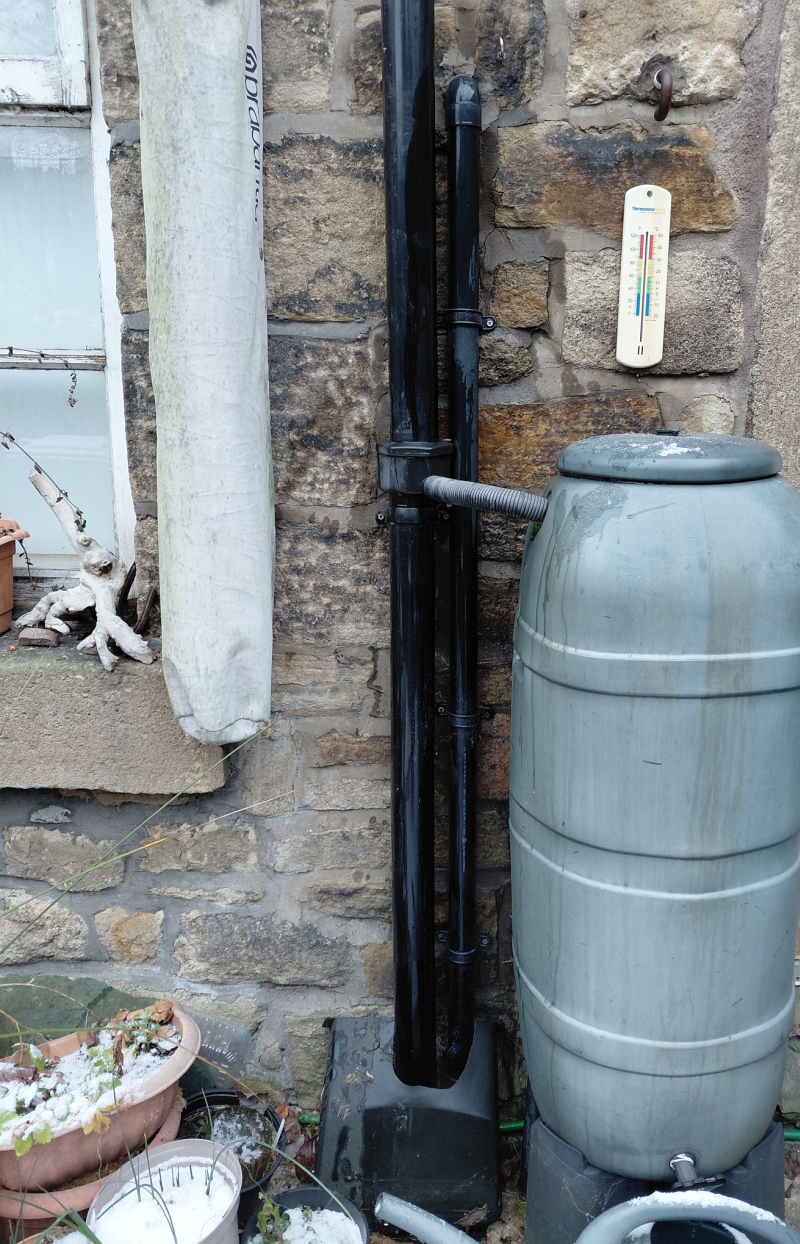
From the side, you can see that the variance in the stone profile means there are some gaps, but it touches in other places.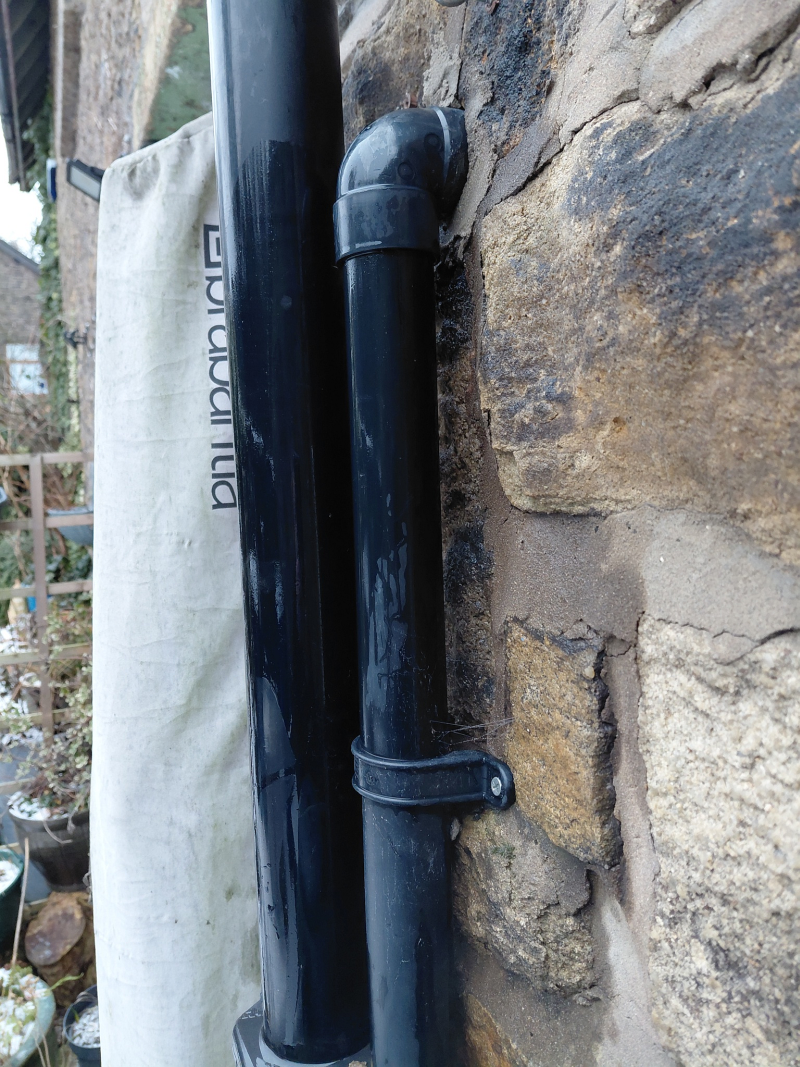
To the points I wanted to address:
Grey pipe insulation - I'd already read about the difference between internal and external closed cell qualities and will go for the best solution long term, but short term, it might be easier to just buy some of the cheap stuff as a temporary fix, until I can get a tradesman to do it properly for me. Might be enough to make an improvement.
I think I'd also like one of the trace heaters - I'd looked at those yesterday too - but that's definitely beyond my own skills. I think I'd perhaps like to go for the full Monty of decent external quality insulation, a trace heater and outer trunking/boxing if possible too.
I can only assume that my hot water flushes were clearing it enough to flow again, but without clearing it totally, as it did seem to fill up and block quicker than I might have expected. If my sums are right and that pipe volume is what I said earlier - it seems implausible that it's generated that much condensate several times over in 36 hours.
And I didn't use boiling water to flush it - I'd already been told that when the BG engineer unblocked it for me last time. I had to use the kettle as I'd no hot water of course, but I have a variable temperature kettle, so the lowest setting is 70ºC - and I poured it into a jug, as the kettle was the wrong shape for me to hold it above the top. So it was perhaps something like 67ºC by the time I went outside with it.
I'm not sure that the rads need bleeding. I've lived with them a long time and know their quirks and the very large one in the kitchen makes a noise when there's any air in the system- and it's running silently just now. I do know how to do it if I need to through. It was an almost daily requirement on my old system.
@ashe - I felt your pain and I'm grateful that mine is just outside the back door and doesn't necessitate calls to window cleaners or the like. Especially as I don't even have a window cleaner. That sounds an ideal scenario to add a trace heater too - the peace of mind would surely be worth it.
Someone mentioned solvent welded joins where the condensate pipe is connected - I can't tell by looking at it - but for now, I'm leaving that particular bit well alone - I know my limitations.0 -
but short term, it might be easier to just buy some of the cheap stuff as a temporary fix,
You will probably need the biggest size.
Pipe Insulation | Plumbing | Screwfix1 -
That sounds rather more sensible - I think I saw one briefly when looking for components earlier - I wasn't sure what it was, but your description makes sense now.QrizB said:My old Worcester boiler had a syphon in the condensate system (a bit like an automatic flushing cistern on a urinal) so that condensate was released as a series of slugs rather than a continuous trickle.It was meant to reduce the risk of the drain freezing up, and it seemed to work; we didn't get a frozen drain any time on the 19 years we had the boiler.0 -
Indeed - I need to measure it before ordering, but the usual stuff certainly isn't wide enough.Albermarle said:but short term, it might be easier to just buy some of the cheap stuff as a temporary fix,
You will probably need the biggest size.
Pipe Insulation | Plumbing | Screwfix0 -
I'm amazed that the condensate is freezing - oversized pipe (50mm dia?) with straight drop, hard to believe that the condensate is freezing as it falls, given that the external temperature isn't much below zero and the limited amount of condensate running at any one time. The solution to freezing condensate would normally be to install an oversized pipe, exactly what you have already.
Has the pipe been checked for any blockages? I can only think that there is something that is slowing down the condensate enough for it to freeze and block. Insulation would be sensible to install, but might not solve the issue if there is a partial blockage.0 -
I've said in more than 1 previous post, that I'm surprised that there's enough volume of condensate to block that capacity of pipe repeatedly over 24 hours. But having said that, I hadn't actually considered the idea of something else blocking it. It seems like a pretty closed vessel, apart from the bottom opening - so what might get in there? Can anything get in there from the boiler - seems unlikely? But no, it hasn't actually been checked - I don't think that I want to try pulling joints apart to look.ComicGeek said:I'm amazed that the condensate is freezing - oversized pipe (50mm dia?) with straight drop, hard to believe that the condensate is freezing as it falls, given that the external temperature isn't much below zero and the limited amount of condensate running at any one time. The solution to freezing condensate would normally be to install an oversized pipe, exactly what you have already.
Has the pipe been checked for any blockages? I can only think that there is something that is slowing down the condensate enough for it to freeze and block. Insulation would be sensible to install, but might not solve the issue if there is a partial blockage.
My other thought was whether the boiler is generating more condensate than it should, due to some fault - but I have no idea if that is even possible0 -
I thought I'd have a quick look before it got too dark. There was a nice big ice cube in the very bottom angled bit on top of the grate, the whole last angled section came away in my hand as I had a poke round.
It definitely wasn't there the first time I cleared it yesterday morning, as I did poke a finger up the pipe end thinking it might be blocked with soggy leaves that had then frozen, but there wasn't much room to probe much further. When I put it in warm water to melt, it came out as five separate lumps, so may be as a result of my earlier efforts and has sintered together in the last section during today. There was no fluid behind it, so it certainly wasn't actually causing a blockage.0 -
I had this years ago on an older install. A long 40mm pipe straight down would freeze up. Fundamentally the pipe was exposed on the side of the house to wind. The water ultimately doesn't just fall down the middle without touching the sides, but rather dribbles out constantly, then down the side of the pipe. As it does, that freezes and sticks, then the next dribble, then the next... like a cholesterol blocking up arteries.
I fixed by fitting a Worcester CondenSure under the boiler - this collects the water, then dumps it automatically in larger flushes - rather than allowing a continual dribble down the pipe. This flushing action gives it weight. Also whilst it collects, as it straddle the flow pipes it is actually heated before being flushed. Newer boilers have this built in.
Outside I extended the small 22mm white pipe that exited the house down inside the 40mm pipe, but also wrapped it with some pipewrap insulation. That way it was insulated inside the 40mm pipe till it got to the floor, and wasn't getting frozen by the wind blowing on the pipe.
These two changes meant I never had the problem again.4 -
Blimey, yes, it's astonishing that it's freezing - it looks an ideal setup.
But, once it did freeze, then I think it's pretty clear it never got completely unfrozen again, so subsequent refreezes were much more likely.
So, why did it freeze first time? No idea! The pipe is a good size, so should drain instantly. I guess that a glaze could form on the inside of the pipe wall, and this just builds up with each glug.
Yes, condie is usually dispensed in glugs, I understand because it's via a 'syphon', a bit like a toilet cistern, so that there's always a water 'seal' that prevents combustion gases getting out.
Could there be other water coming out that way? Yes, if the Main Exchanger has failed and is leaking internally, but that would show as a very significant system pressure drop. You don't have this.
Also 'possible' that rain getting in the flue would end up in the combustion chamber and exit via the condie pipe. But unless you have a broken gutter cascading water down on your flue terminal, this is also unlikely.
So, I'd be looking at the bottom of the condensate pipe, and check that it's unrestricted - nowt in t'way.
Then I'd get good quality lagging, and slip a thin layer behind the pipe between it and the wall if theres only a tight gap, and clip the full sleeve over the rest. Almost certainly that's all you'll need. Complete overkill to go heating element in this case, imo.0 -
Given that it hasn't happened before, it's possibly just due to particular wind direction and outside temperature - the wind chill factor can play a key role, particularly when the outside of the pipe is wet. You may find that it never happens again, but I would definitely insulate the pipe to prevent it happening.BooJewels said:I thought I'd have a quick look before it got too dark. There was a nice big ice cube in the very bottom angled bit on top of the grate, the whole last angled section came away in my hand as I had a poke round.
It definitely wasn't there the first time I cleared it yesterday morning, as I did poke a finger up the pipe end thinking it might be blocked with soggy leaves that had then frozen, but there wasn't much room to probe much further. When I put it in warm water to melt, it came out as five separate lumps, so may be as a result of my earlier efforts and has sintered together in the last section during today. There was no fluid behind it, so it certainly wasn't actually causing a blockage.
Obviously pouring water over the outside of the pipe helps melt the frozen condensate, but also then makes it more likely that it will refreeze in a short time as the temperature of the pipe then drops as the water evaporates. So an easy short term emergency fix but does require you to repeat until the outside temperature rises enough.
Boilers can produce 2-3 litre of condensate per hour in perfect conditions - that would be at around 50 degrees flow and 30 degrees return to the boiler. Even at a lower rate, a blocked pipe can very quickly get filled.1









Confirm your email address to Create Threads and Reply

Categories
- All Categories
- 354.6K Banking & Borrowing
- 254.5K Reduce Debt & Boost Income
- 455.5K Spending & Discounts
- 247.5K Work, Benefits & Business
- 604.3K Mortgages, Homes & Bills
- 178.5K Life & Family
- 261.8K Travel & Transport
- 1.5M Hobbies & Leisure
- 16.1K Discuss & Feedback
- 37.7K Read-Only Boards