We’d like to remind Forumites to please avoid political debate on the Forum.
This is to keep it a safe and useful space for MoneySaving discussions. Threads that are – or become – political in nature may be removed in line with the Forum’s rules. Thank you for your understanding.
Let's discuss... corporate bonds
Comments
-
I worked for a startup that raised its capital through corporate bonds and made a lot of people very wealthy, went on to IPO on the NYSE. What they were doing was extremely high risk & required a lot of capital to build, buy and manage assets in emerging telecoms markets before buying the companies to become one of the biggest in the sector globally. The 5 & 10 year bonds were critical to success
The greatest prediction of your future is your daily actions.0 -
Like gilts I have used corporate fixed interest to return known income and capital with a fixed duration. A trivial part or my plan but not ruled out. I only looked at half a dozen and bought a few, I forget all the issuers but included Aviva and IPF, I converted into some 12% International Personal Finance bonds when a previous issue matured. These mature 2027 and currently trade over par with around 6.5% yield to maturity. My only current holding, I have the stock too.
0 -
Coming back to credit spreads, I wanted to know just how narrow they currently are and how far they might widen. I was reliably told by ChatGPT* that IG spreads are currently 80-110 bps and historically they have been:
70-100 bps in very strong markets
120-150 bps as the long-run average
175-200 bps in mild recession/stress
300-500+ bps in severe stress (2008, March 2020).
Man Sterling Corporate Bond has a duration of 5.3 years (should I be looking at effective or modified duration, not that it makes much difference?) so spreads under mild duration/stress might widen 100bps. That would indicate a 5.3% fall in the fund value which is a risk I can tolerate. Given the track record of the manager and ‘margin of safety’ being one of his investment criteria, even a doubling of that fall would not worry me too much.
* see what I did there? ‘ChatGPT’ and ‘reliably’ used in the same sentence.
1 -
Gemini tells me that the IG spread as of Monday is 0.92%, and that the 30 year historical average is 1.89%. While during typical recessions it can climb to between 3.4-8.4% (3.4% Dotcom, 8.4% GFC, 4.9% Covid). It would be the recession scenario I'd be concerned about. I haven't fact-checked these values.
The 'margin of safety' would hopefully avoid a rating downgrade during difficult times, which would further increase spread. Duration being the other element, which is already taken into account.
Assuming he has picked well, then this would amount to volatility, which would reverse if you ride out whatever crisis causes a plunge.
1 -
The GFC and COVID were "typical recessions"? (Cue response that every recession is atypical in some way, which makes them all typical.)
0 -
According to my pet AI they were.
I'm too young to remember 1973-5, 1981-2 and 1990-92, and one would have to switch to Moody's data to go back that far (so to "Baa" rating). Apparently those spreads were around 3.3%, 4.4% and 3.2% respectively, so GFC is a bit of an outlier when it comes to spreads, but not Covid. In hindsight, I suppose half of the GFC widening was the risk-free rate plummeting.
When you look at all the fun and games going on with companies borrowing from each other to buy each other's products and invest in mass infrastructure that hasn't been proven to be economically viable, one could imagine something akin to the GFC recurring.
So all rather suggestive that an event widening spreads north of 3% comes around once every 7-12 years, based on the post WWII trend.
As our eternally glass-half-full Norse god was often keen to quote:
0 -
masonic mentioned short duration investment grade corp bonds on this thread.
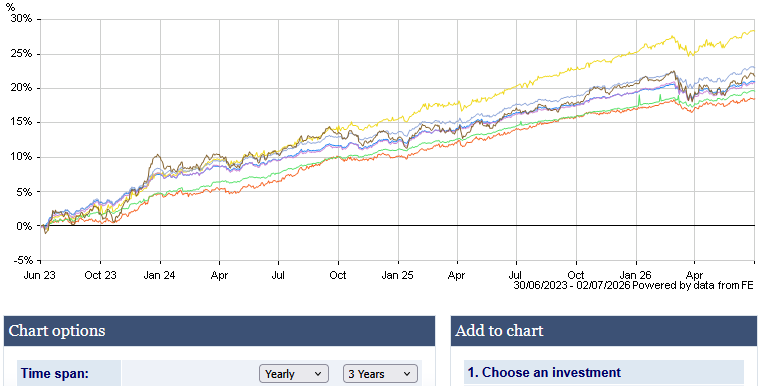
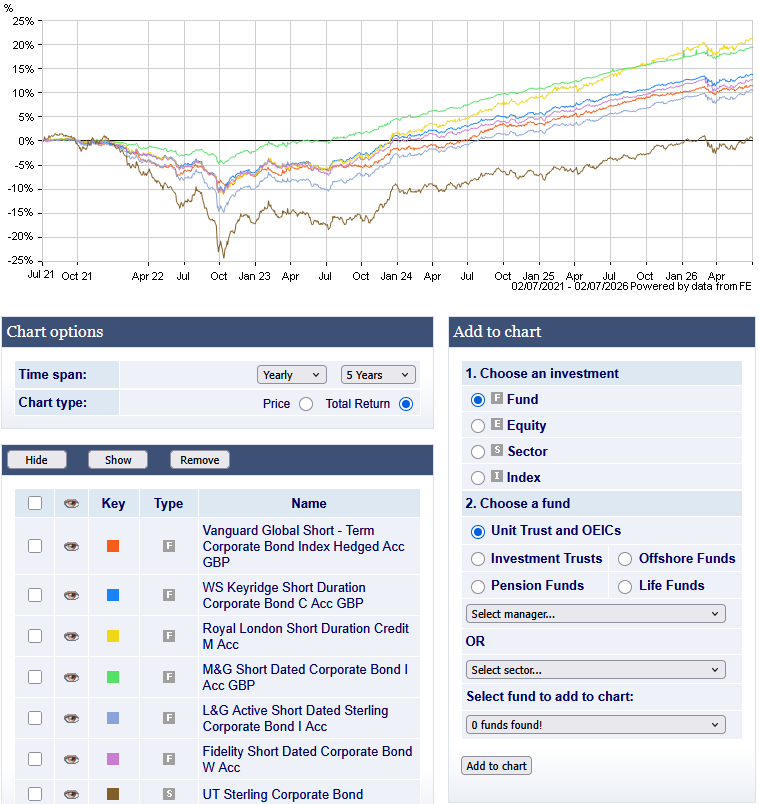
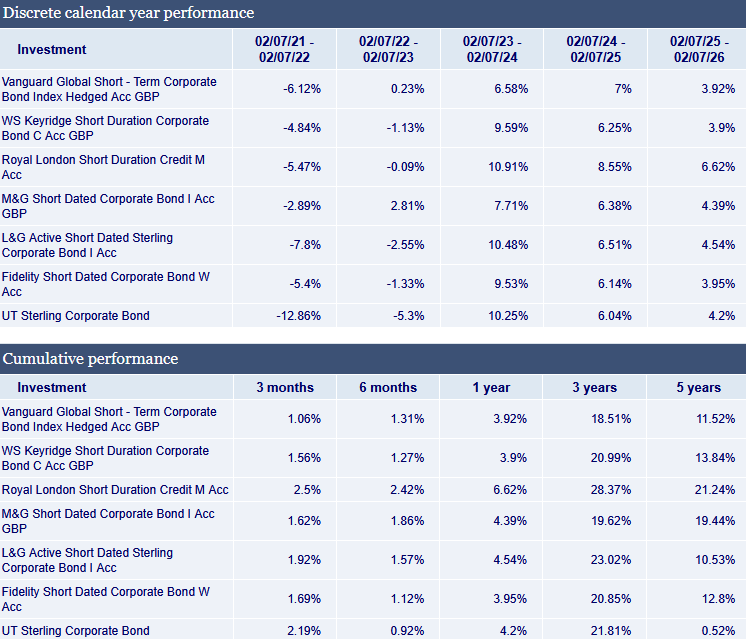
There aren’t loads of them around but these three year and five year charts shows an index fund and five active funds, along with the non-short dated sector. A few things stand out:
- The index fund has performed worst over the three years since interest rates rose. I do not like bond index funds because, almost by definition, they have to buy the most indebted companies.
- Performance does not differ wildly except for Royal London (my long-term favourite).
- L&G was presumably not short dated enough when interest raised rose; M&G was very nicely short dated.
- The non-short dated sector has not performed better in the normalised interest rate era (if three years is an era…).
2-3 year gilts yield are just over 4% and IG credit spreads are on the thin side of 1%, yet in the eight months from last July until the Iran war, the funds were up 3.5%-4.0% (5.25-6.0% annualised), except for Royal London which was up 6% (9% annualised).
You are not going to get rich holding short-dated corp bonds, but I see worthwhile risk-adjusted returns when held alongside gilts in a fixed interest portfolio.
 0
0 -
While I did mention "shortish dated", I wasn't thinking of a short-dated fund per se. My exposure is coming mainly from Man Global IG (a fund discussed earlier in the thread), which is positioned this way tactically. After the cheaper class of the Dynamic Income soft-closed on me just after I started drip-feeding my pension contributions into it, I decided the IG version was a better fit anyway.
0 -
Ah yes, the variant on his Sterling Corporate Bond fund which I've held for over three years. Curiously, according to Morningstar, Sterling Corp Bond has an average credit rating of A- and weighted coupon of 6.97% (duration 5.33 years), while Global IG Opps is BBB+ and 5.98% (duration 5.24 years). Is this because Not Rated holdings are not included in the credit rating but would usually make it lower? Not Rated is 13.72% and -6.18% respectively. (My corporate bond funds are Man Dynamic Income, Man Sterling Corporate Bond and Royal London Short Duration Credit in ratios around 5:3:3.)
1 -
I think Morningstar needs to check its info on Man Sterling Corporate Bond - it is over 80% BBB and below:

According to latest factsheet, effective duration is 6.5 years and running yield is 8% (YTM 8.2%).
The main difference is Global IG is not constrained to Sterling issues and it is probably better characterised as a version of Man Dynamic Income with less junk.
Comparing with Sterling Corporate Bond, credit rating profile is similar, duration is about a year shorter, YTM about 1.4% lower and a little more of this comes from capital gain.
1








Confirm your email address to Create Threads and Reply

Categories
- All Categories
- 355.7K Banking & Borrowing
- 254.9K Reduce Debt & Boost Income
- 456.1K Spending & Discounts
- 248.3K Work, Benefits & Business
- 605.9K Mortgages, Homes & Bills
- 179K Life & Family
- 263.7K Travel & Transport
- 1.5M Hobbies & Leisure
- 16.2K Discuss & Feedback
- 37.7K Read-Only Boards