We’d like to remind Forumites to please avoid political debate on the Forum.
This is to keep it a safe and useful space for MoneySaving discussions. Threads that are – or become – political in nature may be removed in line with the Forum’s rules. Thank you for your understanding.
📨 Have you signed up to the Forum's new Email Digest yet? Get a selection of trending threads sent straight to your inbox daily, weekly or monthly!
Octopus Solar Panel quotes + a window on the roof
Comments
-
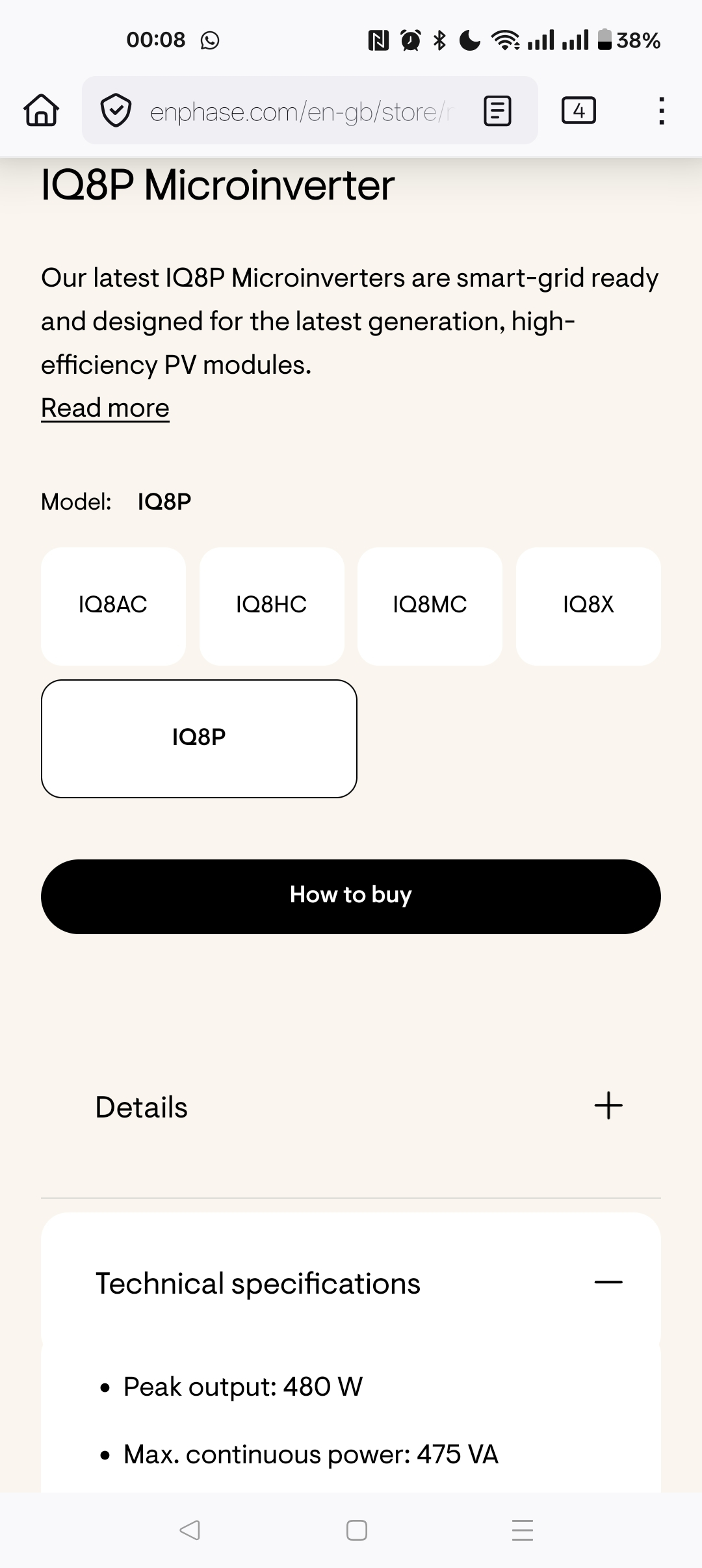
QrizB said:Note that Enphase microinverters top out at ~380 watts (I think?)Err, I belive the IQ8P has a nominal output rating of 480 W and can be used with considerably larger inputs. The models keep changing, and I'm no expert, so please double-check.1
-
squirrelpie said:QrizB said:Note that Enphase microinverters top out at ~380 watts (I think?)Err, I belive the IQ8P has a nominal output rating of 480 W and can be used with considerably larger inputs. The models keep changing, and I'm no expert, so please double-check.Mine is the IQ8AC, something I would have missed if it wasn't for @QrizB
 I'm FTB, not an expert, all my comments are from personal experience and not a professional advice.Mortgage debt start date 11/2024 = 175k (5.19%)... Q1/2026 = PAID (3.94%)0
 -
1) That used to be accurate 5+ years ago but is no longer is the case with modern panels. The typical half cut panel contains 3 bypass diodes, ensuring that partial shading does not bring down the string or even the panel's individual generation, depending on the extent of shading.Jemma01 said:1)I'll give an example of my understanding to help me communicate my thoughts, I'm happy to be corrected as that's far away from what I do for a living, the numbers are random I don't know the actual outputs:Let's say I have 10 panels in a string configuration, 9 can produce 10amps, and the 10th is shaded and produces 5amps. It's my understanding that the output would be 10x5amps= 50amps, NOT 9x10amps +1x5amps = 95ampsHaving a microinverter will allow me to isolate that 5amps panel (decentralise), so the rest can still produce whatever they can. I also understand if a panel fails completely, the current will continue to flow, it's not an emergency that needs fixing. I can live with one down panel (which is a very important requirement for me, living mostly on electricity).I also understand that optimisers are a string configuration, not a modular one.Again, if any of this is wrong, I'm happy to be challenged, it's important for me to understand what I'm buying.2) that makes the tesla less attractive option despite the bigger capacity and better performance.3) No we're not at the stage where Octopus come and have a look, I took some pictures at 2pm on Wednesday where the building next door (block of flats) shaded the whole roof. My property is on a hill and they're above mine. Admittedly, there's probably 10m distance between my property and theirs, so light would still reach, just not direct sunlight.Re:PW3 having 3 strings, I only have two sides, I'd imagine they'd string the south together, and the north together, which does mean if south fails, north will continue, but that's a loss of 10/11 panels. I'm looking for a configuration that would give me a high confidence that my house will run on solar power except in rare circumstances if the battery gives up.
The 500W bifacial panels recommended above contain 3 diodes each. So the end result in your example will be 95 Amps give or take, depending on extent of shading. Remember, optimizers or microinverters cannot make the panel generate additional power, contrary to marketing/ dodgy sales tactics, so the real benefit in your use case may be limited (There are several other benefits to panel optimization but that's another story)
2) Au contraire, the PW3 is arguably the most capable and safest solution available in the UK, as I am certain you will discover in due course It gives the installer the additional ability to place shaded panels in separate strings, effectively preventing shading at different times of the year from killing system generation from any remaining unshaded panels.
3) I suspect Octopus has performed their desktop survey sub optimally.
- Can I ask what direction both your aspects face?
- Have Octopus recommended installing any panels on a North facing aspect by any chance? If so, are these the panels you are concerned with shading? I will respond further when I know the answer to this.
4) As @QrizB has correctly stated, Enphase's previous best IQ8H max out at 384W (as you have shared, these are not default offerings from Octopus but they can be convinced to offer these). Enphase's newest IQ8P are rated at 475W but are significantly more dear as they are meant for "commercial" installations. I am willing to bet Octopus will not offer these, as their JA panel offering do not necessitate ordering these in any volume.
This is particularly relevant as the panel's 500W is peak but the nominal rating + bifacial gains (~10% if you paint the roof area behind the panels) will exceed the IQ8H's maximum rating in the peak generation months. Not significant but if you're keen on squeezing the most out of each panel (like I was) then worth considering. On that note, SolarEdge optimizers have no such limitation, are modular and a less complex device to place on your roof. This is the point where I typically recommend re-reading 1) above.
5) Sadly, Solar PV performs the worst in the winter months (generation in a typical December is roughly 10% of the generation in June). Rather annoyingly, PV generates peak power when the household needs it the least! Fortunately the grid still benefits greatly from it, as the Intelligent Flux tariff should highlight. On the plus side, all £ earned during the peak generation months should easily offset your winter consumption, which I believe is a variant of "net zero", whatever that means. This is why systems are typically designed to maximize overall generation (vs. winter generation).
Apologies in advance if any of this confuses matters further and hope it proves useful!
- 10 x 400w LG Bifacial + 6 x 550W SHARP BiFacial + 2 x 570W SHARP Bifacial + 5kW SolarEdge Inverter + SolarEdge Optimizers. SE London.
- Triple aspect: ENE (2.7 kWp), WSW (3.3 kWp), SSE (2.4 kWp)
- Viessmann 200-W on Advanced Weather Comp. (The most efficient gas boiler sold)Feel free to DM me for help with any form of energy saving! Happy to help!1 -
Screwdriva said:
1) That used to be accurate 5+ years ago but is no longer is the case with modern panels. The typical half cut panel contains 3 bypass diodes, ensuring that partial shading does not bring down the string or even the panel's individual generation, depending on the extent of shading.Jemma01 said:1)I'll give an example of my understanding to help me communicate my thoughts, I'm happy to be corrected as that's far away from what I do for a living, the numbers are random I don't know the actual outputs:Let's say I have 10 panels in a string configuration, 9 can produce 10amps, and the 10th is shaded and produces 5amps. It's my understanding that the output would be 10x5amps= 50amps, NOT 9x10amps +1x5amps = 95ampsHaving a microinverter will allow me to isolate that 5amps panel (decentralise), so the rest can still produce whatever they can. I also understand if a panel fails completely, the current will continue to flow, it's not an emergency that needs fixing. I can live with one down panel (which is a very important requirement for me, living mostly on electricity).I also understand that optimisers are a string configuration, not a modular one.Again, if any of this is wrong, I'm happy to be challenged, it's important for me to understand what I'm buying.2) that makes the tesla less attractive option despite the bigger capacity and better performance.3) No we're not at the stage where Octopus come and have a look, I took some pictures at 2pm on Wednesday where the building next door (block of flats) shaded the whole roof. My property is on a hill and they're above mine. Admittedly, there's probably 10m distance between my property and theirs, so light would still reach, just not direct sunlight.Re:PW3 having 3 strings, I only have two sides, I'd imagine they'd string the south together, and the north together, which does mean if south fails, north will continue, but that's a loss of 10/11 panels. I'm looking for a configuration that would give me a high confidence that my house will run on solar power except in rare circumstances if the battery gives up.
The 500W bifacial panels recommended above contain 3 diodes each. So the end result in your example will be 95 Amps give or take, depending on extent of shading. Remember, optimizers or microinverters cannot make the panel generate additional power, contrary to marketing/ dodgy sales tactics, so the real benefit in your use case may be limited (There are several other benefits to panel optimization but that's another story)
2) Au contraire, the PW3 is arguably the most capable and safest solution available in the UK, as I am certain you will discover in due course It gives the installer the additional ability to place shaded panels in separate strings, effectively preventing shading at different times of the year from killing system generation from any remaining unshaded panels.
3) I suspect Octopus has performed their desktop survey sub optimally.
- Can I ask what direction both your aspects face?
- Have Octopus recommended installing any panels on a North facing aspect by any chance? If so, are these the panels you are concerned with shading? I will respond further when I know the answer to this.
4) As @QrizB has correctly stated, Enphase's previous best IQ8H max out at 384W (as you have shared, these are not default offerings from Octopus but they can be convinced to offer these). Enphase's newest IQ8P are rated at 475W but are significantly more dear as they are meant for "commercial" installations. I am willing to bet Octopus will not offer these, as their JA panel offering do not necessitate ordering these in any volume.
This is particularly relevant as the panel's 500W is peak but the nominal rating + bifacial gains (~10% if you paint the roof area behind the panels) will exceed the IQ8H's maximum rating in the peak generation months. Not significant but if you're keen on squeezing the most out of each panel (like I was) then worth considering. On that note, SolarEdge optimizers have no such limitation, are modular and a less complex device to place on your roof. This is the point where I typically recommend re-reading 1) above.
5) Sadly, Solar PV performs the worst in the winter months (generation in a typical December is roughly 10% of the generation in June). Rather annoyingly, PV generates peak power when the household needs it the least! Fortunately the grid still benefits greatly from it, as the Intelligent Flux tariff should highlight. On the plus side, all £ earned during the peak generation months should easily offset your winter consumption, which I believe is a variant of "net zero", whatever that means. This is why systems are typically designed to maximize overall generation (vs. winter generation).
Apologies in advance if any of this confuses matters further and hope it proves useful!
1) I was doing some reading about the bypass diode, and while I understand the current will flow for the most part, a voltage drop will cause the inverter to drop the MTTP overall, even for unaffected panels. The inveter wouldn't know which panel is the cause, as this is a string setup. This becomes even more pressing for my house, which has shading from trees in the morning, and then the next-door building with hard shading (this is the winter situation, not really looking at the summer situation). The microinverters will allow each panel to figure out what is optimal for itself and its MTTP, and not be impacted by MTTP that applies to all.
This is the roof in the midst of winter on the south-facing roof, barely any direct sunlight 🤔. In the morning, the trees are on the way, and then the building next door, and then the sun sets!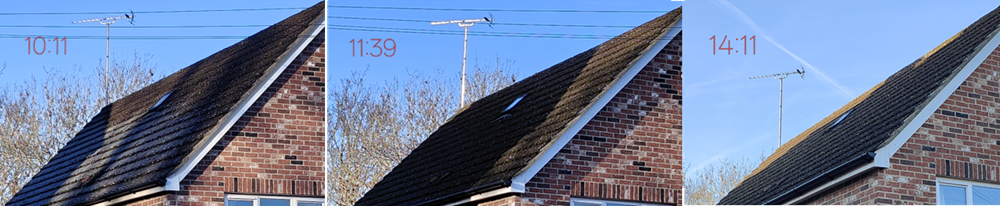
3) The house is east-facing, with a slight tilt towards the south. Roofs are South and north roofs, approximately.
I asked Octopus to use up all the space because my energy consumption is pretty high per winter day 25-30kw, and winter wouldn't generate much, seeing the amount of shading I have on the south-facing roof. So they put 10 on the south to not block the window and 11 on the north.
4) Honestly, I'm not very sure the size of these inverters is the problem for my property, but rather the amount of shading, my panels will probably not even hit the max, except for a short period during summer when the sun is on full blast and at noon time. I'm less worried about the amount of clipping at this point. They also seem to have decent failure rate according to Enphase 0.05%. Can't find anything published on SolarEdge, what are they hiding?
5) For what I want, a reliable system that doesn't require much grid intervention except possibly to charge the batteries during off-peak times in winter, I'm not sure any of these solutions are good enough to provide 30Kw/d with costing an arm and a leg. My house uses up a lot of energy, I'd probably need 2 Teslas or 3 sigenergy batteries. Too many of these things -> more likely of failures.
Either way, I'm not finding anything I'm convinced about. Maybe I need to lower my standard 😁🤔!I'm FTB, not an expert, all my comments are from personal experience and not a professional advice.Mortgage debt start date 11/2024 = 175k (5.19%)... Q1/2026 = PAID (3.94%)0 -
I have about 13.6 kWp of solar panels.
16 @ 250W from a 2014 FIT install which pays around £900pa
Enphase micro inverters on these, SSW facing with some shade on 6 of them, but in total produce around 4,000kWH pa
I have another four 480W panels SSW facing that I added later.
I then added 16 480W (Eurener) panels to the North (NNE?) aspect of the house. They do OK, especially in the summer when they add to the export. I did it to get battery storage at zero VAT at the time.
I can see exactly what every panel produces each day, even instantly, from either the Enphase microinverters or the TIGO optimisers.
I generate about 12,000 kWh pa
I have two ev's and a heat pump.
I only charge 1 ev at home, always from the grid, never from solar.
My heating and DHW is by heat pump.
I have 38kWh of useable battery storage from GivEnergy.
It is AC coupled and my other panels use GroWatt inverters with Tigo optimisers
I use Intelligent Octopus Go.
I don't pay anything for electricity.
I have a net income (excluding the FIT payments) of around £800 pa.
That includes all our electricity consumption encompassing one ev and a hot tub in six months of theyear.
We don't scrimp on electricity at all.
The only issue I have is that I am limited to charging the home batteries at around 2.7kW which means I may run out of battery storage in prolonged cold weather. I haven't yet though.
My average energy cost for all imports is less than 8p per kWh
I do sometimes import at the standard rate, usually when cooking but it is minimal.
I may have to import more at the standard rate in the coming week but I can live with that.
If GivEnergy had a way where I could have two AC coupled inverters I would never import at anything other than 7p per kWh but I still don't think it's possible with GivEnergy..
1 -
matt_drummer said:The only issue I have is that I am limited to charging the home batteries at around 2.7kW which means I may run out of battery storage in prolonged cold weather. I haven't yet though.I don't know what it's like for you, but the current cold snap has brought me clear skies so even though it's struggling to get above freezing I'm getting good PV generation.If it was this cold and overcast, it would be a different story!N. Hampshire, he/him. Octopus Intelligent Go elec / Fuse gas / Vodafone BB / iD mobile. Kirk Hill Co-op member.Economy 7 cap explainer. Gas vs E7 vs peak elec heating costs, Ecoflow Stream, Best kettle :-)
2.72kWp PV facing SSW installed Jan 2012. 11 x 247w panels, 3.6kw inverter. 37 MWh generated, long-term average 2.6 Os.1 -
Yes, clear skies are good, for solar and it is just nice.
Overcast, cold and damp is the worst.
But my heat pump uses the most in these conditions.
I have enough battery to make it through about a week of this but eventually I will run out during the evening.
It is because my GivEnergy AC coupled inverter can only charge at around 2.8kW and discharge at 3.6kW.
If I could have two of them it would be perfect, but you can only have one at the moment.
But it is first world problems, the worst that will happen is I have to buy some electricity at full whack!
My heat pump is still on a SCOP of over 5 and it is nearly two years old.
It's not the end of the world!1 -
@matt_drummer thanks so much for sharing, I'll reread your earlier post when I've got more time. I ruled out the enphase battery because of it's charge and discharge rates, I'm only considering the tesla/sigenergy. But even then I really like the idea of microinverters and being able to measure each panel's performance. I'm a sucker for data! I need to figure out my priorities, can't seem to have it allI'm FTB, not an expert, all my comments are from personal experience and not a professional advice.Mortgage debt start date 11/2024 = 175k (5.19%)... Q1/2026 = PAID (3.94%)0
-
This is where proper system/ layout design comes into play. That said, with the images #2 and 3 shared above, neither a bypass diode or optimizer or micro inverter will enable much generation, if any, with that sort of heavy shading.Jemma01 said:
1) I was doing some reading about the bypass diode, and while I understand the current will flow for the most part, a voltage drop will cause the inverter to drop the MTTP overall, even for unaffected panels. The inveter wouldn't know which panel is the cause, as this is a string setup. This becomes even more pressing for my house, which has shading from trees in the morning, and then the next-door building with hard shading (this is the winter situation, not really looking at the summer situation). The microinverters will allow each panel to figure out what is optimal for itself and its MTTP, and not be impacted by MTTP that applies to all.
Assuming they are North facing, they will generate ~40-50% of their South facing counterparts. This is why I do not recommend North aspect installations ( as each additional panel adds a cost of ~£200 to install, resulting in a much longer payback window). From the images shared, my guess is that you will be able to fit 16 X 500W bifacial panels (assuming you cover up that small window), resulting in a 8kWp sized system (assuming your DNO allocates this via your G99).Jemma01 said:I asked Octopus to use up all the space because my energy consumption is pretty high per winter day 25-30kw, and winter wouldn't generate much, seeing the amount of shading I have on the south-facing roof. So they put 10 on the south to not block the window and 11 on the north.
We all have wanted the same. Each roof is different and I suspect yours will require careful design. That said, your annual consumption of 4.5 mWh does not highlight the need for more than 13.5kW of battery storage, which is what the PW3 offers. Heat Pump tariffs like Cosy offer a chance for multiple charging windows to keep the cost of imported energy low.Jemma01 said:5) For what I want, a reliable system that doesn't require much grid intervention except possibly to charge the batteries during off-peak times in winter, I'm not sure any of these solutions are good enough to provide 30Kw/d with costing an arm and a leg. My house uses up a lot of energy, I'd probably need 2 Teslas or 3 sigenergy batteries. Too many of these things -> more likely of failures.
Either way, I'm not finding anything I'm convinced about. Maybe I need to lower my standard 😁🤔!
I would veer well clear of Sigenergy if I were you.
- 10 x 400w LG Bifacial + 6 x 550W SHARP BiFacial + 2 x 570W SHARP Bifacial + 5kW SolarEdge Inverter + SolarEdge Optimizers. SE London.
- Triple aspect: ENE (2.7 kWp), WSW (3.3 kWp), SSE (2.4 kWp)
- Viessmann 200-W on Advanced Weather Comp. (The most efficient gas boiler sold)Feel free to DM me for help with any form of energy saving! Happy to help!0 -
@Screwdriva even though the annual usage seems fine, the problem area is winter when the heat pump and UFH are on. The house is very well insulated in the summer, my electric usage in the summer is pretty low. I hate how the annual numbers water down the usage. Looking at November 660kwh and December 567.5kwh (with me out of the house for 10days). That's approximately 27% of the total annual usage. I totally understand that I should use the summer months to pay off the bills in winter, I won't have a choice from the look of things 🫣.Re: sigenergy, I like their stackable batteries. I hardly have a space for one tesla, I can stack their batteries as and when I need to 🤔 the specs are pretty on par with tesla.I'm FTB, not an expert, all my comments are from personal experience and not a professional advice.Mortgage debt start date 11/2024 = 175k (5.19%)... Q1/2026 = PAID (3.94%)0








Confirm your email address to Create Threads and Reply

Categories
- All Categories
- 355.7K Banking & Borrowing
- 254.9K Reduce Debt & Boost Income
- 456.1K Spending & Discounts
- 248.3K Work, Benefits & Business
- 605.9K Mortgages, Homes & Bills
- 179K Life & Family
- 263.7K Travel & Transport
- 1.5M Hobbies & Leisure
- 16.2K Discuss & Feedback
- 37.7K Read-Only Boards