We’d like to remind Forumites to please avoid political debate on the Forum.
This is to keep it a safe and useful space for MoneySaving discussions. Threads that are – or become – political in nature may be removed in line with the Forum’s rules. Thank you for your understanding.
📨 Have you signed up to the Forum's new Email Digest yet? Get a selection of trending threads sent straight to your inbox daily, weekly or monthly!
Investing - Where's the pot of gold?

RootOfAll
Posts: 5
 Forumite
I'm dubiously looking into investments instead of saving. Everyone says investments beat savings given a long view. The number one question is, how much do they pay?
One or two sources describe 2% - 4% or 2% - 6% as a 'strong yield', at least for income investments. Then I looked at Hargreaves Lansdown's platform (as I have a cash ISA through them) and at some funds they offer. For income funds, perhaps with bonds, the better yields are around 4 and a bit percent with a couple at 5 and a bit. I looked at growth funds, just to see, and most get around 1 and a bit percent, a few at 2 and a bit maybe.
I can get a cash ISA for 4 and a bit percent with no management fees and no risk. What's so special about investments? I get the impression I'm missing some vital piece of information or arithmetic. Without going into madly volatile waters, how do investments get to be our darling?
One or two sources describe 2% - 4% or 2% - 6% as a 'strong yield', at least for income investments. Then I looked at Hargreaves Lansdown's platform (as I have a cash ISA through them) and at some funds they offer. For income funds, perhaps with bonds, the better yields are around 4 and a bit percent with a couple at 5 and a bit. I looked at growth funds, just to see, and most get around 1 and a bit percent, a few at 2 and a bit maybe.
I can get a cash ISA for 4 and a bit percent with no management fees and no risk. What's so special about investments? I get the impression I'm missing some vital piece of information or arithmetic. Without going into madly volatile waters, how do investments get to be our darling?
0
Comments
-
Over the past 5 years a typical world index fund with income reinvested has increased by over 80% in the past 5 years and 240% in the past 10 years. Some of those years could have shown negative returns, some over 20%. You can smooth out some of the volatility at the expense of lower returns. The years since the 2008 crash have seen better returns than the long term average.
If you want ongoing fairly steady income instead of possibly highly volatile capital growth you need more specialist funds. 4-5% is readily available. My target is 6%.
1 -
"Yield", especially in the context of income investments, refers to the dividends paid by a company or fund as a percentage of their share price. It doesn't take into account any increase in the value of the share price over time.
However share prices do tend to increase offer time even for income investments (on average, in the long run, usual caveats etc) so by basing your estimate of investing returns on quoted yields you are only looking at half the story.0 -
The, "pot of gold" is a total return - dividends/interest plus capital gains - superior to very low risk options like savings accounts, gilts and other highly rated bonds.I'm dubiously looking into investments instead of saving. Everyone says investments beat savings given a long view. The number one question is, how much do they pay?
One or two sources describe 2% - 4% or 2% - 6% as a 'strong yield', at least for income investments. Then I looked at Hargreaves Lansdown's platform (as I have a cash ISA through them) and at some funds they offer. For income funds, perhaps with bonds, the better yields are around 4 and a bit percent with a couple at 5 and a bit. I looked at growth funds, just to see, and most get around 1 and a bit percent, a few at 2 and a bit maybe.
I can get a cash ISA for 4 and a bit percent with no management fees and no risk. What's so special about investments? I get the impression I'm missing some vital piece of information or arithmetic. Without going into madly volatile waters, how do investments get to be our darling?The risk is that something happens in the economy and/or stockmarket that means the value of your investments fall. You try to mitigate this risk by diversifying your investments across lots of companies and geographies and most people's portfolios are some combination of the low risk cash and bond options and higher risk equities: it isn't all or nothing.
If you're looking for both an income and the hope of capital gains there are lots of equity income funds to choose from. For example, City of London Investment Trust (LSE:CTY) is perennially popular and, assuming it won't be cut, its current dividend yield appears to be about 4%. It's unlikely to be cut though as it prides itself on 59 years and counting of raising its dividend.
https://www.theaic.co.uk/income-finder/dividend-heroes
https://www.janushenderson.com/en-gb/uk-investment-trusts/trust/the-city-of-london-investment-trust-plc/
https://www.dividenddata.co.uk/ex-dividend-date-search.py?searchTerm=CTYCTY's five year share price chart: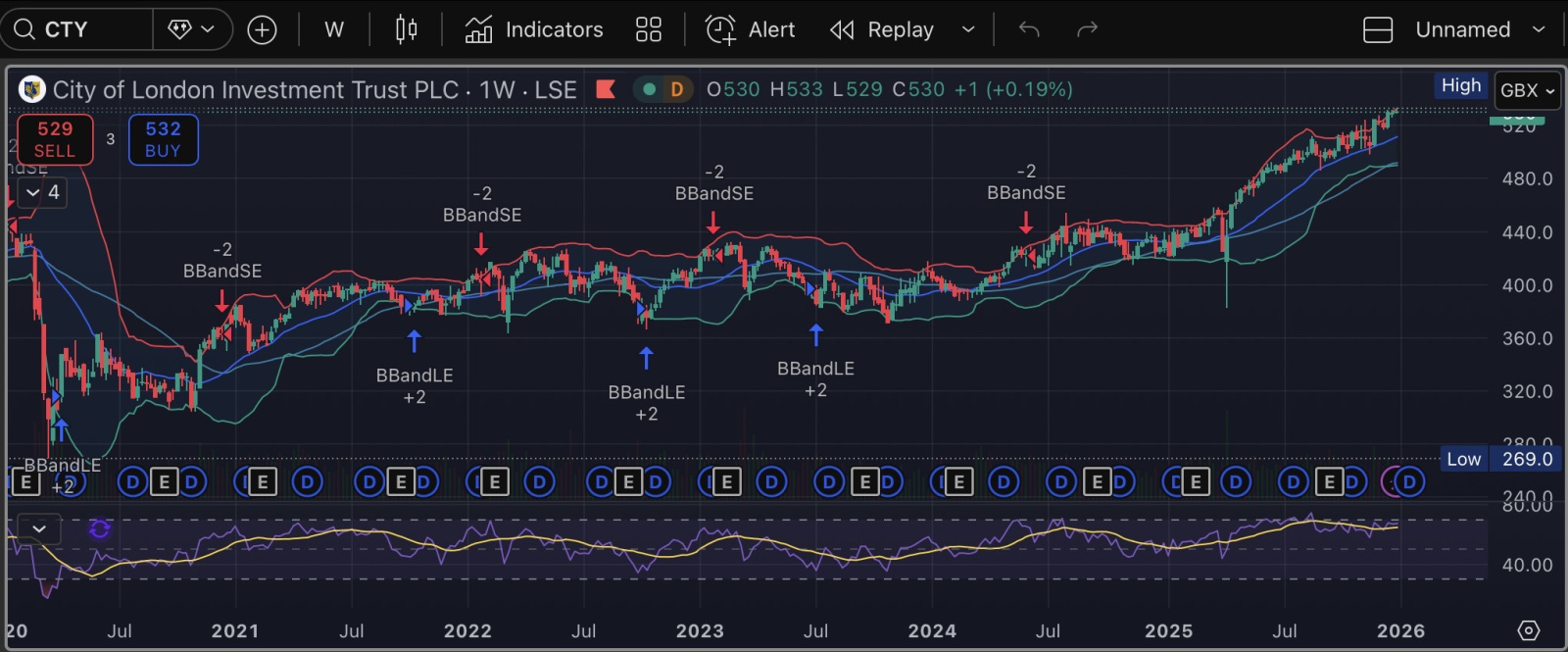 3
3 -
Over time dividends tend to be increased by funds. So what was perhaps a 2% dividend on the original investment becomes perhaps 3% (of the original investment) or more after x years.Then you may well have growth of the original amount, often keeping up with or surpassing inflation.Cash accounts earn interest, but that can decrease (as it is at the moment) and the original imnvestment amount stays the same, so its value decreases with inflation.Risk-wise, funds (like City, and others) are generally less likely to lose all your monry than individual shares.0
-
I looked at growth funds, just to see, and most get around 1 and a bit percent, a few at 2 and a bit maybe.
It seems you are interpreting the info incorrectly.
A typical HL growth fund, containing about 75% shares, has increased in value by more than 10% a year average over the last 5 years.2 -
I'm dubiously looking into investments instead of saving. Everyone says investments beat savings given a long view. The number one question is, how much do they pay?There are over 30,000 conventional investment options out there. Each will provide the returns in different ways.One or two sources describe 2% - 4% or 2% - 6% as a 'strong yield', at least for income investments.Yield refers to income. Not the total return. The total return is the increase in price plus any income it has generated. If you only look at the yield, you are only looking at one bit of it.For income funds, perhaps with bonds, the better yields are around 4 and a bit percent with a couple at 5 and a bit. I looked at growth funds, just to see, and most get around 1 and a bit percent, a few at 2 and a bit maybe.Income (yield) tends to be lower on "growth" funds. However, they tend to have higher growth whereas "income" focused funds tend to have lower growth.I can get a cash ISA for 4 and a bit percent with no management fees and no risk. What's so special about investments? I get the impression I'm missing some vital piece of information or arithmetic. Without going into madly volatile waters, how do investments get to be our darling?Its quite simple really. Investments have consistently performed better than cash over the long term and in most cases over the medium term.
Here is an example with the blue line (E) being cash at base rate, red line (A) being 100% equities and the B,C, D being in between.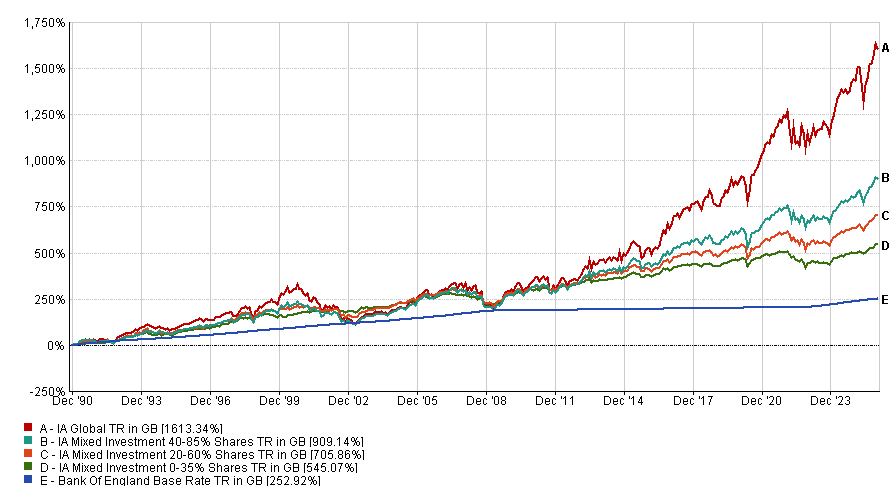
As is usual with graphs, recency appears bigger, and the further back in time you go, it appears smaller.
I am an Independent Financial Adviser (IFA). The comments I make are just my opinion and are for discussion purposes only. They are not financial advice and you should not treat them as such. If you feel an area discussed may be relevant to you, then please seek advice from an Independent Financial Adviser local to you.2 -
Time is your answer. Compounding massively improves returns with the benefit of time. One of my investments was bought for £2 a share 25 years ago and is now valued at £12 per share. In addition it's paid income around 2% a year but that 2% on the £2 share is worth 12% income on that original share price as the price has risen to £12.RootOfAll said:Without going into madly volatile waters, how do investments get to be our darling?Remember the saying: if it looks too good to be true it almost certainly is.2 -
Taking control of ones own long term financial security through knowledge and enwealficiation by investment is empowering and to be encouraged but there's a fair bit of learnin'.
Cash can be eroded by inflation, investment is risking the capital in a different way.
Investments might be lots of things, often people look first at equities and bonds or collectives bundling equities and/or bonds together, there's plenty more to confuse, commodities, private equity, debt, gold, investment trusts, ETFs, crypto and so on. Most involve some risk and how people treat risk matters. I think the double digit returns seen in global equities are a purple patch but I know I don't know, the long term pattern has been high single digit %.
Looking for the pot isn't the route but starting is.1 -
Martin Lewis is starting a series on his TV programme about investment soon.Previously he has concentrated on cash ( managing ones finances, savings and current accounts), taxation, benefits, pensions etc. but steered clear of investment as it is seen as more specialist and risky alongside probably much higher reward than savings.I think that is a welcome addition.You can bet it is well worth watching especially for an introduction and how many of us could do better over the longer term by investing....as well as saving.1
-
jimjames said:
Time is your answer. Compounding massively improves returns with the benefit of time.RootOfAll said:Without going into madly volatile waters, how do investments get to be our darling?"Time is your answer." This.I hold Foreign & Colonial Investment Trust Shares. I began buying them in 1994, when the share price was well under £1. Today, they are trading at over £12.And compounding by re-investing the dividends.
2








Confirm your email address to Create Threads and Reply

Categories
- All Categories
- 355.8K Banking & Borrowing
- 254.9K Reduce Debt & Boost Income
- 456.2K Spending & Discounts
- 248.3K Work, Benefits & Business
- 605.9K Mortgages, Homes & Bills
- 179K Life & Family
- 263.8K Travel & Transport
- 1.5M Hobbies & Leisure
- 16.2K Discuss & Feedback
- 37.7K Read-Only Boards