We’d like to remind Forumites to please avoid political debate on the Forum.
This is to keep it a safe and useful space for MoneySaving discussions. Threads that are – or become – political in nature may be removed in line with the Forum’s rules. Thank you for your understanding.
📨 Have you signed up to the Forum's new Email Digest yet? Get a selection of trending threads sent straight to your inbox daily, weekly or monthly!
New Comms Hub 🐙 - No gas 1/2 hourly readings
Comments
-
Here are the diagrams I mentioned at last. Apologies for the delay.The diagram is based upon the Zappi manual instructions and is a bit more pictorial than the block diagramsThe first is the normal connections through the CTs as advised by Myenergi. (It should be noted that the Zappi has provision for extra CTs but that is not available on all EV Chargers so the simple common case is depicted)
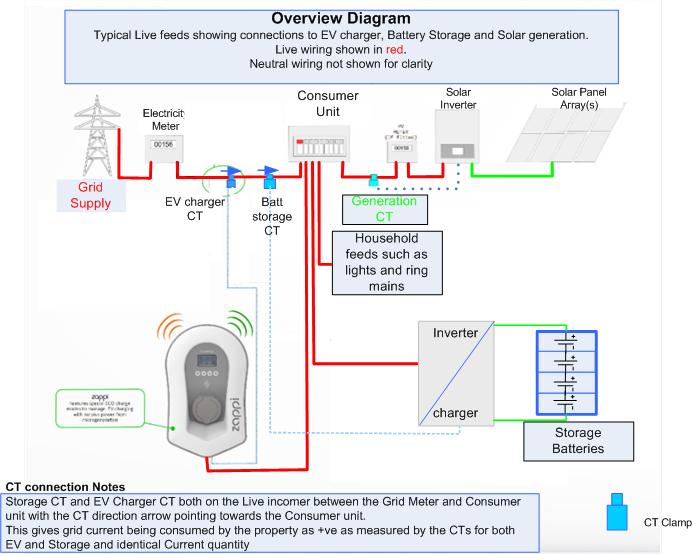 That connection and CT positioning Scheme suffers from the potentially unwanted case of the Storage Battery discharging in to the EV as the BESS CT clamp measure the total property grid current which includes the EV charging currentThis second diagram is a simple modification to route the EV charging neutral not directly back to the consumer unit but via the BESS CT clamp.
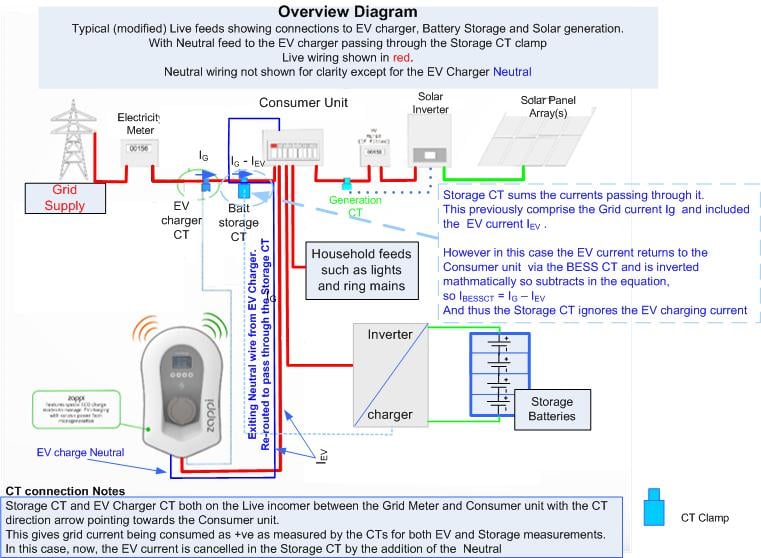 The modified Neutral routing removes the needs for any Henley blocks.The downside is that the Neutral is a permanently installed routing.There are thus three very effective installation method to avoid unwanted BESS discharge:1 The original diagram as posted by SuzeQStan with Henley blocks and the better simpler more conventional routing posted by QrizB with just one Henley block. Advantage being the ability to Change the BESS CT clamp position and thus use the Battery to help or solely charge the EV (if there is sufficient BESS capacity). Downside could be the need to physically move the clamp to change functionality which is not for everybody or possible not practical.2 The Reroute of the Neutral: simple again avoiding any Henley blocks but not possible to change functionality without a rewire or extra switching3 The Zappi extra CT method ( not shown ) where a CT clamp measures BESS current and can take that into account to prevent BESS discharge. Advantage here is that the functionality is under software control through a Zappi option setting and thus does not involve changes near the electrical circuits which may be inconvenient. Not everyone has a Zappi and often simpler chargers.All three methods should work well but I would prefer number 3 ( a Zappi charger) so as to easily change functionality by a button press or two; and then the versatility of QrizB's method.1
 -
The other difference is that only the third method shows all the various components being routed through the CU and thus (perhaps) protected by an RCD. I'm aware that some EV chargers have internal RCDs now, but is that true for all of them?Heedtheadvice said:There are thus three very effective installation method to avoid unwanted BESS discharge:[snip]All three methods should work well but I would prefer number 3 ( a Zappi charger) so as to easily change functionality by a button press or two; and then the versatility of QrizB's method.0 -
With my diagram there's a mini CU between the Henley blocks and the EV charger. I left it out for simplicity, much as I left out the various isolators and generation meter on the solar PV leg of things.squirrelpie said:
The other difference is that only the third method shows all the various components being routed through the CU and thus (perhaps) protected by an RCD. I'm aware that some EV chargers have internal RCDs now, but is that true for all of them?Heedtheadvice said:There are thus three very effective installation method to avoid unwanted BESS discharge:[snip]All three methods should work well but I would prefer number 3 ( a Zappi charger) so as to easily change functionality by a button press or two; and then the versatility of QrizB's method.
N. Hampshire, he/him. Octopus Intelligent Go elec / Fuse gas / Vodafone BB / iD mobile. Kirk Hill Co-op member.Economy 7 cap explainer. Gas vs E7 vs peak elec heating costs, Ecoflow Stream, Best kettle :-)
2.72kWp PV facing SSW installed Jan 2012. 11 x 247w panels, 3.6kw inverter. 37 MWh generated, long-term average 2.6 Os.0








Confirm your email address to Create Threads and Reply

Categories
- All Categories
- 355.7K Banking & Borrowing
- 254.9K Reduce Debt & Boost Income
- 456.1K Spending & Discounts
- 248.3K Work, Benefits & Business
- 605.8K Mortgages, Homes & Bills
- 179K Life & Family
- 263.6K Travel & Transport
- 1.5M Hobbies & Leisure
- 16.2K Discuss & Feedback
- 37.7K Read-Only Boards