We’d like to remind Forumites to please avoid political debate on the Forum.
This is to keep it a safe and useful space for MoneySaving discussions. Threads that are – or become – political in nature may be removed in line with the Forum’s rules. Thank you for your understanding.
📨 Have you signed up to the Forum's new Email Digest yet? Get a selection of trending threads sent straight to your inbox daily, weekly or monthly!
Tesla Powerwall 3 set up.
Comments
-
Update 5pm. I didn’t see any more charging from solar but either side of 2pm the PW3 decided it would have a boost from the grid to take it to 46%. At 4pm the battery kicked in to take over the house load which was reassuring and that’s where we are now.There has been a lot of spare solar today (see photo2) but it seems the PW3 decided it didn’t need it despite me setting a reserve level of 20%. There will be some cheaper electricity tonight (around 6p) yes, so it will be interesting to see if the PW3 feasts on it.JKenH said:I am getting a bit more used to how the PW3 behaves and, perhaps more importantly, it seems to be getting used to me. After the initial disappointment with its response to Agile I programmed in my own”tariff” with four different price bands from super off peak to peak then broke the day up to 7 or 8 time slots and allocated a rate to each. It was necessary though for me to also set separate export rates for each time slot because the PW3 on time based control is focussed on saving money and how it responds to any given import price will depend on the export price at the time. Because the PW3 also takes into account charging losses there has to be a clear margin between import and export. (The rates I entered while reflective of typical time of day pricing are of course are a completely artificial construct and don’t reflect what I pay - I just wanted to programme the PW3 to test how it responds). Over around a 30 hour period the PW3 responded exactly how I wanted it to, charging and discharging perfectly.That exercise completed, yesterday evening I put the PW3 back on the Agile tariff. Having gone to bed with 42% charge I woke up with 44%, it having added 0.4kWh to the battery around 5am. Agile prices had been virtually flat through the night between 14p and 15p so with a sunny day forecast I was not surprised that the PW3 didn’t bother this charging. When rates at breakfast went up to around 17p it kicked in and took the house load. At 8.30 when the import rate went up to 17.3p the battery stopped discharging and we went back to the grid - the reason, being, I imagine, that solar generation had started. It was only around 0.2 kW at 8.30 as it melted the frost from the roof but by 9am had reached 0.8kW. The decision whether to discharge or use grid power seems to be made on the half hour and I think it sticks with that rather than being based on load or solar PV at any point during the hour. Obviously it won’t discharge if the solar PV is covering the load and it seems to make a guess, not just on the load/PV at the start of the hour but what it thinks it might be. This I presume then lets it charge the battery with any excess solar rather than wasting it to the grid.Having said that, as I write this at 9.10 the system is generating 0.9kW and sending 0.2kW to the battery and 0.7kW to the grid. The import rate is currently 16.8p.At 9.12 1kW of PV is being produced and 0.2 is going to the battery and 0.8kW to the grid. At this point my other panels have just taken over the house load. The PW3 cannot see those panels, just the net inflow of generation from them less the house load.At 9.15 the new solar panels are generating 1.1kW and with 0.1 from the house 1.2kW is being sent to the grid. Battery SoC is 38%.There’s still a lot to learn.Update 11.25am This does seem a bit weird. The battery SOC has fallen from 38% to 36% over the last couple of hours despite continuous (hazy) sun. I have both ASHPs running in the house which are taking what the house roof is producing and the new panels above the garage are supplementing that with 0.2kW. Only 0.2 kW is going into the battery and 1.4kW going to the grid. We are paying 15p import until noon then for 3 hours the import rate drops into the 14ps before rising again at 3pm. Is the PW3 waiting for lower import rates rather than forgoing export at 15p or is the PW3 thinking it can tough it out through tonight’s peak 4-7pm with just 36%?
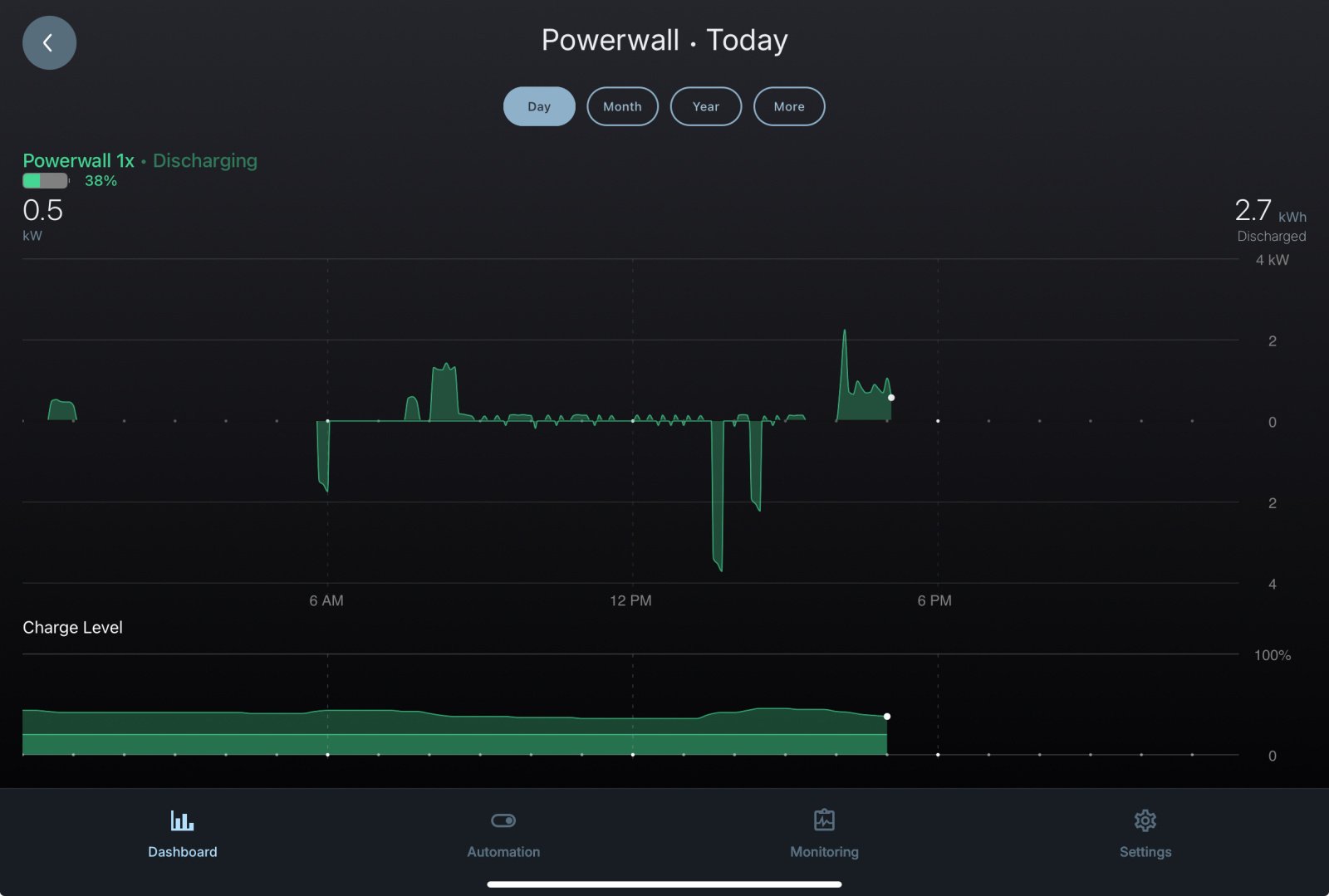 Update 7.45pm: We made it through to 7pm with 23%. The battery has continued discharging so at 7.30pm I dropped the reserve to 5% to make room for some cheap electricity tomorrow; if the PW3 deems it worthwhile.Northern Lincolnshire. 7.8 kWp system, (4.2 kWwest facing panels , 3.6 kWeast facing), Solis inverters installed 2018, 5kW SSE facing system (shaded in afternoon) added in 2025 with Tesla PW3 battery, Mitsubishi SRK35ZS-S and SRK20ZS-S Wall Mounted A2A Heat Pumps, ex Nissan Leaf owner.0
 -
I wouldn’t know which wire to clamp it to orhow to attach the other end to the Powerwall Gateway. I suspect like other Tesla stuff, it isn’t designed for end users to play with.thevilla said:"The PW3 cannot see those panels". I would think that would be easy to change with an additional CT clamp if you wanted to and they're not a massive distance apart.You've already invested in your app but I wondered if you're aware of predbat which runs on home assistant. Maybe more of a faff than you'd like but it's highly configurable and worth bearing in mind if you remain unconvinced with your current setup.Northern Lincolnshire. 7.8 kWp system, (4.2 kWwest facing panels , 3.6 kWeast facing), Solis inverters installed 2018, 5kW SSE facing system (shaded in afternoon) added in 2025 with Tesla PW3 battery, Mitsubishi SRK35ZS-S and SRK20ZS-S Wall Mounted A2A Heat Pumps, ex Nissan Leaf owner.0 -
JKenH said:
Thanks for those tips. I was thinking about IOF for the summer. Couple of questions; does the PW3 fill itself everyday from solar (when available) and does it discharge down to the back up level everyday to maximise revenue for the user or does Octopus charge and discharge it to suit its needs?NedS said:JKenH said:I am getting a bit more used to how the PW3 behaves and, perhaps more importantly, it seems to be getting used to me. After the initial disappointment with its response to Agile I programmed in my own”tariff” with four different price bands from super off peak to peak then broke the day up to 7 or 8 time slots and allocated a rate to each. It was necessary though for me to also set separate export rates for each time slot because the PW3 on time based control is focussed on saving money and how it responds to any given import price will depend on the export price at the time. Because the PW3 also takes into account charging losses there has to be a clear margin between import and export. (The rates I entered while reflective of typical time of day pricing are of course are a completely artificial construct and don’t reflect what I pay - I just wanted to programme the PW3 to test how it responds). Over around a 30 hour period the PW3 responded exactly how I wanted it to, charging and discharging perfectly.This is essentially how I run my PW3, although I'm on the Cosy tariff which is a lot easier to manage. If I were on Agile, I would do as you have done and manually assigning slots as either 'cheap' or 'mid' or 'expensive' throughout the day. You know Agile is generally cheap from 22:30 through to 5am, higher through to 10 or 11am, cheaper through to 4pm, and then expensive until later in the evening. You can probably work out the slots you'd like to charge in / draw from the grid and manually update each day - or pay the monthly subscription to NetZero and let it manage it for you (but I doubt you will save the subscription fee?)I set the 3 Cosy cheap slots as Off-Peak (15p) and set all other times as Peak with an artificially high import price of 200p - in other words DO NOT import outside of the cheap rate slots, only run from the grid or import electricity in the 3 cheap slots. Hopefully this is clear enough that even the Tesla AI can be in no doubt! My average import price is effectively equivalent to the Cosy cheap rate price (~14.8p for me).If you have enough battery capacity to run your home like this, Cosy may be an easier option than Agile unless you think you can achieve a lower average price on Agile over winter. I keep an eye on the Agile pricing, but mostly the lowest prices have been around the same or higher than Cosy, and mostly only occur overnight when we use least due to overnight set backs on the heating, plus Cosy with it's 3 spaced out cheap slots allow us to recharge 3 times per day and cover 40-50kWh per day usage from a single 13.5kWh PW3. So for us, I think on average Cosy is cheapest in winter and gives certainty of pricing.You should absolutely consider switching to Intelligent Octopus Flux (IOF) in summer as this is by far the most lucrative tariff when you are a net exporter. Last summer we averaged 25-26p for our excess exported electricity and then import at ~15p in winter giving great leverage. We switch in around April and back to Cosy in October, and the points we become net exporters / net importers, corresponding roughly to the time the heating goes on/off. This arrangement requires virtually no management or input from me and I can just let the PW3 get on with it, plus I do not need to pay any subscription fees for the NetZero app.With IOF, you have to understand that it's a net metering tariff, import and export rates are the same, so it makes no difference if your use comes from the grid, solar or from battery - it's all the same rate (well, 2 different 'same' rates as there's also a peak rate period 4-7pm). Octopus will fully discharge the battery (to 20%) every day during the peak rate slot 4-7pm. They will recharge it from the grid when they see fit, mostly in the afternoons when electricity is cheapest.Octopus fully control your battery for their benefit. They decide when to charge and discharge it, and they compensate you handsomely for the privilege (see and understand the above, again).The general mode of operation last summer was that Octopus would discharge the battery during the peak rate slot (down to it's 20% reserve) paying you peak rate for that export. The battery would generally then sit at 20% all night whilst the house imports from the grid. The following day, excess solar would export and the battery would generally recharge around midday or just after when electricity is cheapest/most abundant on the grid, being fully recharged by 4pm ready for peak rate export again. Ideally you need to have sufficient permitted export to discharge your batteries (to 20%) in the 3 hour peak-rate window, and to be able to export most of your summertime peak solar generation (although the battery being empty can help store any excess solar).Occasionally, the battery would recharge overnight if electricity was particularly cheap or abundant, although this doesn't occur often in summer as summer nights have no solar and aren't normally very windy.So Octopus generally operate your battery for their benefit, but you can largely ignore all this as the import and export price is the same, regardless. What is important is that you are a net exporter of energy, and the more you export (net), the more you will be paid. I only ever observed one cycle per day of charge / discharge.The only place you lose out is in the AC/DC conversion losses, where it would be more efficient to charge from DC solar than to charge from AC grid imports, but the rates you are receiving more than compensate for this.With a single PW3 and 7.2kWp array, my average export price was 25-26p per kWh last summer (i.e, somewhere between the two rates).If you are a net exporter during summer, getting 25-26p per kWh for that export rather than 15p fixed, is a no-brainer. The more you export (net), the more you make, and you are helping support the grid at the time it most needs it.I am a Forum Ambassador and I support the Forum Team on the Benefits & tax credits, Heat pumps and Green & Ethical MoneySaving forums. If you need any help on those boards, do let me know. Please note that Ambassadors are not moderators. Any post you spot in breach of the Forum Rules should be reported via the report button, or by emailing forumteam@moneysavingexpert.com. All views are my own & not the official line of Money Saving Expert.2 -
Update; 7.30am.JKenH said:
Update 5pm. I didn’t see any more charging from solar but either side of 2pm the PW3 decided it would have a boost from the grid to take it to 46%. At 4pm the battery kicked in to take over the house load which was reassuring and that’s where we are now.There has been a lot of spare solar today (see photo2) but it seems the PW3 decided it didn’t need it despite me setting a reserve level of 20%. There will be some cheaper electricity tonight (around 6p) yes, so it will be interesting to see if the PW3 feasts on it.JKenH said:I am getting a bit more used to how the PW3 behaves and, perhaps more importantly, it seems to be getting used to me. After the initial disappointment with its response to Agile I programmed in my own”tariff” with four different price bands from super off peak to peak then broke the day up to 7 or 8 time slots and allocated a rate to each. It was necessary though for me to also set separate export rates for each time slot because the PW3 on time based control is focussed on saving money and how it responds to any given import price will depend on the export price at the time. Because the PW3 also takes into account charging losses there has to be a clear margin between import and export. (The rates I entered while reflective of typical time of day pricing are of course are a completely artificial construct and don’t reflect what I pay - I just wanted to programme the PW3 to test how it responds). Over around a 30 hour period the PW3 responded exactly how I wanted it to, charging and discharging perfectly.That exercise completed, yesterday evening I put the PW3 back on the Agile tariff. Having gone to bed with 42% charge I woke up with 44%, it having added 0.4kWh to the battery around 5am. Agile prices had been virtually flat through the night between 14p and 15p so with a sunny day forecast I was not surprised that the PW3 didn’t bother this charging. When rates at breakfast went up to around 17p it kicked in and took the house load. At 8.30 when the import rate went up to 17.3p the battery stopped discharging and we went back to the grid - the reason, being, I imagine, that solar generation had started. It was only around 0.2 kW at 8.30 as it melted the frost from the roof but by 9am had reached 0.8kW. The decision whether to discharge or use grid power seems to be made on the half hour and I think it sticks with that rather than being based on load or solar PV at any point during the hour. Obviously it won’t discharge if the solar PV is covering the load and it seems to make a guess, not just on the load/PV at the start of the hour but what it thinks it might be. This I presume then lets it charge the battery with any excess solar rather than wasting it to the grid.Having said that, as I write this at 9.10 the system is generating 0.9kW and sending 0.2kW to the battery and 0.7kW to the grid. The import rate is currently 16.8p.At 9.12 1kW of PV is being produced and 0.2 is going to the battery and 0.8kW to the grid. At this point my other panels have just taken over the house load. The PW3 cannot see those panels, just the net inflow of generation from them less the house load.At 9.15 the new solar panels are generating 1.1kW and with 0.1 from the house 1.2kW is being sent to the grid. Battery SoC is 38%.There’s still a lot to learn.Update 11.25amThis does seem a bit weird. The battery SOC has fallen from 38% to 36% over the last couple of hours despite continuous (hazy) sun. I have both ASHPs running in the house which are taking what the house roof is producing and the new panels above the garage are supplementing that with 0.2kW. Only 0.2 kW is going into the battery and 1.4kW going to the grid. We are paying 15p import until noon then for 3 hours the import rate drops into the 14ps before rising again at 3pm. Is the PW3 waiting for lower import rates rather than forgoing export at 15p or is the PW3 thinking it can tough it out through tonight’s peak 4-7pm with just 36%?Update 7.45pm: We made it through to 7pm with 23%. The battery has continued discharging so at 7.30pm I dropped the reserve to 5% to make room for some cheap electricity tomorrow; if the PW3 deems it worthwhile.The battery discharged down to 5% at around 10pm last night and this morning charged up to 100% using, it seems, the cheapest time slots. I couldn’t have done it better myself😄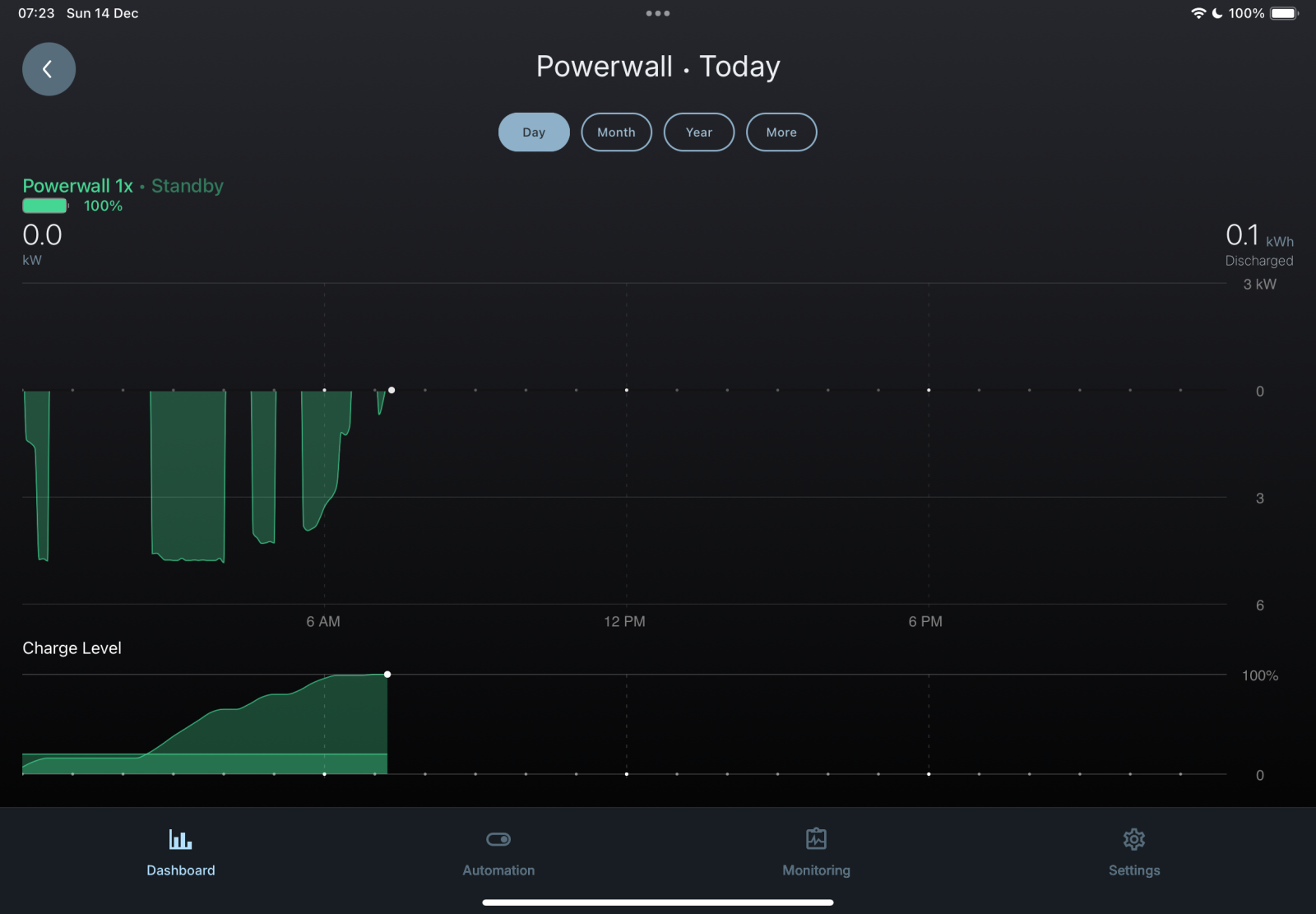 Northern Lincolnshire. 7.8 kWp system, (4.2 kWwest facing panels , 3.6 kWeast facing), Solis inverters installed 2018, 5kW SSE facing system (shaded in afternoon) added in 2025 with Tesla PW3 battery, Mitsubishi SRK35ZS-S and SRK20ZS-S Wall Mounted A2A Heat Pumps, ex Nissan Leaf owner.4
 -
I'm thinking about getting a PW3 so I'm finding it interesting reading about your experience with it. I note that you have the Gateway too; I assume you have power cuts or is there another reason why you added this?I am still struggling to justify the cost benefit of buying one (to add to my existing solar) and keep hoping that prices may become more reasonable going forward but I've yet to see much movement.0
-
We occasionally have power cuts during storms but often have scheduled outages. Longest we have been without electricity is 3 days but that was quite a few years ago. It is hard to justify the Gateway financially based on the amount of time we are off grid. But having decided to get a battery it seemed a bit of a waste not to get one that would provide back up and still allow solar panels to operate when we were without grid power. With most battery systems when the grid goes down your panels cease to generate.
Tesla Powerwalls aren’t cheap compared to other battery systems but I am happy to pay a premium just as I would be to pay more for a Mercedes car than a Dacia. Depending on the level of engagement you hope to have with your battery you may or may not consider the premium worthwhile. As you can probably tell from the fact I started this thread I anticipate having significant engagement with the PW3 and decided to pay a bit extra for what I hope is the Rolls Royce of battery systems.Northern Lincolnshire. 7.8 kWp system, (4.2 kWwest facing panels , 3.6 kWeast facing), Solis inverters installed 2018, 5kW SSE facing system (shaded in afternoon) added in 2025 with Tesla PW3 battery, Mitsubishi SRK35ZS-S and SRK20ZS-S Wall Mounted A2A Heat Pumps, ex Nissan Leaf owner.2 -
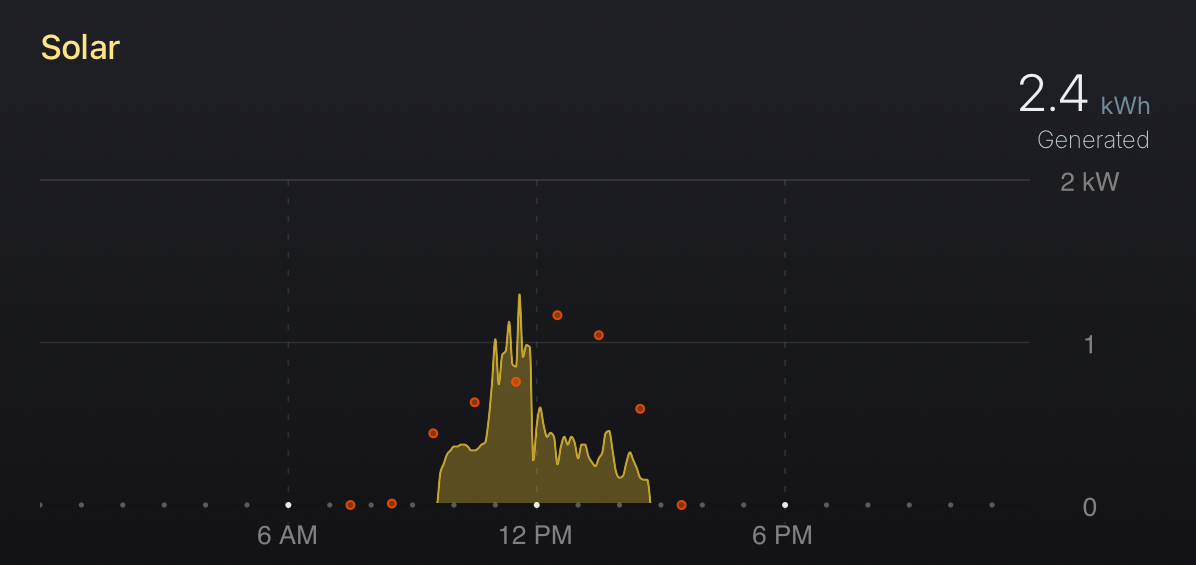
Looking at the NetZero app I wondered what these red dots were about on the solar pv generation screen.
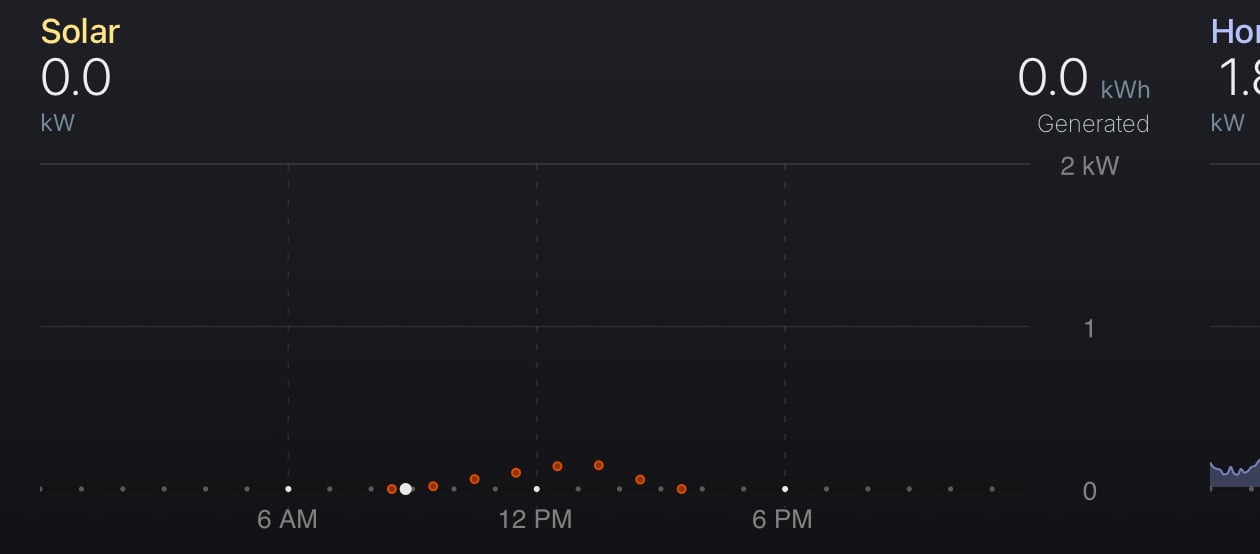 Then I looked back at previous days and it became obvious.
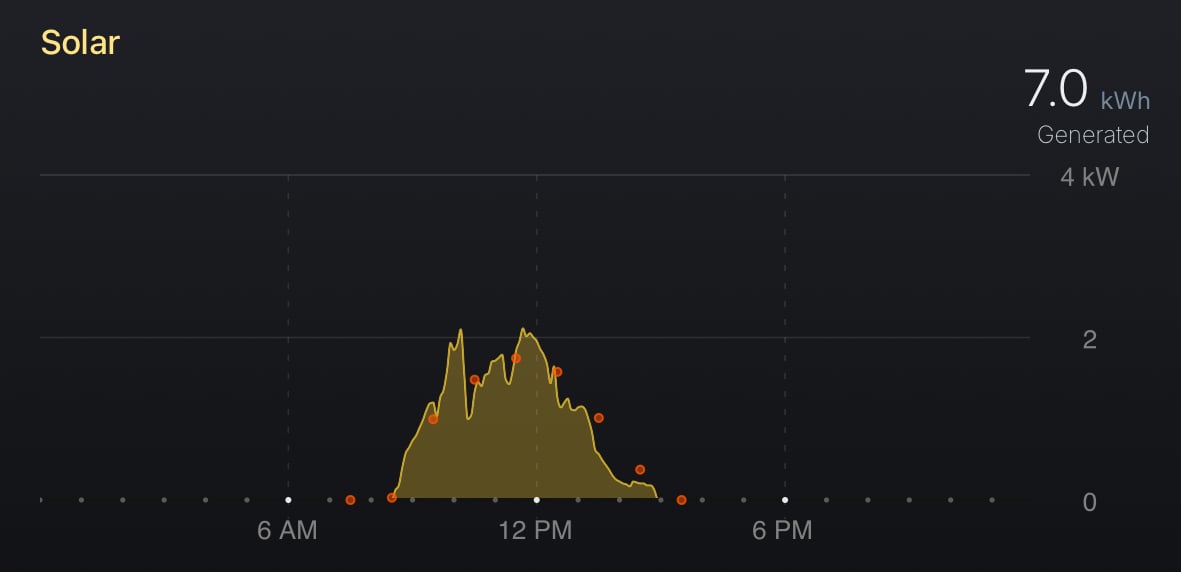 The app doesn’t always get it quite right.
 Northern Lincolnshire. 7.8 kWp system, (4.2 kWwest facing panels , 3.6 kWeast facing), Solis inverters installed 2018, 5kW SSE facing system (shaded in afternoon) added in 2025 with Tesla PW3 battery, Mitsubishi SRK35ZS-S and SRK20ZS-S Wall Mounted A2A Heat Pumps, ex Nissan Leaf owner.0
 -
Unlike to materially make an impact but they are offering a small rebate for installations that have/ will take place from Dec 1st. £375 per PW3 or Expansion pack up to £750 max.Alzire said:I am still struggling to justify the cost benefit of buying one (to add to my existing solar) and keep hoping that prices may become more reasonable going forward but I've yet to see much movement.
https://www.tesla.com/en_gb/support/energy/powerwall/order/rebate
- 10 x 400w LG Bifacial + 6 x 550W SHARP BiFacial + 2 x 570W SHARP Bifacial + 5kW SolarEdge Inverter + SolarEdge Optimizers. SE London.
- Triple aspect: ENE (2.7 kWp), WSW (3.3 kWp), SSE (2.4 kWp)
- Viessmann 200-W on Advanced Weather Comp. (The most efficient gas boiler sold)Feel free to DM me for help with any form of energy saving! Happy to help!2 -
I also use cosy with my PW3, which I believe has greater savings, I don't export as I'm on the old FiT.NedS said:JKenH said:I am getting a bit more used to how the PW3 behaves and, perhaps more importantly, it seems to be getting used to me. After the initial disappointment with its response to Agile I programmed in my own”tariff” with four different price bands from super off peak to peak then broke the day up to 7 or 8 time slots and allocated a rate to each. It was necessary though for me to also set separate export rates for each time slot because the PW3 on time based control is focussed on saving money and how it responds to any given import price will depend on the export price at the time. Because the PW3 also takes into account charging losses there has to be a clear margin between import and export. (The rates I entered while reflective of typical time of day pricing are of course are a completely artificial construct and don’t reflect what I pay - I just wanted to programme the PW3 to test how it responds). Over around a 30 hour period the PW3 responded exactly how I wanted it to, charging and discharging perfectly.This is essentially how I run my PW3, although I'm on the Cosy tariff which is a lot easier to manage. If I were on Agile, I would do as you have done and manually assigning slots as either 'cheap' or 'mid' or 'expensive' throughout the day. You know Agile is generally cheap from 22:30 through to 5am, higher through to 10 or 11am, cheaper through to 4pm, and then expensive until later in the evening. You can probably work out the slots you'd like to charge in / draw from the grid and manually update each day - or pay the monthly subscription to NetZero and let it manage it for you (but I doubt you will save the subscription fee?)I set the 3 Cosy cheap slots as Off-Peak (15p) and set all other times as Peak with an artificially high import price of 200p - in other words DO NOT import outside of the cheap rate slots, only run from the grid or import electricity in the 3 cheap slots. Hopefully this is clear enough that even the Tesla AI can be in no doubt! My average import price is effectively equivalent to the Cosy cheap rate price (~14.8p for me).If you have enough battery capacity to run your home like this, Cosy may be an easier option than Agile unless you think you can achieve a lower average price on Agile over winter. I keep an eye on the Agile pricing, but mostly the lowest prices have been around the same or higher than Cosy, and mostly only occur overnight when we use least due to overnight set backs on the heating, plus Cosy with it's 3 spaced out cheap slots allow us to recharge 3 times per day and cover 40-50kWh per day usage from a single 13.5kWh PW3. So for us, I think on average Cosy is cheapest in winter and gives certainty of pricing.You should absolutely consider switching to Intelligent Octopus Flux (IOF) in summer as this is by far the most lucrative tariff when you are a net exporter. Last summer we averaged 25-26p for our excess exported electricity and then import at ~15p in winter giving great leverage. We switch in around April and back to Cosy in October, and the points we become net exporters / net importers, corresponding roughly to the time the heating goes on/off. This arrangement requires virtually no management or input from me and I can just let the PW3 get on with it, plus I do not need to pay any subscription fees for the NetZero app.0 -
When I bought my PW3, there was no option to install without a Gateway (which there is now). That said, I'm glad I have the Gateway and we have had a number of short power cuts (<5min) since installation.Alzire said:I'm thinking about getting a PW3 so I'm finding it interesting reading about your experience with it. I note that you have the Gateway too; I assume you have power cuts or is there another reason why you added this?I am still struggling to justify the cost benefit of buying one (to add to my existing solar) and keep hoping that prices may become more reasonable going forward but I've yet to see much movement.
I am a Forum Ambassador and I support the Forum Team on the Benefits & tax credits, Heat pumps and Green & Ethical MoneySaving forums. If you need any help on those boards, do let me know. Please note that Ambassadors are not moderators. Any post you spot in breach of the Forum Rules should be reported via the report button, or by emailing forumteam@moneysavingexpert.com. All views are my own & not the official line of Money Saving Expert.1








Confirm your email address to Create Threads and Reply

Categories
- All Categories
- 355.7K Banking & Borrowing
- 254.9K Reduce Debt & Boost Income
- 456.1K Spending & Discounts
- 248.3K Work, Benefits & Business
- 605.8K Mortgages, Homes & Bills
- 179K Life & Family
- 263.6K Travel & Transport
- 1.5M Hobbies & Leisure
- 16.2K Discuss & Feedback
- 37.7K Read-Only Boards