




Gas and electricity Standing Charges in England, Scotland and Wales could be cut by £39 a year from April 2026 if new proposals from the Government are implemented. MoneySavingExpert.com founder Martin Lewis has welcomed the news, but warned that more needs to be done on the future structure of energy bills.
We’d like to remind Forumites to please avoid political debate on the Forum.
This is to keep it a safe and useful space for MoneySaving discussions. Threads that are – or become – political in nature may be removed in line with the Forum’s rules. Thank you for your understanding.
📨 Have you signed up to the Forum's new Email Digest yet? Get a selection of trending threads sent straight to your inbox daily, weekly or monthly!
MSE News: Standing Charges could finally fall from April under Government plans
0
Comments
-
At least this one's linked to a consultation about social policy costs - specifically WHD load share between tge sc and unit rates - rather than genuine market energy purchase and delivery system / supplier costs. (AS yet again another ML post repeating his imo mistaken in general clarion call for SCs to be cut)
But given Aug 24 only £11 from policy costs was on each fuel - about the then annex 2 for just whd - ignoring all other policy components - when Ofgem published its breakdown in its zero SC consultation - and current annex 2 just for whd is c£23 per fuel after Jan rise - not sure where they get tgd £39 total savings predicted.
But surely the real solution to whd (£150) is not to have higher bills including come Jan £235 total policy costs in the first place - up 50% in less than 2 years - plus net zero network costs in network line and renewables CfDs in wholesale line increasing everyone's electric bills - rate up 5.1% again in January - well the majority of homes on standard tariffs - or fixes that track them in longer term - at any rate.
WHD is if anything IMO a more obvious choice to shift from bills to progressive taxation than budget levy changes.
1 -
No costs ever fall, they are just re-categorised. Just like the supposed fall in energy bills announced in the Bodge It, they will be moved to general taxation. This falsely separates them from the area they belong and onto everyone who is foolish enough to have to pay tax.0
-
Costs like insulation or heat pump grants, warm home discount, Winter fuel payment, aren't energy costs. What your basis for saying that energy prices are "where they belong"? It seems no more logical than funding these via a surcharge on eggs.GeneralCommonsense said:No costs ever fall, they are just re-categorised. Just like the supposed fall in energy bills announced in the Bodge It, they will be moved to general taxation. This falsely separates them from the area they belong and onto everyone who is foolish enough to have to pay tax.3 -
Suppliers are at liberty to assign costs to the unit rate or standing charge as they see fit. It's only the price-capped SVT standing charge that's dictated by Ofgem. I was a bit surprised to see just where the policy costs come from; the WHD is charged to suppliers per household, but everything else is levied per MWh sold. This latest proposal (shifting the WHD charge to unit rates) would remove this anomaly. However we feel about the question of whether these costs should be levied on energy bills or through general taxation, it would seem logical for suppliers to follow the same method when billing customers as the exchequer uses when billing them.
I wasted some time trying to make sense of Ofgem's impenetrable Annex 4 - Policy cost allowance methodology and came up with this extract, to which I've added some calculations that may or may not be right:
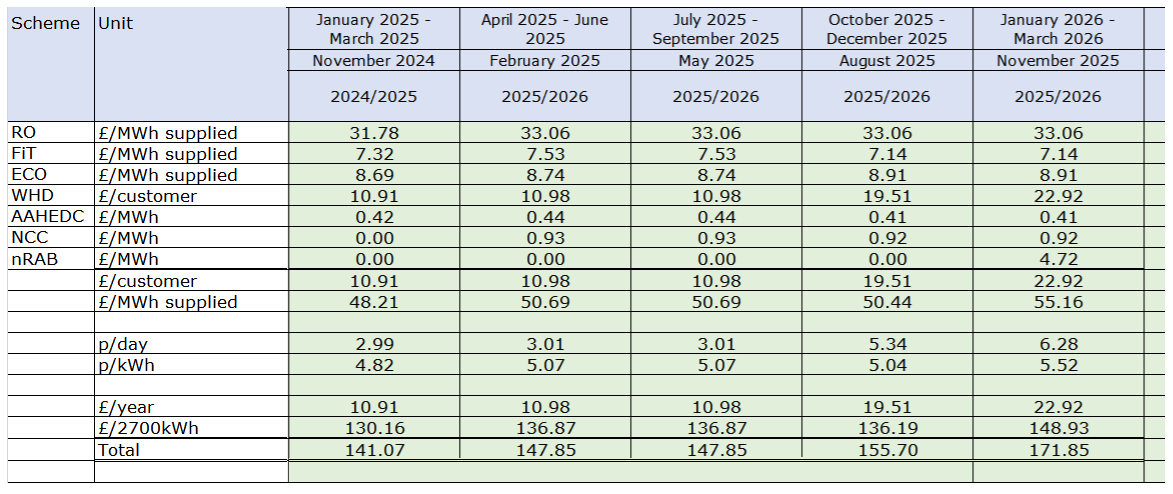
This tab aggregates Ofgem's estimates of the charges to a supplier associated with each scheme. For purely selfish reasons, I looked only at single-rate electricity, so no gas. My calculations are in the rows with no scheme label. The schemes are:
RO Renewables Obligation
ECO Energy Company Obligation
WHD Warm Home Discount
AAHEDC Assistance for Areas with High Electricity Distribution Costs
FIT Feed in Tariffs
NCC Network Charging Compensation Scheme
nRAB Nuclear Regulated Asset Base Scheme allowance.
I find the bottom line (the cost applicable to a typical medium-usage household) eye-watering. Is there something I've misunderstood?I'm not being lazy ... I'm just in energy-saving mode.
If you're asked to post a photo of your meter Meter Configuration Tables v2.0.xlsx0 -
Spreadsheet
Not sure whats going on on your p/kWh figure. Maybe being naive but out by factor of 4 ?
You divide fixed policy cost coreectlg by 3,65 so unit change factors [dimensional analysis] so [£/yr] to [p/d] = x 100 [p/ £] / 365 [d/ yr] etc
How do you get from £/MWh for those policies to p/kWh - your dividing by 2.5 ? Not 10 if directly linked to only those policy costs and nothing else added. So the price out by 4 ?
xx [£/MWh] x 100 [p/£] / 1000 [kWh/ MWh] = xx/10 [p/ kWh]
Or with a number as an example in reverse divide first to get to £/kWh so £50/1000=£0.05 per kWh thenx100 = 5p
You go from £55.16 to 22p not 5.516p
E.g. as a sanity check for last column - £55.16/MWh x 2.7 = £148.93 as 2700 kWh = 2.7MWh should be second last line cost
Or
£55.16/MWh = 5.516p/kWh x2700kWh = 14893 p or £148.93
595.73 as tabled / 148.63 = 4
Side question - why are some in this table and the other you posted before tabled as /MWh supplied - and some just /MWh.
One thought was does one set based on metering at source (generation) and the other destination (homes etc) need compensating for grid and the traditionally bigger local distribution losses - maybe approaching 10%. Of course grid could creep 1-2% higher for some supply given remote renewables and 10+ GW of hvdc link power in plans - egl losses could by in the 3-4% range including conversion stations.1 -
That should teach me not to post late at night. I was in a hurry to get this finished, knowing I wouldn't be able to do it yesterday. The result was copious quantities of egg on my face - thanks for your sanity check!Scot_39 said:Not sure whats going on on your p/kWh figure. Maybe being naive but out by factor of 4 ?
I quickly tracked down the culprit: a single fumble-finger-incident where 100 was entered as 400. I've since edited the table and trimmed my fingernails (4 is just above 1 on my numpad), so I hope it now makes sense.Scot_39 said:Side question - why are some in this table and the other you posted before tabled as /MWh supplied - and some just /MWh.I've no idea. There is some account taken of losses for the AAHDEC, but that's probably not very significant. I'm a bit more confused about whether the MWh amounts are supplied to or by the supplier (to the customer or by the generator). It may be obvious to some and even explained somewhere.
Sorry for the misdirection ...I'm not being lazy ... I'm just in energy-saving mode.
If you're asked to post a photo of your meter Meter Configuration Tables v2.0.xlsx1 -
430 am for the reply - so maybe not the clearest - even by my standards0





 I've no idea. There is some account taken of losses for the AAHDEC, but that's probably not very significant. I'm a bit more confused about whether the MWh amounts are supplied to or by the supplier (to the customer or by the generator). It may be obvious to some and even explained somewhere.
This discussion has been closed.
Confirm your email address to Create Threads and Reply

Categories
- All Categories
- 355.7K Banking & Borrowing
- 254.9K Reduce Debt & Boost Income
- 456.1K Spending & Discounts
- 248.3K Work, Benefits & Business
- 605.9K Mortgages, Homes & Bills
- 179K Life & Family
- 263.7K Travel & Transport
- 1.5M Hobbies & Leisure
- 16.2K Discuss & Feedback
- 37.7K Read-Only Boards