We’d like to remind Forumites to please avoid political debate on the Forum.
This is to keep it a safe and useful space for MoneySaving discussions. Threads that are – or become – political in nature may be removed in line with the Forum’s rules. Thank you for your understanding.
📨 Have you signed up to the Forum's new Email Digest yet? Get a selection of trending threads sent straight to your inbox daily, weekly or monthly!
Gilt Ladder In Pension Fund
Comments
-
Yes, you are buying an insurance policy against high inflation. If inflation is high, you are okay because your ILG always (at today's purchase prices) returns that bit added on to the rate of inflation.
If the inflation rate is low, you would have done better in a conventional (fixed rate) gilt. You have effectively paid a bit of money for an insurance policy on which you did not claim. You still have your buying power plus a bit of profit though.
You will have gone through this with fixed rate savings or a fixed rate mortgage - it's no different0 -
The reverse is also true of non IL Gilts. If you buy to hold to maturity and inflation over the term is greater than the annual coupon then you will make a loss.MetaPhysical said:So is the downside of IL gilts the fact that if inflation were lower then you wouldn't get as much return as none-IL gilt with a stated coupon that was higher than the inflation rate? And, of course, even with "low" inflation, the real terms value of a none-IL gilt will be eroded by the time redemption comes round.0 -
Forget about the TR26 row for now because it might be confusing you.MetaPhysical said:Thanks folks.
I understand conventional gilts but the index linked ones confuse me.
I punched in IL gilts here: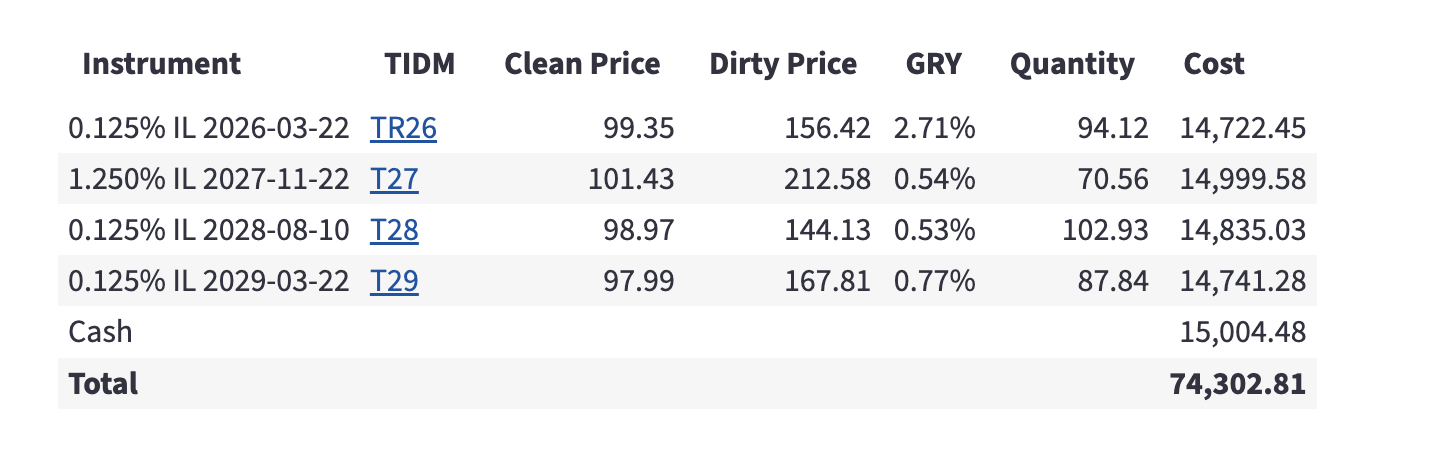
But why is the yield so poor?
The GRY column stands for Gross REAL Yield. You get inflation, plus this number. The GRY is effectively your profit.
T27, if inflation is 3%, will pay you your initial outlay plus about 7% after two years. That's 3.5% per year. That's 3% (inflation) + .54% (profit).
You buy T27 for £212. Just accounting for inflation (since 2006) it should be £209, so you are paying slightly over the odds, but it pays back 1.25% every year. You get 1.25% of £209. Next year, a bit more. It tracks the inflated value. Eventually, it's going to pay back something like £221, depending on the next 2 yrs inflation. So, for £212 you receive 2 x £2.50 + £221. £14 profit from £212 in 2 years. I make that 3.5%ish. All higher or lower, depending on inflation.
Low coupons are popular because the coupons are taxable outside SIPP/ISA. The final payout is always tax free. Most people are buying them for the inflation matching, not for the coupon income.1 -
Thank you. I [think] I am getting my head around this now. The point I was worried about is that there seems to be no or very little "return" on an IL gilt - they are not "working" to earn you a return. But, if you think about it, neither is a none-IL gilt because all the coupon is doing is compensating you for the fact that the redemption/par price remains at £100 so unless you get the coupon or could have bought the gilt at a lower price you have, in real terms, lost money on owning it because £100 in redemption in 2030 is less in real terms than £100 now if you buy at issue and hold to redemption?
So, back to first principles then...... if all the gilt is doing "preserving" value and not creating wealth, what is the point in them? Just for capital preservation slightly above inflation (we hope) ?? So why are we taking risk and lending the government money just for a measley one percent above inflation, and indeed, even a loss?0 -
If you feel you can get a better return somewhere else, you are free to invest there.
If you feel you can get a lower risk investing somewhere else, you are free to invest there.
If you feel you can get a better return at lower risk, please let us know where.
1 -
The possibility of a loss on an IL gilt is extremely remote as the government can just print the money to repay them. 1.5 to 2% above inflation is still around 20% return above inflation over a decade.MetaPhysical said:So, back to first principles then...... if all the gilt is doing "preserving" value and not creating wealth, what is the point in them? Just for capital preservation slightly above inflation (we hope) ?? So why are we taking risk and lending the government money just for a measley one percent above inflation, and indeed, even a loss?
I agree it's not much compared to recent equity market performance but those returns have been abnormally high, have left the assets overvalued compared to historic norms and they may crash 50% at any moment.
For me at least the point is I can bank some of the strong equity market returns by converting around half my current pension valuation into IL gilts and they will cover all my current spending needs in retirement with nothing much to worry about. They also mean I can start with a higher drawdown rate as I don't need to consider sequence of return risks.5 -
Very good points. Sorry if the way I explained myself came across as foolish and arrogant because that was not my intention, I was trying to be clear in words, perhaps not in the most eloquent way.Secret2ndAccount said:If you feel you can get a better return somewhere else, you are free to invest there.
If you feel you can get a lower risk investing somewhere else, you are free to invest there.
If you feel you can get a better return at lower risk, please let us know where.0 -
Others have said it's to take risk off, one of those risks is inflation. I employ IL gilts to try and keep my cash safe from inflation. IL gilts are where I put cash I want in ~10 years time, like I keeps cash I'm going to need this month in my current account, cash I'm going to need in a couple of months in premium bonds and cash I'm going to need in the next ~5 years in conventional gilts (sub par low coupon unsheltered, some 4-5% in sheltered accounts).3
-
Divide your retirement needs into two parts:MetaPhysical said:...... if all the gilt is doing "preserving" value and not creating wealth, what is the point in them? Just for capital preservation slightly above inflation (we hope) ?? So why are we taking risk and lending the government money just for a measley one percent above inflation, and indeed, even a loss?
1. Essential: money for bills and food;
2. Fun money
If you are in the fortunate position to have accumulated more than enough to fund part 1, you might choose to section off that part. If you can protect it against inflation, and know that it will be there when you need it, and even see a small amount of growth, the question becomes 'why not?'
For part 2, there would be a much wider range of approaches. Some might choose to try to double it, accepting the risk that they could lose half of it. Others might try to preserve what they have, whilst continuing to add to their pot. Many opinions are available.
If you keep everything in equities, you might well end up with a larger total pot (so more fun money). There is also a risk that you go from a position of being beyond the finish line to a position where you are behind it again. Many people, once they realise they are past the finish line, are happy to pay for an insurance policy that keeps them there. The question then simplifies to how far over the finish line...
4 -
One of the things I have noted, certainly on Interactive Investor which is my platform, is that you can only acquire IL gilts via the telephone - you can't do it online.1












Confirm your email address to Create Threads and Reply

Categories
- All Categories
- 355.8K Banking & Borrowing
- 254.9K Reduce Debt & Boost Income
- 456.2K Spending & Discounts
- 248.4K Work, Benefits & Business
- 606K Mortgages, Homes & Bills
- 179K Life & Family
- 263.8K Travel & Transport
- 1.5M Hobbies & Leisure
- 16.2K Discuss & Feedback
- 37.7K Read-Only Boards