We’d like to remind Forumites to please avoid political debate on the Forum.
This is to keep it a safe and useful space for MoneySaving discussions. Threads that are – or become – political in nature may be removed in line with the Forum’s rules. Thank you for your understanding.
📨 Have you signed up to the Forum's new Email Digest yet? Get a selection of trending threads sent straight to your inbox daily, weekly or monthly!
The Forum now has a brand new text editor, adding a bunch of handy features to use when creating posts. Read more in our how-to guide
Gilt Ladder In Pension Fund

MetaPhysical
Posts: 576 Forumite



To diversify my portfolio a bit more I'm investigating building a gilt ladder. I have no need of this money within the next ten years since I "pay" myself out of cash that I hold in the SIPP and my MM fund.
With that in mind, would a ladder be a bit redundant and maybe should I just split it across T31 and TR32 with that 4.08% YTM and keep things simple and take the coupons?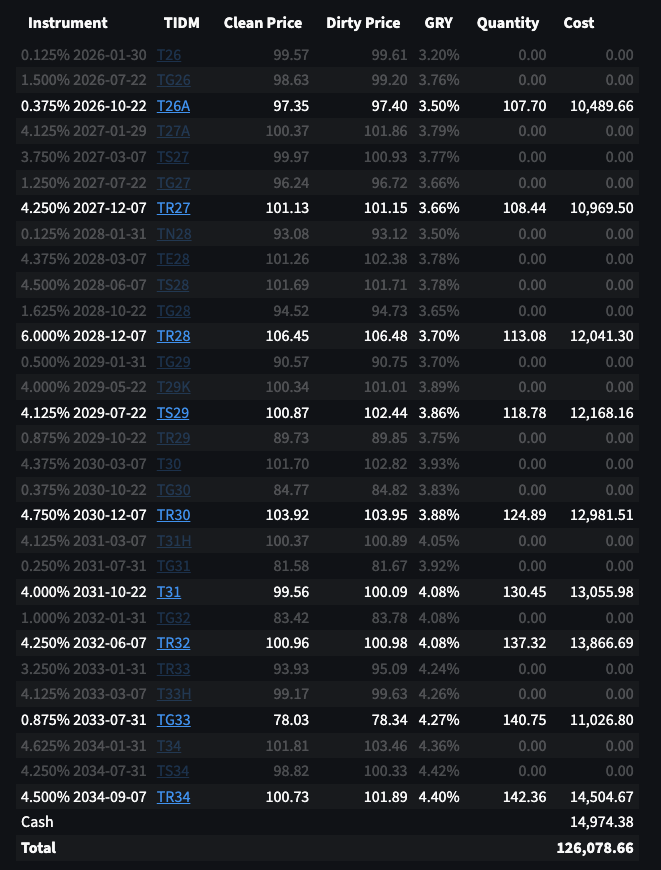
With that in mind, would a ladder be a bit redundant and maybe should I just split it across T31 and TR32 with that 4.08% YTM and keep things simple and take the coupons?
2
Comments
-
As I understand it - the point of the rungs. Is the release of capital for cashflow. Alongside coupons. So if there is no need, and no potential need, for that capital to be released as cashflow.
And you can tolerate any possible price movements that could occur to the 10 year gilt. So the plan doesn't get stuck in a situation where it is needed it after all, and the world has moved against on during run yield/capital/resale price. At the inconvenient time.
In those scenarios the ladder with shorter durations would be impacted (a little) less than the 10 year gilt. And spit capital out each year. But would still be impacted by the same interest rate movements
There is a little loss of coupon. And a positive or mildly more flexibility as cash is being recycled out of maturing gilts - into whatever you put it in next. Consumption, new rung of the ladder at the long end. Equity buyin in a correction. Whatever it is. And the maturity is locked in and known. I don't see many other reasons to avoid simplifying as you suggest. It's a contingent tradeoff.
1 -
I suppose my question would be why you would use a ladder as a diversifier?
The purpose of a Gilt Ladder is to secure guaranteed timed cashflow, not to diversify. If you want to diversify into bonds, it would be normal to choose one of the standard 60:40 or similar funds. If you want to manage the ratio yourself, you would buy a bond fund.
It sounds like you don't need access to these funds for at least 10 years and so you may want to purchase a gilt maturing 10 years from now. With that sort of timeline, you may want to consider an index linked gilt as the expected return between index-linked and conventional gilts is currently not that big meaning you get inflation protection for not much extra outlay.3 -
I'd argue that a gilt ladder is still technically diversification in the portfolio but it's basically money you are no longer taking market risk on if you intend to hold to redemption so the effect is to shrink the scale of assets in which you are unsure of the investment outcome.
However if you build the ladder using conventional gilts then you are still taking the risk that inflation will be above or below expectations so you are not assuring your resulting spending power. Given the obvious problems in the UK economy then my strong preference would be inflation linked gilts. If the government need to print money and use inflation to shrink the national debt relative to GDP the conventional gilt holders (and cash savers) will lose out.
I sleep very well since moving around half my pensions into IL gilts and knowing they will meet my regular spending needs in retirement. I work with people who had access to a DB scheme for some of their career so have a similar foundation of regular inflation linked income. The improvement in gilt yields (and unexpectedly strong growth in equity prices) is going to support a much higher income in retirement than I ever expected roughly double what I currently spend.
MetaPhysical - I am unclear on when you intend to spend this money? If you are likely to spend it all as a lump sum in 10 years time (eg a new car) then you could just buy a single gilt with an aligned maturity date. Ladders are for those looking to draw regular income over a long time period.
1 -
Thanks folks.
I understand conventional gilts but the index linked ones confuse me.
I punched in IL gilts here: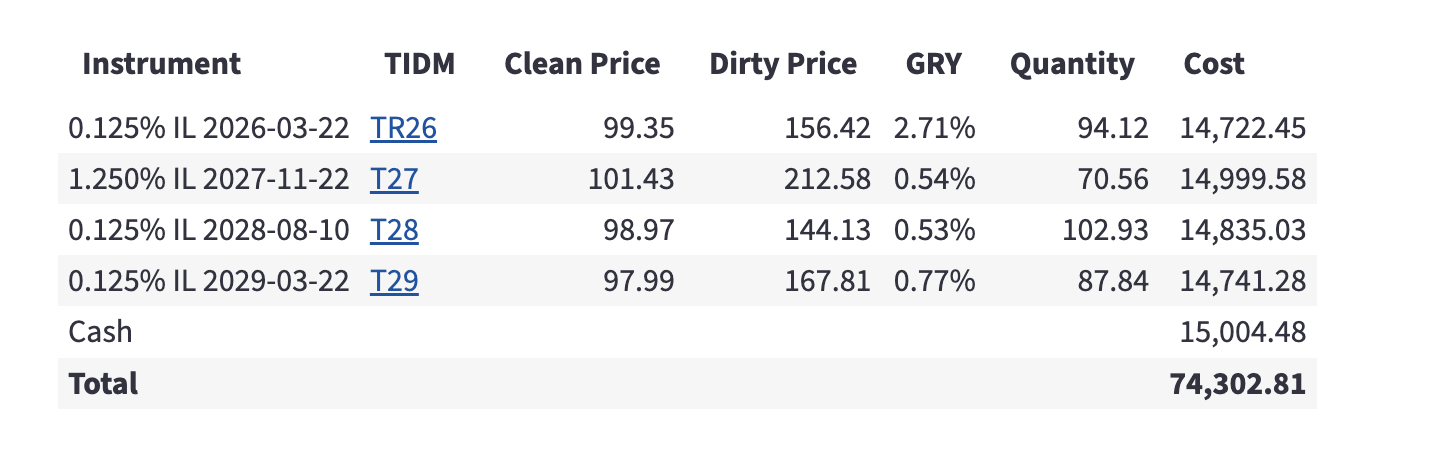
But why is the yield so poor? And the coupons are tiny. Are there higher coupone IL gilts as well? Do I take it that the "value" of the IL Gilt comes with the inflation added to the par price PLUS inflation at redemption? But that means you aren't actually "earning" anything on the gilts at all whilst they are alive - you're just protecting the capital from inflation? That may be fin for some but not if you want to derive some income from your capital. As it happens I have income streams from elsewhere and I want to diversify my portfolio so I am not so exposed to Equities snd HY bonds. However, I'd like to earn a bit of income from £75k of investments and not just keep place with inflation. I am clearly missing something.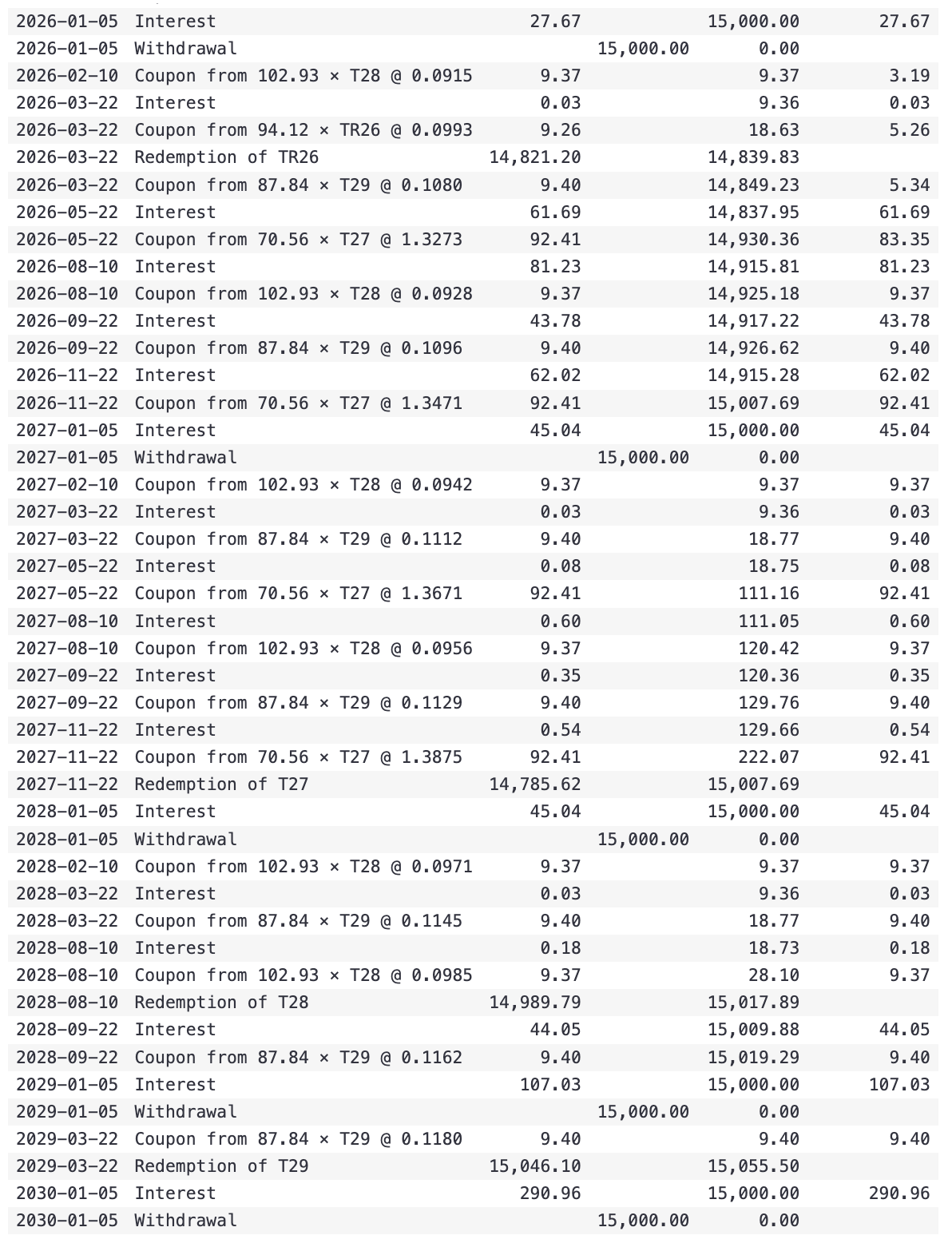
0 -
Both the coupon and original £100 value are multiplied by the Index Ratio (compound inflation) before payment.MetaPhysical said:But why is the yield so poor? And the coupons are tiny. Are there higher coupone IL gilts as well? Do I take it that the "value" of the IL Gilt comes with the inflation added to the par price PLUS inflation at redemption? But that means you aren't actually "earning" anything on the gilts at all whilst they are alive - you're just protecting the capital from inflation? That may be fin for some but not if you want to derive some income from your capital. As it happens I have income streams from elsewhere and I want to diversify my portfolio so I am not so exposed to Equities snd HY bonds. However, I'd like to earn a bit of income from £75k of investments and not just keep place with inflation. I am clearly missing something.
For example on the below 2050 IL gilt (issued in 2009) the real yield is 2.1% above inflation if held until 2050 (assuming that coupons could be reinvested at the same unit price).
https://www.dividenddata.co.uk/gilts.py?ticker=TR50
This is because the dirty market price you would pay would be £132 but it's currently worth £190 (£100 x 1.9 as there has already been 90% inflation since 2009) so the return comes from a combination of the coupons and the capital growth as the 31% discount erodes as it gets closer to redemption.
0 -
I agree with the philosophy here. I am thinking of selling half my (currently 100% equity) SIPP to buy/build an ILG ladder in lieu of an annuity as regular income to fund base expenses - food, heating, council tax etc etc - and using the other half as spending money - holidays, new car, etc.Alexland said:I'd argue that a gilt ladder is still technically diversification in the portfolio but it's basically money you are no longer taking market risk on if you intend to hold to redemption so the effect is to shrink the scale of assets in which you are unsure of the investment outcome.
However if you build the ladder using conventional gilts then you are still taking the risk that inflation will be above or below expectations so you are not assuring your resulting spending power. Given the obvious problems in the UK economy then my strong preference would be inflation linked gilts. If the government need to print money and use inflation to shrink the national debt relative to GDP the conventional gilt holders (and cash savers) will lose out.
I sleep very well since moving around half my pensions into IL gilts and knowing they will meet my regular spending needs in retirement. I work with people who had access to a DB scheme for some of their career so have a similar foundation of regular inflation linked income. The improvement in gilt yields (and unexpectedly strong growth in equity prices) is going to support a much higher income in retirement than I ever expected roughly double what I currently spend.
MetaPhysical - I am unclear on when you intend to spend this money? If you are likely to spend it all as a lump sum in 10 years time (eg a new car) then you could just buy a single gilt with an aligned maturity date. Ladders are for those looking to draw regular income over a long time period.
The ladder looks reasonably simple to effect over the SIPP platform (Bell). Couple of Qs perhaps
I assume I just hit the buy button for the relevant ILG and er...that's it?
I also assume all coupon/interest/redemption payments land in the cash account?
The intention would then be to withdraw that cash via drawdown - with the 25% lump sum benefit.....0 -
Without doing the sums in detail, I'd expect the indexed and non indexed bonds to give similar returns based on the generally expected inflation rate. If either was a better deal than the other, its price would rise as people bought it, until it matched.
In your non-indexed gilts example at the top of this thread, you're looking at bonds with coupons mostly around 4% and gross yields around 3.7% to 4.25%. Of that 4% of 4.24% coupon, you'd need to set aside 3.6% to compensate for current inflation, or maybe 3% if you expect longer term inflation being slightly lower .
With an ILG, you'll get back (as capital ) the price you paid, increased by inflation automatically. Plus or minus any capital gain or loss that has been made since you bought - roughly, if you buy at clean price <100 you'll make a capital gain. Plus the coupons, received as income.
For people holding the bond *outside* a SIPP/ISA, the low coupons can be an advantage as it means more of the overall return is delivered as a tax free capital gain rather than as taxable income.
0 -
If you build the ladder that runs for long enough you may choose to later 'trade-in' the balance of your ladder (and any remaining equities) to buy a lifetime annuity say around age 70-75 to cover the longevity risk. My plan is to draw from the ladder for at least the first 15-20 years of early retirement.I am thinking of selling half my (currently 100% equity) SIPP to buy/build an ILG ladder in lieu of an annuity as regular income to fund base expenses..
Yes on AJ Bell then the 'online' order will be sent to their dealing team to manually trade.Veloflyer said:The ladder looks reasonably simple to effect over the SIPP platform (Bell). Couple of Qs perhaps
I assume I just hit the buy button for the relevant ILG and er...that's it?
Yes that's my understanding.Veloflyer said:
I also assume all coupon/interest/redemption payments land in the cash account?
1 -
Yes if the generally expected inflation rate happens.af1963 said:Without doing the sums in detail, I'd expect the indexed and non indexed bonds to give similar returns based on the generally expected inflation rate. If either was a better deal than the other, its price would rise as people bought it, until it matched.
I've noticed there seems to be a group-think where people seem inclined to convince themselves that inflation will be around 1% less than really happens on average because they ignore the unusual periods that sometimes happen where it briefly materially exceeds expectations. Of course things that have sometimes happened before a few times now will never happen again...
Either way by owning inflation linked gilts you are just saying that whatever happens with inflation your spending power is protected. You can't say the same with conventional gilts it's a gamble what it might be worth in spending power.1 -
So is the downside of IL gilts the fact that if inflation were lower then you wouldn't get as much return as none-IL gilt with a stated coupon that was higher than the inflation rate? And, of course, even with "low" inflation, the real terms value of a none-IL gilt will be eroded by the time redemption comes round.0










Confirm your email address to Create Threads and Reply

Categories
- All Categories
- 354.2K Banking & Borrowing
- 254.4K Reduce Debt & Boost Income
- 455.3K Spending & Discounts
- 247.2K Work, Benefits & Business
- 603.9K Mortgages, Homes & Bills
- 178.4K Life & Family
- 261.4K Travel & Transport
- 1.5M Hobbies & Leisure
- 16.1K Discuss & Feedback
- 37.7K Read-Only Boards