We’d like to remind Forumites to please avoid political debate on the Forum.
This is to keep it a safe and useful space for MoneySaving discussions. Threads that are – or become – political in nature may be removed in line with the Forum’s rules. Thank you for your understanding.
📨 Have you signed up to the Forum's new Email Digest yet? Get a selection of trending threads sent straight to your inbox daily, weekly or monthly!
Advice needed: Extension flat roof leaking despite upstands (flashing not yet installed)


If there are any roofers here that could give advice:
My extension flat roof (single-ply PVC) was recently installed, including upstands, but the lead flashing hasn’t been fitted yet. After the first rain, water got through between the membrane and the wall and into the house.
As far as I understand, the membrane upstand itself should form a continuous waterproof barrier. I thought the lead flashing is more of a secondary protection, rather than the main waterproofing, but I’m not sure. The builder says it will dry out, but clearly it’s leaking.
Has anyone seen this before? Should the membrane-to-wall seal be fully watertight before flashing is installed, or is it normal to rely on the flashing? Any tips on how to fix this properly would be really appreciated.
Comments
-
Need more info.
But, lead flashing is usually used at the joints, say where a vertical wall meets the 'horizontal' roof. It's what diverts any water coming down that wall on to the roof, and safely away. Without that flashing, the rain can usually carry on down past the joint.
So, fair chance what you've been told is correct.
Does the roof come with a proper warranty?0 -
What sort of 'upstand' is it?Whatever it is, it's next to impossible to stop water flowing down the wall from getting between the 'upstand' and the wall. Hence the flashing - led or plastic - it is embedded into the mortar between the bricks and goes over the 'upstand' directing water away from the gap. It is 'secondary', but not optional or decorative.
 How to fix? - To add the flashing.Whoever is building your extension in this time of the year should have made some temporary flashing, e.g. a strip of the same membrane siliconed to the wall and fixed to the wall with some plank over it and screws.
2 -
Nicely explained. I hope it's as you say, Grumpy.
1 -
It looks like this
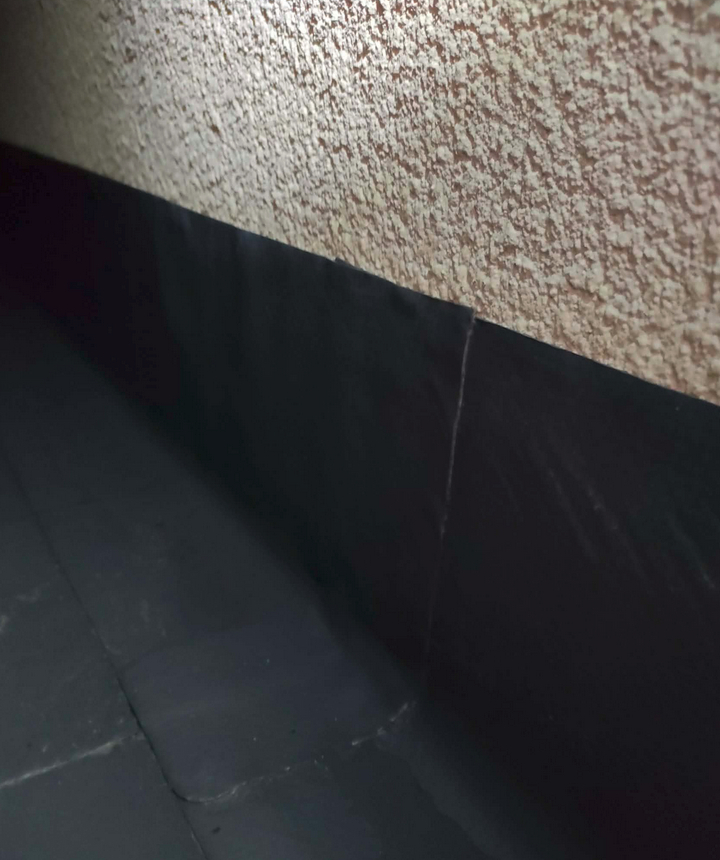
There is about 15 cm of membrane running up the wall, bonded to the wall, but it’s clearly not watertight, water just runs between the membrane and the wall.
The lead flashing will be added later, but I’m curious why the bond can’t be made watertight from the start. If silicone can be used for a temporary flashing, why not use it (or something similar) to seal the connection? Is it normal practice for the connection not to be watertight before the flashing is installed?
0 -
That is a rough textured wall finish. Rain will percolate down every wee groove and get past that membrane.
The flashing will actually be cut right in to that wall, slotted in, and sealed. It'll then overlap that membrane. Jobbie jobbed.
Yes, in this weather, it was remiss of them to not seal it, at least if the inside has been 'finished'. But if it's yet to be 'lined' inside, it's no big deal. No harm.
It'll be fine.1 -
HopelessJoe said:...There is about 15 cm of membrane running up the wall, bonded to the wall, but it’s clearly not watertight, water just runs between the membrane and the wall.
The lead flashing will be added later, but I’m curious why the bond can’t be made watertight from the start.
It can be, but this won't last long, especially for this sort of wall finish. Why spend time and materials if much more reliable flashing will be added regardless? For smooth surfaces self-adhesive flashing tape can be used, but it's less reliable and the surface needs special priming first.If silicone can be used for a temporary flashing, why not use it (or something similar) to seal the connection?Because- for this wall you need a lot of silicone
- as I said earlier, extra fixing is needed
- those who did this didn't care
Is it normal practice for the connection not to be watertight before the flashing is installed?Only for a short time without heavy rains coming. Or if there is no anything under the roof that can be damaged by the expected leaks.2



Confirm your email address to Create Threads and Reply

Categories
- All Categories
- 355.8K Banking & Borrowing
- 254.9K Reduce Debt & Boost Income
- 456.2K Spending & Discounts
- 248.3K Work, Benefits & Business
- 605.9K Mortgages, Homes & Bills
- 179K Life & Family
- 263.7K Travel & Transport
- 1.5M Hobbies & Leisure
- 16.2K Discuss & Feedback
- 37.7K Read-Only Boards