We’d like to remind Forumites to please avoid political debate on the Forum.
This is to keep it a safe and useful space for MoneySaving discussions. Threads that are – or become – political in nature may be removed in line with the Forum’s rules. Thank you for your understanding.
Plans to change what households make from solar Feed-in Tariffs 'feels a breach of pro
Comments
-
QrizB said:_Sam_ said:Out of curiosity would this affect rent-a-roof companies as while the difference in payment is small for an individual, for the companies it would be more substantial given the large numbers of solar panels they invested in.It will indeed.I'm expecting those businesses, plus the larger generators who have FIT-supported industrial systems, to make strong representations in response to this consultation.The consultation period closes on Friday.I am also hoping consumer groups and energy / poverty charities also make strong representations.As they too have been invited to participate.0
-
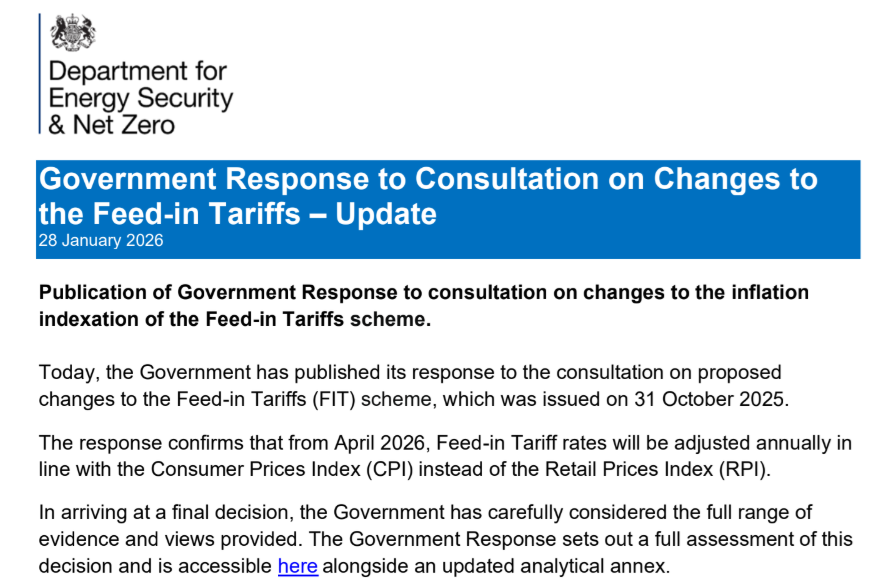
As predicted, the FiT inflation increase is being changed from RPI to CPI.
2 -
So the ludicrous upto 75p/kWh plus remains - c10x average UK wholesale rates in the autumn - allbeit at future indexing at a slightly lower rate.
For a scheme that produces little energy on many high demand - overcast, raining etc - winter days - lije yesterday when the current 21.5GW of solar on ave produced just 1.1% - 0.43GW - ave daily demand
Yet another way renewables increases our energy costs. With FIT adding another 0.7p /kWh to cap prices.
2 -
A contract is a contract, and this is still a reduction in the payments promised contractually. I know it grieves you, but how would you feel if you had a fixed rate mortgage at 2% but the bank decided it would prefer to charge you 3% - same principle. Once contracts go out the window, nothing's safe.
0 -
Supply Contracts in tbe real world are revised .
And we have our energy minister openly writing to energy suppliers to have them break fixed contracts in April.
often just 12m contracts as now bad for consumers.
Just as upto 25 year fit contracts are now proving a very bad deal for consumers.
If all other generators were making 10x market rates - would you be happy to pay far more for your import energy wh3n your solar doesnt cover your needs ?
0 -
It's not a contract according to the Government.
"A number of responses from private individuals suggested that any change to their FIT tariff would constitute a breach of contract. As set out above, the FIT scheme does not involve any contracts between the government and FIT generators. When they join the scheme, FIT generators enter into a “FIT Agreement” or “Statement of FIT Terms” with their electricity supplier. Suppliers make payments to FIT generators based on tariff rates. The means by which these rates are indexed to inflation is set out in legislation. The government is entitled to amend this legislation, subject to established parliamentary and legal processes."
1 -
Which is exactly what they have to say to justify the decision, but the ultimate arbiter is not the government but the courts of course.
0 -
Just making sure I understand, you said a contract is a contract, the government says there was no contract between generators and the Government, so are you saying the Government is being untruthful in their response to the consultation?
You say you have a contractual promise of a certain level of payments, the government say they are entitled to amend those payments.
If you have evidence of a signed contract with the government then surely you can just issue in the small claims court and produce the contract and show the promised payment level in the contract.
I assume everyone under the FIT scheme had these signed contracts issued to them?
Surely it would be a easy win to take it to court, or maybe a class action lawsuit with the 870,000 generators under the FIT scheme.
I'm sure the 40,000+ large generators would want to challenge this if they all have signed contracts with the Government.
What am I missing, why the need to write to your MP's,if you have signed contracts, why isn't everyone just issuing claims in the small claims court and producing the contracts?
1 -
Quite helpfully, the UK Government report debunks some of the more hyperblic claims that have been made in this thread and its close sibling.
Claim 1:
So the ludicrous upto 75p/kWh plus remains - c10x average UK wholesale rates in the autumn - allbeit at future indexing at a slightly lower rate.
The FIT scheme was not about generating cheap electricity; it was about promoting investment and building the UK skill base to allow cheaper solar PV in the future. A future that we are now living in and enjoying, where you can put PV on your roof for considerably less than £1/Wp.
As the report says:
The government wishes to acknowledge the important contribution made by early adopters of renewables in the development of the UK renewables sector. The collective participation of homeowners in domestic solar PV has supported driving down technology costs and normalising the deployment of rooftop solar across the UK.
Claim 2:
For a scheme that produces little energy on many high demand - overcast, raining etc - winter days - lije yesterday when the current 21.5GW of solar on ave produced just 1.1% - 0.43GW - ave daily demand
The report says:
More widely, we recognise that legacy renewables form an integral part of the UK’s generating fleet, and that a stable and predictable policy framework is critical to maintaining investment appetite across the energy sector.
PV has its place, and is never going to make a major contribution to generation in the winter months for a nation which is almost entirely north of the 50th parallel.
N. Hampshire, he/him. Octopus Intelligent Go elec & Tracker gas / Vodafone BB / iD mobile. Kirk Hill Co-op member.Ofgem cap table, Ofgem cap explainer. Economy 7 cap explainer. Gas vs E7 vs peak elec heating costs, Best kettle!
2.72kWp PV facing SSW installed Jan 2012. 11 x 247w panels, 3.6kw inverter. 35 MWh generated, long-term average 2.6 Os.1 -
Greenwashed spun platitudes from vested interests in the desnz vs real hard facts.
The key bit of it for most of us who arent investers - just consumers - being "maintaining investment appetite" - i.e. excessive energy costs to drive profits for grid and renewables operators we nearly all pay for in our bills now and for decades to come.
CfD locking in profits for as of ar7 iirc now 20 yrs - just like FiT solar 25 yrs.
and yes - to counter the post I responded to - your own view - "PV… is never going to make a major contribution to generation in the winter"
Winter demand is already c50% higher than summer - that before 24m homes convert to electric ashp etc heating from gas - is that still by 2045 - if so will it be after 2029 ?
And will be the ultimate arbiter for nuclear and gas generation we can actually rely on that will be required and of course grid tranmission capacity.
Like last Jan when for hours in early AM - 30GW of wind power and 12.5GW of grid solar capacity (total c18GW, c12.5GW grid, 5.5 domestic as of Feb 25) produced as little as 0.25GW-0.27GW actual power.
32GW and 21.5GW total solar capacity now - show the more rapid absolute - 3.5 GW vs 2 and % 19 vs 7 - rise in solar - that only makes potential grid imbalances worse - in summer generation overcapacity worse and in winter …
0







Confirm your email address to Create Threads and Reply

Categories
- All Categories
- 354.6K Banking & Borrowing
- 254.5K Reduce Debt & Boost Income
- 455.5K Spending & Discounts
- 247.5K Work, Benefits & Business
- 604.4K Mortgages, Homes & Bills
- 178.6K Life & Family
- 261.9K Travel & Transport
- 1.5M Hobbies & Leisure
- 16.1K Discuss & Feedback
- 37.7K Read-Only Boards