We’d like to remind Forumites to please avoid political debate on the Forum.
This is to keep it a safe and useful space for MoneySaving discussions. Threads that are – or become – political in nature may be removed in line with the Forum’s rules. Thank you for your understanding.
📨 Have you signed up to the Forum's new Email Digest yet? Get a selection of trending threads sent straight to your inbox daily, weekly or monthly!
The Forum now has a brand new text editor, adding a bunch of handy features to use when creating posts. Read more in our how-to guide
2nd Floor weight limit

neo1875
Posts: 5 Forumite


Hi all!
I've been doing a lot of reading around this and not found a concrete answer but I know there's a few structural engineers lurking in these forum's so hope someone can help.
I've been doing a lot of reading around this and not found a concrete answer but I know there's a few structural engineers lurking in these forum's so hope someone can help.
I live in a 1960's detached house an am looking to put a voice booth on the 2nd floor. The total weight, including myself and equipment would be 440Kg in a 1.2m squared space in the corner of the room next to external walls.
I'm mainly looking for advice / a check as to whether this would be supported or if there's a risk of the floor collapsing. I appreciate it's not possible to guarantee 100% as you'd need joist measurements etc but a rough idea would be good.
I've seen regulations about 150kg/m2 and something about 2.0kn but wondered if someone more familiar would know if 440Kg in 1.2m squared is likely to be a problem? The room itself overall is about 3m x 2.5m
Thanks in advance for any advice! I've reached out to some structural engineers but don't have much cash available to pay for a site visit / check.
I've seen regulations about 150kg/m2 and something about 2.0kn but wondered if someone more familiar would know if 440Kg in 1.2m squared is likely to be a problem? The room itself overall is about 3m x 2.5m
Thanks in advance for any advice! I've reached out to some structural engineers but don't have much cash available to pay for a site visit / check.
0
Comments
-
How was the second floor constructed?
Is it a proper loft conversion with strengthened floors, or is it just boarded over the joists ?
Or was it part of the original house build ?
Or do you actually mean the First floor ( above the ground floor) ?0 -
Thanks for the reply Albermarle.
Yes, to clarify, this is a 1st floor (one above ground), it's part of the original construction so floorboards over wooden joists. The booth manufacturer has said that many of their customers have put this booth on a 1st floor.0 -
Thanks for the reply Albermarle.Albermarle said:How was the second floor constructed?
Is it a proper loft conversion with strengthened floors, or is it just boarded over the joists ?
Or was it part of the original house build ?
Or do you actually mean the First floor ( above the ground floor) ?
Yes, to clarify, this is a 1st floor (one above ground), it's part of the original construction so floorboards over wooden joists. The booth manufacturer has said that many of their customers have put this booth on a 1st floor.0 -
neo1875 said:...
I've seen regulations about 150kg/m2 and something about 2.0kn but wondered if someone more familiar would know if 440Kg in 1.2m squared is likely to be a problem? The room itself overall is about 3m x 2.5m
Thanks in advance for any advice! I've reached out to some structural engineers but don't have much cash available to pay for a site visit / check.Unfortunately you really need to consult a structural engineer... and they will want floorboards lifted so they can inspect the structure, so you'll need a builder as well, unless you are Ok with DIYing it.Figures you'll see published are for design. If you have a new house which was signed off as being built to the design using the correct figures then you'd have some confidence (or not) that a load of the best part of half a tonne is not going to cause issues.But you've got an older house designed to uncertain standards, which may or may not be built to the design, using materials of uncertain quality. The 1960's was one of the time periods when some pretty shoddy building work was done.Furthermore, you don't know what modifications have been made since the house was built. Odds are that central heating wasn't installed at the time of build, so you have the possibility of someone making deep notches in the joists to get the heating pipes in. Or other, possibly more alarming, alterations.Although the floor collapsing under the load would be an obvious concern, you should also bear in mind that there will likely be structural movement at much lower loads - for example, if the joists flex under load you may find the ground-floor ceiling developing superficial cracks. Although these probably aren't likely to be serious, a sharp-eyed surveyor may notice them when you come to sell and start your buyers off worrying about subsidence.0 -
Structural Engineer here, agreeing with Section62. That's more than double the standard loading allowance, as you have noted (and the loading was very similar back when it was built, albeit in lb/ft2). No way to tell that the floor/ structure overall would be ok without measuring up the floor construction and condition and doing calculations. It *might* be ok but I wouldn't count on it.0
-
Appreciate the replies everyone. It's so confusing when the manufacturer (and other customers I've found directly) have said they have the same booth with no issues on a 1st floor. I should point out as well that 90% of the time the weight will only be 340Kg, it only goes up to 435Kg when I'm in it recording which won't be a lot.
I've contacted some structural engineers but the quotes so far have been over £1200 to come and check unfortunately. Going to take some carpet up today to see the floorboards and deduce which way the joists are going but the booth should be sitting on a minimum of 2 joists and within 6 inches of where these joists meet external wall structures / support.0 -
I am not an expert and have no knowledge of sound booths but given the complications and questions around the floor support, is a proper sound booth necessary? Is DIY an option?
If so, would MDFs or plywood along with sound foams suffice (and possibly lighter)?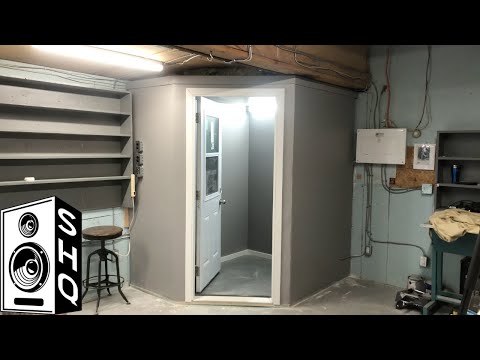 https://www.youtube.com/watch?v=7BzYvULaoyk 0
 -
DIY booths are an option but not really for professional voice actors unfortunately, they just don't provide the necessary dB reduction to ensure you can record at all times of the day no matter the external noise.1
-
It is definitely a sensible idea to obtain professional advice as every house is different and nobody can tell you the capacity of your floor accurately without seeing it. That said, given that you'd be installing this close to where the joists are supported it seems more likely than not that the answer you get from a structural engineer will be the one you're hoping for.
AIUI the design of floor joists is more often than not governed by bending, and specifically by the need to limit deflection so brittle finishes (plasterboard etc) don't crack. These issues depend strongly on the location of a load along the span of the joists.
0 -
Ah interesting, good to know, thanks for the clarification!neo1875 said:DIY booths are an option but not really for professional voice actors unfortunately, they just don't provide the necessary dB reduction to ensure you can record at all times of the day no matter the external noise.0







Confirm your email address to Create Threads and Reply

Categories
- All Categories
- 354.6K Banking & Borrowing
- 254.5K Reduce Debt & Boost Income
- 455.5K Spending & Discounts
- 247.5K Work, Benefits & Business
- 604.4K Mortgages, Homes & Bills
- 178.6K Life & Family
- 262K Travel & Transport
- 1.5M Hobbies & Leisure
- 16.1K Discuss & Feedback
- 37.7K Read-Only Boards