We’d like to remind Forumites to please avoid political debate on the Forum.
This is to keep it a safe and useful space for MoneySaving discussions. Threads that are – or become – political in nature may be removed in line with the Forum’s rules. Thank you for your understanding.
📨 Have you signed up to the Forum's new Email Digest yet? Get a selection of trending threads sent straight to your inbox daily, weekly or monthly!
Worth the upgrade
Comments
-
Thanks... will get it one ordered .. If you dont mind any ideas on the what type of memory is needed,vacheron said:
Yes, this would work, but this drive was introduced in 2018 so a used one from CEX could have 7 years under its belt by now.sidneyyoungblood said:
Thanks ... will this do the job ? Will try and pick it up tommorow and install over the weekend. I got so frustrated with the NVME would rather just try and install another one.vacheron said:
Fitting a SATA SSDsidneyyoungblood said:
Thanks for all the comments , yes it lacks TMP 2.0 support which is why I cant get windows 11 to install,vacheron said:I would second that the specs are fine. An 8th Gen I5 processor should not be taking an age to do anything. I recently upgraded from a 6th gen I7-6700K , but only because the motherboard failed, and my mum uses a 3rd gen I5-3570K, and after a fresh windows 10 install it boots in about 12 seconds from her SATA SSD and runs everything almost instantly.
You mentioned that you were "planning" to add an NVME drive, if he currently uses a spinny disk rather than a SATA SSD, then I would put money on that being the bottleneck! But for video editing another 8gb of RAM wouldn't go amiss and could probably be picked up quite cheap.
A 4GB 1050TI GPU will handle widescreen (or even ultrawide) without a problem, but his games will struggle more if he tries to game at this new native resolution.
I will order a 2.5" SSD to replace the 1TB as a main drive using the same slot - will 256gb be enough?.Also would I need to order a power cable and a tray to hold the SSD ?
I did install a Nvme but cannot get the Bios to run from it as it keeps going back to the original drive ( it cant see it but is seen in windows) .
thanks again
If you are adding the SSD in addition to the 1TB drive you would need an additional SATA power cable, but there should usually be spare SATA power cables already in the PC.
You would also need a SATA Data cable which probably won't be included, and make sure you have a spare SATA port on the motherboard too.
You could buy a bracket to fit the SSD, but these things aren't orientation dependent and virtually impervious to shock or vibration, so you could basically stick it anywhere inside the case with some sticky tape if you wanted. Also, some cases have little places on the rear of the motherboard tray, or base of the PC, where you can fit a 2.5" SSD.
Getting the NVME drive to work:
However, your NVME drive should be working. Did you use the migration tools which came with the NVME drive to migrate the data / operating system over to it?
If you did.... and the original drive did not use UEFI, you may need to enable "Legacy Boot Mode" in the BIOS to allow the PC to recognise the NVME as a bootable device.
You can then convert the Legacy Boot NVME to UEFI later using a couple of simple windows commands.
Also, do you have the boot order set corrrectly in the BIOS so that it will try to boot from the NVME before the original HDD?
Getting the NVME to recognise first would save you having to buy a SATA SSD, but if not, the jump in performance in changing your boot drive from SATA "Spinning Rust" to a SATA SSD is far greater than the jump in (real worrld) performance from a SATA SSD to NVME.
Kingston A400 SA400S37/240G 240GB 2.5" SATA SSD - CeX (UK): - Buy, Sell, Donate
Especially considering you can get a new one for just a fiver more with a warranty.0 -
Almost certainly DDR4 on an 8th Gen board, I’d guess about 2000-3000 MHz. Best to pull a stick out and it’ll be written on the sticker on it.• The rich buy assets.
• The poor only have expenses.
• The middle class buy liabilities they think are assets.0 -
It seems the OP has selective blindness

Let's try again. The device IS on the Windows 11 upgrade list. It HAS TPM 2.0 support and it CAN recognise an NVMe.
RAM here: https://uk.webuy.com/product-detail?id=SMEM8G26661
Reset the BIOS to defaults and try again.0 -
I noticed you referenced laptop memory in your link and a laptop model number when you quoted TPM 2.0 compatibility.BFBW said:It seems the OP has selective blindness
Let's try again. The device IS on the Windows 11 upgrade list. It HAS TPM 2.0 support and it CAN recognise an NVMe.
RAM here: https://uk.webuy.com/product-detail?id=SMEM8G26661
Reset the BIOS to defaults and try again.
Are you sure that the OP has a laptop as the Legion T530 desktop also came with the same specification, and the OP refers to the PC as a “desktop” in their first post.
• The rich buy assets.
• The poor only have expenses.
• The middle class buy liabilities they think are assets.1 -
vacheron said:
I noticed you referenced laptop memory in your link and a laptop model number when you quoted TPM 2.0 compatibility.BFBW said:It seems the OP has selective blindness
Let's try again. The device IS on the Windows 11 upgrade list. It HAS TPM 2.0 support and it CAN recognise an NVMe.
RAM here: https://uk.webuy.com/product-detail?id=SMEM8G26661
Reset the BIOS to defaults and try again.
Are you sure that the OP has a laptop as the Legion T530 desktop also came with the same specification, and the OP refers to the PC as a “desktop” in their first post.
You are correct in that I saw it was a desktop, but in between posts, forgot. But that doesn't actually change the advice, other than the link to the RAM.
With reference to the Legion T530-28APR/Legion T530-28ICB, the device IS on the Windows 11 upgrade list. It HAS TPM 2.0 support and it CAN recognise an NVMe.
Lenovo devices supported for upgrade to Windows 11 - Lenovo Support US
RAM here: https://uk.webuy.com/product-detail?id=SMEM8G2666
Reset the BIOS to defaults and try again.0 -
The NVMe issue might be due to the device being set up for Optane usage.
If this is the case:To replace the Optane drive in your Lenovo Legion T530 with a new NVMe drive, you must first disable Optane in the Intel RST software or BIOS, then remove the Optane module and install the new NVMe drive. After reassembly, you'll need to reinstall Windows or clone your drive, and set the SATA mode to AHCI in the BIOS to ensure your new NVMe drive is recognized correctly.Step 1: Disable Intel Optane and Prepare for InstallationDisable Optane: In Windows, use the Intel Optane Memory and Storage Management application to disable the Optane cache. You may also need to go into the BIOS and disable the Optane memory volume directly, sometimes found under the Intel RST section, and "reset" or "deconcatenate" it.Uninstall the Optane application: After disabling Optane, uninstall the Optane application from Windows, but do not uninstall the drive itself.Reboot: Restart your computer to apply the changes.Step 2: Install the New NVMe DrivePower off: Shut down the computer and unplug the power cord. For a desktop, turn off the power supply switch.Open the case: Open the computer case by removing the screws on the back. Keep track of screw lengths, as they may be different.Locate the Optane drive: Find the existing Optane module, which is a small M.2 drive. Remove the securing screw and gently pull the module out.Install the new NVMe drive: Insert the new NVMe drive into the M.2 slot at an angle, then push it down and secure it with the screw.Step 3: Reconfigure BIOS and Reinstall WindowsChange SATA mode to AHCI: Turn the computer back on and enter the BIOS (usually by pressing F2 or F10). Change the SATA mode from "Intel RST Premium" (or similar) to AHCI.Save and exit: Save your changes in the BIOS and exit. The computer may restart again.Reinstall Windows: If you have not already, you will need to reinstall Windows on the new NVMe drive. You can do this by booting from a Windows installation USB drive.Clone your drive (alternative): You can also clone your existing hard drive or Optane drive to the new NVMe drive using cloning software before reconfiguring the BIOS.Step 4: FinalizeReplace the case: Once Windows is installed and running from the new NVMe drive, you can reassemble the computer case.Verify the new drive: After booting into Windows, verify that the new NVMe drive is recognized in File Explorer and the BIOS. It should appear as a standard storage device.1 -
The 2.5" SSD would be a straight swap. No cables nor trays necessary unless you wish to keep the HDD connected. Then you might need an extra SATA cable. SSD don't need to be fixed, as there are no moving parts within.sidneyyoungblood said:
Thanks for all the comments , yes it lacks TMP 2.0 support which is why I cant get windows 11 to install,vacheron said:I would second that the specs are fine. An 8th Gen I5 processor should not be taking an age to do anything. I recently upgraded from a 6th gen I7-6700K , but only because the motherboard failed, and my mum uses a 3rd gen I5-3570K, and after a fresh windows 10 install it boots in about 12 seconds from her SATA SSD and runs everything almost instantly.
You mentioned that you were "planning" to add an NVME drive, if he currently uses a spinny disk rather than a SATA SSD, then I would put money on that being the bottleneck! But for video editing another 8gb of RAM wouldn't go amiss and could probably be picked up quite cheap.
A 4GB 1050TI GPU will handle widescreen (or even ultrawide) without a problem, but his games will struggle more if he tries to game at this new native resolution.
I will order a 2.5" SSD to replace the 1TB as a main drive using the same slot - will 256gb be enough?.Also would I need to order a power cable and a tray to hold the SSD ?
I did install a Nvme but cannot get the Bios to run from it as it keeps going back to the original drive ( it cant see it but is seen in windows) .
thanks again
But investigate the NVMe issue firstly. Some advice in the posts above. Make sure you are connecting the drive to slot 12, rather than 14. Set the BIOS to defaults.
What is the exact model of NVMe drive?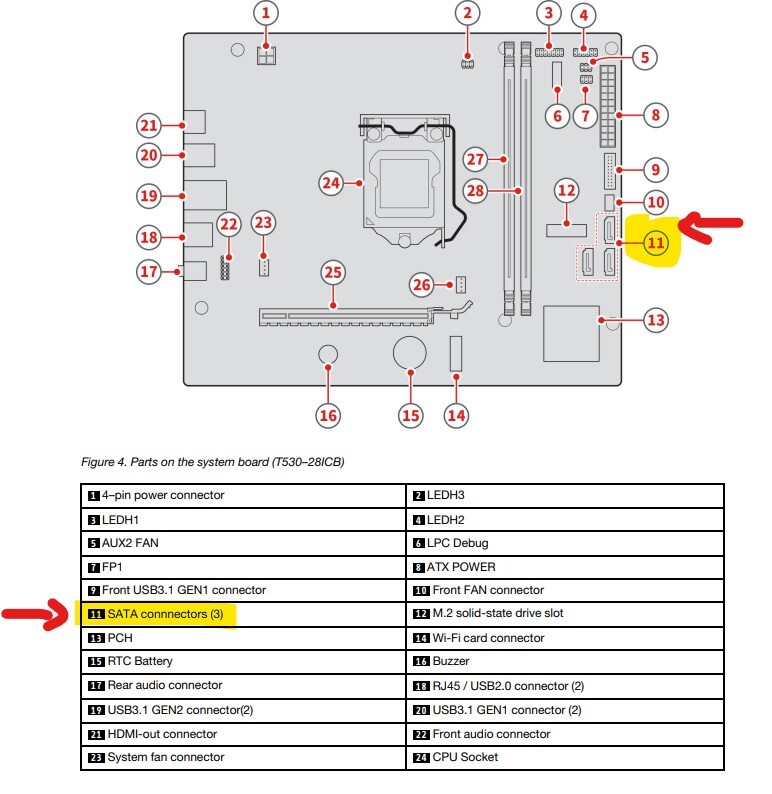
The output resolution of the graphics card:
4096x2160@60Hz(HDMI), 7680x4320@60Hz(DP), 2560x1600@60Hz(DVI)
1 -
As others have said nothing wrong with that spec, although the 8GB of ram might be a factor.
If you are installing Win10 or Win11 you have created latency to the Cloud, I see this all over the place.
With the help of family members I am dumping Windows on my media PC, I installed it with a local account so it is less hooked to the cloud. They are going to install Linux, either Mint or Ubuntu, I might have a VM of windows on it but unlikely. It has a far lower spec than the one you are asking about.
The SSD will make a big difference, the first thing to figure out is how the firmware sees that SSD and whether it can make it the primary drive, although if you use 3rd party tools you can make the SSD the primary boot device, perhaps after cloning your Windows boot partition from the standard hard disk. I can't remember the names but there are some firmware things that lock these to avoid you being a victim of malware. I think you need to unlock that, do your config changes, then put it back on.
1 -
Thanks for all the Advice .. It is a desktop and is not compatible due to the TMP issue ( when I try to install windows 11 I get the message ) and was confirmed by Lenovo ..
Tried the advice on the Nvme and could not get it to work so bought a SSD which hopefully cant installed this weekend.
Would this be suitable for the memory
Kingston 8GB 1X8GB DDR4 2666MHZ 1.2V desktop ram memory KVR26N19S8/8 | eBay UK
Thanks again
0 -
To prevent any further confusion, please state the exact model number of the Desktop. TPM 2.0 is not an impediment to installing Windows 11. It's not needed in Windows 10 nor 11.sidneyyoungblood said:Thanks for all the Advice .. It is a desktop and is not compatible due to the TMP issue ( when I try to install windows 11 I get the message ) and was confirmed by Lenovo ..
Tried the advice on the Nvme and could not get it to work so bought a SSD which hopefully cant installed this weekend.
Would this be suitable for the memory
Kingston 8GB 1X8GB DDR4 2666MHZ 1.2V desktop ram memory KVR26N19S8/8 | eBay UK
Thanks again0









Confirm your email address to Create Threads and Reply

Categories
- All Categories
- 355.8K Banking & Borrowing
- 254.9K Reduce Debt & Boost Income
- 456.2K Spending & Discounts
- 248.3K Work, Benefits & Business
- 605.9K Mortgages, Homes & Bills
- 179K Life & Family
- 263.8K Travel & Transport
- 1.5M Hobbies & Leisure
- 16.2K Discuss & Feedback
- 37.7K Read-Only Boards