We’d like to remind Forumites to please avoid political debate on the Forum.
This is to keep it a safe and useful space for MoneySaving discussions. Threads that are – or become – political in nature may be removed in line with the Forum’s rules. Thank you for your understanding.
📨 Have you signed up to the Forum's new Email Digest yet? Get a selection of trending threads sent straight to your inbox daily, weekly or monthly!
Vanguard Equity Income or Royal London Sterling Extra Yield Bond?





Comments
-
If those were the only funds available and the income was the primary objective, I would invest in both. They are very different funds with very different classes of underlying holdings. Investing in both gives you a much greater level of diversification, an important factor for income investors.
If income is the objective the price performance graph is relatively unimportant. As long as the income keeps coming in why should you care about price volatility?
0 -
Linton said:
If... income was the primary objective...It's primary but it's not critical. I have enough assets not to think about squeezing every bit of yield for day-to-day living, but I am reorganising our assets for retirement using your very intuitive income portfolio + growth portfolio process (for which I am very grateful). The RL fund has been steady over many years and, if you want less volatility and a more predictable trajectory over the next 5-10 years, you would go there over equity income... all the more so given how the equity fund has outperformed during recent years (interestingly, this equity income index fund has outperformed its sector recently, but that's another story).
Naturally they are not, but having weaned myself off actively managed equity funds during the last couple of years I do not want to jump back into them. I could go for an IT like CTY for its dividend reserves, but on a total return basis it often underperforms an equity income index fund and, as I said above, I do not need to squeeze every pip of yield. The RL fund provides a like-for-like alternative to the Vanguard fund, so far as bonds and equities can be compared. I am overweight in bond funds (too many Howards Marks videos...), already holding Man Dynamic Income and Man Sterling Corporate Bond, and currently moving some of my gilt/aggregate bond fund money into Artemis Short-Duration Strategic Bond. The RL fund seems reasonably well diversified when sitting alongside them.Linton said:
If those were the only funds available...0 -
tbh I find the concept of having a separate income portfolio when you arent that bothered about taking income somewhat strange. The separate portfolio concept is intended to deal with multiple incompatible objectives. Surely in your case it could be better to define what you do want in terms of specific objectives and then focus on on creating the simplest portfolio(s) that satisfies them.aroominyork said:Linton said:
If... income was the primary objective...It's primary but it's not critical. I have enough assets not to think about squeezing every bit of yield for day-to-day living, but I am reorganising our assets for retirement using your very intuitive income portfolio + growth portfolio process (for which I am very grateful). The RL fund has been steady over many years and, if you want less volatility and a more predictable trajectory over the next 5-10 years, you would go there over equity income... all the more so given how the equity fund has outperformed during recent years (interestingly, this equity income index fund has outperformed its sector recently, but that's another story).
Naturally they are not, but having weaned myself off actively managed equity funds during the last couple of years I do not want to jump back into them. I could go for an IT like CTY for its dividend reserves, but on a total return basis it often underperforms an equity income index fund and, as I said above, I do not need to squeeze every pip of yield. The RL fund provides a like-for-like alternative to the Vanguard fund, so far as bonds and equities can be compared. I am overweight in bond funds (too many Howards Marks videos...), already holding Man Dynamic Income and Man Sterling Corporate Bond, and currently moving some of my gilt/aggregate bond fund money into Artemis Short-Duration Strategic Bond. The RL fund seems reasonably well diversified when sitting alongside them.Linton said:
If those were the only funds available...
I cant see an obvious objective or portfolio allocation problem for which a bond fund and a 100% equity fund are both appropriate solutions.
In my view it is a mistake to analyse each fund on its own individual merits. Better to look at the portfolio as a whole, decide where the gaps are and fill those. Otherwise just buy more of what you already hold. To this end I use a spreadsheet to combine the individual fund data from Morningstar to provide an overall picture of the portfolio. Omissions and excess allocations are then easy to spot.1 -
I didn’t say I am not bothered about taking income, but that we have enough assets not to need the certainty of knowing to the nearest thousand or two exactly where our income will come from. I used to wonder why people focused on income rather than total return, but now I see it is to avoid selling units during a downturn (and the neatness of natural yield), hence wanting a defined set of income-generating assets. I am very conscious of diversification across both portfolios and have kept it pretty simple:
- for a couple of regions (UK, EM) I am swapping equity index funds for income-generating funds (Vanguard for UK, DEM for half my EM), and my existing spreadsheet keeps an eye on geographic and market cap allocations across the piece.
- moving some gilt/aggregate bond funds into the Artemis fund, and maybe in future moving the rest of the gilt index fund from Acc to Inc (we have some cash to run down so I do not want too much income during the first year or so).
- I would have moved the Man bond funds from Acc to Inc, but Dynamic Income was recently closed and I missed the boat; Sterling Corporate Bond pays income monthly (I’d prefer quarterly at most) so I’ll leave that for now.
- Buying 4 x two year savings bonds, six months apart, to use up my starter savings rate (£5k + £1k) and, when each one matures, decide whether to reinvest or hold the cash.
The growth portfolio is a fallback, hopefully largely for the next generation.
The Vanguard/RL issue is about the best yielding/higher risk assets for income from the UK component of the income portfolio. Of course I recognise they are very different assets, but in their historic performance not so much chalk and cheese as, perhaps, yoghurt and cheese (apologies for that metaphor!).
0 -
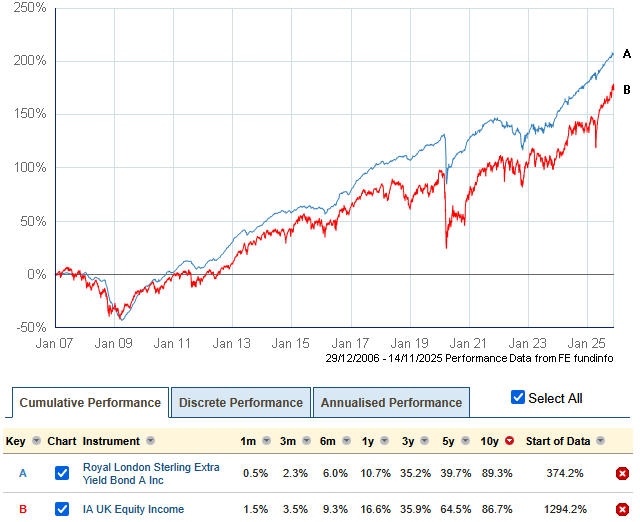
It is a shame that the Vanguard fund was only launched in 2009, as the comparison misses 2007-2008 where the RL fund fell over 40%, which I think would be more than a typical UK equity income fund. The loss potential between the two is probably quite similar, with different crashes being more wounding for one or the other.A reason to favour the RL fund is that dividends can be cut quite readily in a downturn. Which is where ITs come into their own.0
-
I wouldn’t go as far as saying the two funds have performed similarly. They move in similar directions, but the equity income with more volatility and larger returns over the long-term."If you aren’t willing to own a stock for ten years, don’t even think about owning it for ten minutes” Warren Buffett
Save £12k in 2025 - #024 £1,450 / £15,000 (9%)0 -
masonic said:It is a shame that the Vanguard fund was only launched in 2009, as the comparison misses 2007-2008 where the RL fund fell over 40%, which I think would be more than a typical UK equity income fund. The loss potential between the two is probably quite similar, with different crashes being more wounding for one or the other.But we can look at the sector and it performed pretty similarly in 2007-08.
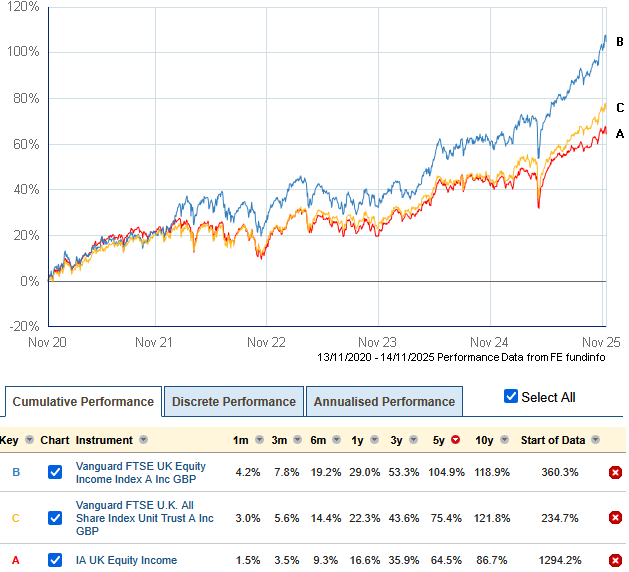
 As impressive as the RL fund is, and with a manager who's been at the game for some 30 years, I think I'll stick with the equity fund. I am already overweight in corporate bonds, having 20% of assets in the two Man bond funds and now adding the Artemis fund. To add more bonds while reducing my UK equity holding to just a couple of % of my equities (those in my global index fund) runs counter to my approach of not doing anything I could blame myself for if it went wrong.My only nervousness is that the equity income index fund has had a good few years, not only outperforming the All Companies index but also its sector. I am not so worried about the sector (underperformance by actively managed funds?) but more about whether non-income/growth funds are due a good run. Given the way the economy is performing, however, maybe that's not something to worry about too much...
 0
0 -
aroominyork said:masonic said:It is a shame that the Vanguard fund was only launched in 2009, as the comparison misses 2007-2008 where the RL fund fell over 40%, which I think would be more than a typical UK equity income fund. The loss potential between the two is probably quite similar, with different crashes being more wounding for one or the other.But we can look at the sector and it performed pretty similarly in 2007-08.But the sector isn't the index, and in this case arguably it isn't even the sector. Many of the popular UK equity income funds of the day belong to the IA UK All Companies sector for some strange reason, and some of the funds within the small remaining Equity Income sector look a bit unusual.Given the lack of an appropriate index fund, I just took a gander at good old Invesco Perpetual [High] Income, which now seem to be Invesco Equity [High] Income (UK), since Woodford mania was still in full sweep back then. Even I held it
 Although I don't recall him getting as much praise for navigating the GFC as he did the Dotcom crash - it was a period he came under some criticism IIRC. But peak to trough his funds fell a little over 30% to RL's just over 40%.I suspect an index tracker wouldn't have fallen any more as the tendency is for them to be lower beta than their peer group.
If it help assuage your nervousness, I could say something about credit spreads having the potential to widen significantly as soon as sentiment turns in the credit markets.aroominyork said:As impressive as the RL fund is, and with a manager who's been at the game for some 30 years, I think I'll stick with the equity fund. I am already overweight in corporate bonds, having 20% of assets in the two Man bond funds and now adding the Artemis fund. To add more bonds while reducing my UK equity holding to just a couple of % of my equities (those in my global index fund) runs counter to my approach of not doing anything I could blame myself for if it went wrong.My only nervousness is that the equity income index fund has had a good few years, not only outperforming the All Companies index but also its sector. I am not so worried about the sector (underperformance by actively managed funds?) but more about whether non-income/growth funds are due a good run. Given the way the economy is performing, however, maybe that's not something to worry about too much...0 -
I read something recently about the likelihood of credit spreads remaining tighter than in the past (yes, I know, like 0.5% base rates were going to be the new normal...). If I can track it down I'll post it.0
-
This is the article - Howard Marks. https://www.oaktreecapital.com/insights/memo/gimme-creditPS If spreads widen, presumably the impact on bond prices would be the same as with interest rate changes, ie fund prices falling c.1% for each percent of widened spread. For a high yield fund with duration of about four years that would not be drastic, and often worse than missing out on gains while waiting for the spread to widen.1




Confirm your email address to Create Threads and Reply

Categories
- All Categories
- 355.8K Banking & Borrowing
- 254.9K Reduce Debt & Boost Income
- 456.2K Spending & Discounts
- 248.3K Work, Benefits & Business
- 605.9K Mortgages, Homes & Bills
- 179K Life & Family
- 263.8K Travel & Transport
- 1.5M Hobbies & Leisure
- 16.2K Discuss & Feedback
- 37.7K Read-Only Boards