We’d like to remind Forumites to please avoid political debate on the Forum.
This is to keep it a safe and useful space for MoneySaving discussions. Threads that are – or become – political in nature may be removed in line with the Forum’s rules. Thank you for your understanding.
📨 Have you signed up to the Forum's new Email Digest yet? Get a selection of trending threads sent straight to your inbox daily, weekly or monthly!
Central Heating Boiler or System
Comments
-
Impossible to diagnose without seeing, but the following may be worth noting.
1. If there are no problems with hot water (and you are not using an immersion heater) , then most likely the boiler is working properly.
2. It would appear the heating not working is intermittent. To me this suggests a component which is occasionally but not always faulty.
3. First suspect would be the central heating motorised valve. It will be the one NOT directly connected to the hot water cylinder, most likely the one on the right in your 4th picture. The way these motorised valves work, is as follows:
3.1 If the programmer is in an "ON" period, the programmer applies a voltage to the central heating room thermostat.
3.2 If the room with the room thermostat in is below the temperature required by that thermostat, it applies a voltage to the motorised valve.
3.3 The motorised valve motor rotates to open the valve. As it reaches the end of its travel, it operates a microswitch inside the valve which applies a voltage to the boiler. If the microswitch isn't activated, the boiler won't fire.
3.4 Provided the boiler is ready, when the voltage is applied it fires, starts the pump, and sends hot water to the heating circuit.
4. Second suspect would be the pump. Seems to work for hot water, so possibly weak, rather than blocked. If the pump is not circulating the water fast enough, the water returning to the boiler will be hotter than it should be, and the boiler may stop firing. However, this normally gives an error message on the boiler.
5. Third suspect would be the room thermostat. Could be faulty and think the room is alreasy warm enough. Or could have been set too low.
6. Fourth suspect would be the programmer. It may not be sending the signal to the room thermostat.
7. A final possibility is a blockage in the pipework between the feed and expansion tank (small tank in loft) and the system. Lack of replenishing water can cause the boiler to over heat, but again there is normally an error message.
Working out which (if any) of the above is the problem takes time, a multimeter and a careful approach. Given that the voltages referenced above are generally mains voltages, then unless you have the equipment, the skill and know what you are doing with electricity, the job is probably best left to a professional. Perhaps worth asking neighbours / work colleagues for recommendations and looking for an independent rather than someone working for a big company.
3 -
Thanks, NFLO - you saved me a lot of typing
 0
0 -
Coldguy, are you going to help us to help you?1) Could you explain what, as exactly as you can, each of the cowboys did? Hopefully we can eliminate their checks.2) Can you confirm that the orange arrow here points to a pressure gauge?
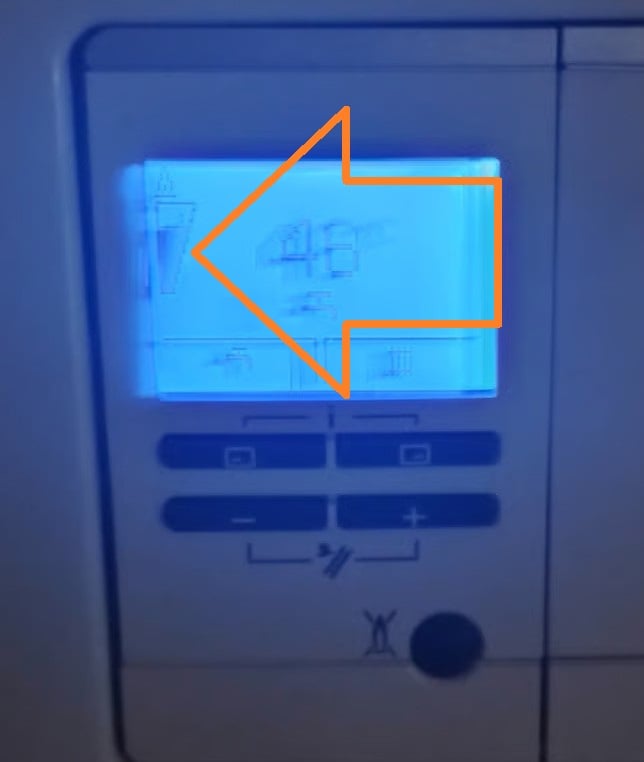 If so, that suggests it isn't a vented system, but a sealed, pressurised 'system' boiler. That in turn makes an airlock unlikely.3) Who carried out the powerflush? What was involved in this? Did they have any reason to do this 'flush other than they were otherwise scratching their heads? Did they check the filter that NFLO mentioned?There are some tests you can carry out, but it would really help to have answers to the above first. For your info, these are some of the important parts of your system:
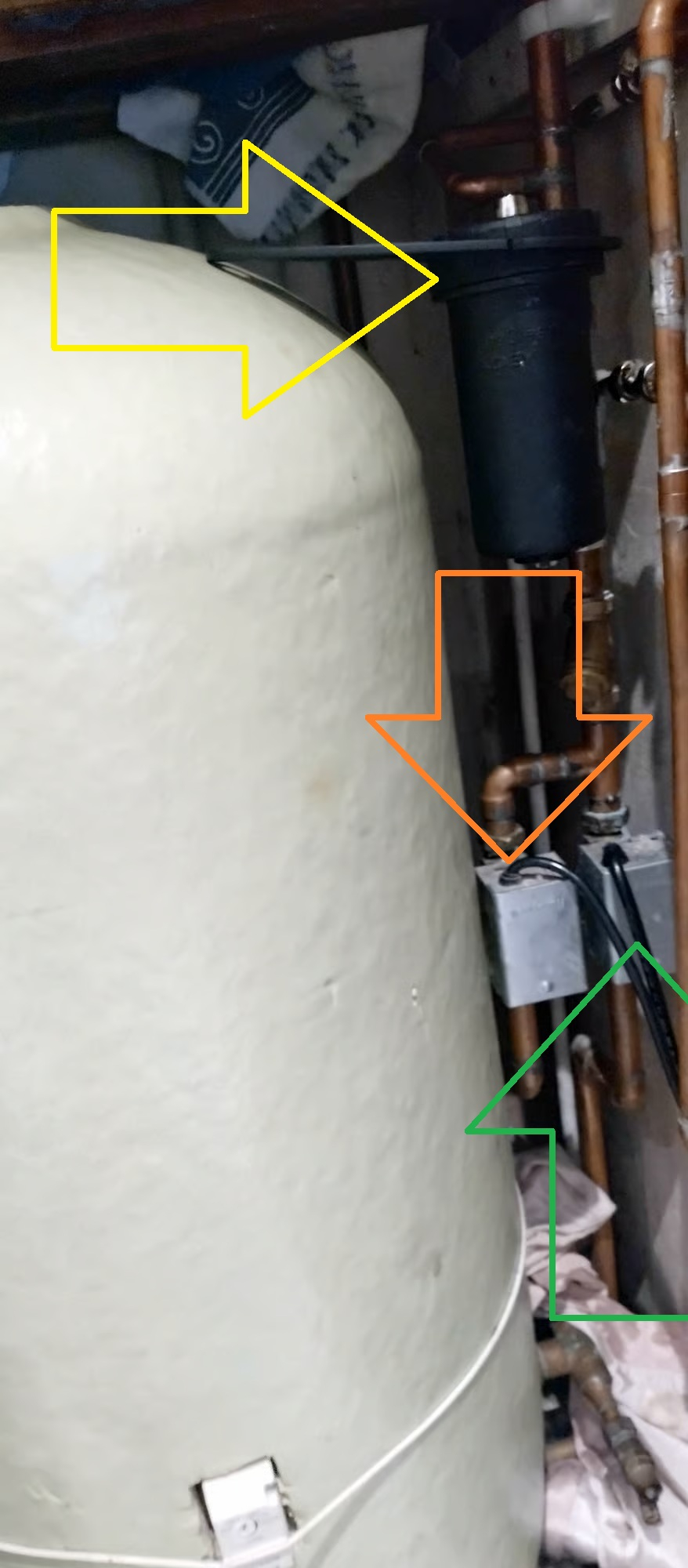 The yellow arrow points to the magnetic filter mentioned by NFLO. This is a DIY job to check, but you need to know the steps. There is already a spanner on the lid for this, but don't open it until you look up what the process is. The state of the filter should give a good indication of the state of your system - one of the first things they should have checked.The green and orange arrows point to motorised valves, the orange - I think - heading to the side of the cylinder in order to heat it up. The green will therefore be for the CH.When you turn on the boiler for, say, DHW, the required motor should whirrr for a few seconds whilst the valve opens, usually finishing with an audible 'click', and then the boiler fires up. When you turn off the DHW demand, the boiler should turn off, and the motor should whirrr back to its previous position. The CH valve does the same when you call for CH. That's a basic test.If you feel the copper pipes at their tops, you should feel the hot water coming through a few seconds after the boiler fires up. And then feel it coming out the valve bottom, and off to wherever the pipes lead.The filter should be on the return pipe to the boiler, but I cannot tell from that picture. If so, then, with the boiler set to provide DHW, the valve should open, the valve's supply pipe begin to heat up after a few seconds (as I said before), and should become quite hot after a minute or so. The 'return' pipe - the one going to the filter - should begin to feel warm as well, but will always lag well behind the supply one, and only become 'hot' when the cylinder is also pretty warmed up.Ditto with your CH - the supply pipe to the valve should become warm very quickly, and pretty hot after a minute or so, but the return pipe - the filter - should feel pretty cool for quite a while, since the radiators are pinching the heat. It'll feel 'warm', then medium after a half hour or so, but never be as hot as the supply pipe.These are tests you can carry out. If you could try this, and report back on what actually happens, that would really help.
0 -
Not the OP, but a Vaillant owner.
For question 2) the orange arrow points to the burner indicator. The filling pressure is displayed on the right and is not present in the picture2 -
GlitterMedusa said:Not the OP, but a Vaillant owner.
For question 2) the orange arrow points to the burner indicator. The filling pressure is displayed on the right and is not present in the pictureThank you.I did see that on the display examples on Google, but assumed the OP's was perhaps an earlier model with the 'bar' on the other side.I know the 'fire' symbol above the bars represents the boiler firing, so are you saying the bars underneath indicate how much flame is on? Ie, how much the boiler is 'modulating'?Cheers.
0 -
It does on mine (3 year old ecoTec plus, system boiler with separate hot water tank) but I don't know if it's the same for the OP's boilerWIAWSNB said:I know the 'fire' symbol above the bars represents the boiler firing, so are you saying the bars underneath indicate how much flame is on? Ie, how much the boiler is 'modulating'?Cheers.
Just for reference, this is a photo of my display showing the pressure on the right (1.4), I haven't go the heating or hot water on right now so there's nothing on the left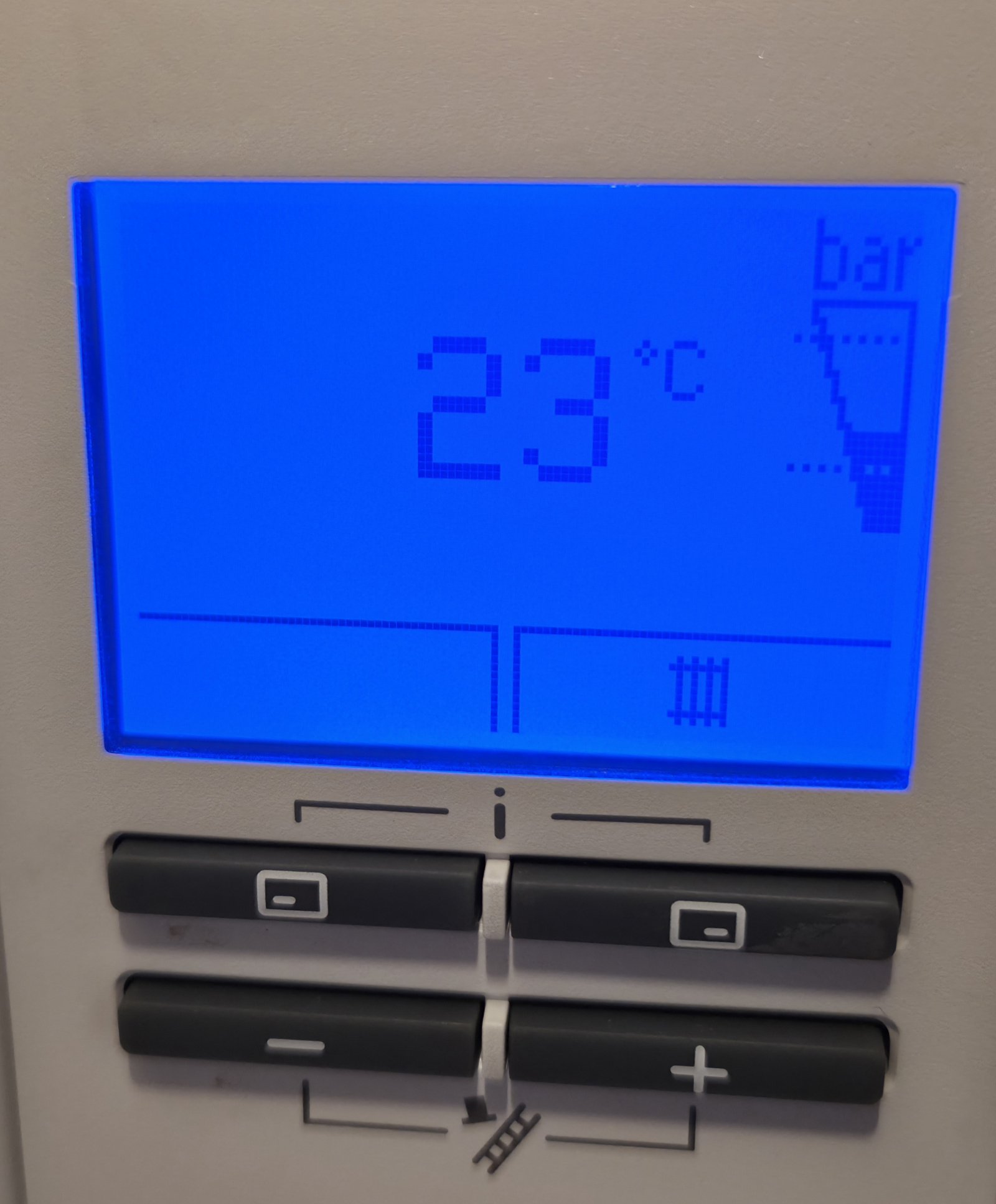 1
1 -
GlitterMedusa said:
It does on mine (3 year old ecoTec plus, system boiler with separate hot water tank) but I don't know if it's the same for the OP's boilerWIAWSNB said:I know the 'fire' symbol above the bars represents the boiler firing, so are you saying the bars underneath indicate how much flame is on? Ie, how much the boiler is 'modulating'?Cheers.
Just for reference, this is a photo of my display showing the pressure on the right (1.4), I haven't go the heating or hot water on right now so there's nothing on the leftBrilliant! Thank you.I didn't expect that :-)I'm impressed - so the display shows how much the boiler is firing at any time. Cooool.So Coldguy might have been right when he said it was an unpressurised system. Ooops...1







Confirm your email address to Create Threads and Reply

Categories
- All Categories
- 355.6K Banking & Borrowing
- 254.8K Reduce Debt & Boost Income
- 456.1K Spending & Discounts
- 248.2K Work, Benefits & Business
- 605.7K Mortgages, Homes & Bills
- 179K Life & Family
- 263.5K Travel & Transport
- 1.5M Hobbies & Leisure
- 16.1K Discuss & Feedback
- 37.7K Read-Only Boards