We’d like to remind Forumites to please avoid political debate on the Forum.
This is to keep it a safe and useful space for MoneySaving discussions. Threads that are – or become – political in nature may be removed in line with the Forum’s rules. Thank you for your understanding.
Advice needed private parking ticket – mediation appointment (Euro Parking / Gladstones Solicitors)



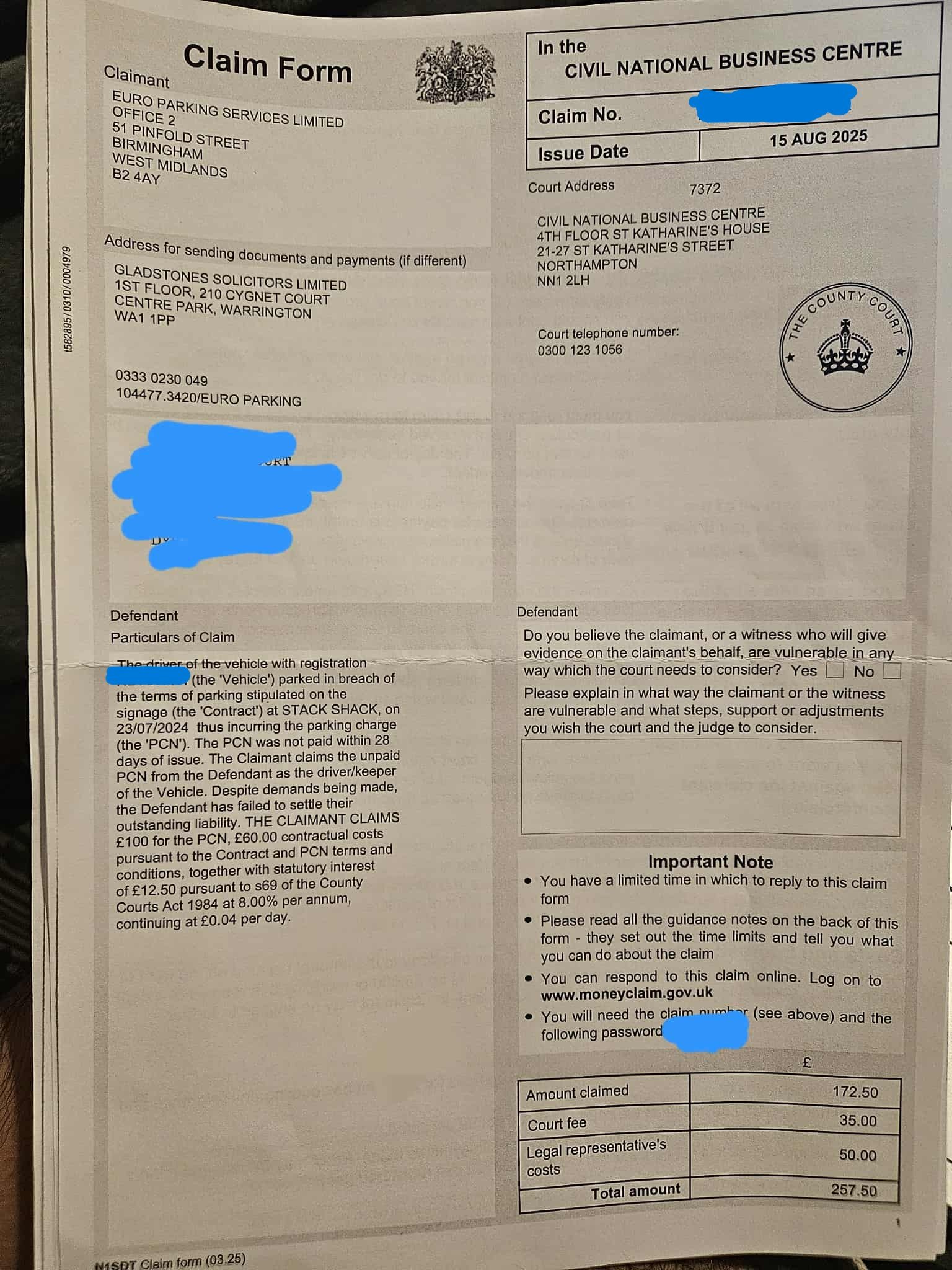
I did park in that parking for a short period of time, while I was trying to find the resturant which is changed now.
My submitted defence was
"1. The Defendant denies the claim in its entirety. The Defendant
3. The Defendant is unable to plead properly to the PoC because: (a) The contract referred to is not detailed or attached to the PoC in accordance with CPR PD 16.7.3(1); (b) The PoC do not state the exact wording of the clause (or clauses) of the terms and conditions of the contract (or contracts) which is/are relied on the claimant asserts the defendant has breached the contract (or contracts) (d) The PoC do not state with sufficient particularity exactly where the breach occurred, the exact time when the breach occurred and how long it is alleged that the vehicle was parked before the parking charge was allegedly incurred; (e) The PoC do not state precisely how the sum claimed is calculated, including the basis for any statutory interest, damages, or other charges; (f) The PoC do not state what proportion of the claim is the parking charge and what proportion is damages; (g) The PoC do not provide clarity on whether the Defendant is sued as the driver or the keeper of the vehicle, as the claimant cannot plead alternative causes of action without specificity.
4. The Defendant submits that courts have previously struck out similar claims of their own initiative for failure to adequately comply with CPR 16.4(1)(a), particularly where the Particulars of Claim failed to specify the contractual terms relied upon or explain the alleged breach with sufficient clarity. The Defendant refers specifically to the persuasive appellate cases:- Civil Enforcement Ltd v Chan (2023), Luton County Court, HHJ Murch, ref: E7GM9W44- CPMS Ltd v Akande (2024), Manchester County Court, HHJ Evans, ref: K0DP5J30 In both cases, the claim was struck out due to identical failures to comply with CPR 16.4(1)(a).
5. The Defendant invites the Court to strike out this claim of its own initiative. The Defendant relies on the judicial reasoning set out in Chan and Akande, as well as other County Court cases involving identical failures to adequately comply with CPR 16.4. In those cases, the court further observed that, given the modest sum claimed, requiring further case management steps would be disproportionate and contrary to the overriding objective. Accordingly, the judge struck out the claim outright rather than permitting an amendment. The Defendant proposes that the following Order be made: Draft OrderOf the Court's own initiative and upon reading the particulars of claim and the defence.
ORDER:
I was hoping that highlighting the shortcomings in the issued parking ticket, I will be able to get the ticket stuck off by the court. The court has received my defence, and Gladstones have sent me their completed N180 Directions Questionnaire stating they agree to mediation.
Comments
-
Advice on mediation is covered in the First 8 steps in the Template defence thread.2
-
Zero offer
End call.
Thats it.4 -
Neo just in case you are bit lost.....go to the top of the parking tickets fines and parking page
Scroll down so you can read the stickys etc
Loads of info on here its worth reading threads everyday to get a bigger picture and try an stay up to date3 -
Thanks everyone.1
-
Don't discuss the case on the mediation call, because its about finding a mutually agreeable financial settlement, but usually there is no agreement, just dispute
Hence, Hello, I offer £zero, no offence but, Goodbye2 -
I was hoping that highlighting the shortcomings in the issued parking ticket, I will be able to get the ticket stuck off by the court. The court has received my defence, and Gladstones have sent me their completed N180 Directions Questionnaire stating they agree to mediation.A judge hasn't read it yet. It goes to your local court after mediation.3
-
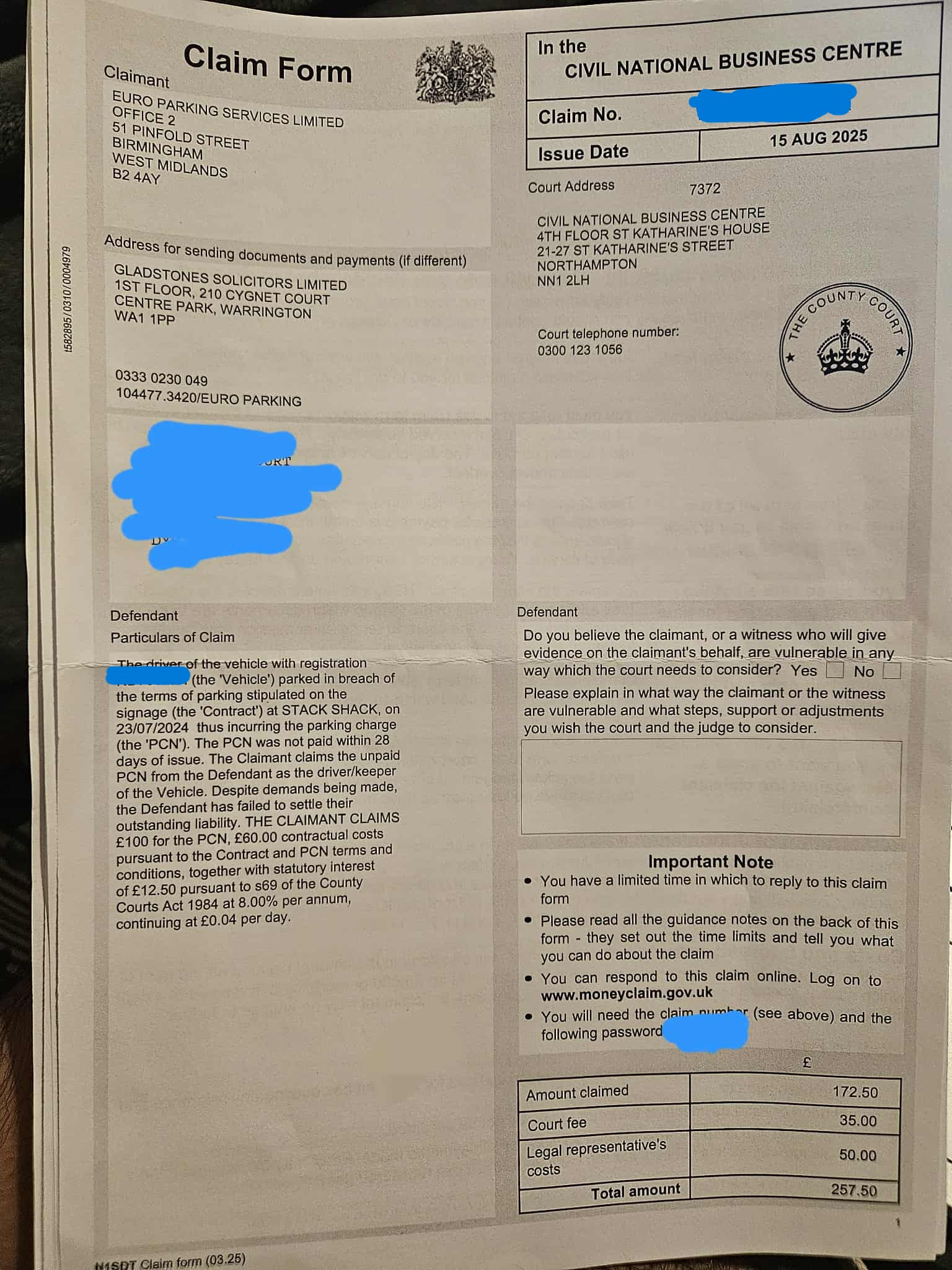
i received this parking ticket
I completed AOS and submitted my defence as follows:
"
- The Defendant denies the claim in its entirety. The Defendant asserts that there is no liability to the Claimant and that no debt is owed. The claim is without merit and does not adequately disclose any comprehensible cause of action.
- There is a lack of precise detail in the Particulars of Claim (PoC) in respect of the factual and legal allegations made against the Defendant such that the PoC do not comply with CPR 16.4(1)(a).
- The Defendant is unable to plead properly to the PoC because:
(a) The contract referred to is not detailed or attached to the PoC in accordance with CPR PD 16.7.3(1);
(b) The PoC do not state the exact wording of the clause (or clauses) of the terms and conditions of the contract (or contracts) which is/are relied on;
(c) The PoC do not adequately set out the reason (or reasons) why the claimant asserts the defendant has breached the contract (or contracts)
(d) The PoC do not state with sufficient particularity exactly where the breach occurred, the exact time when the breach occurred and how long it is alleged that the vehicle was parked before the parking charge was allegedly incurred;
(e) The PoC do not state precisely how the sum claimed is calculated, including the basis for any statutory interest, damages, or other charges;
(f) The PoC do not state what proportion of the claim is the parking charge and what proportion is damages;
(g) The PoC do not provide clarity on whether the Defendant is sued as the driver or the keeper of the vehicle, as the claimant cannot plead alternative causes of action without specificity.
- The Defendant submits that courts have previously struck out similar claims of their own initiative for failure to adequately comply with CPR 16.4(1)(a), particularly where the Particulars of Claim failed to specify the contractual terms relied upon or explain the alleged breach with sufficient clarity. The Defendant refers specifically to the persuasive appellate cases:
- Civil Enforcement Ltd v Chan (2023), Luton County Court, HHJ Murch, ref: E7GM9W44
- CPMS Ltd v Akande (2024), Manchester County Court, HHJ Evans, ref: K0DP5J30
In both cases, the claim was struck out due to identical failures to comply with CPR 16.4(1)(a).
- The Defendant invites the Court to strike out this claim of its own initiative. The Defendant relies on the judicial reasoning set out in Chan and Akande, as well as other County Court cases involving identical failures to adequately comply with CPR 16.4. In those cases, the court further observed that, given the modest sum claimed, requiring further case management steps would be disproportionate and contrary to the overriding objective. Accordingly, the judge struck out the claim outright rather than permitting an amendment. The Defendant proposes that the following Order be made:
Draft Order:
Of the Court's own initiative and upon reading the particulars of claim and the defence.
AND the court being of the view that the particulars of claim do not comply with CPR 16.4(1)(a) because: (a) they do not set out the exact wording of the clause (or clauses) of the terms and conditions of the contract (or contracts) which is (or are) relied on; and (b) they do not adequately set out the reason (or reasons) why the claimant asserts that the defendant was in breach of contract.
AND the claimant could have complied with CPR 16.4(1)(a) had it served separate detailed particulars of claim, as it could have done pursuant to CPR PD 7C.5.2(2), but chose not to do so.
AND upon the claim being for a very modest sum such that the court considers it disproportionate and not in accordance with the overriding objective to allot to this case any further share of the court's resources by ordering further particulars of claim and a further defence, each followed by further referrals to the judge for case management.
ORDER:
- The claim is struck out.
- Permission to either party to apply to set aside, vary or stay this order by application on notice, which must be filed at this Court not more than 5 days after service of this order, failing which no such application may be made. "
Court received ny defence and defence was sent to the claimant.
Then received email from the solicitor
"Dear ..............
We act for the Claimant and have notified the Court of the Claimant’s intention to proceed with the Claim.
Please find enclosed a copy of the Claimant’s completed Directions Questionnaire, which has also been filed with the Court.
You will note the Claimant has elected to mediate in an attempt to settle this matter amicably, without the need for further Court intervention. Should you agree to mediation, please inform the Court who will contact both parties to arrange a mediation appointment.
Yours sincerely
SkyeLegal Assistant
Glad... Solicitors Limited " They have also sent a filled N180 form attached. Claimant N-180 as below:
then I submitted defendant N-180
also I objecetd to claimant N-180
"
County Court Business Centre (CNBC)

Claim no.: [XXXXXXX]

Parties: [Claimant] v [Defendant]
OBJECTION TO CLAIMANT’S N180 DIRECTIONS QUESTIONNAIRE (DEFECTIVE SIGNATURE & AUTHORISATION)
I object to the Claimant’s purported filing of Form N180, which is “signed” only as “Gladstones Solicitors Ltd” with no identified individual signatory.Signature defect (PD 5A)
Form N180 requires a valid signature by the party or an identified legal representative. Practice Direction 5A requires documents to be signed where indicated by the person responsible; where that person acts as a member/employee of a firm, the firm’s name may be added, but a firm name alone is not a signature. The absence of an identified individual undermines accountability and is procedurally defective.Conduct of litigation (Legal Services Act 2007)
Signing and filing an N180 is a step in the “conduct of litigation” within s.12 and Schedule 2 paragraph 4 of the Legal Services Act 2007. Only the party, an authorised person, or an exempt person under Schedule 3 may carry out reserved legal activities.Mazurauthority
The High Court inMazur & Anor v Charles Russell Speechlys LLP[2025] EWHC 2341 (KB) (16 September 2025) confirmed that employees who are not themselves authorised (and not within a Schedule 3 exemption) cannot conduct litigation, even if supervised. The individual who signs must personally be authorised (or exempt).Potential statutory non-compliance
If the person who completed/signed the N180 is not authorised or exempt, carrying on a reserved legal activity may contravene s.14 of the Legal Services Act 2007.Directions sought
A) That the Claimant be directed within 7 days to re-file and serve a properly signed N180 which:(i) identifies the individual signatory by name and status/position; and(ii) confirms that the signatory is authorised (or states the relied-upon Schedule 3 exemption) to conduct litigation.
B) That until compliance, the current N180 be treated as defective and disregarded for case-management purposes, with any further sanction at the Court’s discretion in the event of non-compliance.Service
These documents are served on the Claimant’s solicitors by copy of this email.


Signed:


[Date] "
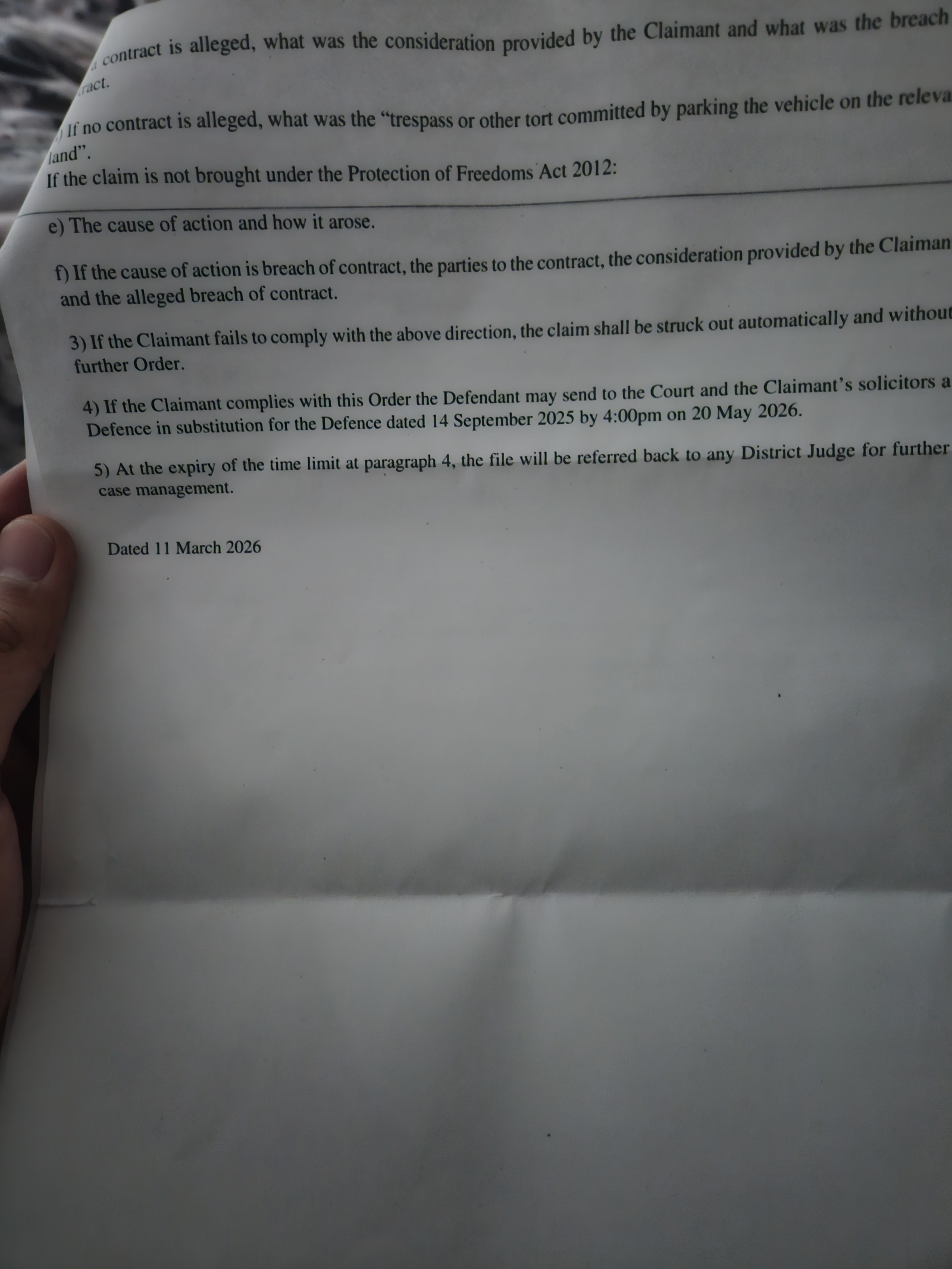
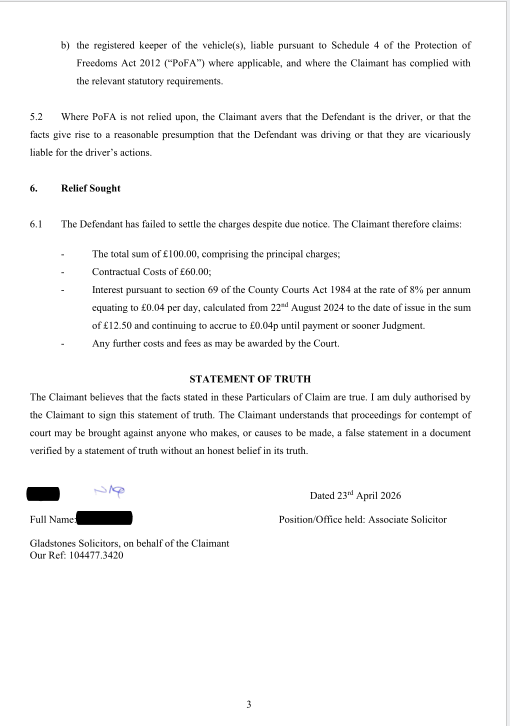
Then there was mediation appointment- which I attended and which was not success full. My case got transfered to Manchester court. Manchester court struck off the case and asked claiment to re-submit with the detailed version. Claimant submitted the new claim as below
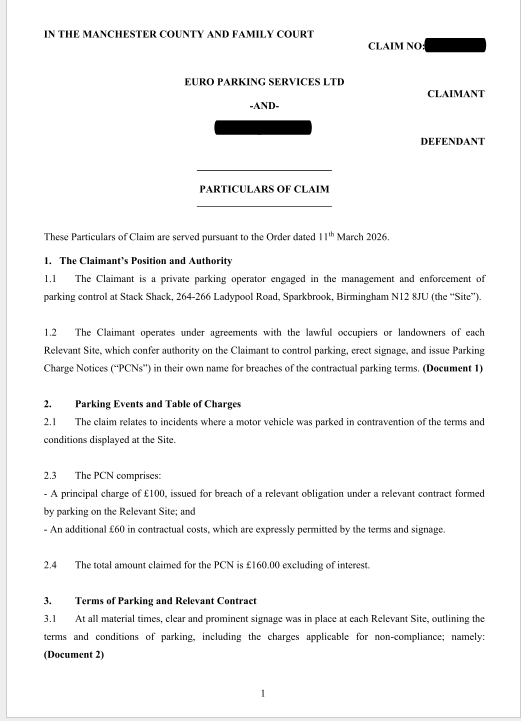
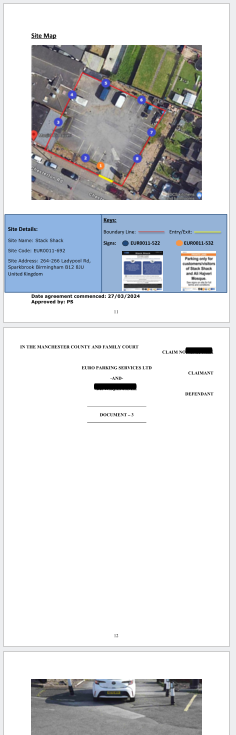
Then claimant submitted a new claim:
and now its my time to update my defence.
Please see my substitue defence- would appreciate some comments
"
"SUBSTITUTE DEFENCE
The Defendant denies the claim in its entirety. The Defendant asserts that there is no liability to the Claimant and that no debt is owed.
The Defendant acknowledges receipt of the amended Particulars of Claim purportedly served pursuant to the Order dated 11 March 2026. However, the Defendant submits that the Claimant has failed to comply with the terms and requirements of that Order.
The Order expressly directed the Claimant to identify “whether the claim is brought under Schedule 4 of the Protection of Freedoms Act 2012”. The amended Particulars of Claim fail to do so with the requisite certainty or specificity.
In particular:
(a) the amended Particulars of Claim state that the claim is brought pursuant to Schedule 4 of the Protection of Freedoms Act 2012 (“POFA”) “where applicable”, but fail to state whether POFA is in fact applicable and relied upon in this claim;
(b) the amended Particulars of Claim continue to plead alternative and inconsistent causes of action by further stating at paragraph 5.2 that “where POFA is not relied upon”, the Claimant will instead seek to establish liability on an alternative basis;
(c) the Claimant has therefore failed to identify clearly and unequivocally whether the Defendant is pursued as driver, keeper pursuant to POFA, or both;
(d) the amended Particulars of Claim continue to advance speculative and contradictory alternatives without properly pleading the legal basis upon which the Claimant seeks to recover the alleged debt.
Accordingly, the Defendant submits that the Claimant has failed to comply with the Court’s Order and continues to fail adequately to particularise the basis of the claim with sufficient clarity and precision. The Defendant respectfully invites the Court to strike out the claim.
Further and in the alternative, if the Court is not minded to strike out the claim, the Defendant responds to the amended Particulars of Claim as follows.
The Defendant denies that any enforceable contractual liability arose between the Claimant and the Defendant.
The Defendant is unable fully to understand the contractual basis of the claim because:
(a) the Claimant has failed to provide strict proof that the signage relied upon was sufficiently prominent, legible, illuminated (if applicable), and capable of binding a reasonable motorist;
(b) the Claimant has failed to provide strict proof that the terms and conditions relied upon were adequately brought to the attention of drivers prior to any alleged contract being formed;
(c) the Claimant has failed to provide strict proof regarding the precise location, positioning, prominence, wording, and visibility of the signage relied upon at the material time;
(d) the Claimant has failed to provide strict proof that the keypad registration system referred to in the amended Particulars of Claim was operational, accessible, properly maintained, clearly explained to patrons, and functioning correctly at the material time.
The Defendant denies that the Claimant has sufficiently proven the identity of the driver and the Claimant is put to strict proof thereof.
To the extent that the Claimant seeks to rely upon Schedule 4 of POFA, the Defendant denies that the Claimant has complied with the mandatory statutory requirements necessary to establish keeper liability. The Claimant is put to strict proof of full compliance with each and every requirement of Schedule 4 of POFA.
Further and in the alternative, if POFA is not relied upon, the Claimant is required to prove, on the balance of probabilities, the identity of the driver. Mere keeper status does not create any lawful presumption of driver liability.
The Defendant further denies that the additional sum of £60, described variously as “contractual costs”, “debt recovery costs” or similar, is recoverable.
The Defendant avers that the additional £60 constitutes an attempt at double recovery and is contrary to established authority and the indemnity principle. The Claimant is put to strict proof that such sum was genuinely incurred, contractually agreed, and lawfully recoverable.
The Defendant further avers that the additional charges claimed exceed the level of parking charge considered by the Supreme Court in ParkingEye Ltd v Beavis [2015] UKSC 67 and that no legitimate interest or commercial justification has been established for the enhanced sum now claimed.
The Defendant denies that the contractual terms relied upon were fair, transparent, or sufficiently prominent so as to satisfy the requirements of the Consumer Rights Act 2015.
The Defendant notes that the original claim was previously found by the Court not to comply with CPR 16.4(1)(a), resulting in the original Particulars of Claim being struck out unless amended. The Defendant maintains that the amended pleading remains materially deficient for the reasons set out above.
The Defendant respectfully reserves the right to amend, supplement, or expand upon this Defence should further documents, evidence, or information be disclosed by the Claimant."
0 -
Your amended defence should be in red and put on a Word doc underneath your initial defence (which should be struck through in red). That's how to do an amended defence. Then sign & date the whole thing at the bottom under the long Statement of Truth, and save it as a PDF (you cannot make a submission as a Word doc).
Do you have the NTK from 2024? If yes, show us both sides.
If it was like this one from a few months later then it wasn't POFA compliant because EPS failed to include most of the required wording from para 9 of Schedule 4:
The Judge's Order said (in essence) whether or not the case was 'POFA compliant' then the cause of action against the Defendant had to be made out clearly by the Claimant, either under contract (breach of a relevant obligation) or trespass.
The new POC does not define either one or the other. You'd expect a full copy of the Notice to Keeper and a clear statement as to whether they say it complied with para 9 of Schedule 4. The NTK isn't even supplied so the court and Defendant is reduced to guessing, which is surely an abuse and in breach of the Order from Manchester Court, which required this point especially, to be specified.
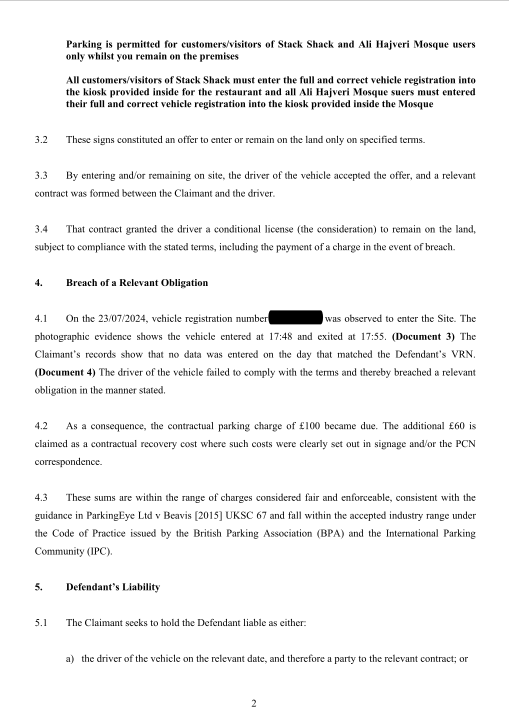
Further, there are no terms on the sign that bind drivers who don't visit either business and effectively trespass. There can be no 'breach of a relevant obligation or contract' by other drivers merely passing through because the only drivers bound by the requirement to put in their VRM at a 'kiosk' (if indeed any such signs were prominent and legible that day - no evidence exists) are ONLY those who were patrons of Stack Shack or the Mosque!
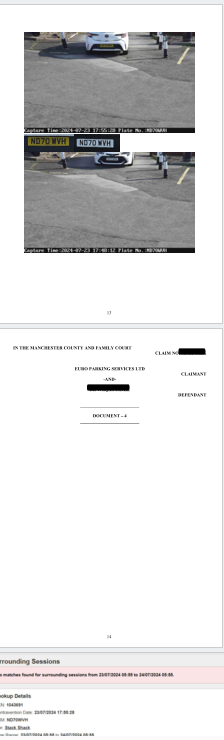
But this car was only there seven minutes all told, so that driver cannot be fairly bound by parking terms. Images of a vehicle driving in and out past a camera at the edge of the site are not the 'period of parking'.
On the balance of probabilities, in those few minutes the driver drove in, perhaps saw a sign, read the terms and rejected them. Whether or not they saw a sign, the incident must have occurred without the driver entering either the Mosque or Stack Shack at all, because there was no time to drive further in, find a parking space and enter those premises, let alone run back to the car and leave.
Therefore the driver cannot be shown to fall under the ONLY two distinct groups of patrons bound by the VRM kiosk obligation. There was no time to visit a restaurant or a Mosque and 'fail' to enter their VRM. The Defendant is forced to guess but it is most likely that the unidentified driver of this car was merely passing through, maybe dropping someone off, and was neither 'parked' nor a patron of either business.
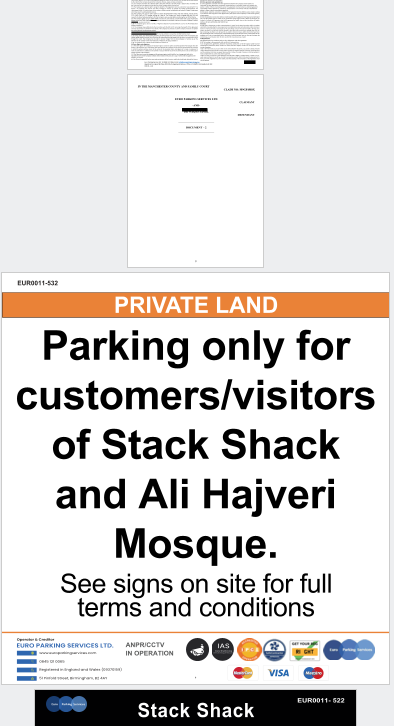
The landowner authority purports to say that 'non-authorised' vehicles get a 'zero' consideration period but there is nothing on the mock up sign offering a contractual licence to non-patrons (unauthorised vehicles), let alone warning of immediate ticketing.
There is also nothing on the mock-up entrance sign that meets the GDPR (DPA 2018) requirement to tell drivers at the entrance how the keeper's data will be used, nor even that images of the vehicle are being taken by ANPR, nor is there a single word about non-customers and immediate ticketing on entry, so somebody perhaps dropping off a passenger as a customer is going to be content they can enter for that purpose:

Even if there was such a warning at the entrance it would be void, because a 'zero' consideration period is impossible in contract law. Zero time allowed to learn of the very t&cs that (at the entrance) drivers are invited in to 'see signs' and read, is blatantly an unfair term because it is entrapment. This set up affords a consumer no opportunity to notice and read any signs inside the site and leave without a penalty. And it is a penalty!Merely entering seems to get all cars a PCN as they cross the site threshold, but that's plainly unfair and unenforceable if the Claimant relies on contract, as is vaguely pleaded.
And the driver was offered nothing of value so there was no consideration and no 'meeting of minds'. It's simply an immediate penalty; a punishment for daring to enter (despite being invited to 'see signs on site') and that's unenforceable. In the absence of a fair consideration period and a 'relevant contract', legitimate interest and agreement on the terms and PCN, the ParkingEye v Beavis case is fully distinguished.
Even if the claim was pleaded as trespass (which it isn't) it cannot be said there were any damages caused in seven minutes driving in and out, and even if there were damages, those could only be claimed by the principal - Stack Shack - whose name appears at the top of the mock-up sign.
I think there's lots you can add (see above and below) and you should state that there are no actual in-situ images of the purported contract. You'd expect evidence of signs in place, not mock-ups like this:

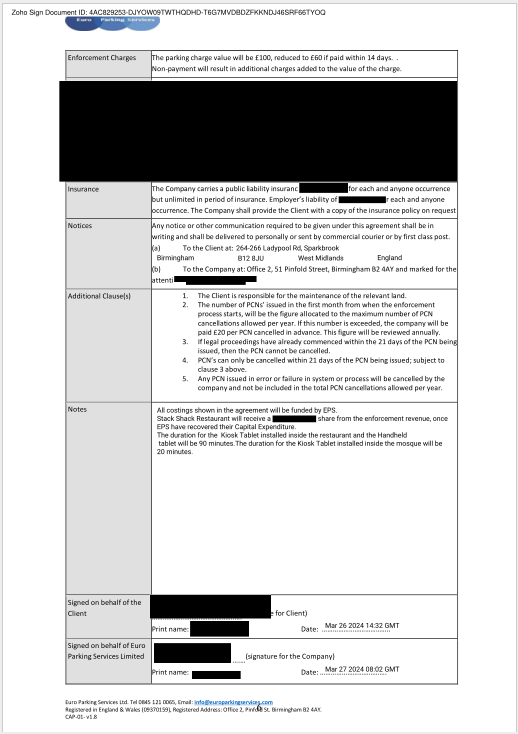
There is also nothing saying they can add £60 (a contract would have to specify that sum, not just hide a vague reference to 'additional charges' in small print).You should copy the wording from the Template Defence about the first transcript of Beavis, by HHJ Moloney, who identified that the pre-action letter chain was fully covered by the PCN itself and not a separate 'debt recovery stage' with additional heads of cost.
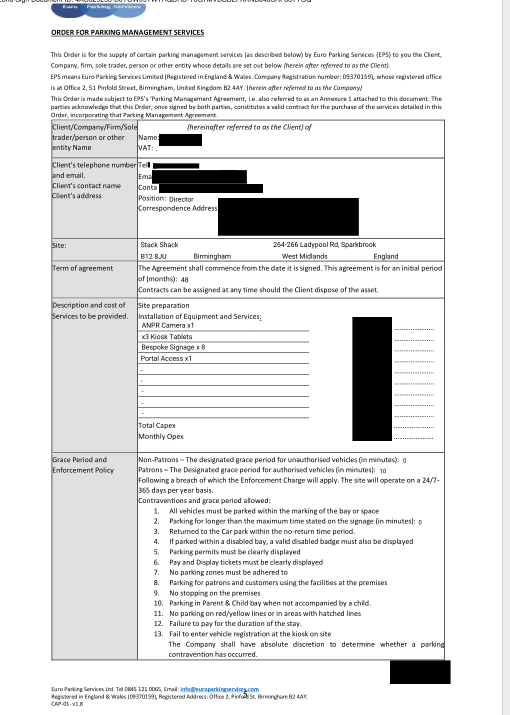
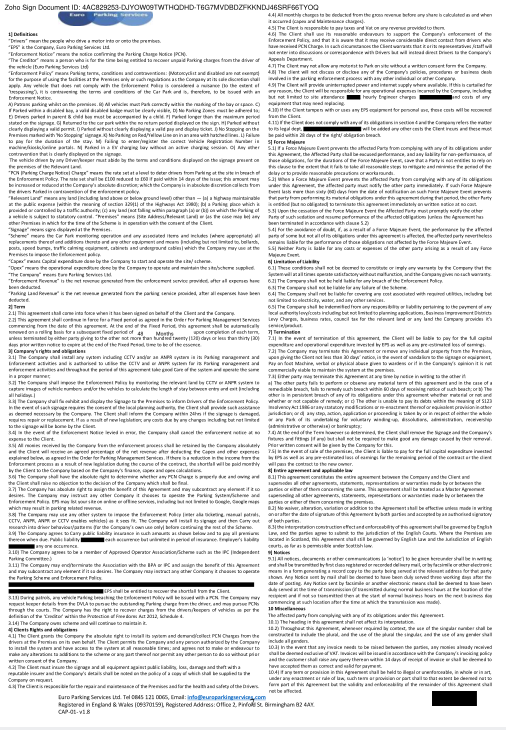
Also the supposed terms on the sign don't match the long list of terms on this landowner order/agreement:
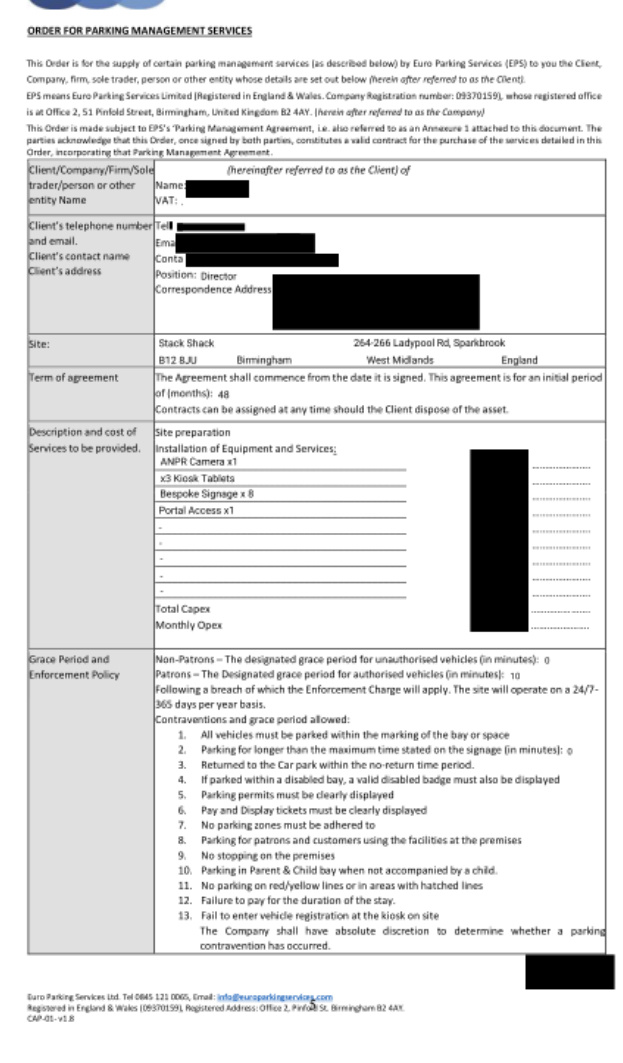
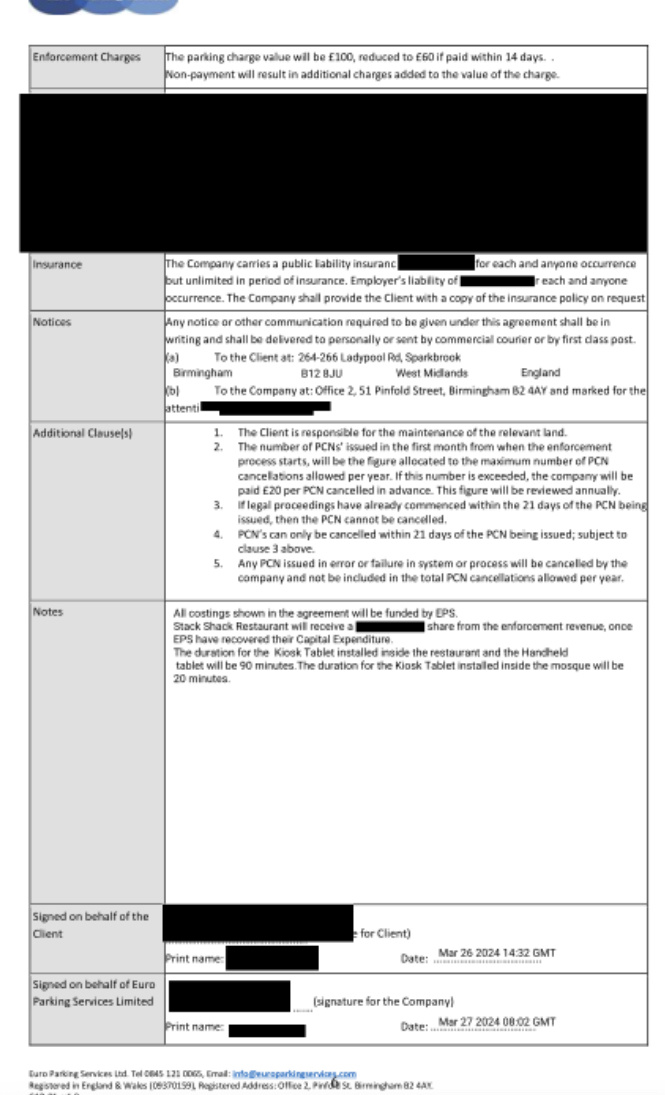
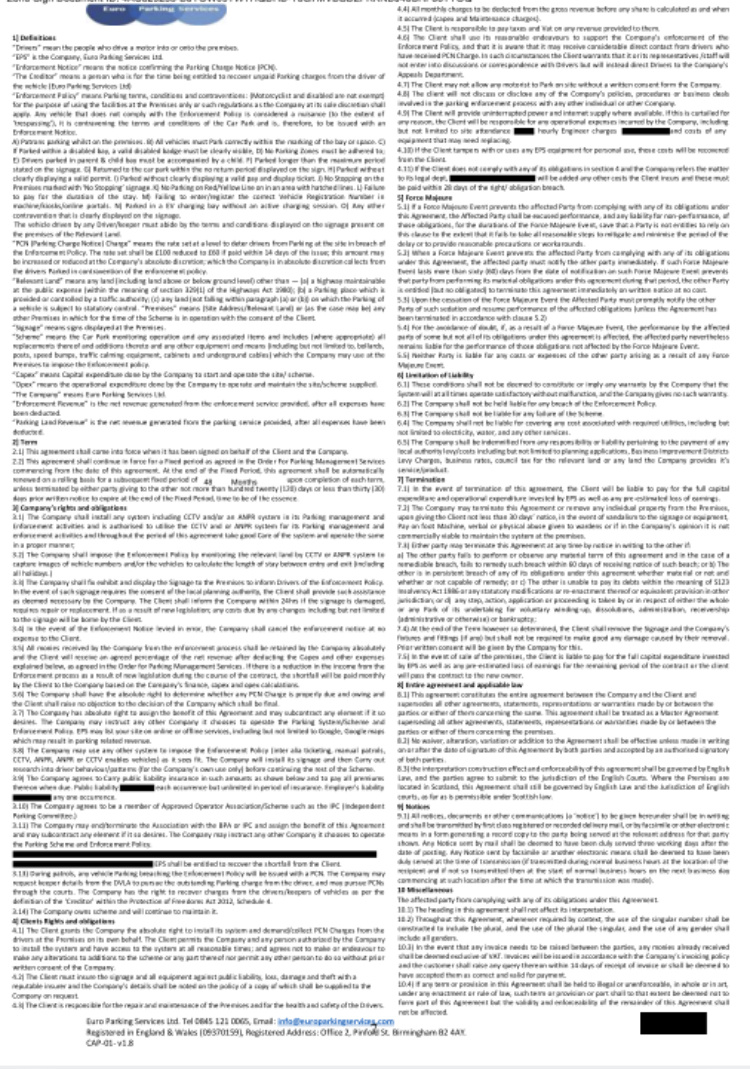
I assume the heavy redactions are theirs? Makes it very hard for the court to construe that contract.Also search the forum for:
PACE v Lengyel
Fairlie v Fenton
Hancock v Promontoria
PRIVATE 'PCN'? DON'T PAY BUT DON'T IGNORE IT (except N.Ireland).
CLICK at the top or bottom of any page where it says:
Home»Motoring»Parking Tickets Fines & Parking - read the NEWBIES THREAD2 -
Thank you so much Coupan- mad, unfortunately I dont have the NTK from 2024. I have updated my defence as per your advise as below:
INITIAL DEFENCE:1. The Defendant denies the claim in its entirety. The Defendant asserts that there is no liability to the Claimant and that no debt is owed. The claim is without merit and does not adequately disclose any comprehensible cause of action.2. There is a lack of precise detail in the Particulars of Claim (PoC) in respect of the factual and legal allegations made against the Defendant such that the PoC do not comply with CPR 16.4(1)(a).3. The Defendant is unable to plead properly to the PoC because:(a) The contract referred to is not detailed or attached to the PoC in accordance with CPR PD 16.7.3(1);(b) The PoC do not state the exact wording of the clause (or clauses) of the terms and conditions of the contract (or contracts) which is/are relied on;(c) The PoC do not adequately set out the reason (or reasons) why the claimant asserts the defendant has breached the contract (or contracts)(d) The PoC do not state with sufficient particularity exactly where the breach occurred, the exact time when the breach occurred and how long it is alleged that the vehicle was parked before the parking charge was allegedly incurred;(e) The PoC do not state precisely how the sum claimed is calculated, including the basis for any statutory interest, damages, or other charges;(f) The PoC do not state what proportion of the claim is the parking charge and what proportion is damages;(g) The PoC do not provide clarity on whether the Defendant is sued as the driver or the keeper of the vehicle, as the claimant cannot plead alternative causes of action without specificity.4. The Defendant submits that courts have previously struck out similar claims of their own initiative for failure to adequately comply with CPR 16.4(1)(a), particularly where the Particulars of Claim failed to specify the contractual terms relied upon or explain the alleged breach with sufficient clarity. The Defendant refers specifically to the persuasive appellate cases:- Civil Enforcement Ltd v Chan (2023), Luton County Court, HHJ Murch, ref: E7GM9W44- CPMS Ltd v Akande (2024), Manchester County Court, HHJ Evans, ref: K0DP5J30In both cases, the claim was struck out due to identical failures to comply with CPR 16.4(1)(a).5. The Defendant invites the Court to strike out this claim of its own initiative. The Defendant relies on the judicial reasoning set out in Chan and Akande, as well as other County Court cases involving identical failures to adequately comply with CPR 16.4. In those cases, the court further observed that, given the modest sum claimed, requiring further case management steps would be disproportionate and contrary to the overriding objective. Accordingly, the judge struck out the claim outright rather than permitting an amendment. The Defendant proposes that the following Order be made:Draft Order:Of the Court's own initiative and upon reading the particulars of claim and the defence.AND the court being of the view that the particulars of claim do not comply with CPR 16.4(1)(a) because: (a) they do not set out the exact wording of the clause (or clauses) of the terms and conditions of the contract (or contracts) which is (or are) relied on; and (b) they do not adequately set out the reason (or reasons) why the claimant asserts that the defendant was in breach of contract.AND the claimant could have complied with CPR 16.4(1)(a) had it served separate detailed particulars of claim, as it could have done pursuant to CPR PD 7C.5.2(2), but chose not to do so.AND upon the claim being for a very modest sum such that the court considers it disproportionate and not in accordance with the overriding objective to allot to this case any further share of the court's resources by ordering further particulars of claim and a further defence, each followed by further referrals to the judge for case management.ORDER:1. The claim is struck out.2. Permission to either party to apply to set aside, vary or stay this order by application on notice, which must be filed at this Court not more than 5 days after service of this order, failing which no such application may be made.SUBSTITUTE DEFENCE
IN THE MANCHESTER COUNTY AND FAMILY COURT
Claim Number:
BETWEEN:
EURO PARKING SERVICES LIMITEDClaimant
-and-
Defendant
A. Preliminary – The Claimant has failed to comply with the Court’s Order and the amended Particulars remain defective
- The Defendant denies the claim in its entirety. The Defendant asserts that there is no liability to the Claimant and that no debt is owed.
- The Defendant acknowledges receipt of the amended Particulars of Claim (“amended PoC”) purportedly served pursuant to the Order dated 11 March 2026 (the “Order”).
- The Order expressly directed the Claimant to identify “whether the claim is brought under Schedule 4 of the Protection of Freedoms Act 2012” (POFA). The amended PoC fail to comply with this requirement.
- Instead of a clear statement, the amended PoC state that the claim is brought pursuant to POFA “where applicable” and then add (at paragraph 5.2) that “where POFA is not relied upon” the Claimant will pursue an alternative basis of liability.
- Those formulations are fundamentally ambiguous and do not comply with the Order. The Claimant must elect one legal basis:
- (a) either the Claimant relies on POFA to hold the Defendant liable as keeper (in which case the Claimant must plead full compliance with all paragraphs of Schedule 4 and provide a copy of the Notice to Keeper); or
- (b) the Claimant does not rely on POFA and instead accepts that it must prove the identity of the driver.
- By pleading both alternatives simultaneously, the Claimant:
- (a) fails to identify whether the Defendant is pursued as driver, keeper under POFA, or both;
- (b) prevents the Defendant from pleading properly to the cause of action;
- (c) continues to advance speculative and contradictory cases, contrary to CPR 16.4(1)(a) and the spirit of the Order.
- Furthermore, the Claimant has not supplied a copy of the Notice to Keeper (NTK) with the amended PoC. The court and the Defendant are therefore reduced to guessing whether the NTK complied with paragraph 9 of Schedule 4 of POFA. This is an abuse of process and a clear breach of the Order, which required the Claimant to specify the basis of liability with particularity.
- Accordingly, the Claimant has failed to comply with the Court’s Order. The Defendant respectfully invites the Court to strike out the claim on that basis alone.
B. Substantive defence (if the Court is not minded to strike out)
- Further and in the alternative, if the Court permits the claim to continue, the Defendant responds to the amended PoC as follows.
No enforceable contract – zero consideration period and no opportunity to accept terms
- The Defendant denies that any enforceable contractual liability arose between the Claimant and the Defendant.
- The only evidence of alleged terms provided by the Claimant is a mock‑up sign (not a photograph of the actual sign in situ on the date in question). The Defendant is entitled to strict proof that the signage relied upon was actually present, legible, and prominently displayed at the entrance and throughout the site. No such evidence has been provided.
- Even if the court were to accept the mock‑up sign as accurate (which is denied), the sign purports to impose a zero consideration period. That is to say, a driver is given no time whatsoever to enter the site, read any signs, and decide whether to accept the terms or leave without incurring a charge.
- A “zero” consideration period is impossible in contract law. A consumer must be afforded a reasonable opportunity to learn of the terms and reject them by leaving the site. The absence of any grace period renders the purported contract void for uncertainty and constitutes an unfair term under the Consumer Rights Act 2015 (unfairness under Schedule 2, paragraph 6 – automatic binding without a real opportunity to become aware of the terms).
- The driver of the vehicle was present on the site for only seven minutes in total (as the Claimant’s own ANPR records show, if disclosed). That is insufficient time to drive in, find a parking space, exit the vehicle, visit either the Mosque or Stack Shack (the only two businesses whose patrons are allegedly bound by the VRM entry obligation), and return to the vehicle. On the balance of probabilities, the driver was merely passing through, perhaps dropping off a passenger, and was neither “parked” nor a patron of either business.
- There is no term on the sign that purports to bind non‑patrons (i.e., vehicles that do not visit either the Mosque or Stack Shack) to pay any charge. The sign only refers to “authorised vehicles” and a requirement to enter a VRM at a kiosk. A driver who is not a patron of either business cannot be said to have breached any obligation because no obligation applies to them.
- The Claimant cannot therefore establish that the driver (whoever they were) fell within the class of persons allegedly bound by the VRM requirement. The Claimant’s case is speculative and should be dismissed.
Identity of the driver and POFA keeper liability
- The Defendant denies that the Claimant has sufficiently proven the identity of the driver. The Claimant is put to strict proof thereof.
- To the extent that the Claimant seeks to rely on Schedule 4 of POFA (assuming such reliance is now unequivocally stated), the Defendant denies that the Claimant has complied with the mandatory statutory requirements necessary to establish keeper liability. In particular:
- (a) The Claimant has not provided a copy of the Notice to Keeper.
- (b) The Defendant puts the Claimant to strict proof that the NTK contained all the wording required by paragraph 9 of Schedule 4 (including the mandatory warning about keeper liability, the period of parking, and the right to appeal).
- (c) On the information available, the Defendant believes that the NTK (if it exists) did not comply with POFA, and therefore no keeper liability can arise.
- If, on the other hand, the Claimant does not rely on POFA (or is unable to prove compliance with it), then the Claimant is required to prove, on the balance of probabilities, the identity of the driver. Mere keeper status does not create any lawful presumption of driver liability. The Claimant has no direct evidence of who was driving and cannot discharge that burden.
- For the avoidance of doubt, the Claimant is not permitted to run both cases in the alternative without pleading facts that would support each. The current pleading (POFA “where applicable” / “where POFA is not relied upon”) is an illegitimate attempt to reverse the burden of proof and should be struck out.
The additional £60 (or similar sum) – not specified in any visible term
- The Defendant further denies that the additional sum of £60, described variously as “contractual costs”, “debt recovery costs” or similar, is recoverable.
- The mock‑up sign does not prominently state that a £60 “debt recovery” charge will be added. At most, there is a vague reference to “additional charges” in small print. To be enforceable, a contractual term must be clear, prominent, and specifically brought to the consumer’s attention. This fails the test of transparency under the Consumer Rights Act 2015.
- The additional £60 constitutes an attempt at double recovery and is contrary to the indemnity principle. The Claimant is put to strict proof that such sum was genuinely incurred, contractually agreed, and lawfully recoverable.
- The additional charges claimed exceed the level of parking charge considered by the Supreme Court in ParkingEye Ltd v Beavis [2015] UKSC 67. The Claimant has not established any legitimate interest or commercial justification for the enhanced sum now claimed. Moreover, HHJ Moloney’s first instance judgment in Beavis (which was approved by the Supreme Court on this point) made clear that the pre‑action letter chain is fully covered by the original PCN sum and that no separate “debt recovery” stage with additional costs is justifiable.
Alternatively, trespass – no damages caused
- If the Claimant purports to plead this case in trespass (which is not clear from the amended PoC), the Defendant denies that any damages were caused by a vehicle driving in and out of the site within seven minutes. There is no allegation of obstruction, damage to the land, or overstaying. The landowner (who is not the Claimant) has suffered no loss.
- Even if nominal damages were theoretically available, those could only be claimed by the principal landowner (Stack Shack, whose name appears on the sign), not by the Claimant. The Claimant has not provided any contract with the landowner that assigns a right to sue in trespass.
Consumer Rights Act 2015 – unfair terms
- The Defendant denies that the contractual terms relied upon were fair, transparent, or sufficiently prominent so as to satisfy the requirements of the Consumer Rights Act 2015. Specifically:
- (a) The zero consideration period is unfair under Schedule 2, paragraph 6.
- (b) The purported £60 additional charge is not prominent and is unfair under Schedule 2, paragraph 14 (charges that disproportionately penalise the consumer).
- (c) The sign (even the mock‑up) does not comply with the GDPR / DPA 2018 requirement to inform drivers at the entrance how their data will be used, nor does it warn that ANPR cameras are in use. This lack of transparency undermines any claim to consent.
No evidence of signage in situ – mock‑ups insufficient
- The Claimant has provided only computer‑generated mock‑ups of signs, not photographs of the actual signs displayed at the site on the date of the alleged incident. The Defendant is entitled to challenge whether the signs were visible, legible, illuminated, and positioned so as to be capable of forming a contract. The Claimant is put to strict proof of the actual signage.
Reliance on struck‑out original claim – abuse of process
- The Defendant notes that the original claim was previously found by the Court not to comply with CPR 16.4(1)(a), resulting in the original Particulars of Claim being struck out unless amended. The Defendant maintains that the amended pleading remains materially deficient for the reasons set out in paragraphs 3–8 above.
- The Claimant has effectively re‑litigated a defective claim without curing the fundamental defects. This is an abuse of process.
C. Conclusion and prayer for relief
- The Defendant respectfully requests that the court:
- (a) strike out the claim for failure to comply with the Order dated 11 March 2026 and for breach of CPR 16.4(1)(a); or
- (b) in the alternative, dismiss the claim on the substantive grounds set out above; and
- (c) order the Claimant to pay the Defendant’s costs (if any) or, in the case of an unreasonable claim, order costs under CPR 27.14(2)(g).
- The Defendant respectfully reserves the right to amend, supplement, or expand upon this Defence should further documents, evidence, or information be disclosed by the Claimant.
STATEMENT OF TRUTH
The Defendant believes that the facts stated in this Defence are true.
Signed: ___________________
Name:
Date: ___________________
Would single line of statement of truth suffice or there needs to be more sentences in it? I could not find any electronic ways of updated defence submission (contrary to initial MCOL in CNBC which was online but now does not give me any option to further update my defence) so I am planning to send it by special delivery to Mancehster court and email to the claiment- are you aware of any other ways of submission?
Thanks again and appreciate your guidance.
0 -
That Statement of truth is maybe 5 years out of date, use the newer longer version
1













Confirm your email address to Create Threads and Reply

Categories
- All Categories
- 354.6K Banking & Borrowing
- 254.5K Reduce Debt & Boost Income
- 455.5K Spending & Discounts
- 247.5K Work, Benefits & Business
- 604.4K Mortgages, Homes & Bills
- 178.6K Life & Family
- 261.9K Travel & Transport
- 1.5M Hobbies & Leisure
- 16.1K Discuss & Feedback
- 37.7K Read-Only Boards