We’d like to remind Forumites to please avoid political debate on the Forum.
This is to keep it a safe and useful space for MoneySaving discussions. Threads that are – or become – political in nature may be removed in line with the Forum’s rules. Thank you for your understanding.
📨 Have you signed up to the Forum's new Email Digest yet? Get a selection of trending threads sent straight to your inbox daily, weekly or monthly!
Ventilation issues in mid-terraced "victorian" grd flr

proformance
Posts: 358 Forumite




Hi - suffering from symptoms of poor ventilation in the grd flr of a mid-terraced "Victorian" house. Chief among them is condensation build-up.
On a related note, "I" am in the process of refurbishing the single-glazed bay window and upgrading to double-glazing, which might help some..
Unfortunately, however, the window's profile is too slim to accommodate an air vent. The joiner whom I've contracted to refurbish the windows suggested "air bricks".
Some quick Googling reveals that the placement of said air bricks is important, optimising and fixing air flow issues.
Without knowing what the underground situation is, can you advise if:
a) air bricks are a sound idea, and;
b) where best to place them?
Floorplan: https://i.ibb.co/C5Y70X4y/flar-map.png
On a related note, "I" am in the process of refurbishing the single-glazed bay window and upgrading to double-glazing, which might help some..
Unfortunately, however, the window's profile is too slim to accommodate an air vent. The joiner whom I've contracted to refurbish the windows suggested "air bricks".
Some quick Googling reveals that the placement of said air bricks is important, optimising and fixing air flow issues.
Without knowing what the underground situation is, can you advise if:
a) air bricks are a sound idea, and;
b) where best to place them?
Floorplan: https://i.ibb.co/C5Y70X4y/flar-map.png
0
Comments
-
Do you have things like good extractor fans in the bathroom and kitchen to help remove moisture from showers / cooking? A dehumidifier?
0 -
Normally old Victorian houses are notoriously draughty. Especially if you have single glazed windows or sashes. Do you dry clothes over the radiators ? Do you have kitchen & bathroom extractor fans ? Do you open widows to clear condensation ?0
-
Modern double glazed windows now have ventilation flaps on the top...so they will help.
A dehumidifier would help as well.0 -
Hi Proformance.
I think you should have a good look at the whole flat before going ahead with a 'solution', especially one that requires a hole in your wall. And one suggested by a joiner...
I just dislike the idea of 'airbricks', assuming this one(s) will be positioned above floor level. Why? They are ugly. And they'll be cold, so likely a condensation point in its own right. And, your new windows, if lacking trickles, will at least have a 'vent' position in its opener, which would do the same thing.
First, can you confirm the issue with the lack of window profile? That seems strange - bespoke windows can have whatever you want. (Although I acknowledge that 'trickles' are ugly things, and often do make the top transom unpleasantly thicker - I dislike them myself).So, explanation of new window type, please, and why a trickle cannot be fitted? (Ah, rereading your post, you are having your existing windows refurbished, and not replaced?)What type of window?What form of 'vent' setting will they have?And... what are your living conditions?Explain how this condensation manifests itself in your flat - all the symptoms, please.
And, what does your flat currently have to extract or vent out unavoidable sources of moisture - cooking, washing, breathing...?
1 -
The condensation you see on the window bay is there because it's the coldest place in the house. Insulation and double glazing will not reduce air born moisture, so that moisture will find another place to condense (the next coldest place). As others have pointed reducing airborne moisture is the solution. So effective fans, dehumidifiers or simply opening the windows are effective solutions. It's also important to consider that these options work on moisture in the air, so reasonable central heating settings are necessary to prevent the condensation and avoiding mould.
2 -
He didn't necessarily say "no", he just sort of skipped over the request and said something along the lines of "most Victorian houses just keep the window open slightly"...and that... "it would be difficult given the window's slim profile"... Paraphrased. I can ask again (and put my foot down), if we think trickle vents in the window frame are the ideal solution (or one of).WIAWSNB said:Hi Proformance.
I think you should have a good look at the whole flat before going ahead with a 'solution', especially one that requires a hole in your wall. And one suggested by a joiner...
I just dislike the idea of 'airbricks', assuming this one(s) will be positioned above floor level. Why? They are ugly. And they'll be cold, so likely a condensation point in its own right. And, your new windows, if lacking trickles, will at least have a 'vent' position in its opener, which would do the same thing.
First, can you confirm the issue with the lack of window profile? That seems strange - bespoke windows can have whatever you want. (Although I acknowledge that 'trickles' are ugly things, and often do make the top transom unpleasantly thicker - I dislike them myself).So, explanation of new window type, please, and why a trickle cannot be fitted? (Ah, rereading your post, you are having your existing windows refurbished, and not replaced?)What type of window?What form of 'vent' setting will they have?And... what are your living conditions?Explain how this condensation manifests itself in your flat - all the symptoms, please.
And, what does your flat currently have to extract or vent out unavoidable sources of moisture - cooking, washing, breathing...?
Here's some photos of the bay window itself, with the condensation shown!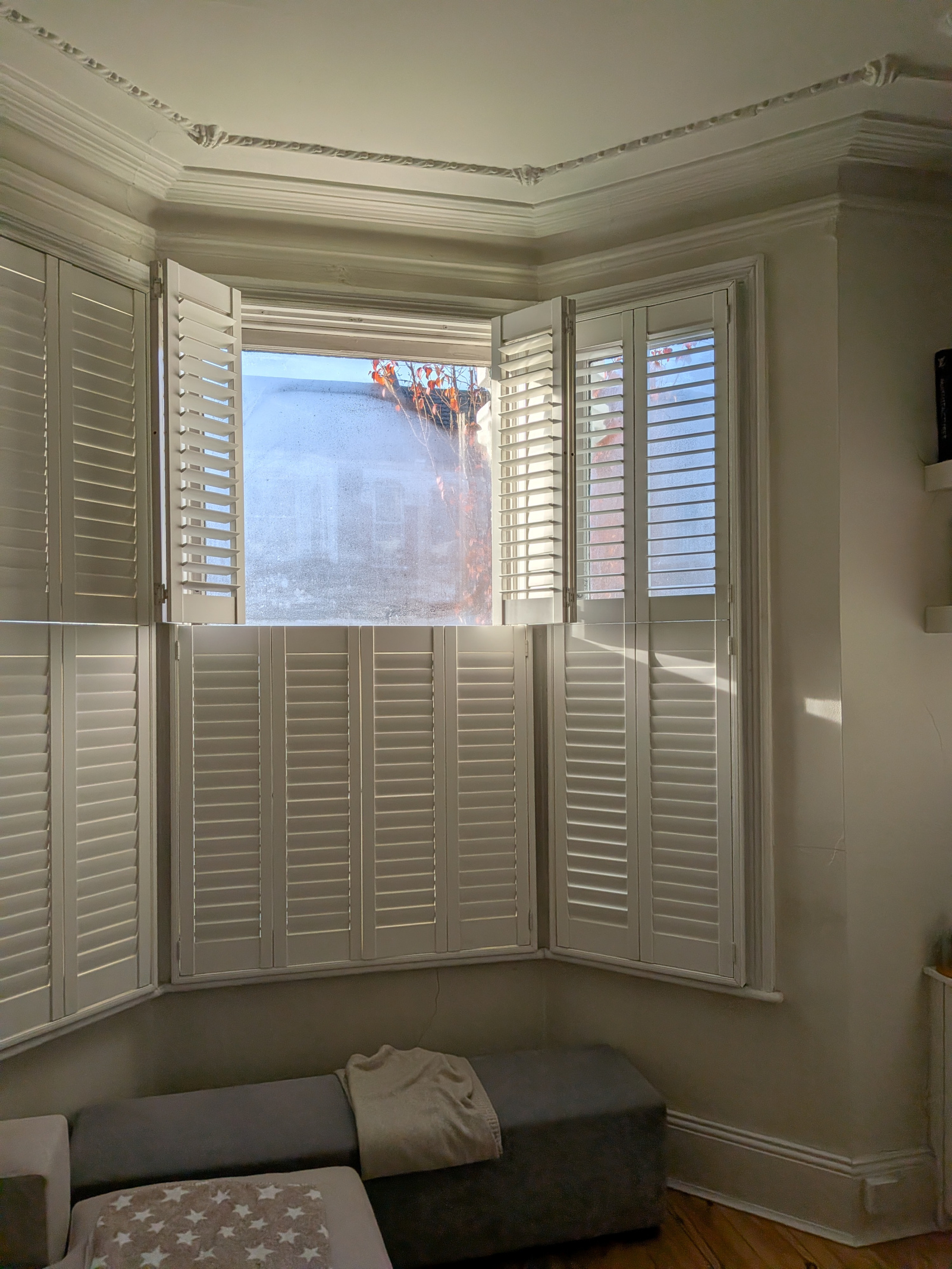
And below, I've uploaded some window close-ups (hopefully they show):


Here are the French doors leading onto the garden (also single-glazed):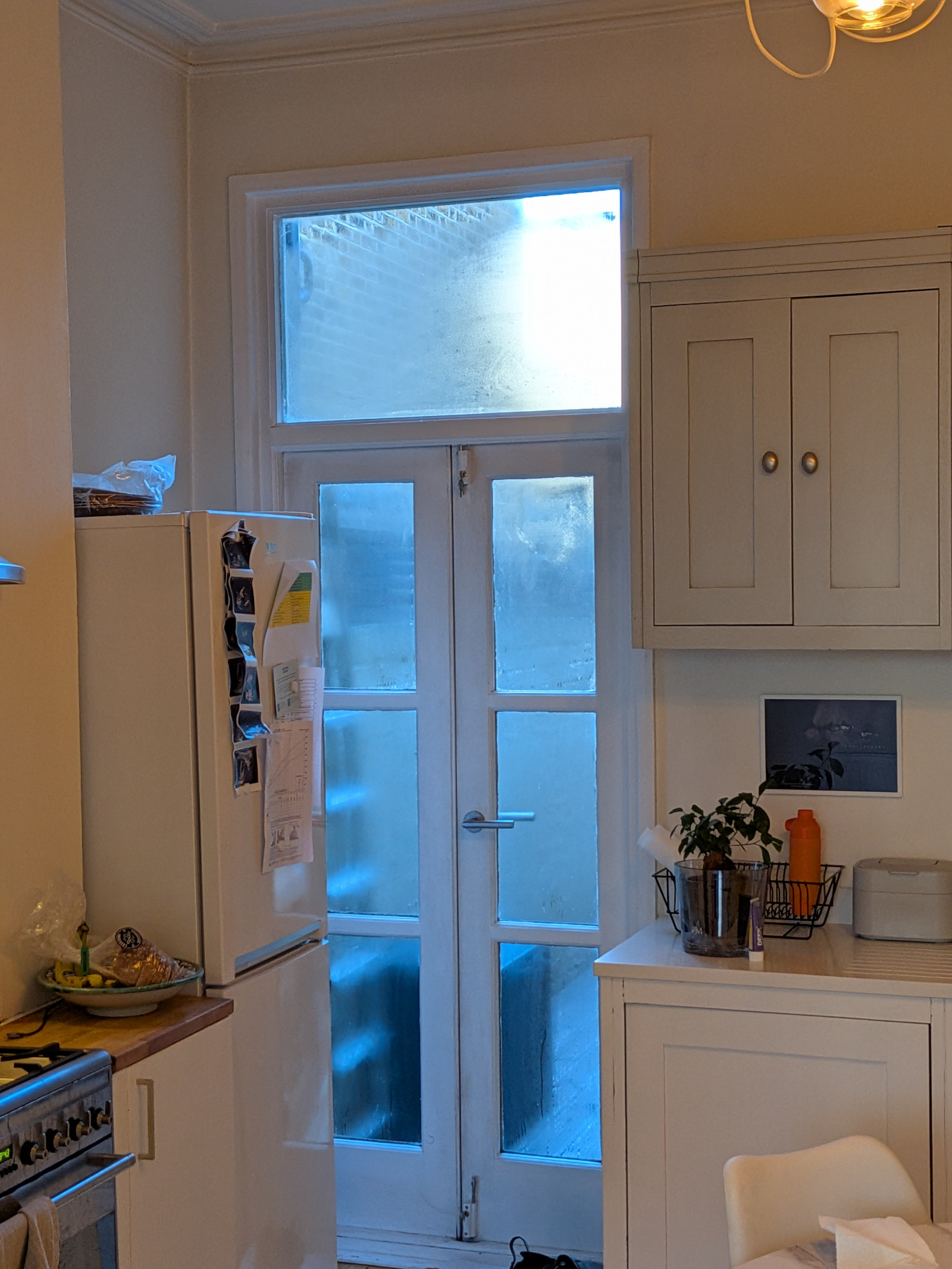
In terms of moisture mitigation...
We have a humidity-sensing extractor fan (recently upgraded) in the bathroom, and the kitchen has a hob extractor (visible in the top corner of the photo above). However, we only turn this on when we're cooking.
We also have a decent Meaco dehumidifier dutifully sucking out moisture, daily.
We also make sure to use a "shower scraper" to remove all water after a shower or bath from the tiles, shower screen and bath itself.
The back of the property doesn't show condensation symptoms nearly as much as the front, but we do keep a window almost permanently ajar.
Lastly, here's the snapshot of the floor plan (front side):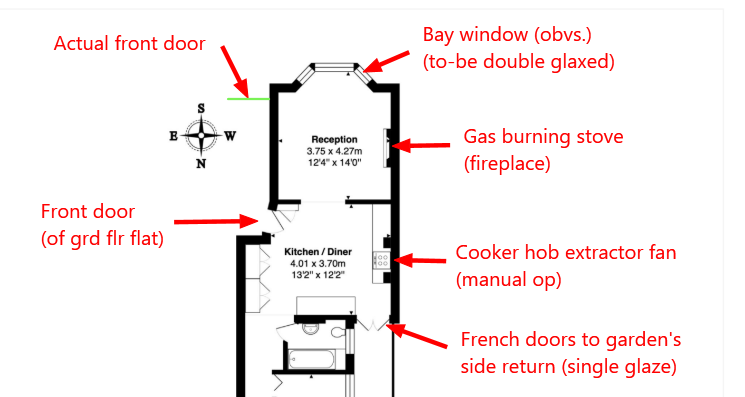
1 -
You need to get a surface thermometer. Any surface at the dew point of below will have condensation forming on it. You need to check at various times of the day.1
-
Good info, Proformance, thank you.Does the kitchen extractor vent to the outside, or just recirculate?Lovely windows and shutters! The latter has good and bad points... If kept closed, the moist air in the room will still get by and condense out on the cold panes. But, since the shutters are cutting down pretty much all the circulating air flow in that room, that condensed water will not be removed. So, using these shutters in the even will almost certainly cause more condensation on the panes.They would only help if 'airtight', so prevented the moist air getting to the windows in the first place! Have you compared the windows, or noticed any difference, by having the shutters fully or partly closed, or even kept away from the windows?If these shutters were effective at cutting away draughts from the windows, then an instant solution would be to crack open the sashes, and then close the shutters over them. The shutters would prevent you from suffering from cold draughts from the cracked open windows, and the windows themselves would be scrubbed bone dry by the outside draught you allowed through. See how wet the windows are? If you were to open the top and bottom sashes by a quarter inch, and closed the shutters over them to leave them to get on, you'd open them in an hour or so to dry panes. I'm pretty sure.So, if these shutters are effective at sealing off the windows from the room, then crack open the sashes first, and let it get on!The bathroom is probably being looked after well by your new extractor, but it's too far away to help with the front room.If the kitchen extractor is not externally venting, then it's pretty useless here. Any chance of making it external if it currently isn't?That gas fire - is it open? Does it allow the room to ventilate up the chimney?Anyhoo, in your position I would not fit trickles to the windows for two reasons - one, they look 'orrible. Two, they ain't needed, as you can achieve the same venting by simply cracking them open. You can have a lock fitted to secure the sashes where it's needed - in fact it should be a standard fitment.2
-
Thanks for your thorough response! Addressing each point/question below:WIAWSNB said:Good info, Proformance, thank you.Does the kitchen extractor vent to the outside, or just recirculate?Lovely windows and shutters! The latter has good and bad points... If kept closed, the moist air in the room will still get by and condense out on the cold panes. But, since the shutters are cutting down pretty much all the circulating air flow in that room, that condensed water will not be removed. So, using these shutters in the even will almost certainly cause more condensation on the panes.They would only help if 'airtight', so prevented the moist air getting to the windows in the first place! Have you compared the windows, or noticed any difference, by having the shutters fully or partly closed, or even kept away from the windows?If these shutters were effective at cutting away draughts from the windows, then an instant solution would be to crack open the sashes, and then close the shutters over them. The shutters would prevent you from suffering from cold draughts from the cracked open windows, and the windows themselves would be scrubbed bone dry by the outside draught you allowed through. See how wet the windows are? If you were to open the top and bottom sashes by a quarter inch, and closed the shutters over them to leave them to get on, you'd open them in an hour or so to dry panes. I'm pretty sure.So, if these shutters are effective at sealing off the windows from the room, then crack open the sashes first, and let it get on!The bathroom is probably being looked after well by your new extractor, but it's too far away to help with the front room.If the kitchen extractor is not externally venting, then it's pretty useless here. Any chance of making it external if it currently isn't?That gas fire - is it open? Does it allow the room to ventilate up the chimney?Anyhoo, in our position I would not fit trickles to the windows for two reasons - one, they look 'orrible. Two, they ain't needed, as you can achieve the same venting by simply cracking them open. You can have a lock fitted to secure the sashes where it's needed - in fact it should be a standard fitment.
"Have you compared the windows, or noticed any difference, by having the shutters fully or partly closed, or even kept away from the windows?" - I haven't tried this, but I will try tonight. We usually close the shutters every evening at around 20:00 and reopen at 07:00.
I will try the following scenarios and monitor the results:
- Only partially closing them overnight (i.e. leave reasonable gaps)
- Keep only the top half open overnight
- Keep only the bottom half open overnight
- Keep all shutters entirely oven overnight"If the kitchen extractor is not externally venting, then it's pretty useless here. Any chance of making it external if it currently isn't?" - How would I go about ascertaining if it is or isn't, do you think? Here's a photo of the extractor fan (from the inside, if that helps.
"That gas fire - is it open? Does it allow the room to ventilate up the chimney?" - Sorry, it's not gas, it's wood-burning. We seldom use it, even in winter. The door stays shut. And yes, it does evacuate through the chimney (which we have professionally swept every year).
"Anyhoo, in our position I would not fit trickles to the windows for two reasons - one, they look 'orrible. Two, they ain't needed, as you can achieve the same venting by simply cracking them open. You can have a lock fitted to secure the sashes where it's needed - in fact, it should be a standard fitment." - Yeah, I think the "'orrible" aesthetic is why my carpenter was so keen to dismiss the idea! I don't think it is commonplace to install trickle vents in timber windows. Anecdotally, looking around the 'hood, I don't see any examples of such. Not that that makes it right, mind.
...Lastly, given the extra context, what are we now thinking about "air bricks"?1 -
We have trickle vents which are in the depth of the frame at the top of our newer windows - you cannot see them from the outside.1








Confirm your email address to Create Threads and Reply

Categories
- All Categories
- 355.6K Banking & Borrowing
- 254.8K Reduce Debt & Boost Income
- 456.1K Spending & Discounts
- 248.2K Work, Benefits & Business
- 605.7K Mortgages, Homes & Bills
- 179K Life & Family
- 263.5K Travel & Transport
- 1.5M Hobbies & Leisure
- 16.1K Discuss & Feedback
- 37.7K Read-Only Boards