We’d like to remind Forumites to please avoid political debate on the Forum.
This is to keep it a safe and useful space for MoneySaving discussions. Threads that are – or become – political in nature may be removed in line with the Forum’s rules. Thank you for your understanding.
📨 Have you signed up to the Forum's new Email Digest yet? Get a selection of trending threads sent straight to your inbox daily, weekly or monthly!
Building Garden Retaining Walls - Questions
Comments
-
Thanks, really helpful!Section62 said:
Plywood isn't a good idea - it isn't sufficiently compressible, and may swell when it gets wet, so is the opposite of what you want.Maffy52 said:The easiest way is to put a strip of sheet polystyrene/Celotex or similar vertically against the house wall before filling the footing with concrete. I have a thin piece of plywood, which I am going to stick against the house wall, makes a gap of about 10-12 mm.
The 'overlap' section will be thinner than the rest of the footing, so will have less shear resistance - if there's an issue with movement then the thinner section of the footing is where it is more likely to crack.Maffy52 said:Ideally footings would be poured in one go, but if it has to be done as two then a vertical join is best. No harm in using some rebar across the joint, but for a wall which is only 4 courses high then it probably isn't essential. Thanks, was wondering about the joint. I thought to make a slight angle at the end of the first section (so it is slightly longer at the bottom, by 5-6 cm). Then the second section would be slightly 'on top' of the first section at the join, but never seen an example to follow for this (they always 'pour' in one go!). But will follow your advice and have a vertical joint (avoids having a thin eMaffy52 said:
Was going to use a 'semi-dry' mix of concrete as much easier for me to handle, do you have any experience of this?Dryer mixes are harder to 'work' - you need to make sure the concrete is well compacted, and if the mix is too dry it is harder to get it to move into voids. One of the big DIY mistakes is to add too much water to make the mix easier to work, which results in weak concrete which is particularly prone to frost damage.The exception is using 'dry mix' - with no added water. This is easier to shift and compact than other types, but the lack of water means it takes a long time for the concrete to fully strengthen. (could be weeks or months)
I will use the plywood as a bit of 'formwork' then remove it leaving a gap of about 12 mm.
I take you point about the joint, better be vertical, stronger.
I was planning to use a 'semi' dry mix, meaning with some water added (and the sand and stone damp). So it can be compacted into a ball in the hand but is not 'runny'. I read this was ultimately stronger, but took longer to fully harden....0 -
In theory the wall should sit on the centre of the foundation. There are special foundations for serious retaining walls, but this doesn't apply to yours. I wouldn't worry too much, a lot of houses I've worked on had the brickwork sitting on the edge of the concrete.Maffy52 said:
Yes, good question, as also not sure about this!stuart45 said:What thickness is the concrete going to be? Also how thick is the wall?
I thought a footing about 30 cm wide and 12-15 cm deep is sufficient for 4 course of brick. Seems reasonable but not really any science behind this!
The bottom two courses will be double (facing brick which is the nice looking brick, like 'fake' stone, and the brick behind being a simple concrete brick (like a small block!). For the top two courses was going to have facing bricks with one concrete brick but standing on its long edge. This will give a gap at the top to set the paving slab into.
This is a rough cross-section I what I planned to do. Do you think it seems reasonable?
Should the wall be in the middle of the footing or nearer to the front? also not sure about this now I think about it!..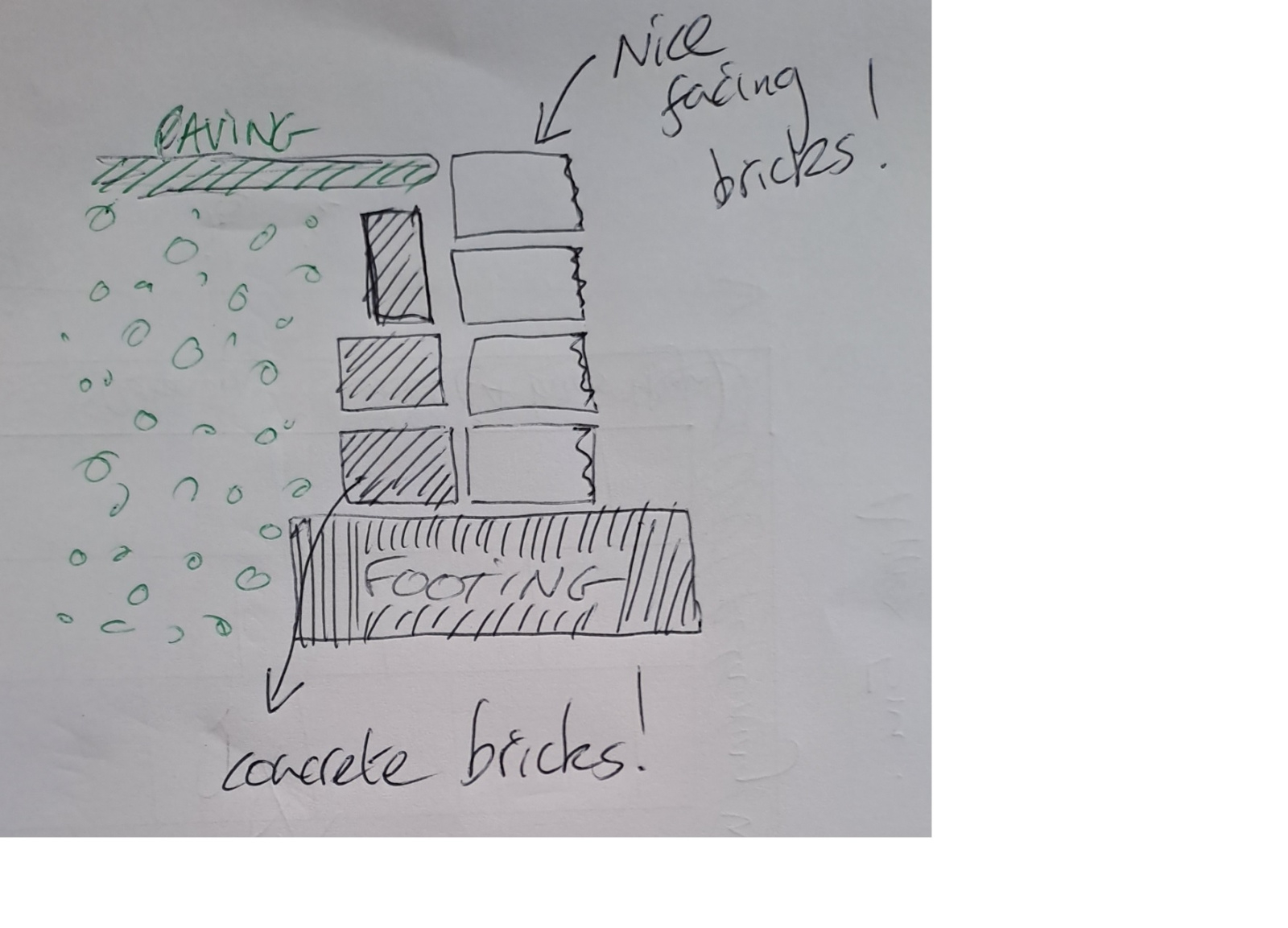 0
0






Confirm your email address to Create Threads and Reply

Categories
- All Categories
- 355.6K Banking & Borrowing
- 254.8K Reduce Debt & Boost Income
- 456.1K Spending & Discounts
- 248.2K Work, Benefits & Business
- 605.7K Mortgages, Homes & Bills
- 179K Life & Family
- 263.5K Travel & Transport
- 1.5M Hobbies & Leisure
- 16.1K Discuss & Feedback
- 37.7K Read-Only Boards