We’d like to remind Forumites to please avoid political debate on the Forum.
This is to keep it a safe and useful space for MoneySaving discussions. Threads that are – or become – political in nature may be removed in line with the Forum’s rules. Thank you for your understanding.
Help with changes to current set up
Comments
-
Always good to hear this, thanks QrizB.
Kit is £5316.82 (plus VAT) if I bought myself, so install will effectively be £1900
I'm not asking for anything fancy, just time shifting. Hopefully in the next 5 years we can have the overnight cheap period but at some point this will reduce/drop when more people convert to EV cars and home batteries (or maybe using V2G on their cars…!)
If I make my money back in 5 years and anything beyond that is a bonus. I'm keen on not complaining about price of power every time the kettle is on and someone else puts the oven on, or similar. Trying to build this house around comfort and this is next step.
0 -
The idea is we can charge the electric car, heat hot water and fill battery at night
Can you really do all three at the same time without blowing your mains fuse? 7 kW to charge your car and about another 7 kW to charge your home batteries plus (guess) 5 kW (peak power) when heating the hot water.
Reed0 -
Our house is 14 years old and has a 100amp supply. The EV chargers are also set up for load balancing so can reduce draw as required.
Will see what DNO says….
1 -
DNO willing, those Qrizb's estimated combined loads on the grid only come to a nominal 76Amps which should be fine for a true 100A supply.
However it would be worth assessing your actual combined loads worst case. Use 4A per kW as a rule of thumb calculation ( it will vary with the grid voltage where I = P/V and resistive heaters will consume more power as the voltage rises) the Zappi max grid draw setting will more than compensate but of course you will get less EV charge.
In the depths of winter that will be the most likely time the charge is reduced - when you need all other systems getting full charge/ power. Summer should not be as much of an issue owing to both lower heating consumption demand and higher PV generation feeding the batteries.
0 -
Worst case for the midnight to 2pm peak period:
Heat pump 3-5kw
Hot tub heater 4kw (intermittent)
Battery charger 10kW
EV charger 7.3kw (can be load balanced)
Load in home 0.5-1.5kw (max)
Total 24.9-27.8kw
@ 230v = 108-121amps when hot tub is heating, 17kw less when not heating
I am aware I would need to be careful but not certain how DNO will see it
0 -
Regarding max power draw, I saw something very interesting on this matter from my DNO National Grid, formerly WPD (Western Power Distribution).
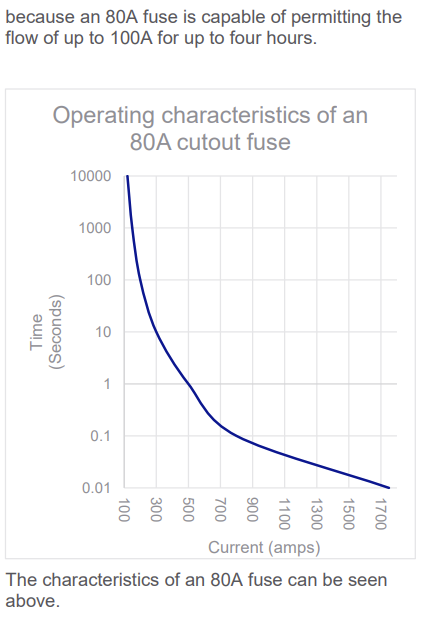
They explained their policy change to only fit 80A 'fuses', no longer 100A. But included a graph to show how long the fuse would last at higher levels. The 80A would handle ~100A for about 4hrs.
That would suggest, to me, that a 100A would 'happily' manage a bit over 100A?
I have the link, but sadly, I can no longer read the full info as it says commercial info and denied. But maybe someone else can find it, or similar based on the info. [Edit - Found a link and included in my later post.]
Hope this helps, rather than opening a large can of worms.
Standardisation of Fusing to 80A
Mart. Cardiff. 8.72 kWp PV systems (2.12 SSW 4.6 ESE & 2.0 WNW). 28kWh battery storage. Two A2A units for cleaner heating. Two BEV's for cleaner driving.
For general PV advice please see the PV FAQ thread on the Green & Ethical Board.0 -
I cannot see the DNO being particularly concerned about the loads ( and therefore the current ) you propose to consume given the supply 100A rating, if that is what it is.
They could well be interested on how it affects the balancing of the supply at the three phase transformer.
The only way to find the answer is to ask them directly or via your electrician.
0 -
Thanks Heedtheadvice.
DNO application made this morning, so now on a waiting game.
1 -
Thanks Martyn1981.
That's a bit unnerving as we are clearly at the upper limits of what we can push through the system.
I think I need to move hot water a little later in our off-peak period and it will be less likely to clash with EV charging most days. I can also look to limit battery charging to 8.5kw which will save a few amps
1 -
Doh! I thought I was giving you good news, that 100A will allow more. Hadn't thought about the policy changes to reduce to 80A might be of concern, sorry. Maybe just keep your head down if your DNO is doing this.
BTW, to all, I've found a link to the document, but it goes straight to the PDF. However, I think it's worth a read, only two pages, and I'll pop a pic of the chart, but note that the time scale is logarithmic.
NGED Standardisation of Fusing to 80A
 Mart. Cardiff. 8.72 kWp PV systems (2.12 SSW 4.6 ESE & 2.0 WNW). 28kWh battery storage. Two A2A units for cleaner heating. Two BEV's for cleaner driving.
For general PV advice please see the PV FAQ thread on the Green & Ethical Board.2









Confirm your email address to Create Threads and Reply

Categories
- All Categories
- 355.7K Banking & Borrowing
- 254.9K Reduce Debt & Boost Income
- 456.1K Spending & Discounts
- 248.2K Work, Benefits & Business
- 605.8K Mortgages, Homes & Bills
- 179K Life & Family
- 263.6K Travel & Transport
- 1.5M Hobbies & Leisure
- 16.1K Discuss & Feedback
- 37.7K Read-Only Boards