We’d like to remind Forumites to please avoid political debate on the Forum.
This is to keep it a safe and useful space for MoneySaving discussions. Threads that are – or become – political in nature may be removed in line with the Forum’s rules. Thank you for your understanding.
Help with changes to current set up
Comments
-
Do check with your DNO (District Network Operator) before installing a larger solar inverter. The existing system may have been capped at 3.6kW for a good reason. 3.6kW is the maximum that usually goes through without any surveys. More than that would require prior approval.Before spending thousands on batteries, work out if the cost savings - the difference between day rate and night rate - will ever pay back the cost of the battery.Also make sure you aren't going to overload your supply. Charging an EV, and running the heat pump, and charging the house batteries, and running the immersion heater all at the same time may require an excessive amount of power.If it sticks, force it.
If it breaks, well it wasn't working right anyway.0 -
Thanks Ectophile.
I hope to get some time this weekend to sit down and crunch some numbers to see whether additional panels and/or battery storage would work. As I’m not clued up on costs to do the work I’ll need to get a couple of quotes to help with that.
Not certain I can ask the DNO directly about the sizing of the inverter but will look into this too.
Agreed about overloading the supply. I’d asked my electrician about this and he said it would be fine with 2x ev chargers in total. We wouldn’t be using sauna overnight; hot tub is a 1.5kw heating element when it kicks in; immersion won’t be used as we’ll have the heat pump for higher efficiency; and cooker/induction hob are also not in use at cheap rate period.
Thanks for your input!0 -
Hi all, late addition to this thread but hoping to get some more advice.Fogstar have 2x batteries available at what looks to be great prices on their website for Black Friday:and
Fogstar Energy 16.1kWh 48V Heated Solar Battery £1,799.99
Fogstar Energy ECO 48V 16.1kWh Solar Battery £1,399.99
Would either of these be suitable for a simple swap out on my current system so I could get 2x batteries installed? I’d probably look to change whatever I need to change to get the batteries to charge / discharge at a higher rating than 3.6kw but if its a swap out may be possible myself for 1 I it’s a decouple and couple option?0 -
bintyandthebeast said:Would either of these be suitable for a simple swap out on my current system so I could get 2x batteries installed?I'm going to quote myself from earlier in this thread when we were discussing Fogstar batteries:Your current system used "high voltage" batteries, not the 48-volt ones that many systems use. As a result it's only compatible with Fox ESS HV batteries. I've got a 16kWh Fogstar battery (not quite the one you link to, but similar). But theyre not compatible with your current inverter.You also say:
That'll mean replacing your current Fox ESS inverter. If you do replace the inverter, your replacement is likely to be suitable for 48-volt batteries.bintyandthebeast said:I’d probably look to change whatever I need to change to get the batteries to charge / discharge at a higher rating than 3.6kwSpeak to a MCS-accredited installer (or your preferred electrician) and ask for a quote for them to supply and install a suitable inverter plus however many Fogstar batteries you think you need.N. Hampshire, he/him. Octopus Intelligent Go elec / Fuse gas / Vodafone BB / iD mobile. Kirk Hill Co-op member.Ofgem cap table, Ofgem cap explainer. Economy 7 cap explainer. Gas vs E7 vs peak elec heating costs, Best kettle!
2.72kWp PV facing SSW installed Jan 2012. 11 x 247w panels, 3.6kw inverter. 37 MWh generated, long-term average 2.6 Os.0 -
For the DNO approval you can just try calling them, north Scotland is SSEn and their number is 0800 048 3516
I'm not sure how helpful they will be, but dont ask, dont know.
I'm southern Scotland and when I called SP energy networks thet said not to bother applying as Southern Scotland was red for generation.
Id be happy to recommend fogstar batteries, I've run them for around 2 years now and been very impressed.
I have just shy of 60kwh of them, so like 4 of the systems you highlighted.
Your fox batteries are high voltage, so you couldn't link them to "normal" home batteries which are usually 50V as QrizB has said.
I have a friend running the same fox system who does want to increase his capacity, so perhaps a deal could be made there, but you would have to be replacing your inverter too, if you moved away from fox, and that won't be cheap.
Most common ac inverters have a 3kw to 3.5kw output, though I think there are some 8kw ones now.
I currently use 2 x Lux ac inverters in parallel to give me around 7kw discharge capacity which usually covers the whole house unless Mrs. Solarchaser decides she wants the oven, the hob, the washing machine and tumble dryer on at the same time 😔
The eddi diverter is a great bit of kit, and for about £50 you can add a relay board to it which does two things, 1 is it it gives inputs for 2x pt1000 temperature sensors so you can see what you water tank is at, and heat until a set temperature, rather than the thermostat cut out, and the other is it has 2 x 16a relays which you can use as heaters amongst other things, and so you could have one of those relays run your hot tub pump on the overnight tarrif, and/or add in a side held 3kw heating element that would dip into your hot tub to heat the water also. (I've never used one, so cant endorse, but thats what id be doing).
This does however, require a knowledge and comfort level with electrics that you may not be comfortable with.
Regarding batteries and solar, I've recently (a bit over a year ago) changed from trying to consume all my solar charging batteries and heating tanks, to instead charging batteries and heating tanks overnight, and exporting everything i can, this has changed my bill from £1400 (after solar and batteries) to £-200 for the year (excluding EV charging)West central Scotland
4kw sse since 2014 and 6.6kw wsw / ene split since 2019
24kwh leaf, 75Kwh Tesla and Lux 3600 with 60Kwh storage1 -
Thanks for your feedback.
in my ignorance I thought the labelling on the front of the Fox box showing 48v DC supply would mean a simple changeover.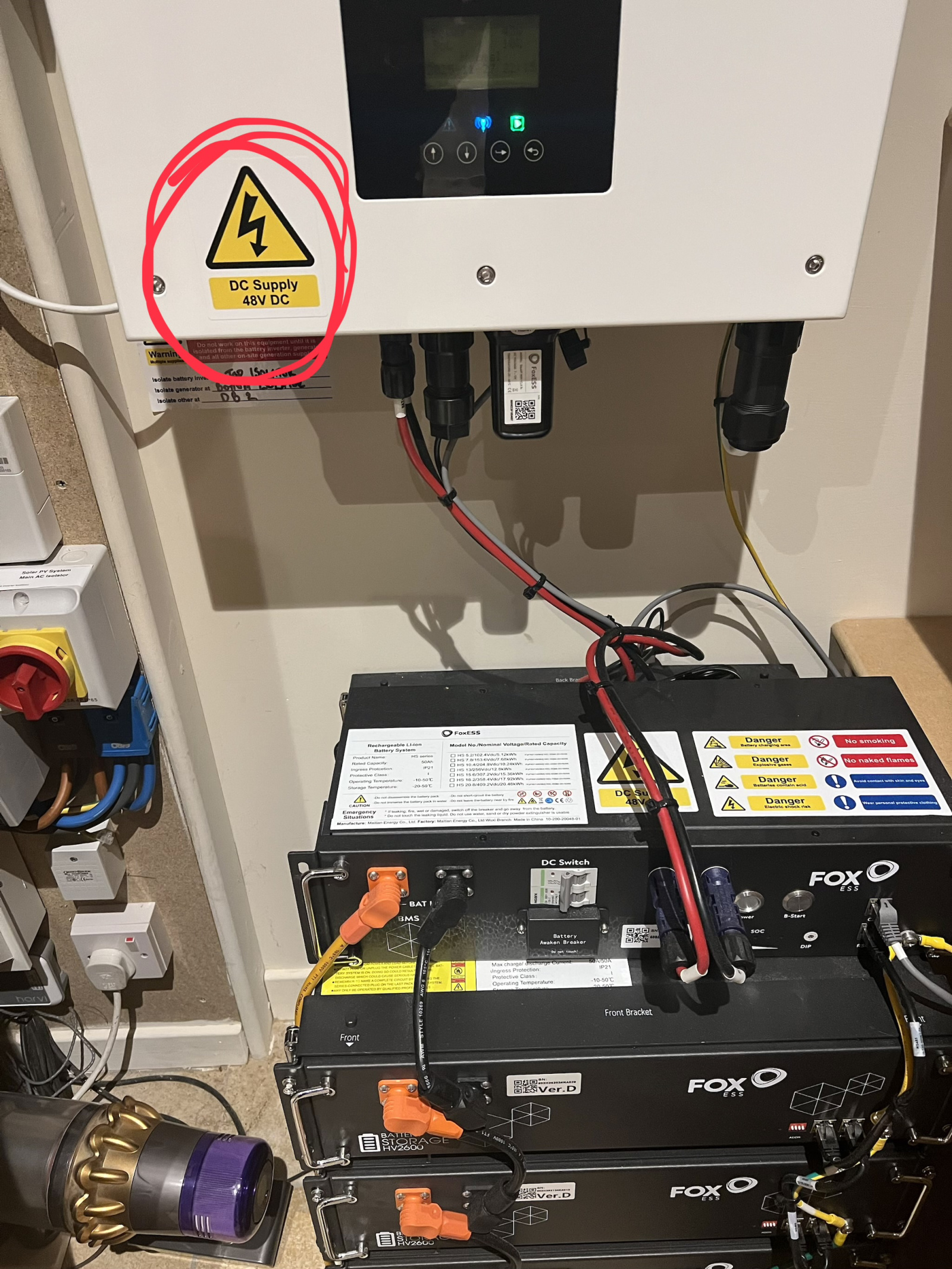 This box is in addition to the Growatt 3600TL Inverter (in attic).If we change the batteries and increase storage we would need to look at a higher charge / discharge rate. We get 5 hours overnight cheap rate and would scrape filling a single battery but any more than that would need an increase in charge rate as ours will be capped at 3700 watts.Our eddies being used for nighttime charge of the cylinder but we have signed off on a heat pump which is being installed in January and we will also be installing a bigger cylinder so won’t be diverting power through the day as will be cheaper to use the heat pump and take the export rate.I’ve asked for a couple of quotes now so will see how they come out after they come out to view what’s installed already.Thanks again!0
 -
Those 48V stickers are misleading and (I'd suggest) dangerously wrong.If you look at the Fox battery modules (towards the bottom of your photo) you'll see that they are connected in series; the positive terminal of the top battery connects to the negative terminal of the one below. The individual battery modules might be "48 volts" (the datasheet suggests a 51.2V nominal voltage) but with four in series, the DC voltage at the terminals on your inverter will be over 200 volts - considerably more hazardous than 48 volts and deserving the same respect you'd give to mains electricity.Datasheet here:N. Hampshire, he/him. Octopus Intelligent Go elec / Fuse gas / Vodafone BB / iD mobile. Kirk Hill Co-op member.Ofgem cap table, Ofgem cap explainer. Economy 7 cap explainer. Gas vs E7 vs peak elec heating costs, Best kettle!
2.72kWp PV facing SSW installed Jan 2012. 11 x 247w panels, 3.6kw inverter. 37 MWh generated, long-term average 2.6 Os.2 -
Fogstar Energy ECO 48V 16.1kWh Solar Battery £1,399.99 at Fogstar | hotukdeals
Is this any good for your new set up to be.0 -
I realised today that I never updated this as never had notification of replies, sorry.
We now have a heat pump (very fancy, it also runs a couple of fan coils in the attic, so we removed all radiators upstairs and now get heating and cooling for upstairs, underfloor heating for downstairs). We now also have a full electric car that I bought at end of March (Skoda Enyaq) and this has been working hard after charging on the 5 hours overnight cheap rate (currently 5.5p until next April). We have 2x Zappi 7kw chargers installed with load balancing activated if required but have only used 1 to date.
I'd been struggling to get a price for upgrading our battery but signed off today. We are installing 48.3kwh of Fogstar batteries plus a 10kw Fogstar (Luxpower) hybrid inverter, so hoping this will give us the comfort we need - charge overnight at cheap rate, discharge through the day and cover 95%+ of our usage. We are in semi-rural Scotland so does get very cold, so hoping for repayment in 4 years as I can sell my old Fox kit and have a £1000 grant we can tap into from our mortgage provider.
The idea is we can charge the electric car, heat hot water and fill battery at night but importantly for us (thinking of comfort) we won't need to worry about whether the toaster goes on while the induction hob is on and I blow a fuse as we are drawing more than 3.6kw which our current system can push through. Only on the coldest days should we need to burn full price power and that will help with the home battery equivalent of electric car range anxiety!
Cost will be £7210 (subject to DNO approval) for this level of storage and the installer is Fogstar approved so hopefully a stress free process but I've thought that before about others, we'll see!
I appreciate it's not a Powerwall but at the price I am paying I think if it needs replacing in 10 years then I am still quids in if/when technology changes / improves / reduces in cost, as we know it does.
Hoping to get DNO approval and installation for November before the worst of winter but half of me was wanting to hold out for a black Friday offer to save £500. In my head, I'm thinking the 3 months earlier install by starting now will mean I can save that anyway on electricity costs; chances are labour and other material costs will continue to increase; and we'll hopefully get a bit more for selling our existing kit when demand is there for others looking to increase their existing system. Based on what I know now, I think this is the best option, we'll see what hindsight tells us later!
2 -
Thank you for coming back with an update!
We are installing 48.3kwh of Fogstar batteries plus a 10kw Fogstar (Luxpower) hybrid inverter … Cost will be £7210 (subject to DNO approval) for this level of storage and the installer is Fogstar approved so hopefully a stress free process but I've thought that before about others, we'll see!
For 48kWh of battery and a 10kW inverter, that seems a keen price. Doubly so as it's in Scotland where prices often seem to be higher than England and Wales.
N. Hampshire, he/him. Octopus Intelligent Go elec / Fuse gas / Vodafone BB / iD mobile. Kirk Hill Co-op member.Ofgem cap table, Ofgem cap explainer. Economy 7 cap explainer. Gas vs E7 vs peak elec heating costs, Best kettle!
2.72kWp PV facing SSW installed Jan 2012. 11 x 247w panels, 3.6kw inverter. 37 MWh generated, long-term average 2.6 Os.0













Confirm your email address to Create Threads and Reply

Categories
- All Categories
- 355.7K Banking & Borrowing
- 254.9K Reduce Debt & Boost Income
- 456.1K Spending & Discounts
- 248.2K Work, Benefits & Business
- 605.8K Mortgages, Homes & Bills
- 179K Life & Family
- 263.6K Travel & Transport
- 1.5M Hobbies & Leisure
- 16.1K Discuss & Feedback
- 37.7K Read-Only Boards