We’d like to remind Forumites to please avoid political debate on the Forum.
This is to keep it a safe and useful space for MoneySaving discussions. Threads that are – or become – political in nature may be removed in line with the Forum’s rules. Thank you for your understanding.
Musings on changing from UC to Pension Age benefits, and a question.
Comments
-
I think retiring for Newcad is off the cards. You can see if you owed them they'd be all over it to the letter.
0 -
I agree that the deduction is simply because of the way that the UC computer has been programmed.
We all know from experience that the programming does not always align with what the UC legislation says.I'm well aware that if I do decide to challenge this deduction then the MR will most likely be denied and it will most probably need a tribunal hearing.
But of course an MR must be refused, or ignored, before you can go to tribunal.Thanks for the comment, however I had already looked at that and strongly disagree on that specific point.
Whilst at first Reg 73(2A) may appear to allow such a deduction, once you think more deeply about it that isn't the case.
Reg 73(2A) exists to account for regular income that is received during a UC claim but that is received on a weekly, fortnightly or 4-weekly basis rather than on a monthly basis. (eg NS ESA, NS JSA, CA, State Pension for the older member of a MAC with an ongoing UC claim).
Reg 73(2a) allows for the pro-rata'ing of such unearned income that will be (is expected to be) received during a period where a UC claim is 'live'.
It does not allow deduction of unearned income that is, or will be, received when there is no 'live' UC claim ongoing.The argument here is that (despite what the UC computer had been programmed to do) the DWP has no legal basis to deduct income, earned or unearned, that is received when there is no existing, 'live', claim for benefit.
ie They cannot legally take into account and deduct for any income received after a benefit claim has been closed.1 -
@Newcad What makes you think that the date you "receive" the payment is more relevant than the period in respect of which it is paid?
See also, for example, the wording in Reg. 22(1)(a): "in respect of".
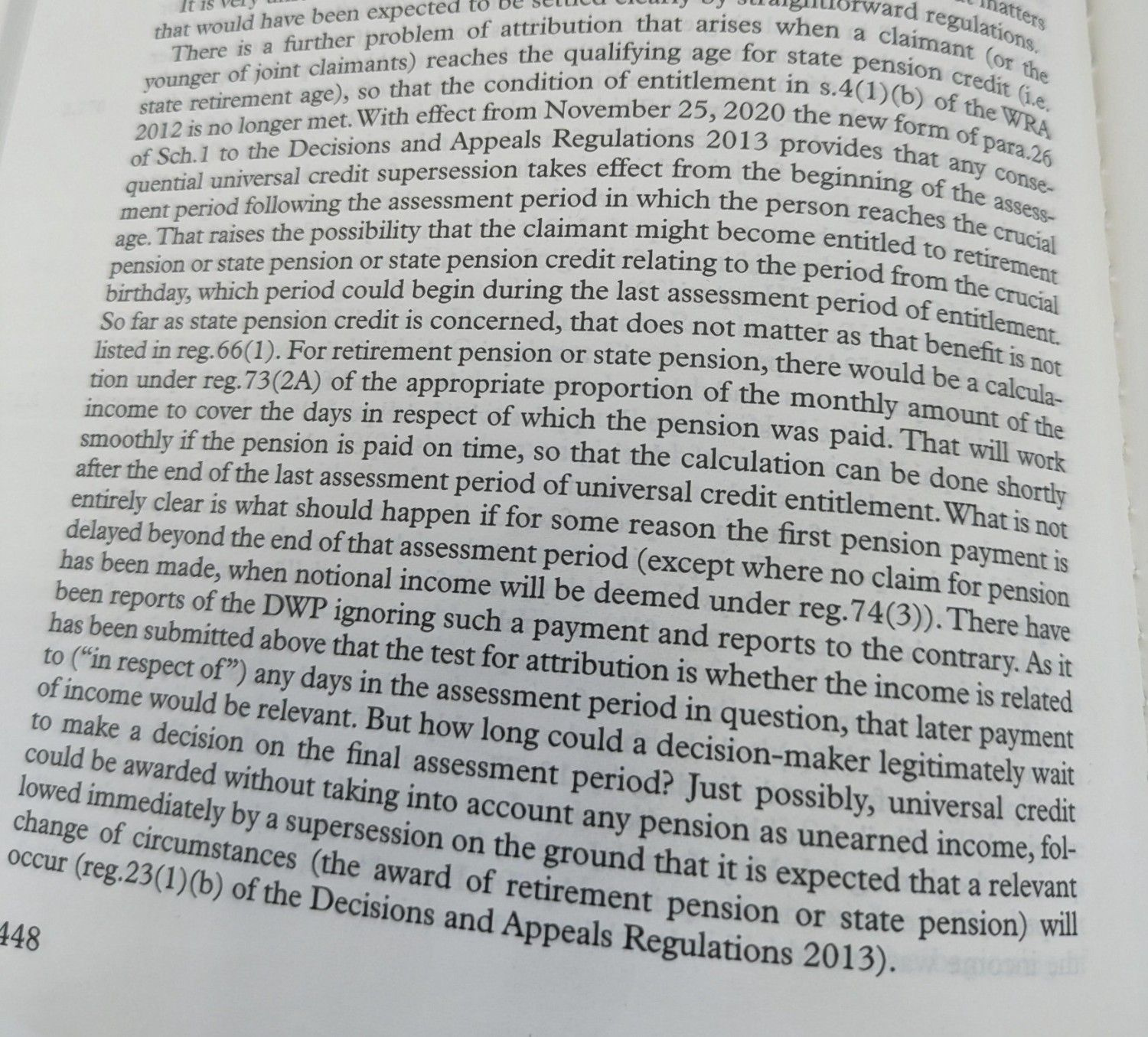
This isn't just me: the learned authors of the Sweet & Maxwell commentary (current and ex-UT judges) to the regulations also come to this conclusion (although they do state that it is unfortunate that the regulations are not clearer about this point).
The Sweet & Maxwell commentary actually specifically discusses your situation. Here is a photo of the relevant section.
 0
0 -
I agree that the legislation on this point is not clear cut at all. Probably because it is a situation that can only ever occur once in a persons lifetime.
What makes me think that the date income is received is relevant?
Quite simple really - If the income is received when you are not claiming any benefit then there is no benefit claim for that income to affect.
Remember that for UC purposes State Pension is "Unearned Income" and not an ovelapping benefit.
(Pension Credit is an overlapping benefit with UC, however it is specifically disregarded in the run-on UC AP by the 2020 ammendment).
0 -
It will only happen once in a lifetime with the State Pension, but it happens the whole time when other sources of unearned income start during an ongoing UC award but are only first paid in a later AP.
You seem to be saying that if the payment is received during an ongoing award, but, say, only in the next AP, then you would accept it could affect the previous AP. But that distinction doesn't make sense to me. Either you take it into account only from the first payment date (which is how IS/ESA/JSA used to work), or you take it into account from the start of the period in respect of which it is paid (which is basically how HB used to work, and still does). The fact that the UC award ended before the payment was made is no different to a situation where the first payment was only made in the following AP, and you want to take it into account in the previous AP.
Regarding Pension Credit, it isn't an overlapping benefit - it simply isn't included in the list of unearned income taken into account by UC. And this was always the case.
The 2020 amendments weren't needed for that - they simply allowed UC to continue past pension age, until the end of the AP.
1 -
"The fact that the UC award ended before the payment was made is no different to a situation where the first payment was only made in the following AP, and you want to take it into account in the previous AP.
Sorry but I disagree wih that point, it is a different situation - there is no "following AP" because the UC claim is being closed.
I think that you will also find that both Pension Credit and Pension Age Housing Benefit are classed as overlapping benefits with UC, although these days that should only happen in the case of a MAC.
(It could previously also happen when the UC computer didn' recognise State Pension age and so didn't clode the UC claim for a single person).That is why both Pension Credit and PA Housing Benefit are specifically included as disregards in the The Universal Credit (Persons who have attained state pension credit qualifying age) (Amendment) Regulations 2020
It is notable that a disregard for State Pension itself is not included in that 2020 legislation,
That's because it should not be deducted from UC as Unearned Income if paid after the UC claim is closed, and so there was no need for it to be specifically disregarded in the 2020 legislation.0 -
My point was that there is logically no difference between a situation where the income is received in an ongoing UC award but in the following AP, or a situation where the UC award has ended and the income is received after it has ended.
PC and HB are NOT overlapping benefits with UC. The disregards you refer to in the legislation you've linked to are to disregard UC from the PC and HB calculations. There is no disregard within UC, because it isn't needed, as they aren't included in the list of unearned income in UC.
0 -
I simply cannot agree with that first statement, of course there is a major difference in the two situations.
In the first situation the UC claim is still ongoing.
In the second situation the UC claim has ended.That is the difference between having a current, active, UC claim and not having a UC claim at all - you can't get a bigger difference in UC that that.
(UC or Not UC; that is the question. - Sorry, I couldn't resist that one),
My major point stands though.
Whatever the income is there is no legislation that I can find that allows for any income (Earned or Unearned) that is paid and recetved outside the period of a UC claim to be deducted from UC payments.
It would be legally perverse to deduct from a benefit income that is received outside of the period when that benefit claim is ongoing.
If you can find any such clause in current legislation, one that allows income received when there is no existing UC claim to be deducted from UC, then please do share it.
As you know, when it comes to interpreting legislation than what isn't included in the legislation can be just as important as what is included.
(A prime example being the 'Unearned Income' list, what isn't listed on it is just as jmportant as what is listed on it, some might say more so)PS. I agree that I was a bit slack with my wording regarding SPC and PA-HB and mutual disregards.
The Expanatory Memorandum to the 2020 legislation spells it out at para. 7.7:
https://www.legislation.gov.uk/uksi/2020/655/pdfs/uksiem_20200655_en.pdf"7.7 This final payment of Universal Credit will not be taken into account when calculating
awards of State Pension Credit or pension age Housing Benefit. Nor will any payment
of State Pension Credit or pension age Housing Benefit be taken into account in the
calculation of the final Universal Credit payment."0 -
Above 54A regulations from 2013
They probably use Regulation 66 lists specific types of unearned income that can be deducted (e.g., Retirement Pension, ESA, etc.).
If a claimant receives a payment of a listed benefit before their UC claim starts, the DWP has no legislative grounds to deduct it from the first UC payment. If they try to "pro-rata" it or overlap it, they are often acting ultra vires (beyond their powers), as there is no provision in the 2013 Regulations for "apportioning" income from a period prior to the claim into the first assessment period.
There is no clause in the Welfare Reform Act 2012 or the Universal Credit Regulations 2013 that explicitly permits the DWP to deduct income received prior to the date of claim.In fact, the legislation points in the opposite direction.
0 -
We aren't the first to discuss these issues. The Sweet & Maxwell commentary (from UT judges) discusses this issue at length (3 pages of tightly-spaced text!).
Their conclusion is that although the legislation isn't the clearest, everything points to the calculation being done on the basis of unearned income received "in respect" of the assessment period, regardless of when it is actually paid (whether before or after the assessment period, and whether there is a live UC award at the point of receipt of the income or not).
We also know that this is in fact how DWP do it in practice.
The main reasons the authors of the Sweet & Maxwell commentary give for this conclusion are as follows:
- the specific rules to look at the actual date of payment is only said for earned income (see Reg. 54(1)).
- Para. 4(1)(c) of Sch. 1 to the WRA 2012 authorises regulations to provide for how to calculate a person's unearned income in respect of an assessment period, and this is then taken up by Reg. 22(1)(a), which states that it should be the unearned income "in respect of the assessment period".
- the calculation given in Reg. 73(2A) clearly works on the basis that what is relevant is the amount of unearned income which is received "in respect" of the assessment period, regardless of when it is paid.
On the specific points made above by @Newcad and @TimeLord1:
- There is no need for a regulation to specify clearly that even if the income is received after the UC award ends, it can be taken into account. Once the Regs specify that what matters is the amount of income received "in respect of" the assessment period, then that is all that matters.
- I see no reason for it to be "legally perverse": ultimately you have received the income for that period.
- Where income is received before the claim, but is received in respect of a period within the assessment period, then there is a legislative basis to include that income in the UC calculation (as above: Para. 4(1)(c) of Sch. 1 to the WRA 2012, and Reg. 22(1)(a)).
I would also add that although there is no explicit case law on this, there is a Court of Appeal decision where the Court deals with the calculation of earned income. It is clear from the decision that the only reason earned income is not calculated by reference to the amounts earned in respect of the assessment period (regardless when received) is because of Reg. 54(1) (which explicitly states that it depends on the amounts actually received in the assessment period). The clear implication is that for unearned income (which does not have an equivalent to Reg. 54(1)), the calculation will be based on the amounts received in respect of the assessment period, regardless of when they are actually received. See Secretary of State for Work And Pensions v Johnson & Ors [2020] EWCA Civ 778.
That, together with the fact that the Sweet & Maxwell commentary (written by UT judges, and extensively used by all Tribunals when making decisions) also comes to this conclusion, means I think the argument won't work.
However, by all means, @Newcad please do appeal it - I will be watching closely!
1











Confirm your email address to Create Threads and Reply

Categories
- All Categories
- 354.5K Banking & Borrowing
- 254.4K Reduce Debt & Boost Income
- 455.5K Spending & Discounts
- 247.4K Work, Benefits & Business
- 604.3K Mortgages, Homes & Bills
- 178.5K Life & Family
- 261.8K Travel & Transport
- 1.5M Hobbies & Leisure
- 16.1K Discuss & Feedback
- 37.7K Read-Only Boards