We’d like to remind Forumites to please avoid political debate on the Forum.
This is to keep it a safe and useful space for MoneySaving discussions. Threads that are – or become – political in nature may be removed in line with the Forum’s rules. Thank you for your understanding.
APCOA/SABA and POPLAs right to adjudicate Penalty Notices issued under railway bylaws




They have provided a DfT response to a query back in 2018 on POPLAs remit to deal with penalties. Whilst it suggests that the DfT approves of an "independent" secondary appeals process, careful reading of the third paragraph of the DfTs letter proves otherwise.
Here is the DfT letter:
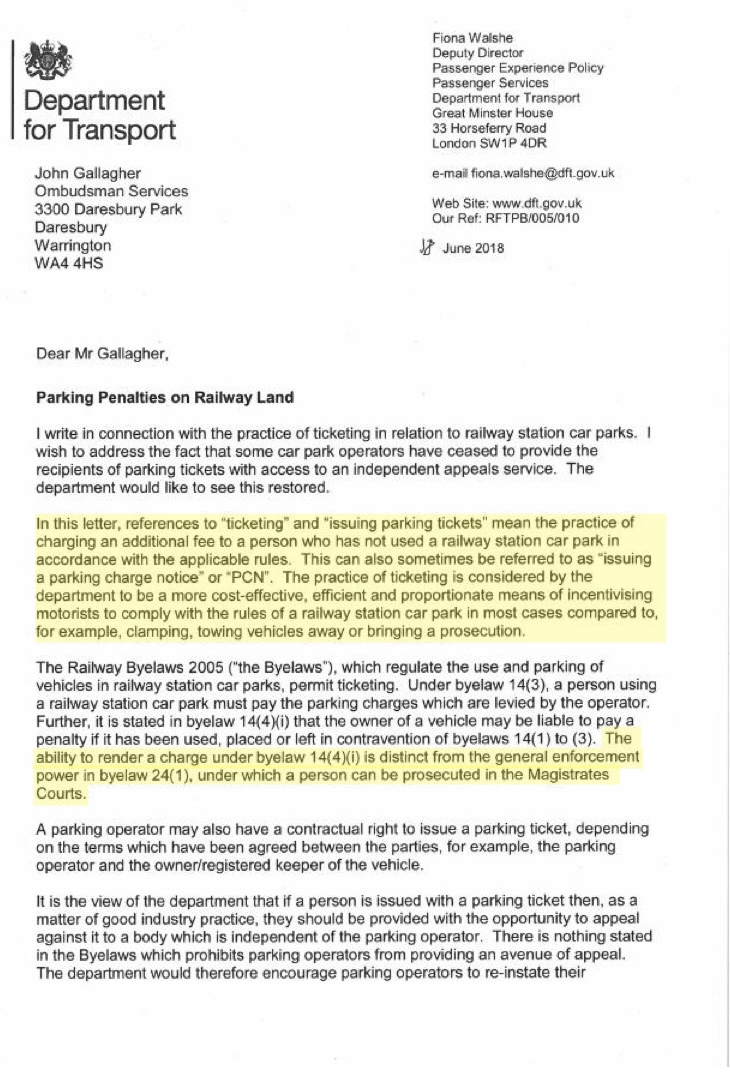
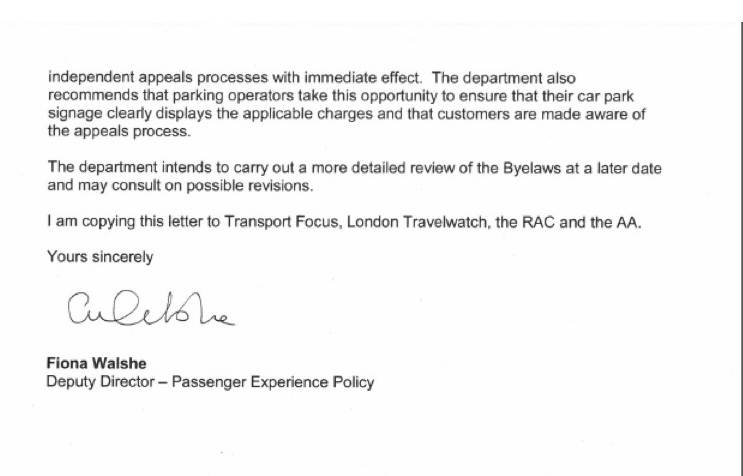
I have highlighted the part that I believe is very relevant here. In short, the DfT has said that they have no issue with a PPC issuing a Parking Charge Notice (PCN) as a "ticket/contractual charge" for a breach of Byelaws 14(1) to (3). However it makes a clear distinction to the effect that it does not expect any ability to prosecute as a criminal matter under the powers of Byelaw 24(1).
I believe that there is cross use of the word "penalty" by the person who authored the letter. The DfT’s use of "penalty" in relation to Byelaw 14(4)(i) creates confusion by implying a statutory enforcement power that does not exist in this context. The correct interpretation is that Byelaw 14(4)(i) authorises civil charges, not criminal penalties, which are solely the remit of Byelaw 24(1) and require prosecution in the Magistrates' Court.
The last sentence in the third paragraph highlights a crucial distinction between two types of enforcement actions under the Railway Byelaws:
Byelaw 14(4)(i): This allows for a civil penalty that the owner of a vehicle may have to pay if the vehicle is parked in contravention of the parking byelaws (such as not paying parking fees or parking improperly). This "penalty" [sic] is typically issued as a Parking Charge Notice by the parking operator. The intent of this byelaw is to create a straightforward mechanism for dealing with parking violations without involving the criminal justice system.
Byelaw 24(1): This provides a separate, more formal criminal enforcement power, under which a person can be prosecuted in the Magistrates' Court for breaching railway byelaws. This is a more serious legal route that could lead to a criminal conviction, typically reserved for more severe or repeated offences rather than minor parking infringements.
The DfT letter, specifically in the third paragraph, does not grant any private parking operator the authority to issue Penalty Notices under railway byelaws with the weight of criminal prosecution. The "penalty" referenced in Byelaw 14(4)(i) is purely civil and contractual, and it lacks the statutory weight of criminal enforcement as outlined in Byelaw 24(1). Without explicit statutory delegation for criminal prosecution, operators cannot claim authority to issue Penalty Notices as criminal penalties. Any such attempt to imply such authority in their notices is misleading and unlawful.
In summary, the DfT’s use of "penalty" in relation to Byelaw 14(4)(i) creates confusion by implying a statutory enforcement power that does not exist in this context. The correct interpretation is that Byelaw 14(4)(i) authorises civil charges, not criminal penalties, which are solely the remit of Byelaw 24(1) and require prosecution in the Magistrates' Court.
Comments
-
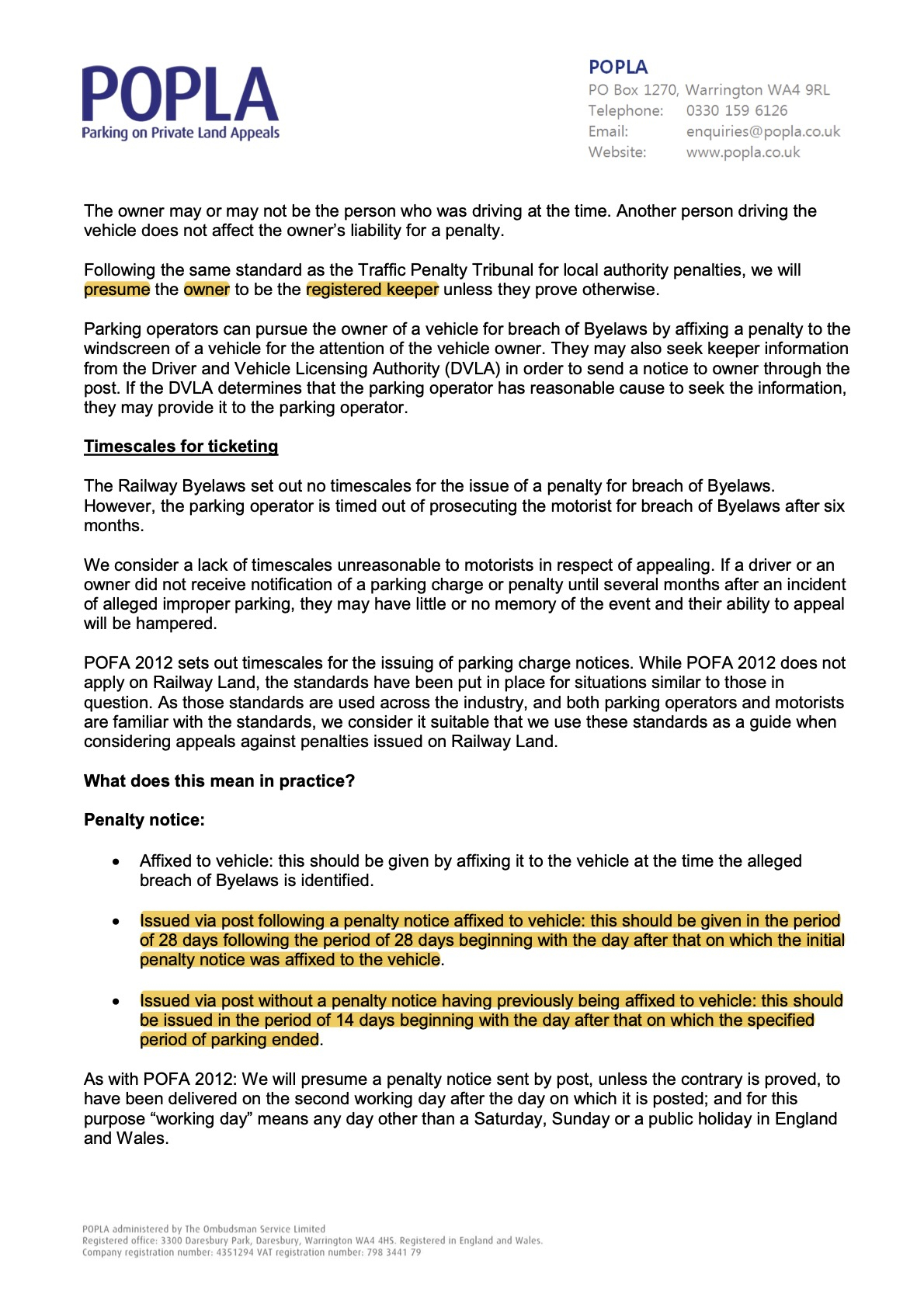
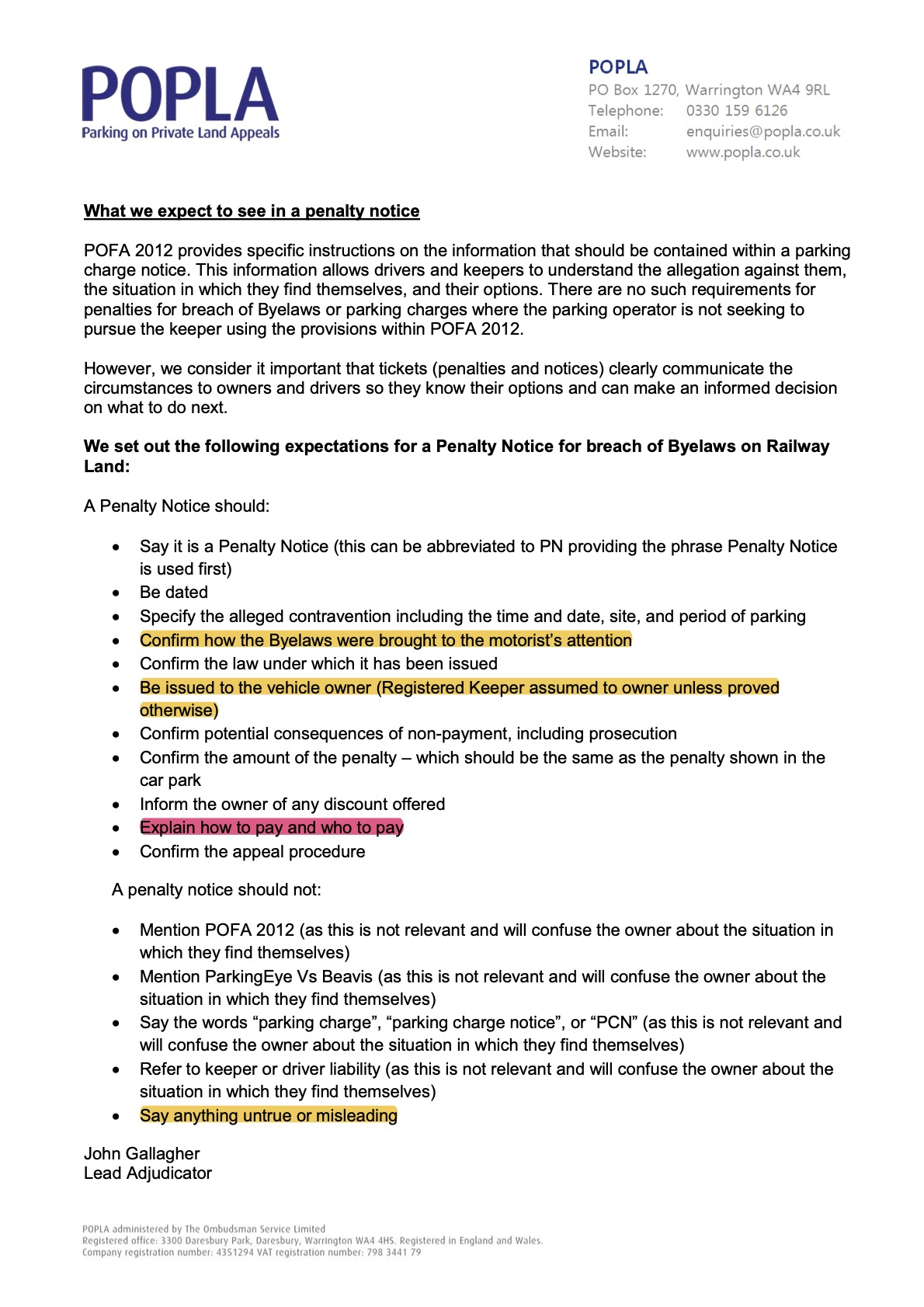
Here is POPLA's interpretation. Obviously it is weighted in the operators favour but it is worthwhile to not two distinct points. They require that a PN, if issued as a windscreen ticket, can only be followed up with a Notice to Owner (NtO) under the same rules as PoFA. The operator must wait 28 days before issuing the NtO and it cannot be issued after 56 days.
The same applies to a postal PN. It must be "given" within 14 days of the alleged "offence".
Anyway, as I have already pointed out, APCOA and SABA are not authorised to issue Penalty Notices under threat of criminal prosecution. They are only "offered contracts" fraudulently dressed up as PNs.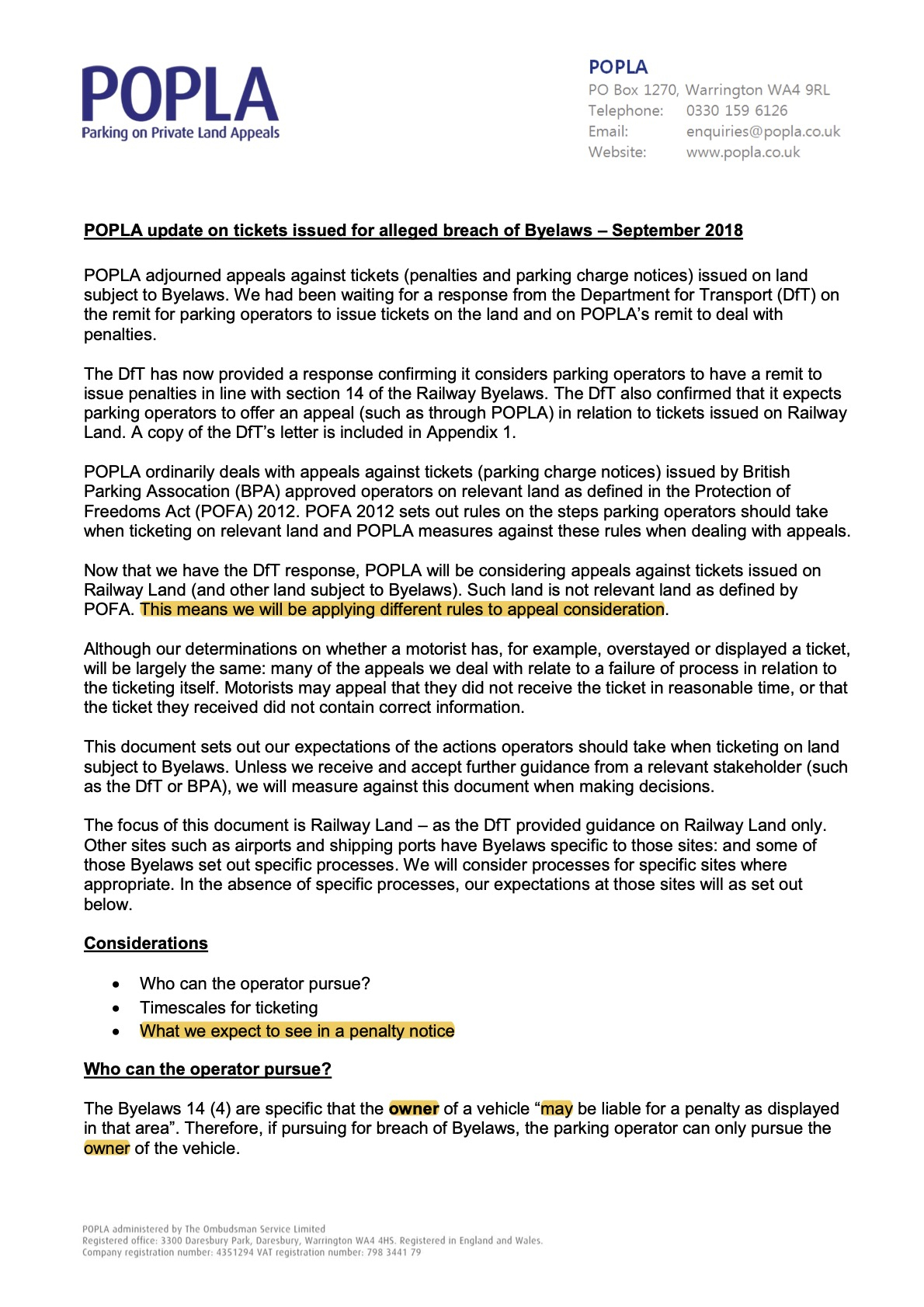
5 -
Interesting. That does match what we already knew and also matches the 2020 BPA CoP Annex about railway penalties.
Have to say (whether you agree with what they are saying or not) POPLA is a hundred times better than the IAS in the detail in their Annual Reports and in the professional way they issue this sort of guidance which clarifies what they expect to see.PRIVATE 'PCN'? DON'T PAY BUT DON'T IGNORE IT (except N.Ireland).
CLICK at the top or bottom of any page where it says:
Home»Motoring»Parking Tickets Fines & Parking - read the NEWBIES THREAD3 -
No idea why the first page of the DfT letter was removed by the mods. It is a matter of public record and is in the public domain.
Regarding the (mis)interpretation that POPLA has put on the DfT letter... it is clear that the DfT intended that breaches of Bylaw 14 should be dealt with under the civil regime. The fact that they used what is in effect an oxymoron to describe it as "civil penalties" doesn't help.
Under civil law, there is no such thing as a “penalty” in the sense of a punitive measure. The DfT should have used different terminology.
In civil law, remedies are compensatory rather than punitive. Civil charges, such as those related to parking breaches, are intended to compensate for losses or to enforce compliance with contractual terms, not to punish or penalise in the same way as criminal fines. The term “penalty” implies punishment, usually in response to a legal offence. This punishment-oriented terminology is inconsistent with civil law principles, where charges must be proportionate and cannot be punitive.
Using “civil penalty” blurs the line between civil and criminal enforcement. It suggests that private operators have the power to impose punitive fines, akin to those imposed by statutory bodies, which they do not. In contract law, “penalties” are generally unenforceable because they are considered punitive and disproportionate. A charge that is punitive rather than compensatory can be struck down in civil courts as an unlawful penalty. Private operators, under civil law, cannot impose penalties—they can only seek reasonable charges linked to actual loss or deterrence.
Instead of “civil penalty,” the DfT should have used terms like “parking charge” or “civil charge.” These terms more accurately describe the nature of the charge in civil law, clarifying that it is intended as a deterrent or compensation, not a punishment. “Parking Charge Notice” (PCN) is the established terminology in the parking industry for civil charges imposed by private operators, and it avoids the punitive implications associated with “penalty.”
By using the term “civil penalty,” the DfT inadvertently suggests that these charges carry a statutory or punitive weight that they do not legally have. This may lead the public to perceive these charges as quasi-criminal fines, which they are not. The DfT’s language has obviously been misinterpreted by APCOA/SABA as a license to impose punitive fines, when their legal authority only extends to civil enforcement within the bounds of proportionality.
The DfT’s use of “civil penalty” is, in effect, an oxymoron and a misuse of legal terminology. In civil law, the correct terms are “parking charge” or “civil charge,” which accurately describe a compensatory measure rather than a punitive penalty. This distinction should have been made to prevent confusion and ensure that parking operators, POPLA and the public understand that these charges are civil in nature, without the punitive or statutory implications associated with true “penalties.”
The DfT specifically state that the ability to render a charge under byelaw 14(4)(i) is distinct from the general enforcement power in byelaw 24(1), under which a person can be prosecuted in the Magistrates Courts. The only logical interpretation of that is infringements of Bylaw 14 should be dealt with as civil matters by way of a PCN and not a Penalty Notice.0



Confirm your email address to Create Threads and Reply

Categories
- All Categories
- 354.6K Banking & Borrowing
- 254.5K Reduce Debt & Boost Income
- 455.5K Spending & Discounts
- 247.5K Work, Benefits & Business
- 604.4K Mortgages, Homes & Bills
- 178.6K Life & Family
- 261.9K Travel & Transport
- 1.5M Hobbies & Leisure
- 16.1K Discuss & Feedback
- 37.7K Read-Only Boards