We’d like to remind Forumites to please avoid political debate on the Forum.
This is to keep it a safe and useful space for MoneySaving discussions. Threads that are – or become – political in nature may be removed in line with the Forum’s rules. Thank you for your understanding.
📨 Have you signed up to the Forum's new Email Digest yet? Get a selection of trending threads sent straight to your inbox daily, weekly or monthly!
The Forum now has a brand new text editor, adding a bunch of handy features to use when creating posts. Read more in our how-to guide
Savings interest tax calculation confusion

rundmc-k
Posts: 133 Forumite




If any brainy types could help me understand this I would be most grateful.
I was playing around with the self assessment calculator to see if I could understand how it was worked out, but I'm a little confused about the following.
So, say savings interest in a year was 1380
SIPP contribution 24,750, raising Basic rate limit to 62450
Using the calculator, if my profit was 73,000:
Income on which tax due 61810
Tax on Savings 1000 x 0% = 0
380 x 20% = 76
So I'd have to pay £76 tax on savings interest as my SIPP contribution has brought me into BR. I understand this.
If my profit was 75,000:
Income on which tax due 63810
Tax on Savings 500 x 0% = 0
860 x 40% = 344
So I'd have to pay £344 tax on savings interest as I am just in the HR bracket. I understand this.
However, If my profit was 74,000:
Income on which tax due 62810
Tax on Savings 140 x 0% = 0 (BR band at nil rate)
360 x 0% = 0 (HR band at nil rate)
So I would pay zero tax on savings interest at this point? How does that work. Why would having 1k less profit give a savings interest tax bill, and 1k more profit give a savings interest tax bill, but having 74k right in the middle of the two give no savings tax bill? Am I missing something here?
Any help would be most appreciated.
I was playing around with the self assessment calculator to see if I could understand how it was worked out, but I'm a little confused about the following.
So, say savings interest in a year was 1380
SIPP contribution 24,750, raising Basic rate limit to 62450
Using the calculator, if my profit was 73,000:
Income on which tax due 61810
Tax on Savings 1000 x 0% = 0
380 x 20% = 76
So I'd have to pay £76 tax on savings interest as my SIPP contribution has brought me into BR. I understand this.
If my profit was 75,000:
Income on which tax due 63810
Tax on Savings 500 x 0% = 0
860 x 40% = 344
So I'd have to pay £344 tax on savings interest as I am just in the HR bracket. I understand this.
However, If my profit was 74,000:
Income on which tax due 62810
Tax on Savings 140 x 0% = 0 (BR band at nil rate)
360 x 0% = 0 (HR band at nil rate)
So I would pay zero tax on savings interest at this point? How does that work. Why would having 1k less profit give a savings interest tax bill, and 1k more profit give a savings interest tax bill, but having 74k right in the middle of the two give no savings tax bill? Am I missing something here?
Any help would be most appreciated.
0
Comments
-
This may be linked to something known as Beneficial Ordering. This is where the Personal Allowance is allocated against the source of income which then gives the lowest overall tax liability.rundmc-k said:If any brainy types could help me understand this I would be most grateful.
I was playing around with the self assessment calculator to see if I could understand how it was worked out, but I'm a little confused about the following.
So, say savings interest in a year was 1380
SIPP contribution 24,750, raising Basic rate limit to 62450
Using the calculator, if my profit was 73,000:
Income on which tax due 61810
Tax on Savings 1000 x 0% = 0
380 x 20% = 76
So I'd have to pay £76 tax on savings interest as my SIPP contribution has brought me into BR. I understand this.
If my profit was 75,000:
Income on which tax due 63810
Tax on Savings 500 x 0% = 0
860 x 40% = 344
So I'd have to pay £344 tax on savings interest as I am just in the HR bracket. I understand this.
However, If my profit was 74,000:
Income on which tax due 62810
Tax on Savings 140 x 0% = 0 (BR band at nil rate)
360 x 0% = 0 (HR band at nil rate)
So I would pay zero tax on savings interest at this point? How does that work. Why would having 1k less profit give a savings interest tax bill, and 1k more profit give a savings interest tax bill, but having 74k right in the middle of the two give no savings tax bill? Am I missing something here?
Any help would be most appreciated.
What is the very bottom line of the calculation when you used profit of £74,000?
Is £1,000 more profit being taxed within the calculation compared to the other two scenarios?0 -
"So, say savings interest in a year was 1380"
"Tax on Savings 1000 x 0% = 0
380 x 20% = 76"
OK, 1000+380 = 1380. That makes sense.
Then, next scenario:
"Tax on Savings 500 x 0% = 0
860 x 40% = 344"
500 + 860 = 1360. Not 1380. Why is there £20 difference? Are those your figures, or " the self assessment calculator" (HMRC online self-assessment? Something else?)
Next scenario:
"Tax on Savings 140 x 0% = 0 (BR band at nil rate)
360 x 0% = 0 (HR band at nil rate)"
I have no idea where "140" has come from, or why it's paired with "360", unless there should be a 3rd line "880 x 20% = 176" ( I suspect scenario 2 should have read "880 x 40% = 352").
Is the thinking that 62810 is 360 more than 62450, so that your zero rate band for interest is still 500, but it should be allowed to cover the £360 on which, otherwise, 40% would be owed - leaving £140 for zero rate coverage of what otherwise would be taxed as 20%, leaving £880 that is taxed at 20%?0 -
The bottom line when using profit of 74,000 is that £12,462 income tax is due.Dazed_and_C0nfused said:
This may be linked to something known as Beneficial Ordering. This is where the Personal Allowance is allocated against the source of income which then gives the lowest overall tax liability.rundmc-k said:If any brainy types could help me understand this I would be most grateful.
I was playing around with the self assessment calculator to see if I could understand how it was worked out, but I'm a little confused about the following.
So, say savings interest in a year was 1380
SIPP contribution 24,750, raising Basic rate limit to 62450
Using the calculator, if my profit was 73,000:
Income on which tax due 61810
Tax on Savings 1000 x 0% = 0
380 x 20% = 76
So I'd have to pay £76 tax on savings interest as my SIPP contribution has brought me into BR. I understand this.
If my profit was 75,000:
Income on which tax due 63810
Tax on Savings 500 x 0% = 0
860 x 40% = 344
So I'd have to pay £344 tax on savings interest as I am just in the HR bracket. I understand this.
However, If my profit was 74,000:
Income on which tax due 62810
Tax on Savings 140 x 0% = 0 (BR band at nil rate)
360 x 0% = 0 (HR band at nil rate)
So I would pay zero tax on savings interest at this point? How does that work. Why would having 1k less profit give a savings interest tax bill, and 1k more profit give a savings interest tax bill, but having 74k right in the middle of the two give no savings tax bill? Am I missing something here?
Any help would be most appreciated.
What is the very bottom line of the calculation when you used profit of £74,000?
Is £1,000 more profit being taxed within the calculation compared to the other two scenarios?
When using 75,000, the income tax due is £12,490, but £344 is then added to that for savings interest tax0 -
I'm using HMRC online self assessment calculator.EthicsGradient said:"So, say savings interest in a year was 1380"
"Tax on Savings 1000 x 0% = 0
380 x 20% = 76"
OK, 1000+380 = 1380. That makes sense.
Then, next scenario:
"Tax on Savings 500 x 0% = 0
860 x 40% = 344"
500 + 860 = 1360. Not 1380. Why is there £20 difference? Are those your figures, or " the self assessment calculator" (HMRC online self-assessment? Something else?)
Next scenario:
"Tax on Savings 140 x 0% = 0 (BR band at nil rate)
360 x 0% = 0 (HR band at nil rate)"
I have no idea where "140" has come from, or why it's paired with "360", unless there should be a 3rd line "880 x 20% = 176" ( I suspect scenario 2 should have read "880 x 40% = 352").
Is the thinking that 62810 is 360 more than 62450, so that your zero rate band for interest is still 500, but it should be allowed to cover the £360 on which, otherwise, 40% would be owed - leaving £140 for zero rate coverage of what otherwise would be taxed as 20%, leaving £880 that is taxed at 20%?
The reason for 1360 figure as opposed to the 1380 you'd expect, due to it being the total savings interest, is because there is 1360 difference between the income on which tax is due (63,810) and the basic rate (62,450). As for why though, I'm not entirely sure.
As for the 140 BR, 360 HR thing, I don't understand it either, but it's here, on the SA calculation.
For interest's sake, if I change profit to 73,641, then it brings up
BR at nil rate £499 x 0%
HR at nil rate £1 x 0%
I just can't work it out0 -
OK, I can understand it now.
73k: total income of 74,380 is below the adjusted 75,020 higher rate threshold. So PSA is 1000, and savings tax is (1380-1000)*0.2=£76.
Salary tax = (73000-12570)*0.2=£12086
total tax £12,162
75k: total income of 76,380 is £1360 above the adjusted 75,020 higher rate threshold. So PSA is £500, and £1380 savings are taxed as follows:
£500 is taxed at 0%
£860 is taxed at 40% = £344
£20 is taxed at 20% = £4
Salary tax = (75000-12570)*0.2=£12486
total tax £12,834
74k: total income of 76,380 is £360 above the adjusted 75,020 higher rate threshold. So PSA is £500, and £1380 savings are taxed as follows:
£360 is taxed at 0% ("would have been" taxed at 40%, but the PSA covers that)
£140 is taxed at 0% ("would have been" taxed at 20%, but the remaining PSA covers that)
£880 is taxed at 20% = £176
Salary tax = (74000-12570)*0.2=£12286
total tax £12,462
73641: total income of 75,021 is £1 above the adjusted 75,020 higher rate threshold. So PSA is £500, and £1380 savings are taxed as follows:
£1 is taxed at 0% ("would have been" taxed at 40%, but the PSA covers that)
£499 is taxed at 0% ("would have been" taxed at 20%, but the remaining PSA covers that)
£880 is taxed at 20% = £176
Salary tax = (73641-12570)*0.2=£12214.20
total tax £12,390 (the 0.2 is rounded down)
Think of the PSA as a moveable allowance that allows you to zero out a section of your interest income. It's positioned to give you maximum benefit - Dazed_and_C0nfused's "Beneficial Ordering". That means zeroing out £360, or £1, that would have been subject to 40% tax in the last 2 cases, and then the rest zeroes out some that would have been subject to 20%. With 75k, it all goes on the 40% band. The £12,290 tax you saw for 75k was the tax on your salary, plus that missing £20 of interest, which fits in the 20% band.
1 -
This is very helpful and I really appreciate you taking the time to explain it so well.EthicsGradient said:OK, I can understand it now.
73k: total income of 74,380 is below the adjusted 75,020 higher rate threshold. So PSA is 1000, and savings tax is (1380-1000)*0.2=£76.
Salary tax = (73000-12570)*0.2=£12086
total tax £12,162
75k: total income of 76,380 is £1360 above the adjusted 75,020 higher rate threshold. So PSA is £500, and £1380 savings are taxed as follows:
£500 is taxed at 0%
£860 is taxed at 40% = £344
£20 is taxed at 20% = £4
Salary tax = (75000-12570)*0.2=£12486
total tax £12,834
74k: total income of 76,380 is £360 above the adjusted 75,020 higher rate threshold. So PSA is £500, and £1380 savings are taxed as follows:
£360 is taxed at 0% ("would have been" taxed at 40%, but the PSA covers that)
£140 is taxed at 0% ("would have been" taxed at 20%, but the remaining PSA covers that)
£880 is taxed at 20% = £176
Salary tax = (74000-12570)*0.2=£12286
total tax £12,462
73641: total income of 75,021 is £1 above the adjusted 75,020 higher rate threshold. So PSA is £500, and £1380 savings are taxed as follows:
£1 is taxed at 0% ("would have been" taxed at 40%, but the PSA covers that)
£499 is taxed at 0% ("would have been" taxed at 20%, but the remaining PSA covers that)
£880 is taxed at 20% = £176
Salary tax = (73641-12570)*0.2=£12214.20
total tax £12,390 (the 0.2 is rounded down)
Think of the PSA as a moveable allowance that allows you to zero out a section of your interest income. It's positioned to give you maximum benefit - Dazed_and_C0nfused's "Beneficial Ordering". That means zeroing out £360, or £1, that would have been subject to 40% tax in the last 2 cases, and then the rest zeroes out some that would have been subject to 20%. With 75k, it all goes on the 40% band. The £12,290 tax you saw for 75k was the tax on your salary, plus that missing £20 of interest, which fits in the 20% band.
I think I essentially understand it now. It was confusing with SA calculator as they were incorporating the £880 taxed at 20% into the calculation without depicting it clearly in the 'PSA section'.
So if I'm correct, the Beneficial Ordering basically means that once you hit HR you don't necessarily immediately jump from 20% tax on all interest earned over £1000 to 40% on all over £500, but there is an 'intermediary period' where, for the first £500 over HR your total income is, you basically pay everything over £500 interest at 20%, which means your tax (in this case) would be static at £176, as opposed to £76 if you were BR, or £352 if you were more than £1380 above HR?
0 -
I am afraid, there's no special 20% tax for HR tax payers on their savings interest.
Here's an example from a real life actual HMRC tax calculation
TAX CODE FOR 2024-25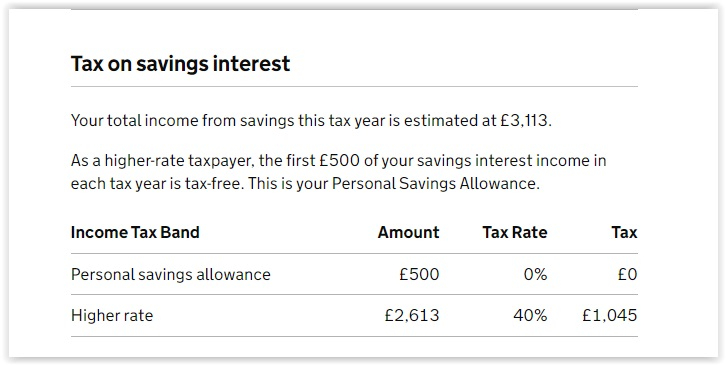 SA RETURN 2022-23
0 -
I think that's more or less right; the interest tax would be static at £176 for salary between £73,641 (the point at which you did an experiment) and £74,140. Above that, some of it gets taxed at 40%, so the interest tax rises until, with a salary of £75,020, it's £352. At that and above, the £880 is all taxed at 40%, so it's always £352, and the salary starts to pay 40% on part of it too.rundmc-k said:
This is very helpful and I really appreciate you taking the time to explain it so well.EthicsGradient said:OK, I can understand it now.
73k: total income of 74,380 is below the adjusted 75,020 higher rate threshold. So PSA is 1000, and savings tax is (1380-1000)*0.2=£76.
Salary tax = (73000-12570)*0.2=£12086
total tax £12,162
75k: total income of 76,380 is £1360 above the adjusted 75,020 higher rate threshold. So PSA is £500, and £1380 savings are taxed as follows:
£500 is taxed at 0%
£860 is taxed at 40% = £344
£20 is taxed at 20% = £4
Salary tax = (75000-12570)*0.2=£12486
total tax £12,834
74k: total income of 76,380 is £360 above the adjusted 75,020 higher rate threshold. So PSA is £500, and £1380 savings are taxed as follows:
£360 is taxed at 0% ("would have been" taxed at 40%, but the PSA covers that)
£140 is taxed at 0% ("would have been" taxed at 20%, but the remaining PSA covers that)
£880 is taxed at 20% = £176
Salary tax = (74000-12570)*0.2=£12286
total tax £12,462
73641: total income of 75,021 is £1 above the adjusted 75,020 higher rate threshold. So PSA is £500, and £1380 savings are taxed as follows:
£1 is taxed at 0% ("would have been" taxed at 40%, but the PSA covers that)
£499 is taxed at 0% ("would have been" taxed at 20%, but the remaining PSA covers that)
£880 is taxed at 20% = £176
Salary tax = (73641-12570)*0.2=£12214.20
total tax £12,390 (the 0.2 is rounded down)
Think of the PSA as a moveable allowance that allows you to zero out a section of your interest income. It's positioned to give you maximum benefit - Dazed_and_C0nfused's "Beneficial Ordering". That means zeroing out £360, or £1, that would have been subject to 40% tax in the last 2 cases, and then the rest zeroes out some that would have been subject to 20%. With 75k, it all goes on the 40% band. The £12,290 tax you saw for 75k was the tax on your salary, plus that missing £20 of interest, which fits in the 20% band.
I think I essentially understand it now. It was confusing with SA calculator as they were incorporating the £880 taxed at 20% into the calculation without depicting it clearly in the 'PSA section'.
So if I'm correct, the Beneficial Ordering basically means that once you hit HR you don't necessarily immediately jump from 20% tax on all interest earned over £1000 to 40% on all over £500, but there is an 'intermediary period' where, for the first £500 over HR your total income is, you basically pay everything over £500 interest at 20%, which means your tax (in this case) would be static at £176, as opposed to £76 if you were BR, or £352 if you were more than £1380 above HR?1 -
Yeah that makes sense, glad to get an understanding of it in the end. Thanks for you helpEthicsGradient said:
I think that's more or less right; the interest tax would be static at £176 for salary between £73,641 (the point at which you did an experiment) and £74,140. Above that, some of it gets taxed at 40%, so the interest tax rises until, with a salary of £75,020, it's £352. At that and above, the £880 is all taxed at 40%, so it's always £352, and the salary starts to pay 40% on part of it too.rundmc-k said:
This is very helpful and I really appreciate you taking the time to explain it so well.EthicsGradient said:OK, I can understand it now.
73k: total income of 74,380 is below the adjusted 75,020 higher rate threshold. So PSA is 1000, and savings tax is (1380-1000)*0.2=£76.
Salary tax = (73000-12570)*0.2=£12086
total tax £12,162
75k: total income of 76,380 is £1360 above the adjusted 75,020 higher rate threshold. So PSA is £500, and £1380 savings are taxed as follows:
£500 is taxed at 0%
£860 is taxed at 40% = £344
£20 is taxed at 20% = £4
Salary tax = (75000-12570)*0.2=£12486
total tax £12,834
74k: total income of 76,380 is £360 above the adjusted 75,020 higher rate threshold. So PSA is £500, and £1380 savings are taxed as follows:
£360 is taxed at 0% ("would have been" taxed at 40%, but the PSA covers that)
£140 is taxed at 0% ("would have been" taxed at 20%, but the remaining PSA covers that)
£880 is taxed at 20% = £176
Salary tax = (74000-12570)*0.2=£12286
total tax £12,462
73641: total income of 75,021 is £1 above the adjusted 75,020 higher rate threshold. So PSA is £500, and £1380 savings are taxed as follows:
£1 is taxed at 0% ("would have been" taxed at 40%, but the PSA covers that)
£499 is taxed at 0% ("would have been" taxed at 20%, but the remaining PSA covers that)
£880 is taxed at 20% = £176
Salary tax = (73641-12570)*0.2=£12214.20
total tax £12,390 (the 0.2 is rounded down)
Think of the PSA as a moveable allowance that allows you to zero out a section of your interest income. It's positioned to give you maximum benefit - Dazed_and_C0nfused's "Beneficial Ordering". That means zeroing out £360, or £1, that would have been subject to 40% tax in the last 2 cases, and then the rest zeroes out some that would have been subject to 20%. With 75k, it all goes on the 40% band. The £12,290 tax you saw for 75k was the tax on your salary, plus that missing £20 of interest, which fits in the 20% band.
I think I essentially understand it now. It was confusing with SA calculator as they were incorporating the £880 taxed at 20% into the calculation without depicting it clearly in the 'PSA section'.
So if I'm correct, the Beneficial Ordering basically means that once you hit HR you don't necessarily immediately jump from 20% tax on all interest earned over £1000 to 40% on all over £500, but there is an 'intermediary period' where, for the first £500 over HR your total income is, you basically pay everything over £500 interest at 20%, which means your tax (in this case) would be static at £176, as opposed to £76 if you were BR, or £352 if you were more than £1380 above HR?0







Confirm your email address to Create Threads and Reply

Categories
- All Categories
- 354.3K Banking & Borrowing
- 254.4K Reduce Debt & Boost Income
- 455.4K Spending & Discounts
- 247.3K Work, Benefits & Business
- 604K Mortgages, Homes & Bills
- 178.4K Life & Family
- 261.5K Travel & Transport
- 1.5M Hobbies & Leisure
- 16K Discuss & Feedback
- 37.7K Read-Only Boards