We’d like to remind Forumites to please avoid political debate on the Forum.
This is to keep it a safe and useful space for MoneySaving discussions. Threads that are – or become – political in nature may be removed in line with the Forum’s rules. Thank you for your understanding.
📨 Have you signed up to the Forum's new Email Digest yet? Get a selection of trending threads sent straight to your inbox daily, weekly or monthly!
The Forum now has a brand new text editor, adding a bunch of handy features to use when creating posts. Read more in our how-to guide
Average Share Price - Dealing Costs / Monthly subs!

ChilliBob
Posts: 2,441 Forumite



Hey everyone,
I've been digging into the weeds of the average share price on Interactive Investor to see if it includes equalisation payments - I don't believe it does - and come across a bit of an oddity regarding trading costs.
If you have a monthly sub with them then you get X 'free trades' from your trading credit, otherwise you have to pay for a trade, say £3.99.
So in some cases, if you purchased 10k's worth of a fund, then you pay 10k, in other cases you pay 10k+3.99.
So, when working out your average share price would you:
1. Just use the price paid - whether the trade was 'free' or paid
2. Assume all trades are £3.99 - as the monthly sub is a cost
3. Take out the costs only where these were outside the monthly sub!
It seems when working out your average price paid you'd:
(Total paid-Equalisation Payments)/ Quantity Purchased
If using II figures this would cover any trading costs outside the monthly subscription anyway.
Then for disposal purposes it seems you can look to (Quantity Sold / Total size of Section 104 pool)* total cost for pool.
I assume total cost can only be costs specific to this pool - so the trades which were paid, as opposed to attributing a monthly subscription to the costs..
So, when disposing of say 10% of this 'pool' I guess it means:
1. Strip out any £3.99 values from each trade where it was a paid trade
2. Sum up the £3.99s spent for the 'section 104 pool'..... 10% of these costs can be allowed in the average price calculation
Curious to get people's thoughts on this!
I've been digging into the weeds of the average share price on Interactive Investor to see if it includes equalisation payments - I don't believe it does - and come across a bit of an oddity regarding trading costs.
If you have a monthly sub with them then you get X 'free trades' from your trading credit, otherwise you have to pay for a trade, say £3.99.
So in some cases, if you purchased 10k's worth of a fund, then you pay 10k, in other cases you pay 10k+3.99.
So, when working out your average share price would you:
1. Just use the price paid - whether the trade was 'free' or paid
2. Assume all trades are £3.99 - as the monthly sub is a cost
3. Take out the costs only where these were outside the monthly sub!
It seems when working out your average price paid you'd:
(Total paid-Equalisation Payments)/ Quantity Purchased
If using II figures this would cover any trading costs outside the monthly subscription anyway.
Then for disposal purposes it seems you can look to (Quantity Sold / Total size of Section 104 pool)* total cost for pool.
I assume total cost can only be costs specific to this pool - so the trades which were paid, as opposed to attributing a monthly subscription to the costs..
So, when disposing of say 10% of this 'pool' I guess it means:
1. Strip out any £3.99 values from each trade where it was a paid trade
2. Sum up the £3.99s spent for the 'section 104 pool'..... 10% of these costs can be allowed in the average price calculation
Curious to get people's thoughts on this!
0
Comments
-
Forget percentages, they won't work. If this is, as I suspect, for tax purposes you shouldn't rely on those 'dashboard' figures. There are many ways in which they will be imprecise (equalisation, dividends, ERI, corporate actions, transfers etc). They are useful for high level 'at a glance' snapshots but platforms are under no obligation to make them compliant with tax legislationYou need to use actual figures so go back to your contract notes and perhaps the annual Consolidated Tax Certificates0
-
Hey ColdIron, thanks for the response. Yes, I'm not relying on a dashboard, but using it for information at this stage. I have actually gone through all the contract notes and transactions from II so I can clearly see what I have purchased, for now much, to what degree I've paid over the monthly sub, and the equalisation payments received.
I've then stumbled upon this HMRC calculation: https://assets.publishing.service.gov.uk/media/641c4712ba5ac9000cb1a72d/HS284_Example_3_2023.pdf
Which I'm trying to work through but it's just confusing me!
It seems much more intuitive to take:
Sold Price minus
Average Share Price (generated by taking total cost, including dealing costs, divided by total quantity)
Multiplied by quantity sold
To give 'chargable gain'
I've worked through their way instead and my figures are different - 0.052% different mind - £2.36 difference on 4.5k chargable gain.
The example doesn't mention Equalisation payments though, which as I understand can be used to reduce the total cost0 -
Hey ColdIron, thanks for the response. Yes, I'm not relying on a dashboard, but using it for information at this stage. I have actually gone through all the contract notes and transactions from II so I can clearly see what I have purchased, for now much, to what degree I've paid over the monthly sub, and the equalisation payments received.
I've then stumbled upon this HMRC calculation: https://assets.publishing.service.gov.uk/media/641c4712ba5ac9000cb1a72d/HS284_Example_3_2023.pdf
Which I'm trying to work through but it's just confusing me!
It seems much more intuitive to take:
Sold Price minus
Average Share Price (generated by taking total cost, including dealing costs, divided by total quantity)
Multiplied by quantity sold
To give 'chargable gain'
I've worked through their way instead and my figures are different - 0.052% different mind - £2.36 difference on 4.5k chargable gain.
The example doesn't mention Equalisation payments though, which as I understand can be used to reduce the total cost0 -
Yes for Income units, not Accumulation units. The equalisation is a return of capital so it reduces your book cost (or ASP) therefore increasing your gainEdit: Apologies if I don't respond much more, this site is unusable today, I've had 5 504 errors getting this far :'(0
-
The only allowable expenses for CGT purposes are the costs and stamp duty directly involved in the trade so monthly fees aren't allowable.1
-
I've knocked up a fictitious example now - I think my 0.05% difference was due to rounding or something, I can account for it in my real workings now:
I think this is making sense now. Still not 100% sure on the costs side of things, but I think it makes sense.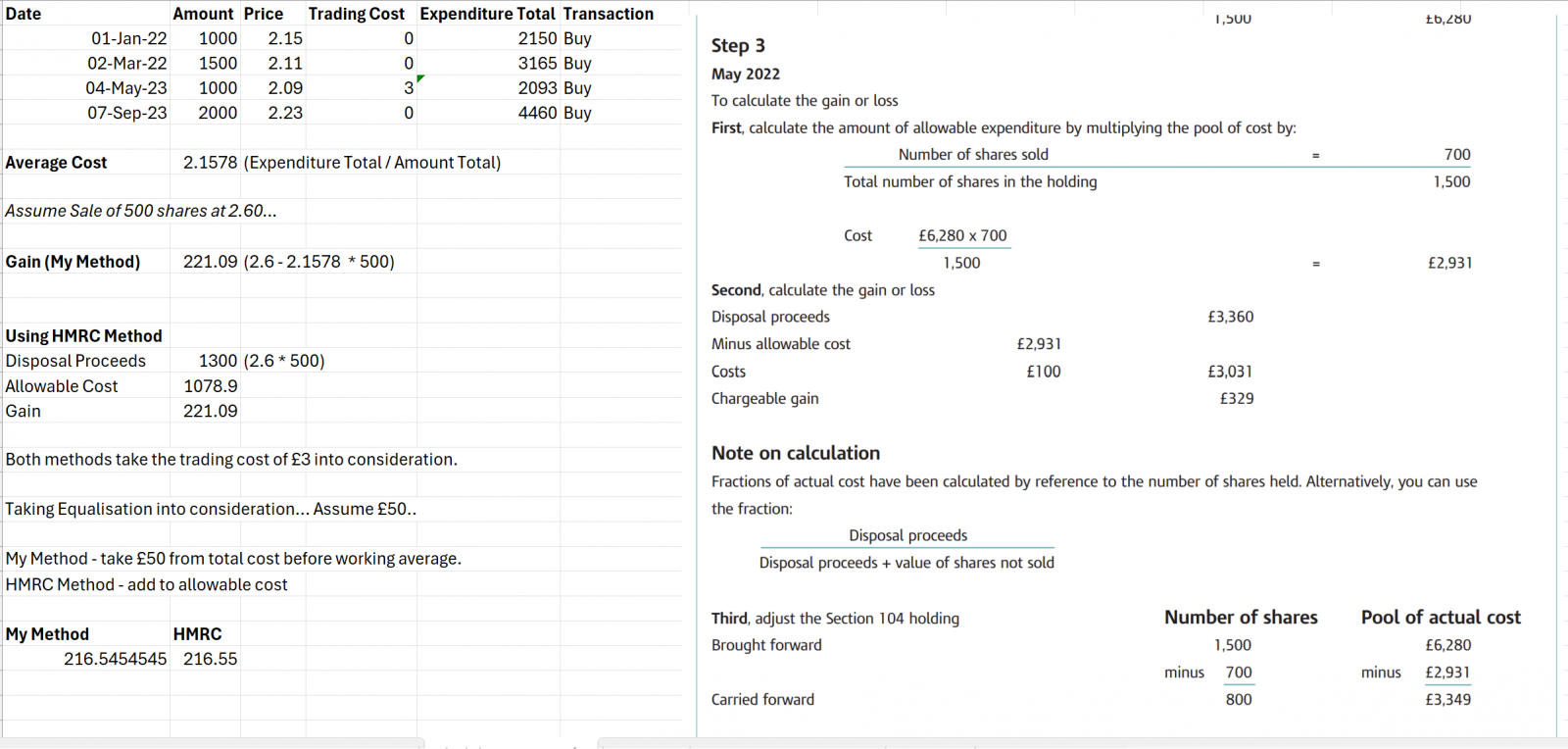 0
0 -
So to revisit this again, essentially the two methods boil down to this really:Comparison is effectively:My MethodTotal Pool Cost minus equalization / Total S104 Pool Quantity = Average PriceSale Price minus Average Pool Price X Sale Quantity = Chargeable GainHMRC MethodSale Price X Sale Quantity <-- Disposal Proceeds(Total Pool Cost -Equalization) X Sale Quantity / Total Pool Quantity <-- Allowable CostDisposal Proceeds - Allowable Cost = Chargeable Gain
I can get the same results doing both a real worked example with my fund holdings, and a couple of fictitious examples.0 -
Above a set threshold, your capital gains have to be declared on a self-assessment form ... and your computations must be attached. It is going to be easier for HMRC to accept the computations if they are presented in the standard manner, I think.Also, moving forward from this disposal, you need to be able to calculate the pool of purchase costs, and the average of purchase costs, to work out the gain on *future* disposals. This is going to give rise to more head-scratching, unless you stick to the HMRC method. (The Pool needs to be reduced by the allowable costs of disposals).0
-
I think my previous comment didn't come through for some reason, however, it was basically that I intended to be below the CGT threshold for this year. The trade is done now so I'll wait for II to give me the info, I'll then log this in my own spreadsheet - where I have collated all the contract notes info.
Yeah, you're right, next year I'll need to faff with the same process, so good to keep the records and stick to an agreed process!0 -
Make sure you get the sign right when you take accumulation into account. As ColdIron said, it reduces the cost. Which means it increases the gain. So when you write "My Method - take £50 from total cost", you've got the sign right. But the "HMRC Method - add to allowable cost" is incorrect. And since your last calculation for both methods has reduced the final gain, it looks like you've incorrectly added the equalisation to cost in both cases.ChilliBob said:I've knocked up a fictitious example now - I think my 0.05% difference was due to rounding or something, I can account for it in my real workings now:
I think this is making sense now. Still not 100% sure on the costs side of things, but I think it makes sense.1








Confirm your email address to Create Threads and Reply

Categories
- All Categories
- 354.3K Banking & Borrowing
- 254.4K Reduce Debt & Boost Income
- 455.4K Spending & Discounts
- 247.3K Work, Benefits & Business
- 604K Mortgages, Homes & Bills
- 178.4K Life & Family
- 261.5K Travel & Transport
- 1.5M Hobbies & Leisure
- 16.1K Discuss & Feedback
- 37.7K Read-Only Boards