We’d like to remind Forumites to please avoid political debate on the Forum.
This is to keep it a safe and useful space for MoneySaving discussions. Threads that are – or become – political in nature may be removed in line with the Forum’s rules. Thank you for your understanding.
Gilts Question
Comments
-
'The previous plan for my SIPP was to transition from largely equities to more bonds, in the final years before retirement.
I kept asking my old IFA about bonds, he just said stick to equities and cash.....Now I keep hearing that bonds are coming back from 30% losses over the past two years, So I would like some safe growth to balance the rest of my SIPP.
However, when I look at the recent perfomance graphs of Gilt funds, I dont see much improvement in their performance. I see corporate bonds increasing, but I understand they are riskier than Gilts.'
There's plenty of good sense in that transition (although not all bonds behave the same), so don't abandon your plan on the basis of your current limited understanding of bonds. Get a better understanding, then you'll know if bonds are for you.
Be very careful about predictions like 'bonds are coming back' if it is a prediction; 'are coming' is present tense, but with investing there's only the past and the future that are of much interest, eg 'bonds were coming back' or 'will be coming back'. Be very wary about predictions, as the future is usually unknown; and be wary of statements in the present tense ('are coming back') leading you to think it predicts the future.
Gilt fund growth graph patterns are likely to be largely the effect of interest rate changes. because bonds have two major risks: default and interest rate changes. Since we usually think the government won't default on their debt, only interest rate effects remain. So it's imperative that you understand how bond prices are affected by interest rate changes, both in the direction of change and the time course of changes.
So, here's a nice demonstration of how gilt values recover, as they have recently and will continue to, god willing. Then you will understand the little improvement you've observed and give you some confidence of how bonds could work for you. https://www.bogleheads.org/forum/viewtopic.php?t=360575
0 -
When comparing gilts, what are the main things to be looking out for?
What makes one stand out from the others? Are some providers better than others, or is it all about the yield?
Are you tied in to any particular period? Best held until maturity? 5 yrs, 15 yrs etc?
Take this screenshot from Fidelity (sorted in yield order)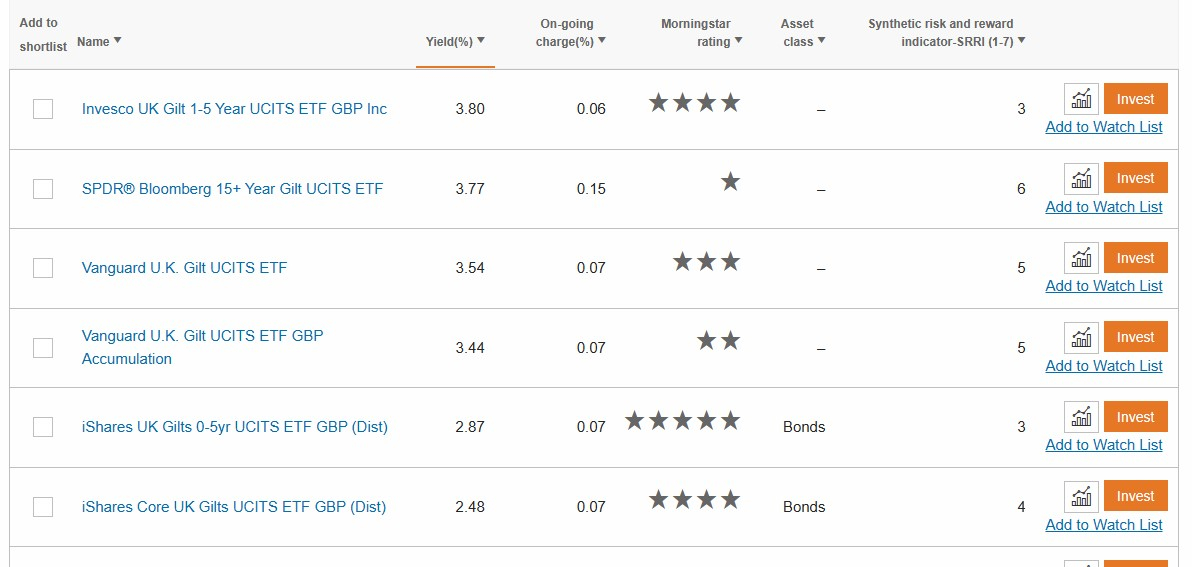
If one was looking at investing, say £10,000, in something like this, why would you, rather than go for a 5 yr fixed rate cash bond at say ~4.5% (ISA status not withstanding), where your return is guaranteed?How's it going, AKA, Nutwatch? - 12 month spends to date = 3.24% of current retirement "pot" (as at end December 2025)0 -
'When comparing gilts, what are the main things to be looking out for?
What makes one stand out from the others? Are some providers better than others, or is it all about the yield?
Are you tied in to any particular period? Best held until maturity? 5 yrs, 15 yrs etc?'
You are asking about comparing gilt funds, not gilts; there's a big difference. Funds don't mature, individual gilts do.
Most important would be how long to maturity of the bonds in the fund. 1-5 yr bonds is short 'duration' (or time to maturity); 15+ yr is fairly long (especially if a lot of the bonds are 40 yr).
The duration tells how much the price will rise (or fall) when interest rates fall (or rise). Long bonds can see big price changes. The reward for taking the risk with long bonds is better yields than short bonds usually; the 'bond curve' usually slopes up (longer time to maturity, higher yields) but can be flat or down sloping.
Returns on bonds are usually modest, so the fees of the bond fund are more important than they are for stock funds I suppose.
You can sell your bond fund holding at any time. There is no holding to maturity as funds don't mature the way individual bonds mature. In the days/months leading to selling, you're at the mercy of the markets as to whether the fund price will drop away.
I'd guess most providers are much the same. You can't be landed with dud gilts the way you can be landed with dud stocks if you choose badly, so yield is less important than getting a duration that suits your timeframe I'd guess.
'If one was looking at investing, say £10,000, in something like this, why would you, rather than go for a 5 yr fixed rate cash bond at say ~4.5% (ISA status not withstanding), where your return is guaranteed?'You need to envisage different scenarios, and roughly guesstimate the consequences with either approach.
With the 15+yr fund, if interest rates drop 2% in a year's time, you'll make a 30+% capital gain very quickly. The opposite, worst, can happen. In short, I don't know what a fixed cash rate bond is, but if it's a fixed term deposit, and nothing to do with a bond in the bond sense, then it's probably a good choice now particularly if you need to spend that money in 5 years.
1 -
Thanks for that @JohnWinder
I didn't know how to look for individual Gilts, rather than funds, as this was what came up on Fidelity when I did a search for "gilts".
Yes, it was a fixed term cash deposit I was comparing to.
Thanks for trying to explain it all, but I still don't "get it", so as they say, don't invest in what you don't understand.
How's it going, AKA, Nutwatch? - 12 month spends to date = 3.24% of current retirement "pot" (as at end December 2025)0 -
Nope. The market has priced in rate cuts. You'll only make a gain or loss if rates move differently from how the market expects.JohnWinder said:With the 15+yr fund, if interest rates drop 2% in a year's time, you'll make a 30+% capital gain very quickly. The opposite, worst, can happen.
1 -
There's a good summary here: https://www.yieldgimp.com/ At the top right there's a link to a table of index linked gilts. Once you understand the basics conventional gilts are pretty easy to understand. Index linked gilts are tougher.Sea_Shell said:Thanks for that @JohnWinder
I didn't know how to look for individual Gilts, rather than funds, as this was what came up on Fidelity when I did a search for "gilts".
Yes, it was a fixed term cash deposit I was comparing to.
Thanks for trying to explain it all, but I still don't "get it", so as they say, don't invest in what you don't understand.
The code in the first column e.g., T25 is the 'stock ticker' you can usually use with a stockbroker and you can enter on the LSE's website to find charts and other data, same as with a company's share.
0 -
Yes, rate changes are priced in. I'm not sure the way you've elaborated it is the better way, because as you've written it the market has priced in rate cuts and if rates don't fall the fund investor will get an unexpected capital gain/loss (which is it?) I don't see it that way.aroominyork said:
Nope. The market has priced in rate cuts. You'll only make a gain or loss if rates move differently from how the market expects.JohnWinder said:With the 15+yr fund, if interest rates drop 2% in a year's time, you'll make a 30+% capital gain very quickly. The opposite, worst, can happen.
For sea shell, try Thau or Swedroe's books on bonds.
https://www.bogleheads.org/wiki/Bond_basics
0 -
Longer dated Gilts also reflect the expectatation that inflation will progressively come down closer to the 2% target.aroominyork said:
Nope. The market has priced in rate cuts. You'll only make a gain or loss if rates move differently from how the market expects.JohnWinder said:With the 15+yr fund, if interest rates drop 2% in a year's time, you'll make a 30+% capital gain very quickly. The opposite, worst, can happen.
0








Confirm your email address to Create Threads and Reply

Categories
- All Categories
- 354.3K Banking & Borrowing
- 254.4K Reduce Debt & Boost Income
- 455.4K Spending & Discounts
- 247.3K Work, Benefits & Business
- 604K Mortgages, Homes & Bills
- 178.4K Life & Family
- 261.5K Travel & Transport
- 1.5M Hobbies & Leisure
- 16K Discuss & Feedback
- 37.7K Read-Only Boards