We’d like to remind Forumites to please avoid political debate on the Forum.
This is to keep it a safe and useful space for MoneySaving discussions. Threads that are – or become – political in nature may be removed in line with the Forum’s rules. Thank you for your understanding.
PLEASE READ BEFORE POSTING
Hello Forumites! However well-intentioned, for the safety of other users we ask that you refrain from seeking or offering medical advice. This includes recommendations for medicines, procedures or over-the-counter remedies. Posts or threads found to be in breach of this rule will be removed.Making yoghurt in a slow cooker




 and this is MSE so I looked to see what else I could use.
- Put 1 litre of UHT milk into your yoghurt fermenting pot (I used the pot from the old yoghurt maker, but eg. a Kilner jar or jam jar would also work).
- Stir two dessert spoons of live yoghurt into the UHT milk (this starts your yoghurt off).
- Add 2-300ml of warm water to the slow cooker (you're going to be using it as a bain marie).
- Put the fermenting pot into the water. The water level should come well up the pot, but not overflow the slow cooker. Top up the water if necessary.
- Put the temperature probe from the controller into the water, where it won't fall out.
- Put the lid on the slow cooker. If the lid won't fit because the fermenting pot is too tall, use eg. a pudding basin instead.
- Plug in the temperature controller, Set it to hold at 35-40C.
- Plug the slow cooker into the controller.
- Turn the slow cooker on at the lowest setting ("warm" if you have it, otherwise "low").
- Check occasionally to make sure everything is OK (I started mine off in the afternoon, but it wasn't quite done by bedtime so I left it running overnight).
- After 8-12 hours, the yoghurt should be done. Turn off the power and remove the fermenting pot to cool.
- Once cool, transfer the yoghurt to the fridge.
2.72kWp PV facing SSW installed Jan 2012. 11 x 247w panels, 3.6kw inverter. 37 MWh generated, long-term average 2.6 Os.
Comments
-
Thanks for this recipe! Might have to try this - seems like a reasonable home method1
-
We were discussing only today whether we could make yogurt in a slow cooker and decided it would be too hot, so it's interesting to read about this method.
However, our bread maker also makes yogurt in about 8 hours, although my attempt to use soya milk today appears to have failed! I used the last bit of the live milk yogurt from the last batch.3 -
Had no idea that you could make yoghurt this way!2childmum2 said:We were discussing only today whether we could make yogurt in a slow cooker and decided it would be too hot, so it's interesting to read about this method.
However, our bread maker also makes yogurt in about 8 hours, although my attempt to use soya milk today appears to have failed! I used the last bit of the live milk yogurt from the last batch.0 -
Our bread maker has a yogurt setting, but I don't think they all do (my last one didn't)0
-
My electric pressure cooker/slow cooker has a yoghurt setting. I'm never very successful with home-made yoghurt, I like thick Greek style and when I've tried it at home it's usually too watery and bland tasting. I believe as long as you've got the right temperature at the start you can make it in a Thermos.
I had one of those insulated pot types but only had success using the Easi-Yo packets, which I thought was no cheaper than buying it. Your way sounds effective, I didn't know you could buy a temperature controller. Was that something you already owned?Life is mainly froth and bubble: two things stand like stone. Kindness in another’s trouble, courage in your own.0 -
PollyWollyDoodle said:Your way sounds effective, I didn't know you could buy a temperature controller. Was that something you already owned?I bought it specially for making yoghurt.Sending £15 on a gadget to let me make yohurt might not sound very MSE, but natural yoghurt is about £1 for 500g in the shops and we get through one or two tubs a week. We make ours using full-fat UHT milk, which is about £1 a litre and makes a kg of yoghurt, so we're saving 50p-£1 a week. It'll pay for itself before the next equinox.N. Hampshire, he/him. Octopus Intelligent Go elec / Fuse gas / Vodafone BB / iD mobile. Kirk Hill Co-op member.Economy 7 cap explainer. Gas vs E7 vs peak elec heating costs, Ecoflow Stream, Best kettle :-)
2.72kWp PV facing SSW installed Jan 2012. 11 x 247w panels, 3.6kw inverter. 37 MWh generated, long-term average 2.6 Os.2 -
Almost three years (and maybe 120 batches of yoghurt) later I've come back to this thread with some photos!
Here's everything you need except for the yoghurt starter and the milk.
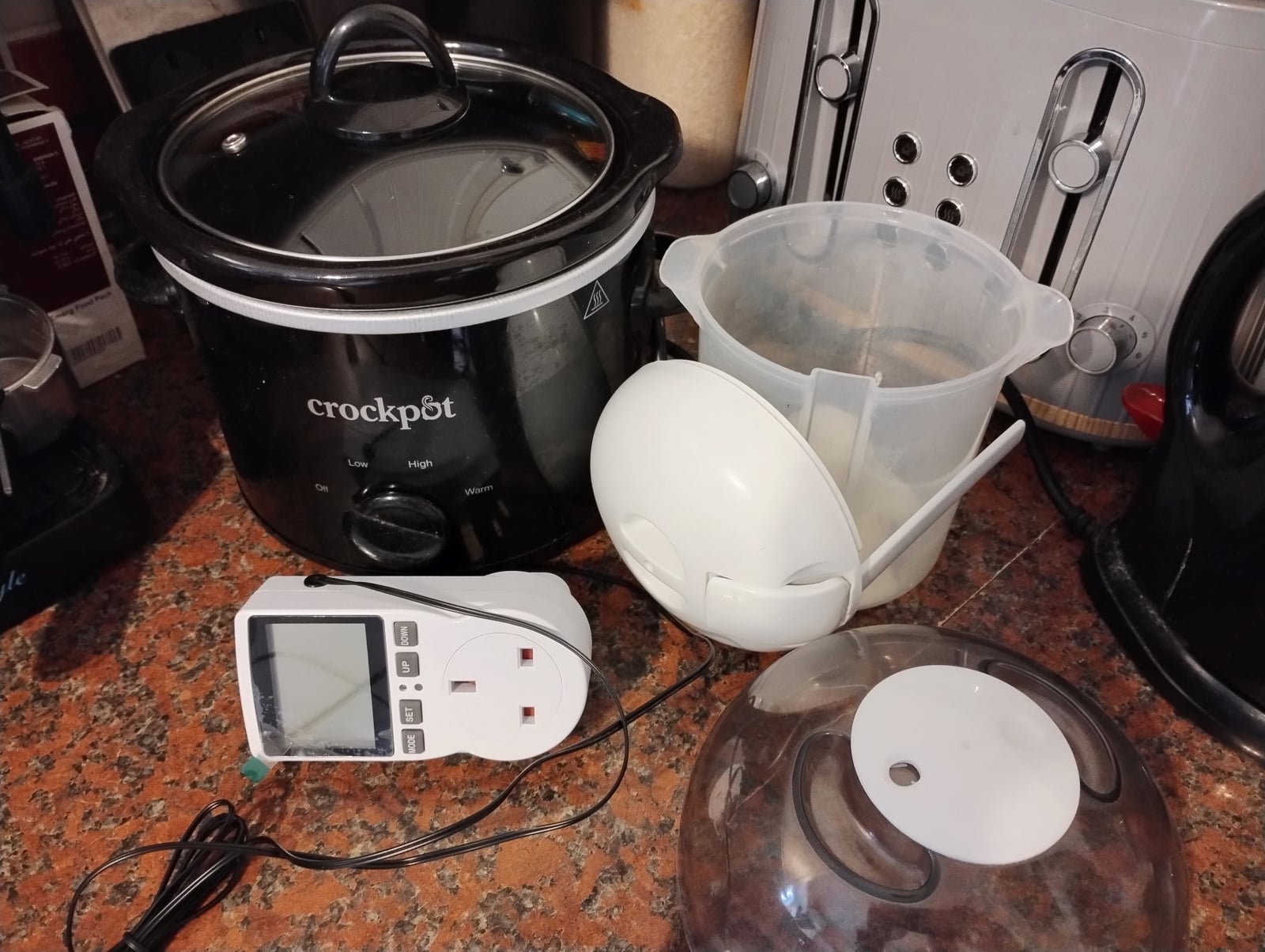
The toaster is not part of the process!
The temperature controller is the white plugin thing at the bottom-left. The black wire attached ends in a silvery capsule which is the bit that senses temperatures, but which isn't visible in this photo.
Here the pot I make yoghurt in (part of my previous yoghurt maker, but a regular glass jar would also work) with a couple of tablespoons of part-thawed yoghurt in the bottom, waiting for me to add the litre of UHT milk.
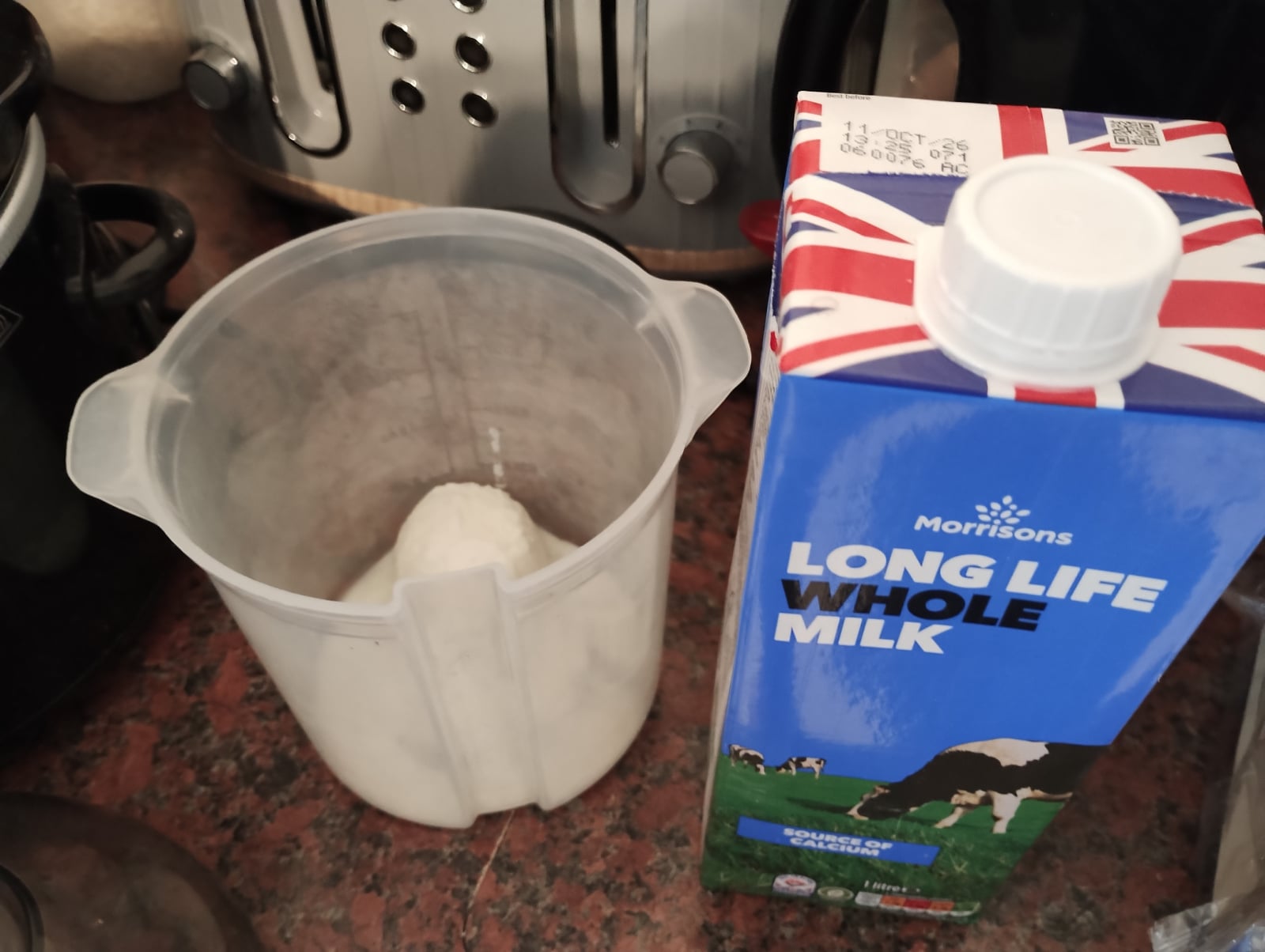
My yoghurt starter was saved from the previous batch of yoghurt and frozen until required. You can do this almost indefinitely.
Put the lid on the pot, place it into the slow cooker and fill the remaining space between the pot and the crock with water. You're not going to drink this water so I usually use warm tapwater.
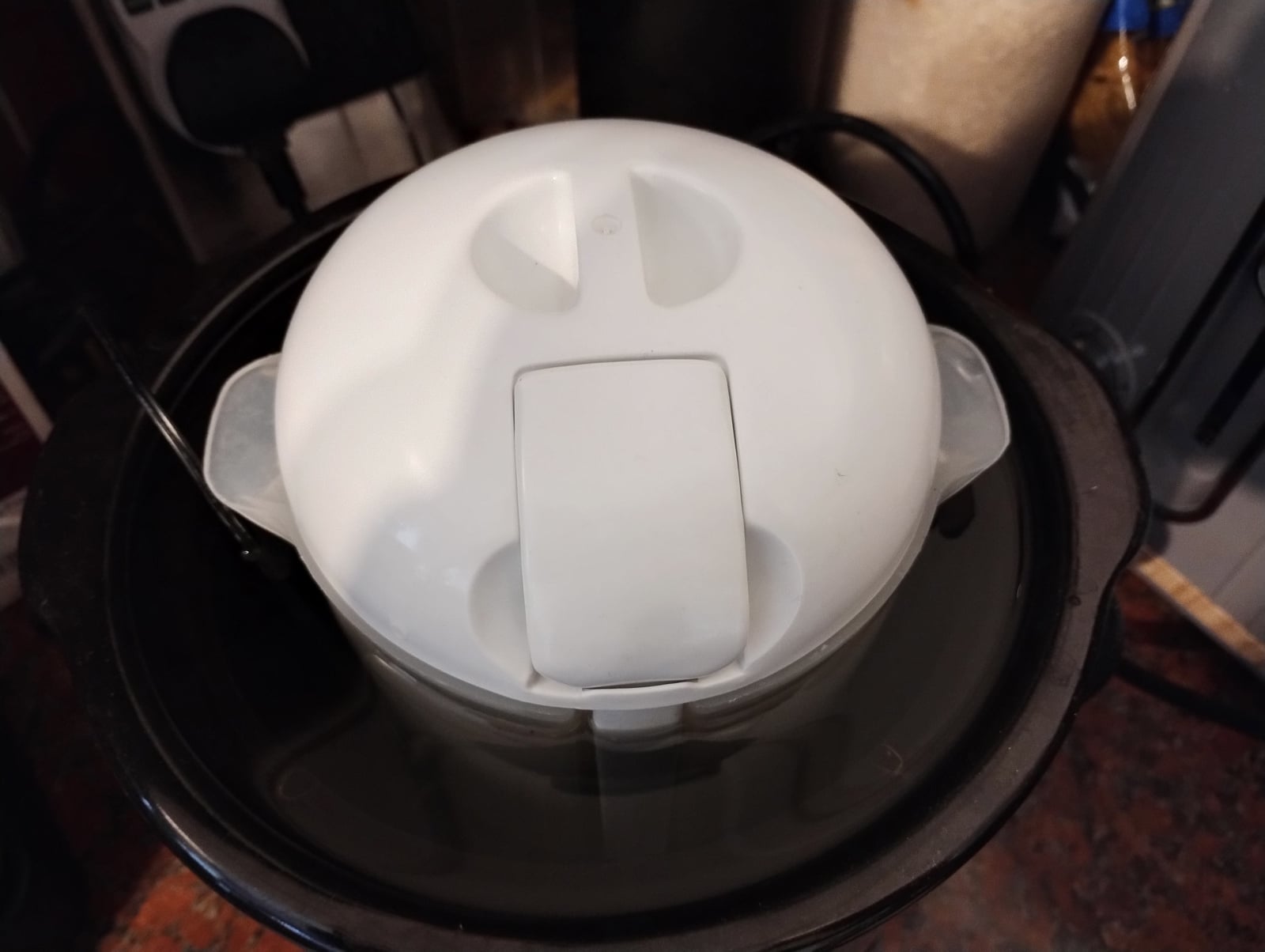
Just to the left of the yoghurt pot you'll see the black wire from the temperature controller. The silvery capsule is in the water, near the bottom of the crock. If you don't put this in the water, the controller will happily boil the water and kill your yoghurt microbes - leaving you with an entirely unsatisfactory product and needing to buy some more live yoghurt to gat another starter!
Plug the slow cooker into the temperature controller and the temperature controller into your mains socket. Set the temperature controller to hold the temperature between 37 and 40 degrees C (roughly body temperature for someone with a mild fever).
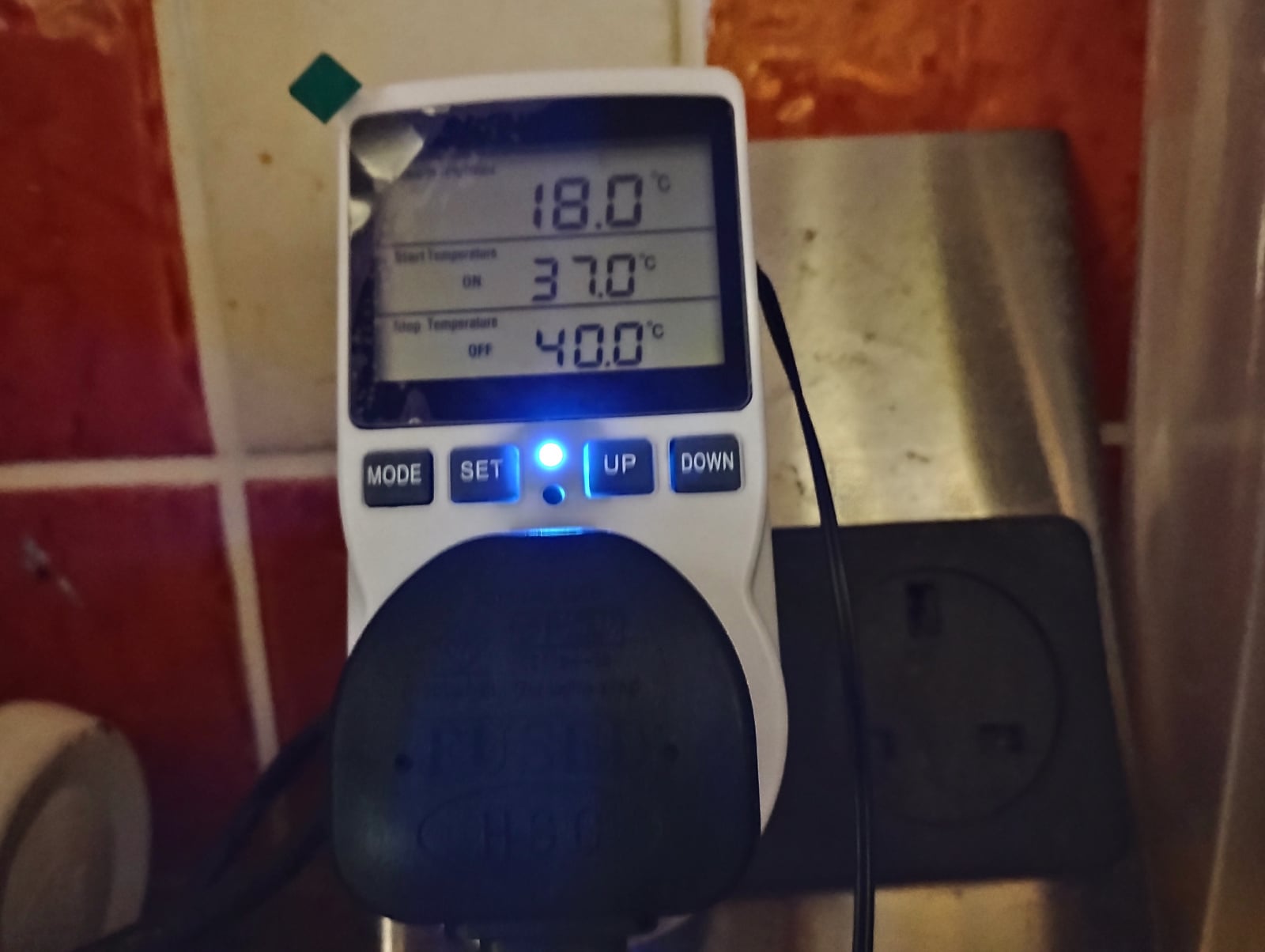
This was what my controller was showing when I first started. This actual temperature at the probe is 18C, and I've told it to heat to 40C then turn off until the temperature falls to 37C.
And here's the whole caboodle:
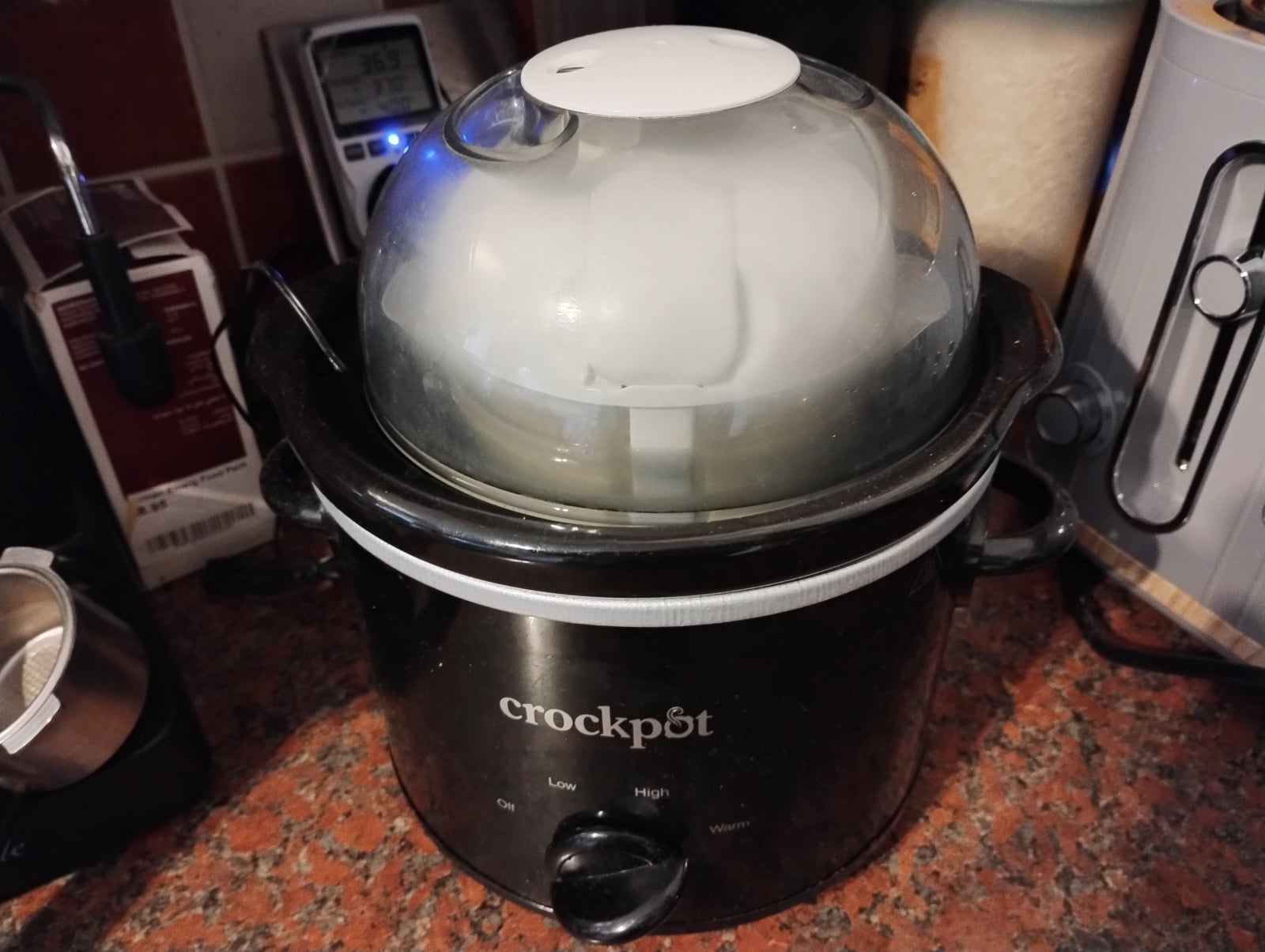
Again, because the lid of my yoghurt pot is domed I've kept the matching domed cover from my previous yoghurt maker which is a reasonable fit on my slow cooker. If I was using a flat-topped jar I could instead cover it with the regular slow cooker lid.
I try to leave my slow cooker set to HIGH for the first hour or so, turning it back to WARM (the lowest setting) at that point. WARM is enough for the controller to maintain 37-41C at the typical temperature of my kitchen; if you were making yoghurt in an igloo you might need to leave it on LOW or even HIGH instead.
After a total of eight to ten hours, the yoghurt is done. I take it out of the slow cooker, allow it to cool on the worktop for a while and then transfer it to the fridge. After an overnight stay in the fridge it's nice and cool to have with breakfast the following day.
Don't forget to take a couple of tablespoons of the fresh batch to freeze and use as your next starter!
I tend to find it'll keep for 5-6 days, by which time I've generally used it all up and need to make another batch. If I don't eat it fast enough it eventually turns pink which is a sign that it's past it
Hopefully this will help anyone else who's thinking of doing the same!
N. Hampshire, he/him. Octopus Intelligent Go elec / Fuse gas / Vodafone BB / iD mobile. Kirk Hill Co-op member.Economy 7 cap explainer. Gas vs E7 vs peak elec heating costs, Ecoflow Stream, Best kettle :-)
2.72kWp PV facing SSW installed Jan 2012. 11 x 247w panels, 3.6kw inverter. 37 MWh generated, long-term average 2.6 Os.4 -
For homemade yoghurt, I warm the long life milk in the microwave, stir in some powdered milk and yoghurt and just bung it in a food vacuum flask. I have got out of the habit since we have been making kefir. That is even easier, strain kefir “grains” and add them to fresh milk, repeat daily.
Fashion on the Ration 2026 Coupons, socks 6, 8 vests 24, cardigan 5, pyjamas 2 16, pants 10, l s vests 3 9 Total 66 + 4
Grocery Challenge 2026 £5 a day for food for 2 Total £1,825
Jan £128.45 -£26.55
Feb £122.55 -£17.45
Mar £154.50 -.50
Apr £144.78 -£5.22
May £151.63 -£3.37
Jun £143.61 -£6.39
Jul £150.76 -£4.24
Aug £139.44. -£15.541 -
How long did it take to turn into yoghurt, @Nelliegrace ?
- Pip
"Be the type of woman that when you get out of bed in the morning, the devil says 'Oh crap. She's up.'
It ain’t what you do, it’s the way that you do it - that’s what gets results!
2026 Fashion on the Ration Challenge 107.5 spent out of 80.5 coupons (66 plus 14.5 from 2025) 27 over
Coupon Spend
57.5 - yarn
12 - 3 M&S thermal bodies
4 - shorty pyjamas
1 - bra
8 - 2 t-shirts (Queens Club & 10CC Cricket)
5 - black leather loafers
5 - leather handbag
15 - DKNY black puffer coat0 -
I would leave it overnight, @PipneyJane I scalded the clean flask with boiling water.
Aldi have Greek style yoghurt at £1.49 a kilo at present. Powdered milk went up a lot in price a few years ago, especially the branded one.
Fashion on the Ration 2026 Coupons, socks 6, 8 vests 24, cardigan 5, pyjamas 2 16, pants 10, l s vests 3 9 Total 66 + 4
Grocery Challenge 2026 £5 a day for food for 2 Total £1,825
Jan £128.45 -£26.55
Feb £122.55 -£17.45
Mar £154.50 -.50
Apr £144.78 -£5.22
May £151.63 -£3.37
Jun £143.61 -£6.39
Jul £150.76 -£4.24
Aug £139.44. -£15.541








Confirm your email address to Create Threads and Reply

Categories
- All Categories
- 355.7K Banking & Borrowing
- 254.9K Reduce Debt & Boost Income
- 456.1K Spending & Discounts
- 248.3K Work, Benefits & Business
- 605.9K Mortgages, Homes & Bills
- 179K Life & Family
- 263.7K Travel & Transport
- 1.5M Hobbies & Leisure
- 16.2K Discuss & Feedback
- 37.7K Read-Only Boards