We’d like to remind Forumites to please avoid political debate on the Forum.
This is to keep it a safe and useful space for MoneySaving discussions. Threads that are – or become – political in nature may be removed in line with the Forum’s rules. Thank you for your understanding.
'Unfair' standing charges need to go: MPs back Martin's and MSE's calls for energy bill overhaul
Comments
-
Dolor said:There is a way to reduce standing charges that is fair on all consumers. Suppliers should offer power-limited tariffs with lower standing charges as is the situation in France:
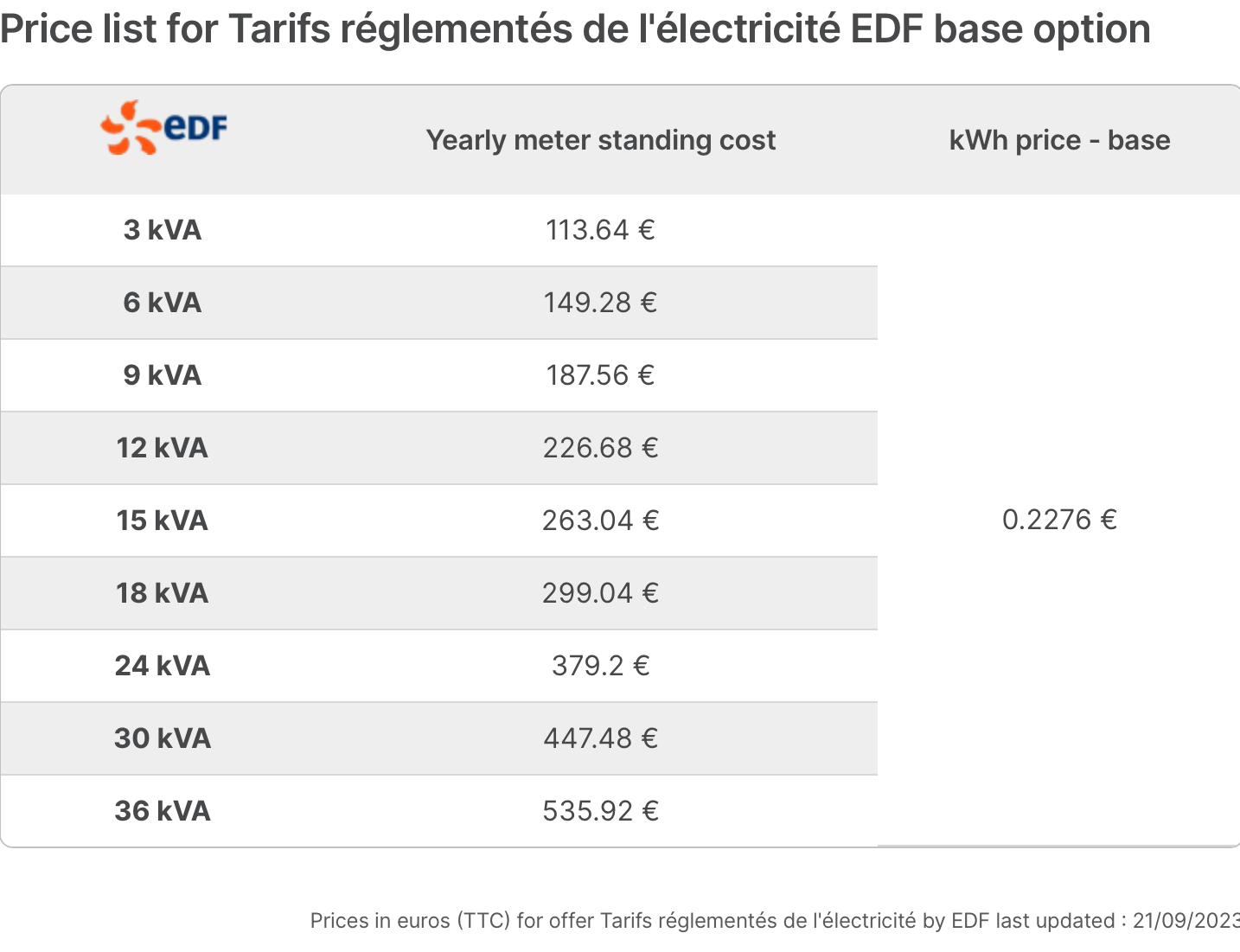
Note: this has nothing to do with how much energy a consumer uses (kWh) but how much instant power (kW) a consumer wants from the Grid. For kVA, read kW.
I would be happy to pay £50 a month for my electricity supply, especially if I knew that others less fortunate than me would have the opportunity to pay less.
I like this as a concept but I can't see how you would distinguish high use between those with money and those without?0 -
I like this as a concept but I can't see how you would distinguish high use between those with money and those without?
I believe they fit a limiting device so it is up to the customer to decide what limit they want and how much they pay in standing charge.
0 -
The smart meter is the limiting device and this is what remote disconnection is all about. If the agreed power level is exceeded and warnings (IHD/Text/etc) are ignored, then the supply will be disconnected. Reconnection is via a dedicated National phone line. Frequent excursions result in the consumer being moved to a higher kVA tariff with a higher standing charge.Netexporter said:I like this as a concept but I can't see how you would distinguish high use between those with money and those without?I believe they fit a limiting device so it is up to the customer to decide what limit they want and how much they pay in standing charge.
3 -
I would imagine that it is limited through a smart meter.I like this as a concept but I can't see how you would distinguish high use between those with money and those without?I believe they fit a limiting device so it is up to the customer to decide what limit they want and how much they pay in standing charge.
What I am talking about is somebody like me who wants to import and export at a high rate at times and has enough money to pay, somebody with a heat pump, an ev, a hot tub etc etc.
What about somebody on benefits, maybe with a disability, medical equipment and maybe inefficient electric heating?
They might pay the same as me and it really defeats the object of the exercise.
There would need to be a way to distinguish between those with high demand and money and those with high demand and less money.
To be effective a system like this needs to put the burden on those who can pay and those who can't.
My fear is that anything other than what we have hurts those most in need.
The real answer is to leave the standing charge alone and give more money to the poorest and most disadvantaged.
I think that is what most people in a similar position to me want.
Look after those who need help and stop handing out money to those taking advantage of a broken system.
The EBSS was a good example of vast amounts of money being given to people who didn't really need it when it could have been targeted at the most in need in this country.
2 -
Ah, that rings a bell. I vaguely remembered somebody I correspond with, who lives in France, mentioning the power limits but he never mentioned having a smart meter, so I assumed there was a "hard" control, rather than a "nudge".[Deleted User] said:
The smart meter is the limiting device and this is what remote disconnection is all about. If the agreed power level is exceeded and warnings (IHD/Text/etc) are ignored, then the supply will be disconnected. Reconnection is via a dedicated National phone line. Frequent excursions result in the consumer being moved to a higher kVA tariff with a higher standing charge.Netexporter said:I like this as a concept but I can't see how you would distinguish high use between those with money and those without?I believe they fit a limiting device so it is up to the customer to decide what limit they want and how much they pay in standing charge.
1 -
In Spain, they have recently introduced a version of Agile/Tracker. It is a 3 tier tariff with peak; mid peak and offpeak times with the unit rates for each period changing each day.Consumers also elect for one of 2 maximum power levels (kW) which cover the peak and mid peak tariff times: that is, no power limit for offpeak2
-
That sounds like a reasonable mix of stick and carrot. It will be interesting to see how it affects consumer behaviour.[Deleted User] said:In Spain, they have recently introduced a version of Agile/Tracker. It is a 3 tier tariff with peak; mid peak and offpeak times with the unit rates for each period changing each day.Consumers also elect for one of 2 maximum power levels (kW) which cover the peak and mid peak tariff times: that is, no power limit for offpeak0 -
A small to mediym property combi gas boiler can peak at 25-40 kW.
When the 20+ million using them agree to pay £400+ standing charges then I'll maybe start to listen to this debate.
Until then it's a highly discrimatory move against in many cases the poor and elderly who live with electric heating.
Not all of whimom are on benefits that qualify for additional aid.2 -
Let’s just go crazy and set the standing charge based on council tax band…0
-
Scot_39 said:A small to mediym property combi gas boiler can peak at 25-40 kW.On the other hand, a small to medium property with a regular boiler and a HW tank only needs 9-12kW.N. Hampshire, he/him. Octopus Intelligent Go elec & Tracker gas / Vodafone BB / iD mobile. Kirk Hill Co-op member.Ofgem cap table, Ofgem cap explainer. Economy 7 cap explainer. Gas vs E7 vs peak elec heating costs, Best kettle!
2.72kWp PV facing SSW installed Jan 2012. 11 x 247w panels, 3.6kw inverter. 35 MWh generated, long-term average 2.6 Os.1









Confirm your email address to Create Threads and Reply

Categories
- All Categories
- 354.6K Banking & Borrowing
- 254.5K Reduce Debt & Boost Income
- 455.5K Spending & Discounts
- 247.5K Work, Benefits & Business
- 604.4K Mortgages, Homes & Bills
- 178.6K Life & Family
- 262K Travel & Transport
- 1.5M Hobbies & Leisure
- 16.1K Discuss & Feedback
- 37.7K Read-Only Boards