We’d like to remind Forumites to please avoid political debate on the Forum.
This is to keep it a safe and useful space for MoneySaving discussions. Threads that are – or become – political in nature may be removed in line with the Forum’s rules. Thank you for your understanding.
📨 Have you signed up to the Forum's new Email Digest yet? Get a selection of trending threads sent straight to your inbox daily, weekly or monthly!
The Forum now has a brand new text editor, adding a bunch of handy features to use when creating posts. Read more in our how-to guide
Does the eco function on a dishwasher still save money
Comments
-
The eco function on a dishwasher is designed to use less energy and water compared to regular cycles. Generally, using the eco function is still more energy-efficient than traditional cycles, even if electricity prices have risen.While electricity prices can vary, it's unlikely that the increase would completely negate the energy savings achieved by using the eco function. You can compare the energy consumption of the eco function and regular cycles to get a better idea of the potential cost difference.
1 -
From one of the latest Samsung dishwasher manuals:
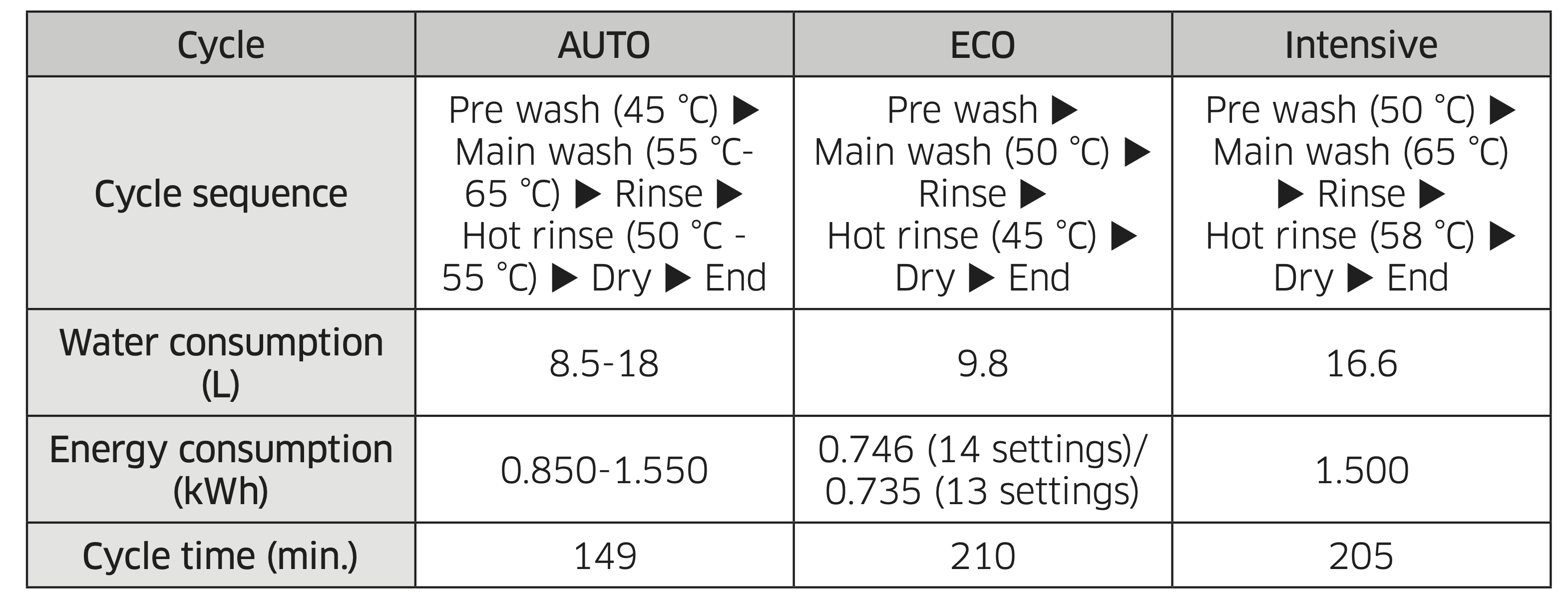
3 -
Electricity prices can never "negate" the savings made by using less, unless the price drops to zero. The higher the price, the greater the saving.anthonybax said:While electricity prices can vary, it's unlikely that the increase would completely negate the energy savings achieved by using the eco function.1 -
From my pretty new Hotpoint:
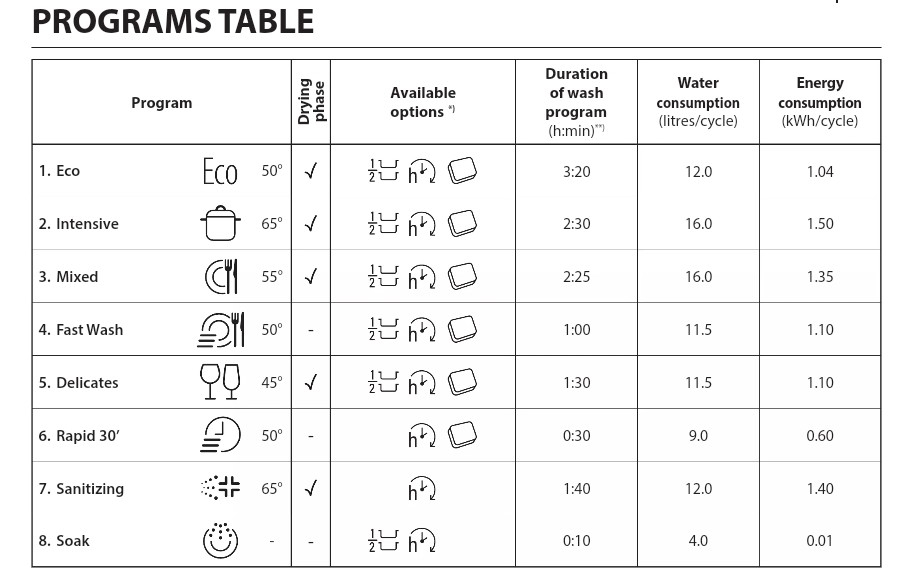
For a full load Eco uses the least water and least electricity (aside from a fast wash)
I'd suggest the engineer should have at the least qualified his statement with "depending on the machine" because as written his statement isn't true.
Regardless of energy costs, the programme that uses least electricity and water will always be the cheapest.
1 -
Other than the OP and at least one other poster believes Eco is only lower in water consumption and is higher in electricity use and so the spread between the two prices would impact it. Personally haven't seen any Eco programmes like that, ours is certainly lower on both water and electricityQyburn said:
Electricity prices can never "negate" the savings made by using less, unless the price drops to zero. The higher the price, the greater the saving.anthonybax said:While electricity prices can vary, it's unlikely that the increase would completely negate the energy savings achieved by using the eco function.1 -
Massive saving using eco on the dishwasher. Although you need to note that all dishwashers are not created equal.kingbullit said:A man who came to service our dishwasher recently told my partner that it is no longer economical to use the eco function on a dishwasher as the price of electricity has risen so much. I'm dubious but she gets very annoyed whenever I continue to use the eco function. Is there any truth to this "expert" advice?
This time last year when we were doing the rounds with tapo plugs, we tested our dishwasher. Sadly, i don't have the figures any more but using eco used around half the electricity compared to the normal programme. We also replaced the dishwasher with a more energy efficient one with a better quality eco function to lower it further
The main reason for the lower electricity use is that it doesn't heat the water as much and doesn't use hot air to dry the dishes. It has a longer soak and a longer drying cycle. The eco cycle on ours takes 4 hrs 55 minutes. It is also a smart dishwasher and allows a timer. So, to improve things further, we run the dishwasher overnight to use off-peak rates. (wont apply to the op if they are not on a multi-tariff)
I am an Independent Financial Adviser (IFA). The comments I make are just my opinion and are for discussion purposes only. They are not financial advice and you should not treat them as such. If you feel an area discussed may be relevant to you, then please seek advice from an Independent Financial Adviser local to you.0 -
As shown above, its probably better to look at the specification of the appliance than rely on the dubious advice from a so called expert.
If in doubt look it up. Even if you've lost the handbook most manufacturers have them on the wbNever under estimate the power of stupid people in large numbers0 -
Of course as all MSErs know, long programmes on a smart tariff such as Octopus Agile may end up costing the consumer more than a shorter programme because of 30 minute changing unit prices. You can also save money on any programme by opening the door before the hot drying cycle and using a tea towel.1
-
On my bosch the eco program takes a long time but uses about 30% less energy per wash than any of the other programmes, as measured with a Tapo.1
-
Yes, ironically it can sometimes be cheaper to use more energy at the right time. For example if it's sunny I often put the dishwasher on a shorter, more energy-intensive cycle to utilise solar power rather than risk delaying the drying section until after the sun disappears.[Deleted User] said:Of course as all MSErs know, long programmes on a smart tariff such as Octopus Agile may end up costing the consumer more than a shorter programme because of 30 minute changing unit prices. You can also save money on any programme by opening the door before the hot drying cycle and using a tea towel.0











Confirm your email address to Create Threads and Reply

Categories
- All Categories
- 354.5K Banking & Borrowing
- 254.4K Reduce Debt & Boost Income
- 455.4K Spending & Discounts
- 247.4K Work, Benefits & Business
- 604.2K Mortgages, Homes & Bills
- 178.5K Life & Family
- 261.7K Travel & Transport
- 1.5M Hobbies & Leisure
- 16.1K Discuss & Feedback
- 37.7K Read-Only Boards