We’d like to remind Forumites to please avoid political debate on the Forum.
This is to keep it a safe and useful space for MoneySaving discussions. Threads that are – or become – political in nature may be removed in line with the Forum’s rules. Thank you for your understanding.
I'm back...this time with a rail station penalty notice.
Comments
-
Really out of date stuff there. Remove point 6.
And replace these words (specifically this bit) because the PoFA is irrelevant to a PENALTY:"As none of the mandatory information set out by Schedule 4 paragraphs 8 and 9 of the PoFA has been made available to me as Registered Keeper the conditions set out by paragraph 6 of Schedule 4 has not been complied with. Therefore, there can be no keeper liability.
The keeper liability requirements of Schedule 4 of the Protection of Freedoms Act 2012 must be complied with, where the appellant is the registered keeper, as in this case. One of these requirements is the issue of a NTK compliant with certain provisions. This operator failed to serve any NTK at all. As there has been no admission as to who may have parked the car and no evidence of this person has been produced by the operator, it has been held by POPLA multiple times that a parking charge with no NTK cannot be enforced against the registered keeper."
Replace that bit with:
In the alternative, there was no 'NOTICE TO OWNER' (NTO) issued, as required under the statutory regime that APCOA claim to be operating under. The owner cannot be held liable without the Authority (TOC in this case) or its authorised agent first issuing a NTO.
It seems that this car park is subject to railway byelaws. The railway byelaws (otherwise referred to as the ‘byelaws’) are made under section 219 of the Transport Act 2000 by the Strategic Rail Authority and were confirmed under Schedule 20 of the Transport Act 2000 by the Secretary of State for Transport on 22 June 2005.
The Government summarises what is required in PENALTY NOTICE (aka 'fines') cases:
https://www.gov.uk/parking-tickets/challenging-a-ticket
"If your informal challenge is rejected:
You’ll get a ‘notice to owner’. It will explain how to pay or make a formal challenge.
Making a formal challenge
You have 28 days to make a formal challenge (called a ‘representation’) after you get a notice to owner. You must:
- explain your reasons for challenging the PCN in as much detail as possible
- provide copies of any evidence or documents to support your challenge
You will not have to pay the fine if your representation is accepted.
If your formal challenge is rejected: You’ll get a ‘notice of rejection’ - it will give you 28 days to appeal..." (in this case to POPLA).
The timeline and documents required in the Penalty regime is also summarised by an Authority here:
https://www.hastings.gov.uk/parking/pcns/pcnprocess/
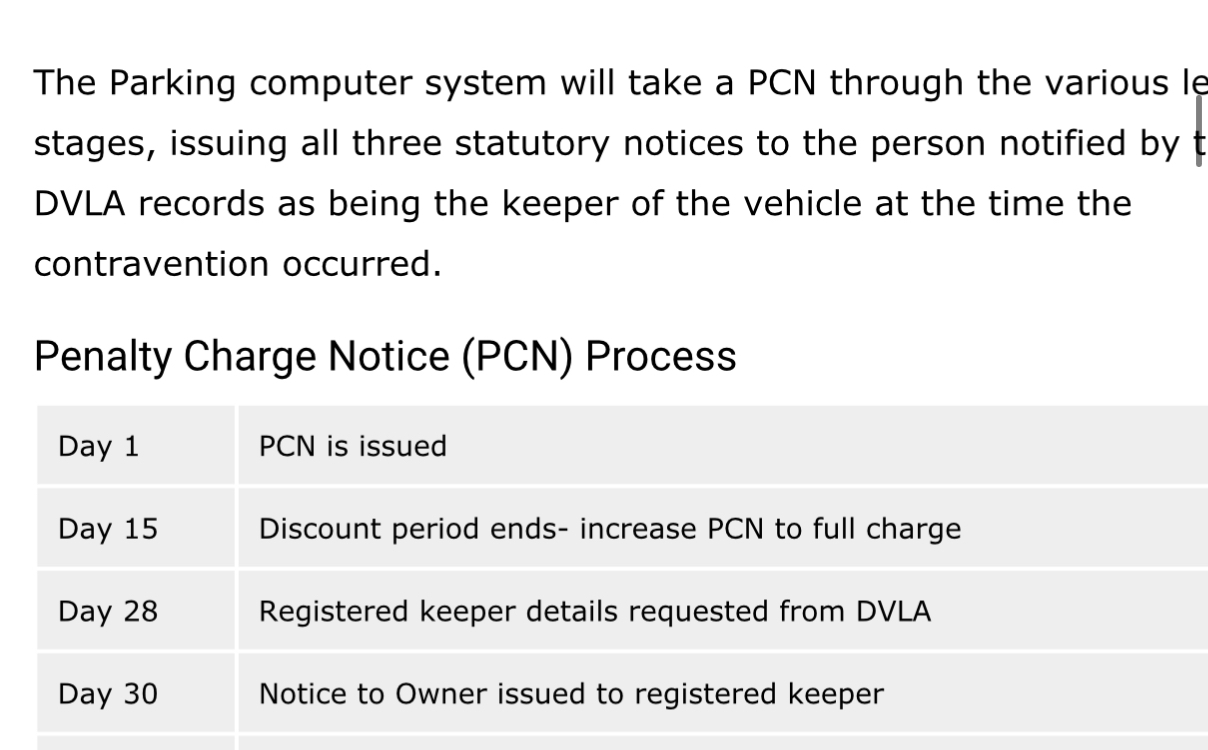
Notice to Owner (NTO)
"If the penalty charge is not paid we will issue a Notice to Owner.
The purpose of this is to ensure that the penalty charge notice was received by the vehicle owner and to remind the vehicle owner that payment in full is now due and if it is not paid within a further 28 days it may be increased.
The NTO is a formal notice which states the details of the vehicle concerned, the contravention, the amount of the penalty due, the date by which it should be paid or formal representations made and the statutory grounds upon which representations may be made.
The form covers all the details necessary to guide the owner to make a decision about whether to pay or make a formal representation."The appellant takes from this that even in Railway Penalty Notice cases issued under another similar enforcing Act, there MUST be an NTO issued, if the operator doesn't know who was driving. This would ensure that whoever the 'OWNER' is (who could be a company of third party and may well not be the keeper or the driver) has received a Notice in their name, telling them about potential 'owner liability' and repercussions.
No NTO was served.
It is irrelevant that the keeper has appealed. This does not remove the requirement to issue a NTO or NTK.
The 'liability notice' requirement has been swerved and POPLA cannot find that "the Owner is liable" merely based on a windscreen PCN alone. This 'liability notice' point is the same whether the POFA applies or the byelaws apply: a keeper cannot be held liable in the complete absence of a NTK or NTO.
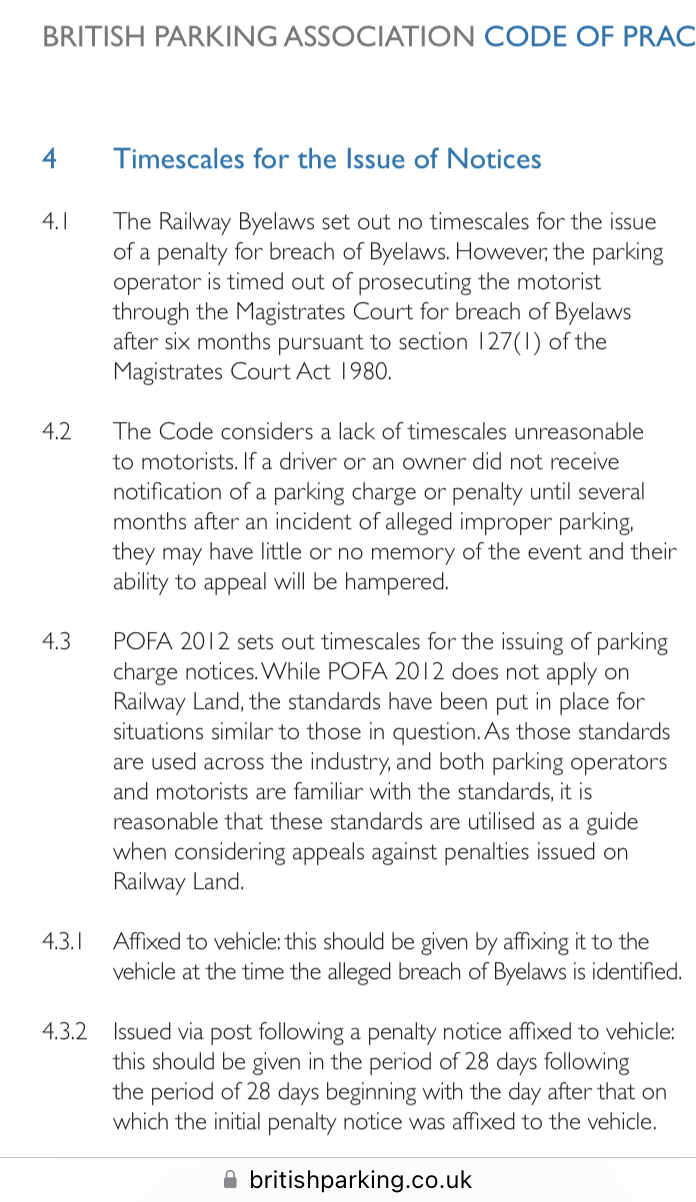
Further, as POPLA must surely be aware, the BPA Code confirms this at Annex G
https://www.britishparking.co.uk/write/Documents/AOS/AOS_Code_of_Practice_January_2020_v8(2).pdf
See point 4 of Annex G where the BPA says that the SAME TIMELINE for Notices must be applied as is set out earlier in the Code (in this case the relevant timelines and notices for an operator to mirror, is in the earlier BPA CoP section about about NTKs following a windscreen PCN, in cases where the driver remains unidentified and where an operator wishes to invoke 'keeper liability'):
PRIVATE 'PCN'? DON'T PAY BUT DON'T IGNORE IT (except N.Ireland).
CLICK at the top or bottom of any page where it says:
Home»Motoring»Parking Tickets Fines & Parking - read the NEWBIES THREAD2 -
B789 said:As the registered keeper of xxxx, I received a window screen Penalty Notice from APCOA Parking Limited’s on xxxx, 2023.You responded to the NtD and so that suggests you were the driver. You should have waited for the NtK before responding. Your wording in your POPLA appeal almost shouts that you were the driver.
You need to think about how to word it as the RK discovering the NtD because you weren't the driver. Tough one but, whatever the outcome, it has no bearing on any court claim should it come to that.
Thanks. All I have done so far is appeal saying i was keeper and driver would not be named and no assumptions can be made (blue text newbies standard) and then on 2nd appeal I literally wrote the text that ukonmass suggested earlier in this thread. I take your point though and will reword above0 -
Fruitcake said:Get rid of 3. Genuine no pre-estimate of loss went out with the Beavis case in 2015.
The UTCCR was superceded by the CRA 2015.
Wherever you found that example you are using, it is seriously out of date.
found in searching on here there are so many threads can you point me to one that is up to date or will removing points 3 and 6 and rewording per coupon mad enough?0 -
Try that and show us what it now looks like.PRIVATE 'PCN'? DON'T PAY BUT DON'T IGNORE IT (except N.Ireland).
CLICK at the top or bottom of any page where it says:
Home»Motoring»Parking Tickets Fines & Parking - read the NEWBIES THREAD0 -
Hi Coupon Mad & others here
The screenshots coupon mad included in hers will be included in my actual PDF i wasnt sure how to attach in the post please forgive me

Dear Sir or Madam,
PCN number: xxxxx
I appealed a Penalty Notice from APCOA Parking Limited as the keeper of the vehicle noted above and was refused in a letter dated August xx (attached) saying I had come to the end of their internal reviews procedures and that I should now contact POPLA.
I continue to deny all liability to APCOA Parking Limited (“APCOA”) on the following basis:1.) No Notice to Keeper, no 'keeper liability' under PoFA
APOCA had 56 days from the day after the parking event on xx, 2023 to issue a compliant Notice to Keeper following a windscreen ticket. To date I have not been issued a Notice to Keeper (NTK) by APCOA. As a Penalty Notice was provided on the vehicle windscreen, an NTK is required to be issued no sooner than 28 days after, or no later than 56 days after the service of that notice. This stipulation is laid out in Schedule 4 of the Protection of Freedoms Act 2012 (PoFA).
The alleged infringement occurred on xx, 2023 and from my understanding the NTK was required to reach me by August xx, 2023.
In the alternative, there was no 'NOTICE TO OWNER' (NTO) issued, as required under the statutory regime that APCOA claim to be operating under. The owner cannot be held liable without the Authority (TOC in this case) or its authorised agent first issuing a NTO.
It seems that this car park is subject to railway byelaws. The railway byelaws (otherwise referred to as the ‘byelaws’) are made under section 219 of the Transport Act 2000 by the Strategic Rail Authority and were confirmed under Schedule 20 of the Transport Act 2000 by the Secretary of State for Transport on 22 June 2005.
The Government summarises what is required in PENALTY NOTICE (aka 'fines') cases:
https://www.gov.uk/parking-tickets/challenging-a-ticket
"If your informal challenge is rejected:
You’ll get a ‘notice to owner’. It will explain how to pay or make a formal challenge.
Making a formal challenge
You have 28 days to make a formal challenge (called a ‘representation’) after you get a notice to owner. You must:
· explain your reasons for challenging the PCN in as much detail as possible
· provide copies of any evidence or documents to support your challenge
You will not have to pay the fine if your representation is accepted.
If your formal challenge is rejected: You’ll get a ‘notice of rejection’ - it will give you 28 days to appeal..." (in this case to POPLA).
The timeline and documents required in the Penalty regime is also summarised by an Authority here:
https://www.hastings.gov.uk/parking/pcns/pcnprocess/
Notice to Owner (NTO)
"If the penalty charge is not paid we will issue a Notice to Owner.
The purpose of this is to ensure that the penalty charge notice was received by the vehicle owner and to remind the vehicle owner that payment in full is now due and if it is not paid within a further 28 days it may be increased.
The NTO is a formal notice which states the details of the vehicle concerned, the contravention, the amount of the penalty due, the date by which it should be paid or formal representations made and the statutory grounds upon which representations may be made.
The form covers all the details necessary to guide the owner to make a decision about whether to pay or make a formal representation."The appellant takes from this that even in Railway Penalty Notice cases issued under another similar enforcing Act, there MUST be an NTO issued, if the operator doesn't know who was driving. This would ensure that whoever the 'OWNER' is (who could be a company of third party and may well not be the keeper or the driver) has received a Notice in their name, telling them about potential 'owner liability' and repercussions.
No NTO was served.
It is irrelevant that the keeper has appealed. This does not remove the requirement to issue a NTO or NTK.
The 'liability notice' requirement has been swerved and POPLA cannot find that "the Owner is liable" merely based on a windscreen PCN alone. This 'liability notice' point is the same whether the POFA applies or the byelaws apply: a keeper cannot be held liable in the complete absence of a NTK or NTO.
Further, as POPLA must surely be aware, the BPA Code confirms this at Annex G
https://www.britishparking.co.uk/write/Documents/AOS/AOS_Code_of_Practice_January_2020_v8(2).pdf
See point 4 of Annex G where the BPA says that the SAME TIMELINE for Notices must be applied as is set out earlier in the Code (in this case the relevant timelines and notices for an operator to mirror, is in the earlier BPA CoP section about about NTKs following a windscreen PCN, in cases where the driver remains unidentified and where an operator wishes to invoke 'keeper liability'):
2.) There is no liability to me as keeper - railway land is not ‘Relevant Land’
APCOA have failed to identify the driver of my vehicle. They are now seeking to impose liability on me as keeper. As far as I am aware, the Protection of Freedoms Act (2012) (“PoFA”) is the only legal means by which APCOA could seek to do this, but they specifically avoided reference to this Act in their correspondence. If they are not seeking to use PoFA to impose liability on me as keeper, they should state and prove the legal basis they claim makes me liable. If they cannot, then my appeal must be allowed immediately and the POPLA adjudicator can be spared consideration of the rest of this appeal letter.
Should APCOA now seek to make use of PoFA (despite avoiding doing so in their correspondence with me), I deny any possible use of PoFA to impose liability on me as keeper on the following grounds:
· Since byelaws apply to railway land, the land is not relevant land within the meaning of PoFA and so is specifically excluded from 'keeper liability' under Schedule 4 of PoFA. As I am the registered keeper I am not legally liable as this Act does not apply on this land. I ask the Operator for strict proof otherwise if they disagree with this point and would require them to show evidence including documentary proof from the Rail authorities that this land is not already covered by bylaws.
3.) The signage was not compliant with the BPA Code of Practice and was not seen before parking - so there was no valid contract formed between APCOA and the driver
APCOA signs in this car park are sparse and unclear, to the extent that they are incapable of forming a contract even if the driver had seen and agreed to the terms, which is not the case in this instance. Any alleged contract (denied in this case) could only be formed upon entering the premises, prior to parking. It is not formed after the vehicle has already been parked, such as when the driver walks away and past a sign, as this is too late. In breach of Appendix B (Mandatory Entrance Signs) APCOA has no signage with full terms which could be readable at eye level, for a driver in moving traffic on arrival.Further, the single sign which appears at one end of the carpark breaches the BPA CoP Appendix B which effectively renders it unable to form a contract with a driver: ''Signs should be readable and understandable at all times, including during the hours of darkness...when parking enforcement activity takes place at those times. This can be achieved...by direct lighting or by using the lighting for the parking area. If the sign itself is not directly or indirectly lit...should be made of a retro-reflective material similar to that used on public roads''. I put APCOA to strict proof otherwise; as well as a site map they must show photos in darkness taken without a camera flash. The sign is not prominent, not reflective & placed too high to be lit by headlights. A Notice is not imported into the contract unless brought home so prominently that the party 'must' have known of it and agreed terms. The driver did not see any sign; there was no consideration/acceptance and no contract agreed between the parties.
4.) Lack of standing / authority from landowner
APCOA has no title in this land and no BPA compliant landowner contract assigning rights to charge and enforce in the courts in their own right.
BPA CoP paragraphs 7.1 & 7.2 dictate some of the required contract wording. I put APCOA to strict proof of the contract terms with the actual landowner (not another agent as they are not the landholder).APCOA has no legal status to enforce this charge because there is neither assignment of rights to pursue PCNs in the courts in its own name nor standing to form contracts with drivers itself. They do not own this car park and appear(at best) to have a bare licence to put signs up and 'ticket' vehicles on site, merely acting as agents. No evidence has been supplied lawfully showing that APCOA are entitled to pursue these charges in their own right.
I require APCOA to provide a full copy of the contemporaneous, signed & dated (unredacted) contract with the landowner. I say that any contract is not compliant with the BPA Code of Practice and does not allow APCOA (specifically) to issue proceedings for this sum for this alleged contravention in this car park. APCOA have previously failed in several attempted small claims in 2014 when it was exposed that only their principal had the right to start court proceedings. I say this is likely to be typical of APCOA contracts. In my case with this car park site, if APCOA cannot show the landowner has authorised them to pursue PCNs in the court in their own name alone, they will fail to show they have standing and authority. In order to refute this it will not be sufficient for the Operator merely to supply a site agreement or witness statement, as these do not show sufficient detail (such as the restrictions, charges and revenue sharing arrangements agreed with a landowner) and may well be signed by a non-landholder such as another agent. A redacted contract will not refute my assertion either because the redaction could be the relevant wording about who can start court proceedings.
In order to comply with paragraph 7 of the BPA Code of Practice, a non-landowner private parking company must have a specifically-worded contract with the landowner - not merely an 'agreement' with a non-landholder managing agent - otherwise there is no authority.
I therefore respectfully request that my appeal is upheld and for POPLA to inform APCOA that the charge is dismissed.
Yours faithfully
0 -
All good except remove para 2.
They are not saying they are using the POFA.
Para 1 already covers owner liability and including that irrelevant 'POFA argument' paragraph 2 detracts from the specific argument in para 1, about Railway PNs and the BPA Code.PRIVATE 'PCN'? DON'T PAY BUT DON'T IGNORE IT (except N.Ireland).
CLICK at the top or bottom of any page where it says:
Home»Motoring»Parking Tickets Fines & Parking - read the NEWBIES THREAD0 -
remove the whole point 2.)?0
-
Dear Sir or Madam,
PCN number:
I appealed a Penalty Notice from APCOA Parking Limited as the keeper of the vehicle noted above and was refused in a letter dated xxxx saying I had come to the end of their internal reviews procedures and that I should now contact POPLA.
I continue to deny all liability to APCOA Parking Limited (“APCOA”) on the following basis:1.) No Notice to Keeper, no 'keeper liability' under PoFA
APOCA had 56 days from the day after the parking event on xxx to issue a compliant Notice to Keeper following a windscreen ticket. To date I have not been issued a Notice to Keeper (NTK) by APCOA. As a Penalty Notice was provided on the vehicle windscreen, an NTK is required to be issued no sooner than 28 days after, or no later than 56 days after the service of that notice. This stipulation is laid out in Schedule 4 of the Protection of Freedoms Act 2012 (PoFA).
The alleged infringement occurred on xxx and from my understanding the NTK was required to reach me by xxx.
In the alternative, there was no 'NOTICE TO OWNER' (NTO) issued, as required under the statutory regime that APCOA claim to be operating under. The owner cannot be held liable without the Authority (TOC in this case) or its authorised agent first issuing a NTO.
It seems that this car park is subject to railway byelaws. The railway byelaws (otherwise referred to as the ‘byelaws’) are made under section 219 of the Transport Act 2000 by the Strategic Rail Authority and were confirmed under Schedule 20 of the Transport Act 2000 by the Secretary of State for Transport on 22 June 2005.
The Government summarises what is required in PENALTY NOTICE (aka 'fines') cases:
https://www.gov.uk/parking-tickets/challenging-a-ticket
"If your informal challenge is rejected:
You’ll get a ‘notice to owner’. It will explain how to pay or make a formal challenge.
Making a formal challenge
You have 28 days to make a formal challenge (called a ‘representation’) after you get a notice to owner. You must:
· explain your reasons for challenging the PCN in as much detail as possible
· provide copies of any evidence or documents to support your challenge
You will not have to pay the fine if your representation is accepted.
If your formal challenge is rejected: You’ll get a ‘notice of rejection’ - it will give you 28 days to appeal..." (in this case to POPLA).
The timeline and documents required in the Penalty regime is also summarised by an Authority here:
https://www.hastings.gov.uk/parking/pcns/pcnprocess/
Notice to Owner (NTO)
"If the penalty charge is not paid we will issue a Notice to Owner.
The purpose of this is to ensure that the penalty charge notice was received by the vehicle owner and to remind the vehicle owner that payment in full is now due and if it is not paid within a further 28 days it may be increased.
The NTO is a formal notice which states the details of the vehicle concerned, the contravention, the amount of the penalty due, the date by which it should be paid or formal representations made and the statutory grounds upon which representations may be made.
The form covers all the details necessary to guide the owner to make a decision about whether to pay or make a formal representation."The appellant takes from this that even in Railway Penalty Notice cases issued under another similar enforcing Act, there MUST be an NTO issued, if the operator doesn't know who was driving. This would ensure that whoever the 'OWNER' is (who could be a company of third party and may well not be the keeper or the driver) has received a Notice in their name, telling them about potential 'owner liability' and repercussions.
No NTO was served.
It is irrelevant that the keeper has appealed. This does not remove the requirement to issue a NTO or NTK.
The 'liability notice' requirement has been swerved and POPLA cannot find that "the Owner is liable" merely based on a windscreen PCN alone. This 'liability notice' point is the same whether the POFA applies or the byelaws apply: a keeper cannot be held liable in the complete absence of a NTK or NTO.
Further, as POPLA must surely be aware, the BPA Code confirms this at Annex G
https://www.britishparking.co.uk/write/Documents/AOS/AOS_Code_of_Practice_January_2020_v8(2).pdf
See point 4 of Annex G where the BPA says that the SAME TIMELINE for Notices must be applied as is set out earlier in the Code (in this case the relevant timelines and notices for an operator to mirror, is in the earlier BPA CoP section about about NTKs following a windscreen PCN, in cases where the driver remains unidentified and where an operator wishes to invoke 'keeper
liability'):
2.) The signage was not compliant with the BPA Code of Practice and was not seen before parking - so there was no valid contract formed between APCOA and the driver
APCOA signs in this car park are sparse and unclear, to the extent that they are incapable of forming a contract even if the driver had seen and agreed to the terms, which is not the case in this instance. Any alleged contract (denied in this case) could only be formed upon entering the premises, prior to parking. It is not formed after the vehicle has already been parked, such as when the driver walks away and past a sign, as this is too late. In breach of Appendix B (Mandatory Entrance Signs) APCOA has no signage with full terms which could be readable at eye level, for a driver in moving traffic on arrival.Further, the single sign which appears at one end of the carpark breaches the BPA CoP Appendix B which effectively renders it unable to form a contract with a driver: ''Signs should be readable and understandable at all times, including during the hours of darkness...when parking enforcement activity takes place at those times. This can be achieved...by direct lighting or by using the lighting for the parking area. If the sign itself is not directly or indirectly lit...should be made of a retro-reflective material similar to that used on public roads''. I put APCOA to strict proof otherwise; as well as a site map they must show photos in darkness taken without a camera flash. The sign is not prominent, not reflective & placed too high to be lit by headlights. A Notice is not imported into the contract unless brought home so prominently that the party 'must' have known of it and agreed terms. The driver did not see any sign; there was no consideration/acceptance and no contract agreed between the parties.
3.) Lack of standing / authority from landowner
APCOA has no title in this land and no BPA compliant landowner contract assigning rights to charge and enforce in the courts in their own right.
BPA CoP paragraphs 7.1 & 7.2 dictate some of the required contract wording. I put APCOA to strict proof of the contract terms with the actual landowner (not another agent as they are not the landholder).APCOA has no legal status to enforce this charge because there is neither assignment of rights to pursue PCNs in the courts in its own name nor standing to form contracts with drivers itself. They do not own this car park and appear(at best) to have a bare licence to put signs up and 'ticket' vehicles on site, merely acting as agents. No evidence has been supplied lawfully showing that APCOA are entitled to pursue these charges in their own right.
I require APCOA to provide a full copy of the contemporaneous, signed & dated (unredacted) contract with the landowner. I say that any contract is not compliant with the BPA Code of Practice and does not allow APCOA (specifically) to issue proceedings for this sum for this alleged contravention in this car park. APCOA have previously failed in several attempted small claims in 2014 when it was exposed that only their principal had the right to start court proceedings. I say this is likely to be typical of APCOA contracts. In my case with this car park site, if APCOA cannot show the landowner has authorised them to pursue PCNs in the court in their own name alone, they will fail to show they have standing and authority. In order to refute this it will not be sufficient for the Operator merely to supply a site agreement or witness statement, as these do not show sufficient detail (such as the restrictions, charges and revenue sharing arrangements agreed with a landowner) and may well be signed by a non-landholder such as another agent. A redacted contract will not refute my assertion either because the redaction could be the relevant wording about who can start court proceedings.
In order to comply with paragraph 7 of the BPA Code of Practice, a non-landowner private parking company must have a specifically-worded contract with the landowner - not merely an 'agreement' with a non-landholder managing agent - otherwise there is no authority.
I therefore respectfully request that my appeal is upheld and for POPLA to inform APCOA that the charge is dismissed.
Yours faithfully
0 -
That's better except remove this; it isn't true!APCOA have previously failed in several attempted small claims in 2014 when it was exposed that only their principal had the right to start court proceedings. I say this is likely to be typical of APCOA contracts. In my case with this car park site, if APCOA cannot show the landowner has authorised them to pursue PCNs in the court in their own name alone, they will fail to show they have standing and authority. In order to refute this it will not be sufficient for the Operator merely to supply a site agreement or witness statement, as these do not show sufficient detail (such as the restrictions, charges and revenue sharing arrangements agreed with a landowner) and may well be signed by a non-landholder such as another agent. A redacted contract will not refute my assertion either because the redaction could be the relevant wording about who can start court proceedings.
APCOA have never tried a parking small claim (and they can't in this case anyway, because the charge wasn't issued under contract law).
PRIVATE 'PCN'? DON'T PAY BUT DON'T IGNORE IT (except N.Ireland).
CLICK at the top or bottom of any page where it says:
Home»Motoring»Parking Tickets Fines & Parking - read the NEWBIES THREAD0 -
PCN number: xxx
I appealed a Penalty Notice from APCOA Parking Limited as the keeper of the vehicle noted above and was refused in a letter dated xxxxxxsaying I had come to the end of their internal reviews procedures and that I should now contact POPLA.
I continue to deny all liability to APCOA Parking Limited (“APCOA”) on the following basis:1.) No Notice to Keeper, no 'keeper liability' under PoFA
APOCA had 56 days from the day after the parking event on xxx to issue a compliant Notice to Keeper following a windscreen ticket. To date I have not been issued a Notice to Keeper (NTK) by APCOA. As a Penalty Notice was provided on the vehicle windscreen, an NTK is required to be issued no sooner than 28 days after, or no later than 56 days after the service of that notice. This stipulation is laid out in Schedule 4 of the Protection of Freedoms Act 2012 (PoFA).
The alleged infringement occurred on xxx and from my understanding the NTK was required to reach me by xxx, 2023.
In the alternative, there was no 'NOTICE TO OWNER' (NTO) issued, as required under the statutory regime that APCOA claim to be operating under. The owner cannot be held liable without the Authority (TOC in this case) or its authorised agent first issuing a NTO.
It seems that this car park is subject to railway byelaws. The railway byelaws (otherwise referred to as the ‘byelaws’) are made under section 219 of the Transport Act 2000 by the Strategic Rail Authority and were confirmed under Schedule 20 of the Transport Act 2000 by the Secretary of State for Transport on 22 June 2005.
The Government summarises what is required in PENALTY NOTICE (aka 'fines') cases:
https://www.gov.uk/parking-tickets/challenging-a-ticket
"If your informal challenge is rejected:
You’ll get a ‘notice to owner’. It will explain how to pay or make a formal challenge.
Making a formal challenge
You have 28 days to make a formal challenge (called a ‘representation’) after you get a notice to owner. You must:
· explain your reasons for challenging the PCN in as much detail as possible
· provide copies of any evidence or documents to support your challenge
You will not have to pay the fine if your representation is accepted.
If your formal challenge is rejected: You’ll get a ‘notice of rejection’ - it will give you 28 days to appeal..." (in this case to POPLA).
The timeline and documents required in the Penalty regime is also summarised by an Authority here:
https://www.hastings.gov.uk/parking/pcns/pcnprocess/
Notice to Owner (NTO)
"If the penalty charge is not paid we will issue a Notice to Owner.
The purpose of this is to ensure that the penalty charge notice was received by the vehicle owner and to remind the vehicle owner that payment in full is now due and if it is not paid within a further 28 days it may be increased.
The NTO is a formal notice which states the details of the vehicle concerned, the contravention, the amount of the penalty due, the date by which it should be paid or formal representations made and the statutory grounds upon which representations may be made.
The form covers all the details necessary to guide the owner to make a decision about whether to pay or make a formal representation."The appellant takes from this that even in Railway Penalty Notice cases issued under another similar enforcing Act, there MUST be an NTO issued, if the operator doesn't know who was driving. This would ensure that whoever the 'OWNER' is (who could be a company of third party and may well not be the keeper or the driver) has received a Notice in their name, telling them about potential 'owner liability' and repercussions.
No NTO was served.
It is irrelevant that the keeper has appealed. This does not remove the requirement to issue a NTO or NTK.
The 'liability notice' requirement has been swerved and POPLA cannot find that "the Owner is liable" merely based on a windscreen PCN alone. This 'liability notice' point is the same whether the POFA applies or the byelaws apply: a keeper cannot be held liable in the complete absence of a NTK or NTO.
Further, as POPLA must surely be aware, the BPA Code confirms this at Annex G
https://www.britishparking.co.uk/write/Documents/AOS/AOS_Code_of_Practice_January_2020_v8(2).pdf
See point 4 of Annex G where the BPA says that the SAME TIMELINE for Notices must be applied as is set out earlier in the Code (in this case the relevant timelines and notices for an operator to mirror, is in the earlier BPA CoP section about about NTKs following a windscreen PCN, in cases where the driver remains unidentified and where an operator wishes to invoke 'keeper
liability'):
2.) The signage was not compliant with the BPA Code of Practice and was not seen before parking - so there was no valid contract formed between APCOA and the driver
APCOA signs in this car park are sparse and unclear, to the extent that they are incapable of forming a contract even if the driver had seen and agreed to the terms, which is not the case in this instance. Any alleged contract (denied in this case) could only be formed upon entering the premises, prior to parking. It is not formed after the vehicle has already been parked, such as when the driver walks away and past a sign, as this is too late. In breach of Appendix B (Mandatory Entrance Signs) APCOA has no signage with full terms which could be readable at eye level, for a driver in moving traffic on arrival.Further, the single sign which appears at one end of the carpark breaches the BPA CoP Appendix B which effectively renders it unable to form a contract with a driver: ''Signs should be readable and understandable at all times, including during the hours of darkness...when parking enforcement activity takes place at those times. This can be achieved...by direct lighting or by using the lighting for the parking area. If the sign itself is not directly or indirectly lit...should be made of a retro-reflective material similar to that used on public roads''. I put APCOA to strict proof otherwise; as well as a site map they must show photos in darkness taken without a camera flash. The sign is not prominent, not reflective & placed too high to be lit by headlights. A Notice is not imported into the contract unless brought home so prominently that the party 'must' have known of it and agreed terms. The driver did not see any sign; there was no consideration/acceptance and no contract agreed between the parties.
3.) Lack of standing / authority from landowner
APCOA has no title in this land and no BPA compliant landowner contract assigning rights to charge and enforce in the courts in their own right.
BPA CoP paragraphs 7.1 & 7.2 dictate some of the required contract wording. I put APCOA to strict proof of the contract terms with the actual landowner (not another agent as they are not the landholder).APCOA has no legal status to enforce this charge because there is neither assignment of rights to pursue PCNs in the courts in its own name nor standing to form contracts with drivers itself. They do not own this car park and appear(at best) to have a bare licence to put signs up and 'ticket' vehicles on site, merely acting as agents. No evidence has been supplied lawfully showing that APCOA are entitled to pursue these charges in their own right.
I require APCOA to provide a full copy of the contemporaneous, signed & dated (unredacted) contract with the landowner. I say that any contract is not compliant with the BPA Code of Practice and does not allow APCOA (specifically) to issue proceedings for this sum for this alleged contravention in this car park.
In order to comply with paragraph 7 of the BPA Code of Practice, a non-landowner private parking company must have a specifically-worded contract with the landowner - not merely an 'agreement' with a non-landholder managing agent - otherwise there is no authority.
I therefore respectfully request that my appeal is upheld and for POPLA to inform APCOA that the charge is dismissed.
Yours faithfully
0









Confirm your email address to Create Threads and Reply

Categories
- All Categories
- 354.6K Banking & Borrowing
- 254.5K Reduce Debt & Boost Income
- 455.5K Spending & Discounts
- 247.5K Work, Benefits & Business
- 604.4K Mortgages, Homes & Bills
- 178.6K Life & Family
- 261.9K Travel & Transport
- 1.5M Hobbies & Leisure
- 16.1K Discuss & Feedback
- 37.7K Read-Only Boards