We’d like to remind Forumites to please avoid political debate on the Forum.
This is to keep it a safe and useful space for MoneySaving discussions. Threads that are – or become – political in nature may be removed in line with the Forum’s rules. Thank you for your understanding.
📨 Have you signed up to the Forum's new Email Digest yet? Get a selection of trending threads sent straight to your inbox daily, weekly or monthly!
The Forum now has a brand new text editor, adding a bunch of handy features to use when creating posts. Read more in our how-to guide
Taxing savings or selling funds?

talexuser
Posts: 3,610 Forumite



Basically asking if my logic here is correct.
You are a higher rate taxpayer with income and savings interest below the 40% threshold and dividends above the 40% threshold.
Savings interest is taxed before dividends.
Savings interest above the 0% allowance will attract a tax rate of 20% until they (with income) reach the higher rate threshold. Assume they don't.
Conversely CGT selling funds will also be taxed at 20% beyond the 6k (this year) allowance since a higher rate taxpayer.
However savings interest is worse from a tax point of view because the extra interest, even if only taxed at 20% pushes the total income higher and more of the existing dividends will be taxed at 33.75%.
So purely from a tax point of view it is better to minimise savings interest to the 0% allowance band and add extra income to the GIA and pay CTG as and when necessary? Assume ISA and SIPP maxed out and out of the equation.
Where is the catch - ignoring investment risk?
I suppose putting extra into the GIA will increase dividends taxed at 33.75 anyway, so you can't win?
You are a higher rate taxpayer with income and savings interest below the 40% threshold and dividends above the 40% threshold.
Savings interest is taxed before dividends.
Savings interest above the 0% allowance will attract a tax rate of 20% until they (with income) reach the higher rate threshold. Assume they don't.
Conversely CGT selling funds will also be taxed at 20% beyond the 6k (this year) allowance since a higher rate taxpayer.
However savings interest is worse from a tax point of view because the extra interest, even if only taxed at 20% pushes the total income higher and more of the existing dividends will be taxed at 33.75%.
So purely from a tax point of view it is better to minimise savings interest to the 0% allowance band and add extra income to the GIA and pay CTG as and when necessary? Assume ISA and SIPP maxed out and out of the equation.
Where is the catch - ignoring investment risk?
I suppose putting extra into the GIA will increase dividends taxed at 33.75 anyway, so you can't win?
0
Comments
-
If you've paid the most into your pensions have you remembered to factor in that the higher rate threshold will rise from £50,270? You may have less higher rate liability than you think
2 -
Good point, I can only pay max of 3600 into the SIPP since already drawing a final salary scheme, so that's the max the 40% threshold can gain.1
-
33.75% tax on dividends is a sure way to force me to pay as much as I can into my pension to keep me below the threshold.2
-
talexuser said:Conversely CGT selling funds will also be taxed at 20% beyond the 6k (this year) allowance since a higher rate taxpayer.Let's leave CGT out of it for a moment, it doesn't affect the interest/dividends equationSo purely from a tax point of view it is better to minimise savings interest to the 0% allowance band and add extra income to the GIAIt's always better to minimise savings interest to 0% but I don't think it's relevant to your question which seems to be:
Is it better (in my particular circumstances above) to move money from interest to dividends?Yes it isI suppose putting extra into the GIA will increase dividends taxed at 33.75 anywayNo it won't, they will be the sameIf we assume the return from interest and dividends is broadly the same and you remove a lump of interest producing cash (at 20%) and replace it with dividend producing investments (at 8.75%) it doesn't alter the amount above the HRT thresholdBut 8.75% is less than 20% so you pay less taxBack to CGT. It's always nice to have an extra allowance to take advantage of. CGT is largely an elective tax, you can control the sales and therefore how much tax you pay. You could choose growth investments rather than higher dividend ones and reduce your dividend tax further, replacing them with capital gains (which you won't pay tax on)All of this 'ignoring investment risk' of course0 -
Yes, but I'm already paying 33.75% tax on dividends, so interest increases "down the income + savings scale" pushes dividends at the top of the scale further into the 33.75 area, and less in the 8.75 area, if that makes sense?
I did some calculatons with interest at £500, £1000, £2000 etc and was surprised the tax increase did not work out at 20% of the excess of interest but actually more.... which turned out to be "constant" dividends being taxed less at 8.75 and more at 33.75 as the gross increased intot he 40% tax area..0 -
You have interest and some dividends below £50,270 (20% and 8.75%) and some dividends above it (33.75%)If you swap some of that interest for dividends (by putting it into a GIA) you will pay 8.75% on that sum instead of 20%. Your interest/dividend mix won't change the HRT threshold so the dividends above it are unchanged0
-
Try this
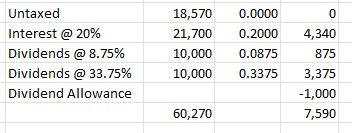 Now move £10,000 from savings to investments
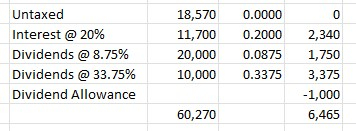 - Less interest at 20%, more dividends at 8.75%, same dividends at 33.75% = less tax2
 -
If I put your example figures into my tax spreadsheet I get £625 less tax with the 10,000 from savings to investments which proves your point, even if the savings interest of 21700 is a little on the high side :-)
I think I was increasing the savings interest and seeing an increase in the 33.75 band without trying the equivalent amounts as dividends and comparing the final amounts.
In any case with increased savings rates and decreasing (by inflation) allowances it will be difficult to maintain a float for emergencies without paying more tax nowadays and in the foreseeable future, but an interesting exercise to see if minimising tax is practical at all.0 -
There is no "allowance" for dividends in the way you've shown it.ColdIron said:Try thisNow move £10,000 from savings to investments - Less interest at 20%, more dividends at 8.75%, same dividends at 33.75% = less tax
In the first table the first £1,000 of dividend income would be taxed at 0% (dividend nil rate band) and use up £1,000 of the basic rate band leaving just £9,000 available for dividends to be taxed at the dividend basic rate.
1 -
How did I not know, when constructing the tables, that this was coming (again)
 1
1




Confirm your email address to Create Threads and Reply

Categories
- All Categories
- 354.3K Banking & Borrowing
- 254.4K Reduce Debt & Boost Income
- 455.4K Spending & Discounts
- 247.3K Work, Benefits & Business
- 604K Mortgages, Homes & Bills
- 178.4K Life & Family
- 261.5K Travel & Transport
- 1.5M Hobbies & Leisure
- 16K Discuss & Feedback
- 37.7K Read-Only Boards