We’d like to remind Forumites to please avoid political debate on the Forum.
This is to keep it a safe and useful space for MoneySaving discussions. Threads that are – or become – political in nature may be removed in line with the Forum’s rules. Thank you for your understanding.
Dealing with a Nightmare: Energy Supplier and Ombudsman Frustrations
Comments
-
Thank you for your points. I see where you're coming from, and I agree that a sample size of 2,000 out of millions could be statistically significant. However, in the context of energy meters, a few factors could affect the reliability of these results.
When it comes to energy meters, the population isn't homogenous. We have various makes, models, and ages of meters, all of which can perform differently and have varying lifespans. So, while 2,000 is a significant number, it would be more reliable if the sample were representative of the diverse meter population in terms of make, model, age, and geographical location.
Furthermore, regarding the testing of latest models and those reported faulty by the public, it would be beneficial to have access to the specifics of this information. Without transparency on these details, we're left to make assumptions on how comprehensive and representative the testing was.
Finally, the focus on testing meters that have already been flagged as faulty might result in a skewed perception of the general meter population's reliability. It's crucial that random, unreported meters are also included in the testing sample to give a more balanced view.
In conclusion, my point is not to assert that energy meter faults are common. It's rather to emphasize the importance of thorough and transparent testing, and how assumptions about rarity can't be confidently made without clear, detailed, and publicly available data.
0 -
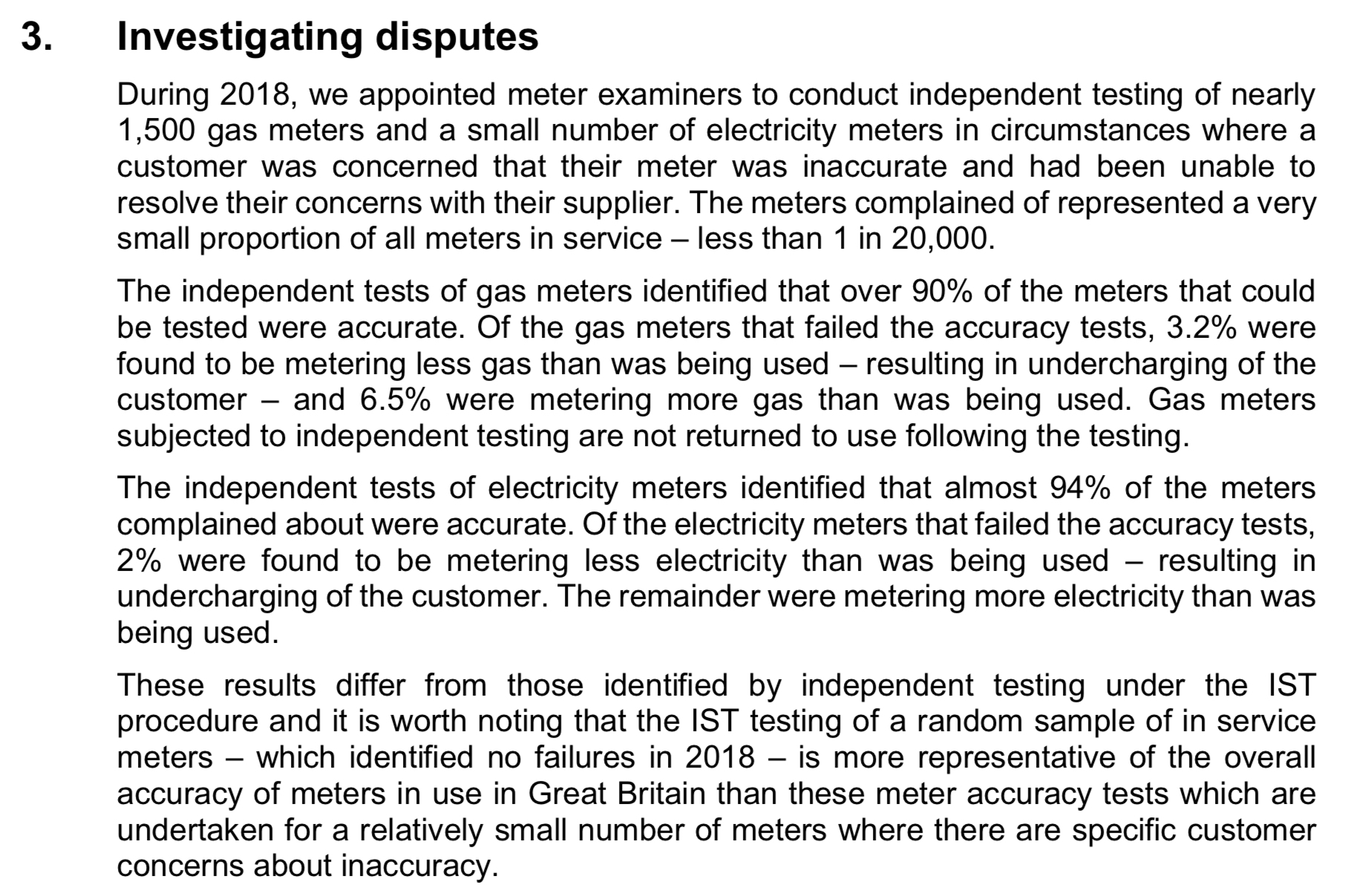
OPSS does not test gas meters. It outsources the testing of gas meters to SGS (SGS.Com). Annual reports are issued by OPSS. How much more transparency are you seeking?
0 -
Thank you for sharing this information. I understand that OPSS outsources the testing of gas meters to SGS and that annual reports are issued. This is a good start towards transparency.
However, what I am advocating for is a deeper level of detail in these reports. It would be beneficial to know specifics like the makes and models of the meters tested, their ages, and their geographical locations. This information would provide a more comprehensive understanding of the testing process and its results.
Additionally, it would be insightful to know the proportion of meters tested that were already flagged as potentially faulty by consumers versus those randomly chosen for testing. This could give us a better perspective on the overall health of the energy meters in use.
Ultimately, the goal is to provide consumers with as much information as possible so that they can have confidence in their energy meters and in the processes that are in place to ensure their reliability. The more transparent and detailed the information, the better it is for everyone involved.
0 -
2% is pretty good accuracy. Electricity meters are generally worse than that. I've measured hundreds of electricity over the years and very few are better than +/- 2%. That's within spec, so not an issue. Does mean that one consumer could be paying a few percent more or less than an identical customer, just because of normal metering errors.Biggest issue is consumers falsely believing that measuring anything with a device that retails for less than £30 is ever going to be super accurate. Metering at the domestic level is never super accurate, doesn't have to be according to the law. If we wanted super accurate metering we'd have to foot the bill for meters that cost thousands of pounds each. Not going to happen in the real world.0
-
I would expect every meter in the batch of 000's could behave the same way when the battery hits the same level in the cases we have seen on the forum, So them going out and testing that model/batch would certainly put my mind at rest.
In my time on the forum i think all meters tested came back faulty like we all expected, But i think most simply give up trying and get the meter swapped for a new smart meter and then report far lower usage, small sample i know but it must mean 100's more unreported from the stats.0 -
If you read my post above, you will see that for someone using 12000kWh/ year the tolerances are not +/-240kWhs/year. The accuracy of 2% appears to be linked to 1/5th of the meter’s maximum flow rate.JSHarris said:2% is pretty good accuracy. Electricity meters are generally worse than that. I've measured hundreds of electricity over the years and very few are better than +/- 2%. That's within spec, so not an issue. Does mean that one consumer could be paying a few percent more or less than an identical customer, just because of normal metering errors.Biggest issue is consumers falsely believing that measuring anything with a device that retails for less than £30 is ever going to be super accurate. Metering at the domestic level is never super accurate, doesn't have to be according to the law. If we wanted super accurate metering we'd have to foot the bill for meters that cost thousands of pounds each. Not going to happen in the real world.
My smart gas meter has a maximum flow of 6M3/hour or 65kWh. Twenty percent of 65 is 13kWh: so the permitted discrepancy is +/- 2% or 0.26kWh/hour (assuming the boiler is constantly inputting 13kWh/ hour of gas).At my present tariff rate of 4p/kWh, my hourly unit cost might differ from 4 x 13 or 52p/hour by 0.26x 4 or 1.04p. Put another way, I might end up paying 51 or 53p for the 13kWh of gas consumed.
I am sure that someone will be along to correct my maths.0 -
Back to the original point: in this case, if your evidence is robust (i.e. you have a video of the meter incrementing while the gas valve is closed) then you might need to resolve the issue in court. You'll need to build a sound case with thorough details and arrive at a figure which you can demonstrate is owed to you. Then, ultimately, issue a Money Claim On Line and take them to court.
There's quite a bit of legwork to do first and mediation would be an option (if you can find someone at the energy company capable of engaging). Ideally you'd find someone senior at the company who was willing to enter into dialogue before such action, but it's often impossible. The first step should be to try to contact the CEO's office. Be polite and concise. Some companies are more responsive on social media (Twitter is a good start).0 -
It strikes me as odd that EDF are the one's pursuing this. Isn't it usually the administrators of the failed supplier that chase alleged debts? While the Ombudsman wouldn't get involved there either, it would normally be down to them to prove the money was owed and pursue it through the courts.If the 'debt' was correctly transferred to EDF, then UP aren't relevant. @Stuart_ have you raised a formal complaint with the ombudsman service themselves over their refusal to adjudicate?Petriix said:Back to the original point: in this case, if your evidence is robust (i.e. you have a video of the meter incrementing while the gas valve is closed) then you might need to resolve the issue in court. You'll need to build a sound case with thorough details and arrive at a figure which you can demonstrate is owed to you. Then, ultimately, issue a Money Claim On Line and take them to court.
There's quite a bit of legwork to do first and mediation would be an option (if you can find someone at the energy company capable of engaging). Ideally you'd find someone senior at the company who was willing to enter into dialogue before such action, but it's often impossible. The first step should be to try to contact the CEO's office. Be polite and concise. Some companies are more responsive on social media (Twitter is a good start).Courts do like to see (though don't require) an attempt at mediation before a matter sits before a Judge, although I'd imagine the ombudsman would count as a good faith attempt to avoid court.In either case mediation is only an option if both sides are willing to compromise and give concessions to the other. If OP is determined that they don't owe anything, then further mediation would be fruitless.
3.6 kW PV in the Midlands - 9x Sharp 400W black panels - 6x facing SE and 3x facing SW, Solaredge Optimisers and Inverter. 400W Derril Water (one day). Octopus Flux0 -
Slight misunderstanding.[Deleted User] said:
If you read my post above, you will see that for someone using 12000kWh/ year the tolerances are not +/-240kWhs/year. The accuracy of 2% appears to be linked to 1/5th of the meter’s maximum flow rate.JSHarris said:2% is pretty good accuracy. Electricity meters are generally worse than that. I've measured hundreds of electricity over the years and very few are better than +/- 2%. That's within spec, so not an issue. Does mean that one consumer could be paying a few percent more or less than an identical customer, just because of normal metering errors.Biggest issue is consumers falsely believing that measuring anything with a device that retails for less than £30 is ever going to be super accurate. Metering at the domestic level is never super accurate, doesn't have to be according to the law. If we wanted super accurate metering we'd have to foot the bill for meters that cost thousands of pounds each. Not going to happen in the real world.
My smart gas meter has a maximum flow of 6M3/hour or 65kWh. Twenty percent of 65 is 13kWh: so the permitted discrepancy is +/- 2% or 0.26kWh/hour (assuming the boiler is constantly inputting 13kWh/ hour of gas).At my present tariff rate of 4p/kWh, my hourly unit cost might differ from 4 x 13 or 52p/hour by 0.26x 4 or 1.04p. Put another way, I might end up paying 51 or 53p for the 13kWh of gas consumed.
I am sure that someone will be along to correct my maths.
Both accuracy measures (gas and electricity) are an allowable error percentage at all values up to the maximum the meter can measure. The gas measure has that bottom 1/5th limit because errors as a percentage of value increase at extremely low flow.
So for your meter, the reading must be within 2% of 65kWh when the flow is equivalent to 65kWh and within 2% of 0.26kWh when the flow is equivalent to 0.26kWh.
For flows below 0.26kWh equivalent, the percentage error can be higher.0 -
Just for info (as I'm only familiar with electricity metering) the standard for domestic meters is an accuracy of +2.5%, -3.5% overall. In general electricity meters are worse at low power levels and better at high power levels. Very, very common to find a meter will be right at the accuracy limits when only a couple of hundred watts is going through it, but may well be better than 1% accurate when running at a few kW load.I would guess that gas meters follow a similar pattern. Metrology in general often has a dynamic range accuracy problem. If you make a meter capable of measuring a very high energy use accurately then it's inevitable that it won't be as accurate when measuring a very low energy use.2










Confirm your email address to Create Threads and Reply

Categories
- All Categories
- 354.6K Banking & Borrowing
- 254.4K Reduce Debt & Boost Income
- 455.5K Spending & Discounts
- 247.4K Work, Benefits & Business
- 604.3K Mortgages, Homes & Bills
- 178.5K Life & Family
- 261.8K Travel & Transport
- 1.5M Hobbies & Leisure
- 16.1K Discuss & Feedback
- 37.7K Read-Only Boards