We’d like to remind Forumites to please avoid political debate on the Forum.
This is to keep it a safe and useful space for MoneySaving discussions. Threads that are – or become – political in nature may be removed in line with the Forum’s rules. Thank you for your understanding.
📨 Have you signed up to the Forum's new Email Digest yet? Get a selection of trending threads sent straight to your inbox daily, weekly or monthly!
The Forum now has a brand new text editor, adding a bunch of handy features to use when creating posts. Read more in our how-to guide
Percentage of bill going on standing charges.
Comments
-
Yes. Paying for goods is not the same as paying for a utility/service. If you take a mobile phone contract as an example of a service, you might pay £5 a month for 3GB’s worth of data and £8 a month for 25GB. The bulk of the monthly cost is network charges: energy is the same.Brie said:Got to admit I don't understand why it's charged separately. Does that happen with water? I know it doesn't happen with my groceries.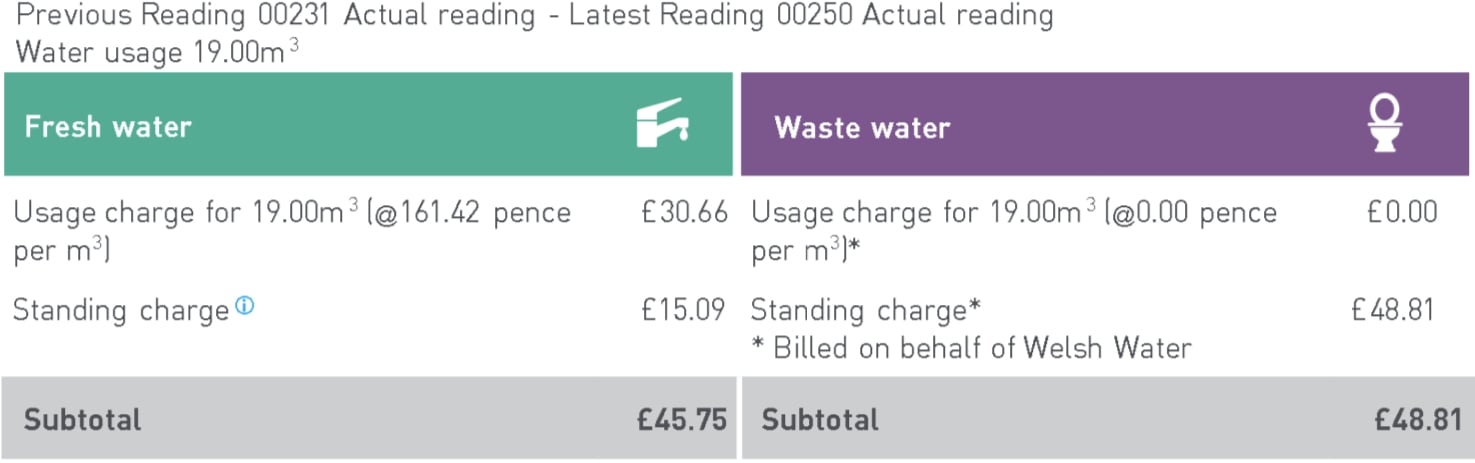
2 -
Brie said:Got to admit I don't understand why it's charged separately. Does that happen with water? I know it doesn't happen with my groceries.I think due to the nature of how they want it to be paid.If was a supplement on the bill as a % (like VAT) or just taken as part of the unit price, larger families and student houses would perhaps on average pay more, and historically we in this country we seem to like per household billing methods (which burdens singletons more). In addition it provides an assured income which is probably the bigger reason, I could go away for a few months, turn everything off, and they still get that income from me.
I didnt intend this thread to be another should we do this or that with SC, was just curious if for most people its still a low %. So probably wont comment on this more for my opinion.May take a while for SVR tariffs to get to where they were before the crisis (if they ever do), until then I think the masses on SVR, even singletons wont have as high % as me.0 -
Over an entire year, SC is 32% of electricity cost and 15% of gas cost2
-
Use more, the percentages will go down!Krakkkers said:Over an entire year, SC is 32% of electricity cost and 15% of gas cost0 -
At the moment, 100% of my gas bill is standing charges. Likely to be that way until July at the earliest.
Any language construct that forces such insanity in this case should be abandoned without regrets. –
Erik Aronesty, 2014
Treasure the moments that you have. Savour them for as long as you can for they will never come back again.2 -
Over the summer months, my SC will be somewhere between 50-100% of my electricity bill due to solar generation, but that doesn't mean I shouldn't have to pay it anyway as my share of the cost of providing and maintaining the grid...
2 -
And perhaps that is the most significant tissue, we are paying to feed profits rather than delivering a key service that people need to live. This applies across all utilities.[Deleted User] said:
Ofgen does not exist. It is the Office of Gas and Electricity Markets (Ofgem): a non-Ministerial department within the UK Government. If Ofgem was shut down, it would have to be replaced with another organisation that had identical responsibilities.wrf12345 said:Ofgen are to blame for the absurdly high standing charges that discourage low/green usage, no reason why they can't be eliminated and rolled into the unit charge (only those above average use would pay more). The latest bit of trickery is to increase the standing charges on prepayment meters from July 1st and slightly decrease the unit rate (the idiots in govn seem to only have mandated that the overall average rate be the same as DD) in direct opposition to the mandate to improve things for those on prepayment meters. Those on smart prepayment meters do not cost more than DD because they can not get into debt so that element saves the co's a huge amount of dosh and s/c's should be moving towards zero. I am not sure if we are dealing with incompetence or crookedness from Ofgen but they should be closed down.
You keep pedalling the assertion that standing charges are unfair yet you fail to acknowledge that there is an infrastructure cost associated with maintaining the Grid; providing you with a meter etc. These fixed costs do not vary based on how much energy you use.
Zero standing charge tariffs failed because low users and those, say, with PV solar do not contribute to business profits in any meaningful way. The supplier still has to raise bills and pay staff to purchase energy; deal with customer issues etc
The underlying premise in all your posts is that those who earn more or use more energy should pay more. I would respectfully suggest that those who are higher earners already contribute more to the Tax pot which pays for the public services that we all benefit from.Sadly, we have become a country that is now associated with falling productivity. If I was younger, standing charges would be low in my list of concerns. I would be more worried about who was going to pay for my State Pension; Health and other benefits? Taxing the rich is not a sustainable plan.
It should not be driven by profits but by ensuring funding is reinvested into the necessary infrastructure, looking forward 20-50 years, to ensure energy security and assure a level of service.
Selling off the industry and focussing on profits have got us into this situation.Your life is too short to be unhappy 5 days a week in exchange for 2 days of freedom!0 -
PFI schemes offered politicians a way of improving schools; hospitals etc without having to demand higher personal taxes: higher taxes are not usually regarded as a vote winner. Politicians are also reluctant to commit to infrastructure schemes which might benefit the opposition at the time of delivery.BikingBud said:
And perhaps that is the most significant tissue, we are paying to feed profits rather than delivering a key service that people need to live. This applies across all utilities.[Deleted User] said:
Ofgen does not exist. It is the Office of Gas and Electricity Markets (Ofgem): a non-Ministerial department within the UK Government. If Ofgem was shut down, it would have to be replaced with another organisation that had identical responsibilities.wrf12345 said:Ofgen are to blame for the absurdly high standing charges that discourage low/green usage, no reason why they can't be eliminated and rolled into the unit charge (only those above average use would pay more). The latest bit of trickery is to increase the standing charges on prepayment meters from July 1st and slightly decrease the unit rate (the idiots in govn seem to only have mandated that the overall average rate be the same as DD) in direct opposition to the mandate to improve things for those on prepayment meters. Those on smart prepayment meters do not cost more than DD because they can not get into debt so that element saves the co's a huge amount of dosh and s/c's should be moving towards zero. I am not sure if we are dealing with incompetence or crookedness from Ofgen but they should be closed down.
You keep pedalling the assertion that standing charges are unfair yet you fail to acknowledge that there is an infrastructure cost associated with maintaining the Grid; providing you with a meter etc. These fixed costs do not vary based on how much energy you use.
Zero standing charge tariffs failed because low users and those, say, with PV solar do not contribute to business profits in any meaningful way. The supplier still has to raise bills and pay staff to purchase energy; deal with customer issues etc
The underlying premise in all your posts is that those who earn more or use more energy should pay more. I would respectfully suggest that those who are higher earners already contribute more to the Tax pot which pays for the public services that we all benefit from.Sadly, we have become a country that is now associated with falling productivity. If I was younger, standing charges would be low in my list of concerns. I would be more worried about who was going to pay for my State Pension; Health and other benefits? Taxing the rich is not a sustainable plan.
It should not be driven by profits but by ensuring funding is reinvested into the necessary infrastructure, looking forward 20-50 years, to ensure energy security and assure a level of service.
Selling off the industry and focussing on profits have got us into this situation.I confess that I have never understood the public anger against profits. Profits generate both taxes and further investment which, in turn, generates jobs and growth. Even when dividends that are paid go shareholders this money is usually spent in products or services that also generate taxes and growth. This is no guarantee that if a Government ran the railways that the ‘profits’ (if there were any) would be re-invested in the railways. This is not how Government finances work.1 -
Dolor said:PFI schemes offered politicians a way of improving schools; hospitals etc without having to demand higher personal taxes: higher taxes are not usually regarded as a vote winner. Politicians are also reluctant to commit to infrastructure schemes which might benefit the opposition at the time of delivery.Alternatively, PFI schemes allowed a reduction in CAPEX at the cost of increased OPEX.The private companies building the schools, hospitals etc. could not borrow as cheaply as the government and so the finance costs will inevitably be greater than if the government had funded it up-front. These finance costs are met through OPEX.It's a bit of sleight-of-hand to keep the cost of construction off the government's books.See also Hinkley Point C where it's been stated (quote taken from the Wikipedia article):According to Dieter Helm, professor of Energy Policy at the University of Oxford, "Hinkley Point C would have been roughly half the cost if the government had been borrowing the money to build it at 2%, rather than EDF's cost of capital, which was 9%."
N. Hampshire, he/him. Octopus Intelligent Go elec & Tracker gas / Vodafone BB / iD mobile. Kirk Hill Co-op member.Ofgem cap table, Ofgem cap explainer. Economy 7 cap explainer. Gas vs E7 vs peak elec heating costs, Best kettle!
2.72kWp PV facing SSW installed Jan 2012. 11 x 247w panels, 3.6kw inverter. 35 MWh generated, long-term average 2.6 Os.1 -
I am not defending PFI, I am just saying that it was attractive to politicians as it offered something tangible in terms of delivery. That said, I accept that the PFI pigeons are now coming home to roost.QrizB said:Dolor said:PFI schemes offered politicians a way of improving schools; hospitals etc without having to demand higher personal taxes: higher taxes are not usually regarded as a vote winner. Politicians are also reluctant to commit to infrastructure schemes which might benefit the opposition at the time of delivery.Alternatively, PFI schemes allowed a reduction in CAPEX at the cost of increased OPEX.The private companies building the schools, hospitals etc. could not borrow as cheaply as the government and so the finance costs will inevitably be greater than if the government had funded it up-front. These finance costs are met through OPEX.It's a bit of sleight-of-hand to keep the cost of construction off the government's books.See also Hinkley Point C where it's been stated (quote taken from the Wikipedia article):According to Dieter Helm, professor of Energy Policy at the University of Oxford, "Hinkley Point C would have been roughly half the cost if the government had been borrowing the money to build it at 2%, rather than EDF's cost of capital, which was 9%."
2
![[Deleted User]](https://us-noi.v-cdn.net/6031891/uploads/defaultavatar/nFA7H6UNOO0N5.jpg)






Confirm your email address to Create Threads and Reply

Categories
- All Categories
- 354.4K Banking & Borrowing
- 254.4K Reduce Debt & Boost Income
- 455.4K Spending & Discounts
- 247.3K Work, Benefits & Business
- 604K Mortgages, Homes & Bills
- 178.4K Life & Family
- 261.5K Travel & Transport
- 1.5M Hobbies & Leisure
- 16K Discuss & Feedback
- 37.7K Read-Only Boards