We’d like to remind Forumites to please avoid political debate on the Forum.
This is to keep it a safe and useful space for MoneySaving discussions. Threads that are – or become – political in nature may be removed in line with the Forum’s rules. Thank you for your understanding.
📨 Have you signed up to the Forum's new Email Digest yet? Get a selection of trending threads sent straight to your inbox daily, weekly or monthly!
The Forum now has a brand new text editor, adding a bunch of handy features to use when creating posts. Read more in our how-to guide
High yield vs. investment grade vs. equities

aroominyork
Posts: 3,807 Forumite



I came across this Invesco article promoting investment grade bonds. Two things stood out from the chart below comparing US asset classes over 50 years. First, high yield's outperformance of IG, with only marginally worse returns during slowdown and contraction phases. Second, high yield's lower volatility and better returns than equities over the cycle. Returns for the five asset classes over the cycle are: equities 23.7%; high yield 28.8%; bank loan 15.5%; investment grade 16.4; govt bond 12.9%. Does this look a credible reflection of these asset classes' behaviour?

0
Comments
-
The website detects you're British, and seems unwilling to serve the page outside the USA. Is there any trick apart from a VPN, needed to see it?0
-
If you look at the dates January 1970-December 2021 you will see that the period under test is dominated by the steady fall in interest rates starting in 1980 when bonds gained from unsustainable capital value increases. Even in 1970 the 10-year US treasury interest rate was about 8%.aroominyork said:I came across this Invesco article promoting investment grade bonds. Two things stood out from the chart below comparing US asset classes over 50 years. First, high yield's outperformance of IG, with only marginally worse returns during slowdown and contraction phases. Second, high yield's lower volatility and better returns than equities over the cycle. Returns for the five asset classes over the cycle are: equities 23.7%; high yield 28.8%; bank loan 15.5%; investment grade 16.4; govt bond 12.9%. Does this look a credible reflection of these asset classes' behaviour?
The figure refers to "excess" returns - what are these? In excess of what?
Peerhaps this graph may be of interest. It shows UK high yield and general corporate biond funds against the FTSE World equity index. Note that this starts near to the worst case for equity at the height of the .com boom. Also note that since the graph is over a long time period and has a linear scale its shape very misleading. The minor wobbles at the start represent something like a 40% fall in equity.
Or starting in 2003 near the bottom of the .com bust: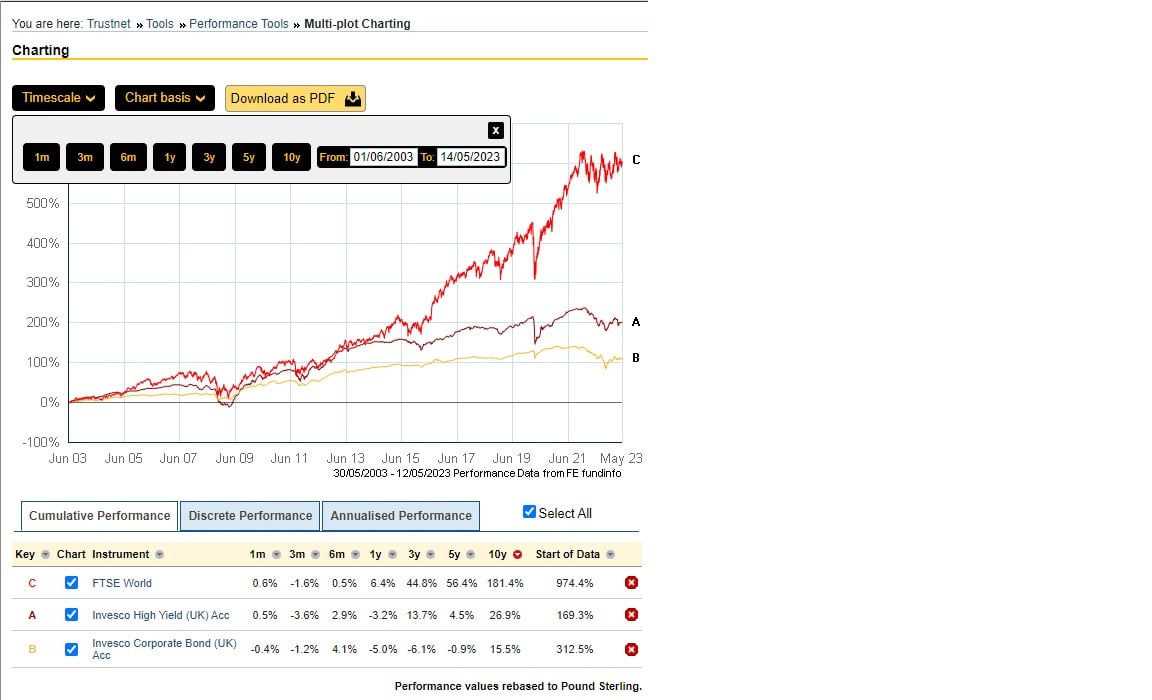
3 -
The Trustnet charts above seem fairly representative to me, based on my experience of funds other than those selected. HY typically has a positive correlation with equities, but with somewhat lower volatility. IG, even lower volatility, but still largely a positive correlation.
2




Confirm your email address to Create Threads and Reply

Categories
- All Categories
- 353.9K Banking & Borrowing
- 254.3K Reduce Debt & Boost Income
- 455.2K Spending & Discounts
- 246.9K Work, Benefits & Business
- 603.5K Mortgages, Homes & Bills
- 178.3K Life & Family
- 261K Travel & Transport
- 1.5M Hobbies & Leisure
- 16K Discuss & Feedback
- 37.7K Read-Only Boards