We’d like to remind Forumites to please avoid political debate on the Forum.
This is to keep it a safe and useful space for MoneySaving discussions. Threads that are – or become – political in nature may be removed in line with the Forum’s rules. Thank you for your understanding.
📨 Have you signed up to the Forum's new Email Digest yet? Get a selection of trending threads sent straight to your inbox daily, weekly or monthly!
HMRC Poor Wording
Comments
-
2. Excluding ISA interest.eskbanker said:
Where has that wording been taken from? It is true that income from investments with a high proportion of bonds is categorised as interest rather than dividends, but that just means that 'interest can come from some investments as well as savings', rather than "Investment income includes interest received on savings accounts", so perhaps I'm missing the context?RG2015 said:- Investment income includes interest received on savings accounts. This despite saving (in savings accounts) and investing being quite different from each other.
Looks like the ISA issue has been done to death elsewhere (the general principle being that ISAs are excluded from anything to do with income tax, as explained at https://www.gov.uk/individual-savings-accounts/how-isas-work ), but it's also necessary to self-assess with dividend income over £10K, so the wording seems correct?RG2015 said:- Per HMRC. You need to register for Self Assessment if your income from savings and investments is over £10,000. This does not include interest received on ISAs or dividends received on investments which are not applicable for this £10k threshold.
RG2015 said:
Not sure I'm seeing how that's poor wording from HMRC as such, unless they state or imply something to the contrary somewhere?- The tax year for interest received is based on the date it is available not for the year when it was earned.
It may be a general principle explained somewhere else, but for the benefit of the uninitiated, it should be explained where the statement is made.
3. Tax period.
Many are confused about the tax period for interest on 2 to 5 year fixed savings accounts. HMRC say it is liable for tax in the year is is available, but in some cases it is taxable in the year it is declared by the savings provider.0 -
Yes, it is.Dazed_and_C0nfused said:
That list looks remarkably like the available options HMRC have to record details on your tax record.RG2015 said:
1. investment Income.eskbanker said:
Where has that wording been taken from? It is true that income from investments with a high proportion of bonds is categorised as interest rather than dividends, but that just means that 'interest can come from some investments as well as savings', rather than "Investment income includes interest received on savings accounts", so perhaps I'm missing the context?RG2015 said:- Investment income includes interest received on savings accounts. This despite saving (in savings accounts) and investing being quite different from each other.
Looks like the ISA issue has been done to death elsewhere (the general principle being that ISAs are excluded from anything to do with income tax, as explained at https://www.gov.uk/individual-savings-accounts/how-isas-work ), but it's also necessary to self-assess with dividend income over £10K, so the wording seems correct?RG2015 said:- Per HMRC. You need to register for Self Assessment if your income from savings and investments is over £10,000. This does not include interest received on ISAs or dividends received on investments which are not applicable for this £10k threshold.
RG2015 said:
Not sure I'm seeing how that's poor wording from HMRC as such, unless they state or imply something to the contrary somewhere?- The tax year for interest received is based on the date it is available not for the year when it was earned.
On the personal tax online page for reporting missing investment income, which includes untaxed interest.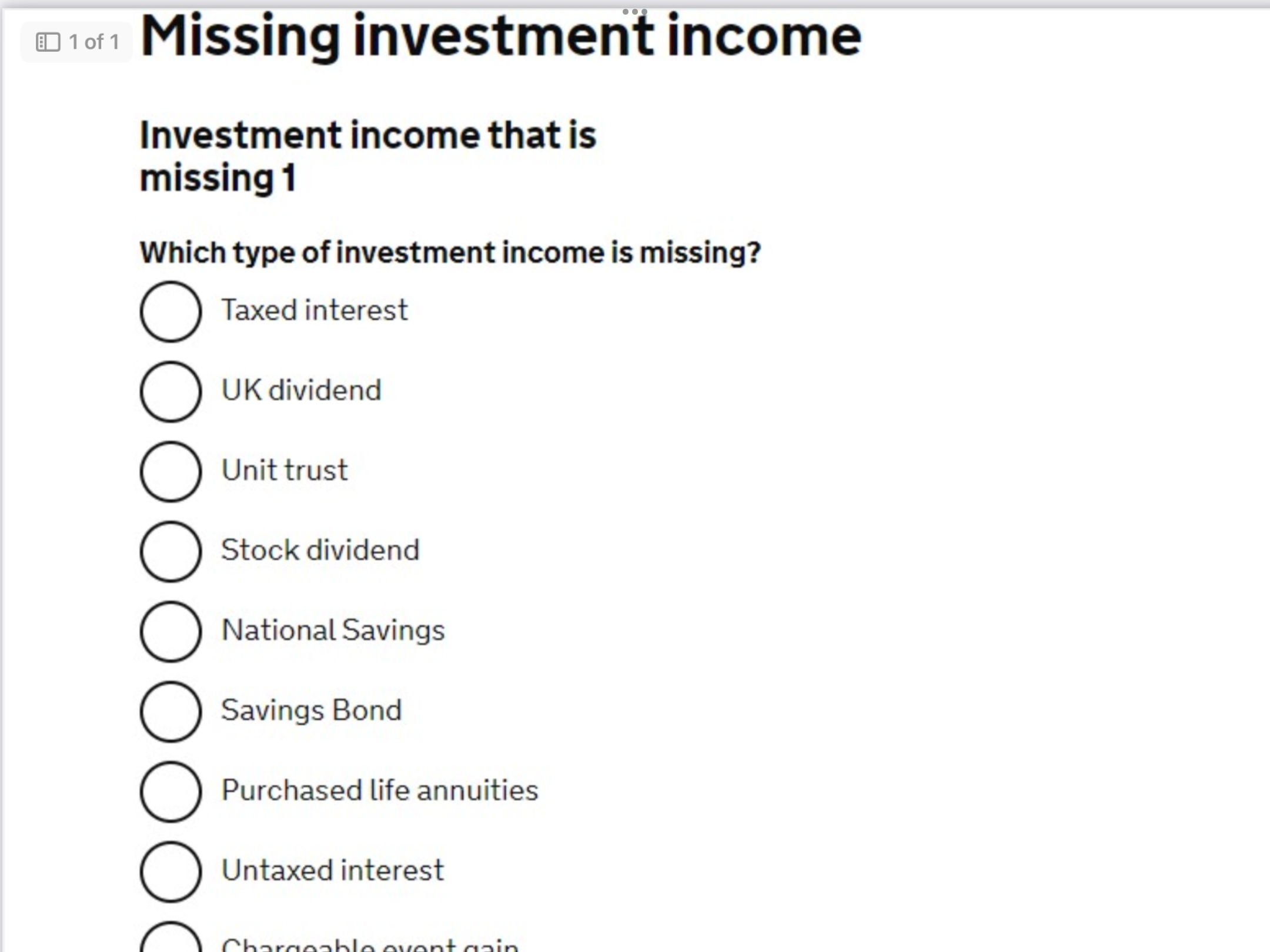
https://www.gov.uk/hmrc-internal-manuals/paye-manual/paye130060
The point being that interest is under the heading of investment income despite it possibly coming from a savings account rather than an investment.
Investing and saving are regarded as different activities particularly on this forum.0 -
Not sure I’m getting that to be honest. Interest from savings has always been taxed as investment income as far back as the days of Schedule D Case III.RG2015 said:
Yes, it is.Dazed_and_C0nfused said:
That list looks remarkably like the available options HMRC have to record details on your tax record.RG2015 said:
1. investment Income.eskbanker said:
Where has that wording been taken from? It is true that income from investments with a high proportion of bonds is categorised as interest rather than dividends, but that just means that 'interest can come from some investments as well as savings', rather than "Investment income includes interest received on savings accounts", so perhaps I'm missing the context?RG2015 said:- Investment income includes interest received on savings accounts. This despite saving (in savings accounts) and investing being quite different from each other.
Looks like the ISA issue has been done to death elsewhere (the general principle being that ISAs are excluded from anything to do with income tax, as explained at https://www.gov.uk/individual-savings-accounts/how-isas-work ), but it's also necessary to self-assess with dividend income over £10K, so the wording seems correct?RG2015 said:- Per HMRC. You need to register for Self Assessment if your income from savings and investments is over £10,000. This does not include interest received on ISAs or dividends received on investments which are not applicable for this £10k threshold.
RG2015 said:
Not sure I'm seeing how that's poor wording from HMRC as such, unless they state or imply something to the contrary somewhere?- The tax year for interest received is based on the date it is available not for the year when it was earned.
On the personal tax online page for reporting missing investment income, which includes untaxed interest.
https://www.gov.uk/hmrc-internal-manuals/paye-manual/paye130060
The point being that interest is under the heading of investment income despite it possibly coming from a savings account rather than an investment.
Investing and saving are regarded as different activities particularly on this forum.0 -
In which case it has always been poorly worded. If something has always been wrong it doesn't make it right.[Deleted User] said:
Not sure I’m getting that to be honest. Interest from savings has always been taxed as investment income as far back as the days of Schedule D Case III.RG2015 said:
Yes, it is.Dazed_and_C0nfused said:
That list looks remarkably like the available options HMRC have to record details on your tax record.RG2015 said:
1. investment Income.eskbanker said:
Where has that wording been taken from? It is true that income from investments with a high proportion of bonds is categorised as interest rather than dividends, but that just means that 'interest can come from some investments as well as savings', rather than "Investment income includes interest received on savings accounts", so perhaps I'm missing the context?RG2015 said:- Investment income includes interest received on savings accounts. This despite saving (in savings accounts) and investing being quite different from each other.
Looks like the ISA issue has been done to death elsewhere (the general principle being that ISAs are excluded from anything to do with income tax, as explained at https://www.gov.uk/individual-savings-accounts/how-isas-work ), but it's also necessary to self-assess with dividend income over £10K, so the wording seems correct?RG2015 said:- Per HMRC. You need to register for Self Assessment if your income from savings and investments is over £10,000. This does not include interest received on ISAs or dividends received on investments which are not applicable for this £10k threshold.
RG2015 said:
Not sure I'm seeing how that's poor wording from HMRC as such, unless they state or imply something to the contrary somewhere?- The tax year for interest received is based on the date it is available not for the year when it was earned.
On the personal tax online page for reporting missing investment income, which includes untaxed interest.
https://www.gov.uk/hmrc-internal-manuals/paye-manual/paye130060
The point being that interest is under the heading of investment income despite it possibly coming from a savings account rather than an investment.
Investing and saving are regarded as different activities particularly on this forum.
What if I hadn't ever read schedule D Case III? I haven't even heard of it, let alone read it.
If savings and investment are different, surely savings income and investment income are different.
0 -
The distinction between savings and investments from a tax point of view is relatively recent. Historically, anything that was not earned income was categorised as investment income, for the purpose of applying the rules governing investment income surcharge (abolished in 1984). Part of the problem arises from loose wording. A chargeable event gain is not income, for example, let alone investment income (as it is described in the list), in any normal sense of the term. It is a capital profit that is deemed to be income for the purposes of applying the income tax legislation relevant to it. I doubt that there is any legislation that would describe it as "investment income".[Deleted User] said:
Not sure I’m getting that to be honest. Interest from savings has always been taxed as investment income as far back as the days of Schedule D Case III.RG2015 said:
Yes, it is.Dazed_and_C0nfused said:
That list looks remarkably like the available options HMRC have to record details on your tax record.RG2015 said:
1. investment Income.eskbanker said:
Where has that wording been taken from? It is true that income from investments with a high proportion of bonds is categorised as interest rather than dividends, but that just means that 'interest can come from some investments as well as savings', rather than "Investment income includes interest received on savings accounts", so perhaps I'm missing the context?RG2015 said:- Investment income includes interest received on savings accounts. This despite saving (in savings accounts) and investing being quite different from each other.
Looks like the ISA issue has been done to death elsewhere (the general principle being that ISAs are excluded from anything to do with income tax, as explained at https://www.gov.uk/individual-savings-accounts/how-isas-work ), but it's also necessary to self-assess with dividend income over £10K, so the wording seems correct?RG2015 said:- Per HMRC. You need to register for Self Assessment if your income from savings and investments is over £10,000. This does not include interest received on ISAs or dividends received on investments which are not applicable for this £10k threshold.
RG2015 said:
Not sure I'm seeing how that's poor wording from HMRC as such, unless they state or imply something to the contrary somewhere?- The tax year for interest received is based on the date it is available not for the year when it was earned.
On the personal tax online page for reporting missing investment income, which includes untaxed interest.
https://www.gov.uk/hmrc-internal-manuals/paye-manual/paye130060
The point being that interest is under the heading of investment income despite it possibly coming from a savings account rather than an investment.
Investing and saving are regarded as different activities particularly on this forum.1 -
Yes, so isn't that more about inconsistent application of the rules rather than poor wording as such, in that the rules are relatively well defined in the HMRC manual? In other words, fair game for a more generalised gripe about HMRC, but less valid for a thread specifically about examples of poor wording!RG2015 said:
3. Tax period.eskbanker said:RG2015 said:
Not sure I'm seeing how that's poor wording from HMRC as such, unless they state or imply something to the contrary somewhere?- The tax year for interest received is based on the date it is available not for the year when it was earned.
Many are confused about the tax period for interest on 2 to 5 year fixed savings accounts. HMRC say it is liable for tax in the year is is available, but in some cases it is taxable in the year it is declared by the savings provider.1 -
Yes, I see that.eskbanker said:
Yes, so isn't that more about inconsistent application of the rules rather than poor wording as such, in that the rules are relatively well defined in the HMRC manual? In other words, fair game for a more generalised gripe about HMRC, but less valid for a thread specifically about examples of poor wording!RG2015 said:
3. Tax period.eskbanker said:RG2015 said:
Not sure I'm seeing how that's poor wording from HMRC as such, unless they state or imply something to the contrary somewhere?- The tax year for interest received is based on the date it is available not for the year when it was earned.
Many are confused about the tax period for interest on 2 to 5 year fixed savings accounts. HMRC say it is liable for tax in the year is is available, but in some cases it is taxable in the year it is declared by the savings provider.
0 -
Why is interest is paid on savings? It isn't to encourage you to save. It is because the bank are using your money to make their investments.RG2015 said:
In which case it has always been poorly worded. If something has always been wrong it doesn't make it right.[Deleted User] said:
Not sure I’m getting that to be honest. Interest from savings has always been taxed as investment income as far back as the days of Schedule D Case III.RG2015 said:
Yes, it is.Dazed_and_C0nfused said:
That list looks remarkably like the available options HMRC have to record details on your tax record.RG2015 said:
1. investment Income.eskbanker said:
Where has that wording been taken from? It is true that income from investments with a high proportion of bonds is categorised as interest rather than dividends, but that just means that 'interest can come from some investments as well as savings', rather than "Investment income includes interest received on savings accounts", so perhaps I'm missing the context?RG2015 said:- Investment income includes interest received on savings accounts. This despite saving (in savings accounts) and investing being quite different from each other.
Looks like the ISA issue has been done to death elsewhere (the general principle being that ISAs are excluded from anything to do with income tax, as explained at https://www.gov.uk/individual-savings-accounts/how-isas-work ), but it's also necessary to self-assess with dividend income over £10K, so the wording seems correct?RG2015 said:- Per HMRC. You need to register for Self Assessment if your income from savings and investments is over £10,000. This does not include interest received on ISAs or dividends received on investments which are not applicable for this £10k threshold.
RG2015 said:
Not sure I'm seeing how that's poor wording from HMRC as such, unless they state or imply something to the contrary somewhere?- The tax year for interest received is based on the date it is available not for the year when it was earned.
On the personal tax online page for reporting missing investment income, which includes untaxed interest.
https://www.gov.uk/hmrc-internal-manuals/paye-manual/paye130060
The point being that interest is under the heading of investment income despite it possibly coming from a savings account rather than an investment.
Investing and saving are regarded as different activities particularly on this forum.
What if I hadn't ever read schedule D Case III? I haven't even heard of it, let alone read it.
If savings and investment are different, surely savings income and investment income are different.
But I believe hmrc actually have it under the heading of savings and investment income rather than just investment income.You keep using that word. I do not think it means what you think it means - Inigo Montoya, The Princess Bride1 -
The one that confused me when I first saw it was on the SA form, where you enter your relief at source pension contributions:
"Enter the payments and basic rate tax"
This could be worded so much more clearly, something like "Enter the payments plus basic rate tax relief received on those payments." Although that might be confusing in a different way so maybe HMRC shouldn't hire me to rewrite their forms.
1 -
I just reminded myself of another, even worse, example from the SA form:
"If you've received notification from the Student Loans Company that your repayment of an Income Contingent Loan was due before 6 April 2023, put 'X':"
I fell foul of this when I had nearly finished paying off my loan and was paying it by direct debit rather than from my salary. The amount deducted from my salary was zero so HMRC thought I had hugely underpaid my student loan. It turns out that the correct answer was no, even though the real answer was yes.
I guess this won't be an issue for most recent graduates though. They'll never finish paying their loans off...0





![[Deleted User]](https://us-noi.v-cdn.net/6031891/uploads/defaultavatar/nFA7H6UNOO0N5.jpg)








Confirm your email address to Create Threads and Reply

Categories
- All Categories
- 355.8K Banking & Borrowing
- 254.9K Reduce Debt & Boost Income
- 456.2K Spending & Discounts
- 248.3K Work, Benefits & Business
- 606K Mortgages, Homes & Bills
- 179K Life & Family
- 263.8K Travel & Transport
- 1.5M Hobbies & Leisure
- 16.2K Discuss & Feedback
- 37.7K Read-Only Boards