Ready, steady… save!
You don’t need a chart to join in. Here are 2 ways to record your savings:
1. Cross it off
Pop a chart into your first post. Saved an amount? Cross it out! Read more »
£0.01 £0.02 £0.03
2. Write it down
Skip the chart and add updates to your first post. Read more »
“Another +£3 saved today. Go me!”
Use +£ before each new saving so it counts towards your total.
We’d like to remind Forumites to please avoid political debate on the Forum.
This is to keep it a safe and useful space for MoneySaving discussions. Threads that are – or become – political in nature may be removed in line with the Forum’s rules. Thank you for your understanding.
📨 Have you signed up to the Forum's new Email Digest yet? Get a selection of trending threads sent straight to your inbox daily, weekly or monthly!
Octopus Agile
Comments
-
I'd expect nothing else.
0 -
And we have a winner.
0 -
The main issue is that if you get solar/battery, you have to invest a large amount up front, and it takes 6-10 years just to break even. If you invest that money in stocks, after 6-10 years, you will very likely have made 50% or more on top of your original investment.
I got this solar/battery stuff installed this year, and the business case and payback time, at least for me, are dictated by a) Export rates and b) the difference in price between your best import price and your peak import price. The benefits comes from load shifting and export revenue. Based on the experience up to now, I’m on track to get break even in about 6-7 years - but that is with heavy optimisation using Home Assistant technology.
0 -
I decided to go for solar panels about 12 years ago and calculated that the break even would come at about 13 - provided that I didn't move house in the interim, quite a gamble. I think that to go for a battery now would be an even greater gamble for a user of moderate technical ability. It wasn't rocket science to compare the cost of a battery with my monthly bill, which admittedly is likely to rise, and conclude that the sums just didn't add up. The case in favour banks on energy bills going up and the cost of a battery going down. And that ignores sophisticated considerations like "opportunity costs". Caveat emptor.
Telegraph Sam
There are also unknown unknowns - the one's we don't know we don't know0 -
The difference here is risk. With solar/battery from good installer on 10 years warranty the risk os extremely low, its almost guarnateed that after 7 years you will make profit. I like comapring that to low risk investment like gilts.
With stocks in 7 years you may be 50% up or 50% down - there's no way of being knowing. And I personally think that typical ETF heavily investing in US Tech stocks are like gambling now, they will either crash thabks to AI bubble or takeover the wolrd 😅
2 -
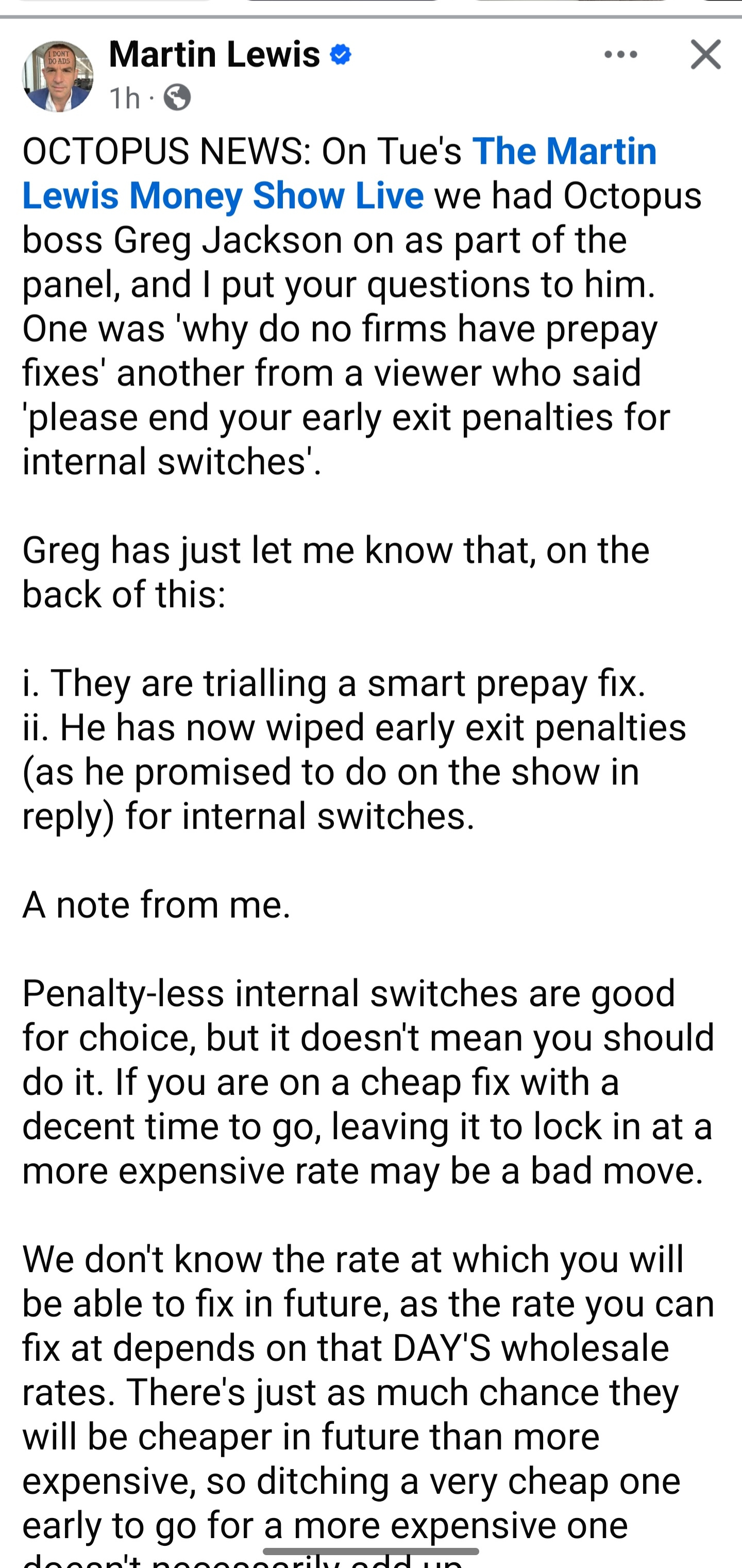
For those that have moved to variable Cosy consider fixed Cosy as Greg at Octoous promised Martin Lewis, after being on his show, to abolish exit fees when moving to another Octopus tariff.
0 -
That's interesting. I'll keep an eye on it.
0 -
Fixed Cosy makes zero sense now. Rates are: 52p/35p/17p and for fixed E7 34p/14p.
0 -
Makes sense for those with heat pumps and no battery or solar with the split of hours you can keep the house warm, not something you can do with e7. E7 for just heat pumps is no good.
Octopus do normally give notice on Cosy price changes so a fix before the prices rise, even with a noted exit fee should be free given the news so free to switch back to agile when needed.
0 -










Categories
- All Categories
- 356K Banking & Borrowing
- 255K Reduce Debt & Boost Income
- 456.3K Spending & Discounts
- 248.5K Work, Benefits & Business
- 606.3K Mortgages, Homes & Bills
- 179.1K Life & Family
- 264.1K Travel & Transport
- 1.5M Hobbies & Leisure
- 16.2K Discuss & Feedback
- 37.7K Read-Only Boards