We’d like to remind Forumites to please avoid political debate on the Forum.
This is to keep it a safe and useful space for MoneySaving discussions. Threads that are – or become – political in nature may be removed in line with the Forum’s rules. Thank you for your understanding.
📨 Have you signed up to the Forum's new Email Digest yet? Get a selection of trending threads sent straight to your inbox daily, weekly or monthly!
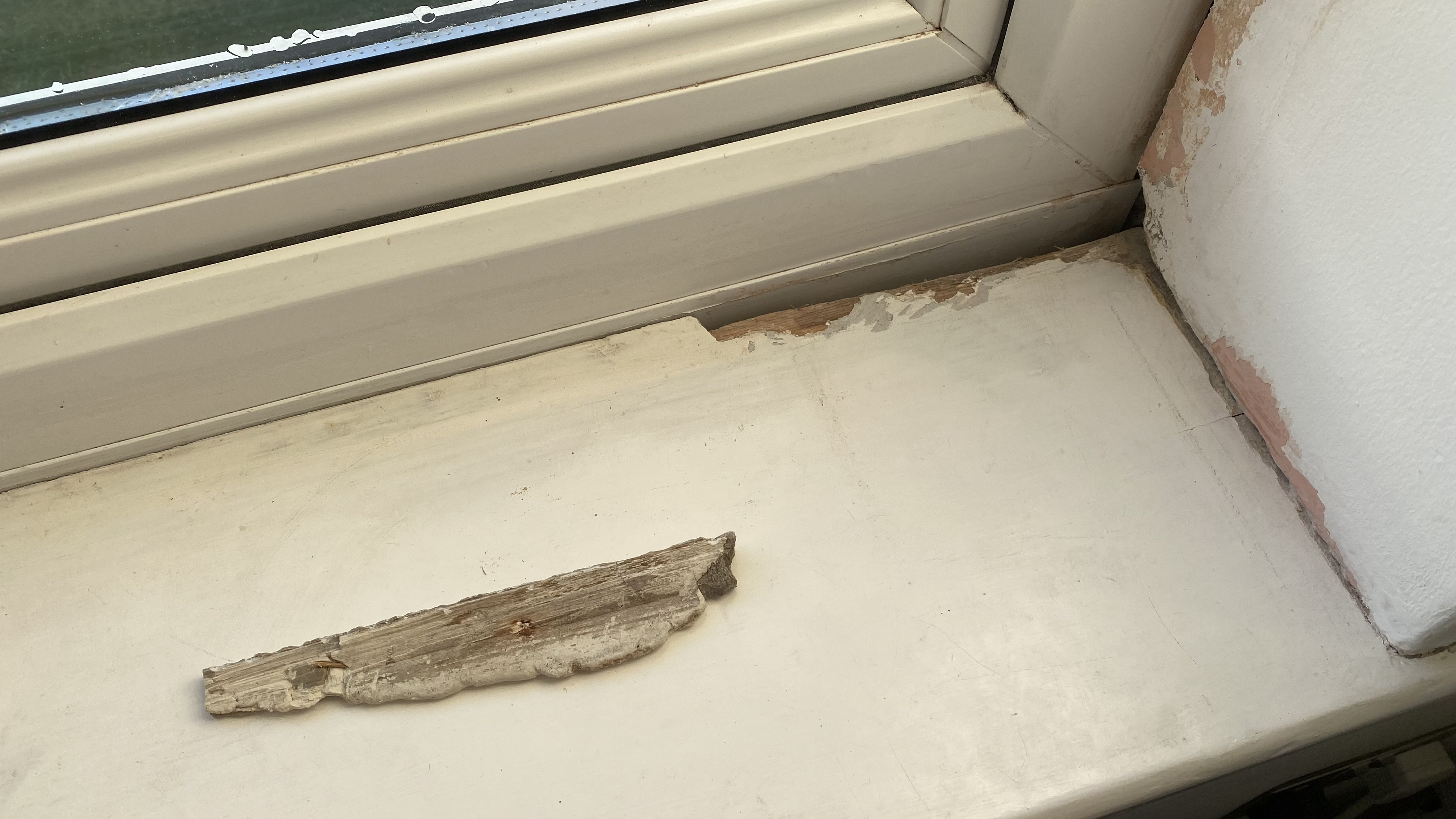
Repairing Window Sill / Wall?

paperclap
Posts: 779 Forumite



Hi all,
So a few weeks back when we had a lot of wind, rain and cold weather, this area of the wall (not the sill) was damp. Went outside to check the sealant around the window, couldn't see anything suspect. Think it was just condensation-related damp... especially as we didn't have the heating on much then.
So, some back story.
Before all of this, we had window trim around the perimeter of the window. I removed it all, as it looked rubbish. Underneath, where the wooden sill meets the window, needed filling up. I did so with two-pack wood filler. By and large, the filler has worked and stayed in place.
However, this area of the sill has come away. I think there must have been a split in the wooden sill here prior to me filling... and after much contract, expansion and maybe even a little of the nearby wall area damp, it'll just pulled apart. But mostly, I think this has happened because the wood was already split.
I've knocked out the mortar and plaster from the wall (it was loose anyway, so must've been damp in previous years but gone unnoticed). I've also pulled out the loose two-pack filler and any shards of wood intertwined with it.
What I'd planned to do is fill up the wall gap with some ready-mixed mortar (purely as I've got a little leftover from a previous job), and then face fill with plaster. Then, fill up the inch deep void of wooden sill with either two-pack wood filler or regular wood filler, but build it up in layers.
One person (before writing this) suggested I use expanding foam, then face fill with plaster on the wall and two-pack filler on the wood. Not a terrible idea, as it's obviously faster and may even help insulate that portion... but don't want to buy a tube of the stuff just for a tiny area!
Thoughts?
So a few weeks back when we had a lot of wind, rain and cold weather, this area of the wall (not the sill) was damp. Went outside to check the sealant around the window, couldn't see anything suspect. Think it was just condensation-related damp... especially as we didn't have the heating on much then.
So, some back story.
Before all of this, we had window trim around the perimeter of the window. I removed it all, as it looked rubbish. Underneath, where the wooden sill meets the window, needed filling up. I did so with two-pack wood filler. By and large, the filler has worked and stayed in place.
However, this area of the sill has come away. I think there must have been a split in the wooden sill here prior to me filling... and after much contract, expansion and maybe even a little of the nearby wall area damp, it'll just pulled apart. But mostly, I think this has happened because the wood was already split.
I've knocked out the mortar and plaster from the wall (it was loose anyway, so must've been damp in previous years but gone unnoticed). I've also pulled out the loose two-pack filler and any shards of wood intertwined with it.
What I'd planned to do is fill up the wall gap with some ready-mixed mortar (purely as I've got a little leftover from a previous job), and then face fill with plaster. Then, fill up the inch deep void of wooden sill with either two-pack wood filler or regular wood filler, but build it up in layers.
One person (before writing this) suggested I use expanding foam, then face fill with plaster on the wall and two-pack filler on the wood. Not a terrible idea, as it's obviously faster and may even help insulate that portion... but don't want to buy a tube of the stuff just for a tiny area!
Thoughts?
0
Comments
-
Foam or a flexible caulk might be the way to allow for some movement of the wood/upvc, then plaster where required. Not sure mortar is the best to use internally.1
-
You're right, mortar would be totally inappropriate for filling this gap. If the window board could be removed, I'd cut a thin strip of timber and glue/nail it to the back edge. Then caulk to fill any small gaps. Failing that, a 12mm scotia strip fixed all round the frame would hide the gaps without looking too intrusive.flashg67 said: Not sure mortar is the best to use internally.
Any language construct that forces such insanity in this case should be abandoned without regrets. –
Erik Aronesty, 2014
Treasure the moments that you have. Savour them for as long as you can for they will never come back again.2 -
I see only one photo? And it shows the types of small finishing gap that sili or frame sealant is designed for.paperclap said:Hi all,
So a few weeks back when we had a lot of wind, rain and cold weather, this area of the wall (not the sill) was damp. Went outside to check the sealant around the window, couldn't see anything suspect. Think it was just condensation-related damp... especially as we didn't have the heating on much then.
So, some back story.
Before all of this, we had window trim around the perimeter of the window. I removed it all, as it looked rubbish. Underneath, where the wooden sill meets the window, needed filling up. I did so with two-pack wood filler. By and large, the filler has worked and stayed in place.
However, this area of the sill has come away. I think there must have been a split in the wooden sill here prior to me filling... and after much contract, expansion and maybe even a little of the nearby wall area damp, it'll just pulled apart. But mostly, I think this has happened because the wood was already split.
I've knocked out the mortar and plaster from the wall (it was loose anyway, so must've been damp in previous years but gone unnoticed). I've also pulled out the loose two-pack filler and any shards of wood intertwined with it.
What I'd planned to do is fill up the wall gap with some ready-mixed mortar (purely as I've got a little leftover from a previous job), and then face fill with plaster. Then, fill up the inch deep void of wooden sill with either two-pack wood filler or regular wood filler, but build it up in layers.
One person (before writing this) suggested I use expanding foam, then face fill with plaster on the wall and two-pack filler on the wood. Not a terrible idea, as it's obviously faster and may even help insulate that portion... but don't want to buy a tube of the stuff just for a tiny area!
Thoughts?
Wall gap is too small for either mortar or foam. If it really needs filling before finishing off with a neat bead of sealant, then I think a 'powder' type filler will be best - this sets chemically, and should be more durable. It's also smooth and easy to work with - you should be able to squish it right in there, and smooth it off flush with the wall reveals. The lightest of sanding should get it nigh-on perfect.
If the cill removes, then pull it out and PVA and firmly clamp the missing piece back into place. Plane/sand flush, fill any remaining cracks with filler, and thoroughly paint all faces and edge before replacing. To do this in situ, 2-part filler will be easier as it's in an awkward place. The same powder filler should do. Paint it thoroughly asap, and a finishing bead of frame sealant between it and the window frame.
(I prefer frame sealant to sili where painted surfaces are involved, as merest trace of the latter will prevent the paint from adhering. Caulk is fine, but needs to be a waterproof type - are they all? I don't know.1 -
Thanks all.
The gap in the wood is about 1 inch deep. The void in the wall is about 1 inch deep. The photo is quite deceptive.
I think I’ll fill the wall with bonding plaster, then face fill with some other filler.
The share you see in the photo is made up largely of one-year-old two-pack filler – some wood in there I’m sure, but not much.
Not sure about filling the wood gap with the same plaster though? Wouldn’t a wood filler be a better route to go?
Will have to do it in situ, as from what I remember, it’s nailed into the brick below!
Got 12 tubes of caulk waiting to be opened, so I’ll use caulk, haha1







Confirm your email address to Create Threads and Reply

Categories
- All Categories
- 354.9K Banking & Borrowing
- 254.6K Reduce Debt & Boost Income
- 455.6K Spending & Discounts
- 247.7K Work, Benefits & Business
- 604.7K Mortgages, Homes & Bills
- 178.7K Life & Family
- 262.3K Travel & Transport
- 1.5M Hobbies & Leisure
- 16.1K Discuss & Feedback
- 37.7K Read-Only Boards