We’d like to remind Forumites to please avoid political debate on the Forum.
This is to keep it a safe and useful space for MoneySaving discussions. Threads that are – or become – political in nature may be removed in line with the Forum’s rules. Thank you for your understanding.
Critique our updated 2023 retirement investment portfolio
Comments
-
JohnWinder said:
‘I dont understand your analysis of investing in a 2 stock split 90/10% world. The existance of a 90/10 split could simply be a reflection of the size of the companies. Both could have the same Return On Investment. I am unaware of any evidence that the ROI is proportional to the company's size. Though at the extremes I assume a very large company is less likely to go bust than a very small one.
So to minimise the risk I suggest a better investment approach could be say 2/3 large company amd 1/3 small company. Perhaps a bit of maths could come up with a justifiable split.. That is not claiming the smaller company is a better investment, without further knowledge it would be sensible to assume the % return is the same. It is not gambling but diversification to reduce the risk of relying almost entirely on only one company.’
You might be right there, I can’t easily dispute that. But some comments….I don’t understand ROI, but I thought it was backward looking; you calculate how much you gained, then annualise the result to give ‘it returned x%/year’. Stock prices are based on forward looking guesstimates of future earnings, so a tech company might make no money now (zero ROI), but be considered to have great prospects and thus be priced high. So if the 90/10 pair had the same ROI, their prospects and thus price might be different, I’m guessing wildly.
Going 2/3 and 1/3 with the 90/10 pair would reduce the risk should the 90 blow up, but wouldn’t it reduce your likely returns since the market as a whole has put 90% of its money into the 90 stock because it thinks its prospects are better? That’s less of a wild guess.
‘. It is not gambling but diversification to reduce the risk of relying almost entirely on only one company.’It might be better if we avoid the words ‘gambling’ and ‘diversification’ since we don’t all share the same meaning or understanding of what they’re about. I say that because I see it as a gamble to deviate from market cap weighting, since the returns for the ‘deviator’ might be better or worse - that’s gambling to me. Whereas ‘it’s not gambling but diversification…’ views, correctly, the deviation from 90/10 as a safeguard against the 90 blowing up, and hence the antithesis of gambling.
As to ‘diversification’, it’s worst if you hold only one stock, and best if you hold them all, but in what proportions? It might not matter much; it certainly doesn’t matter much if you omit the smallest 10 or 20%, or if you hold them all in equal amounts rather than cap weighted. But I keep coming back to the notion that an efficient market captures all the information there is to best estimate the value of any stock; if you deviate from that, it is because you think you know something about the future of those companies than others don’t. Calling market cap weighting ‘optimally diversified’ doesn’t sit well with some people because it’s contrary to the common sense different ways you can be diversified, I suppose.
If going 2/3 1/3 with the 90/10 stocks reduces the possible range of return outcomes, then I suppose it reduces the risk; that means there has to be no condition in which 2/3 1/3 does worse than being 90/10. That puts the onus on me to find it I suppose.
Perhaps you need to think that through again. Lets have as simple an example I can think of.....
Consider company A which has 10000 shares and a smaller company B has 1000 shares. Company A happens to be 10 X the turnover, 10X the profits.10X the total dividends etc etc of company B. So we can assume that company A has 10 times the intrinsic value of company B.
So, all other things being equal you would expect one share of company A to be the same price as 1 share of company B.Each company is providing the same % returns and each share represents the same amount of profit in £ terms. If they weren't the same price one could sell the more expensive share and buy more of the cheaper share getting a larger return.
If each share has the same price the Market Capitalisation of A will be 10 times that of B. But A and B both provide the same return per share.0 -
With I/L gilts, it is worth comparing the real YTM with the nominal YTM of an equivalent conventional gilt. The difference is can be viewed as the breakeven rate of inflation. You'll get the inflation protection anyway, but if inflation is higher than breakeven, you'll gain from the inflation protection vs not having it. If your risk tolerance is low, then you are unlikely to have other assets that would hold up in value against inflation, so they provide a good insurance policy when they can be obtained at a sensible breakeven rate.baj25 said:
Yes, I get that key difference.Linton said:
Note that a bond fund is very different to a set of individual bonds. If you buy a bond with 10 years to maturity then in 10 years the you are guaranteed to get the same interest on your initial investments every 6m months for the next 10 years and then you will receive the £100 capital.baj25 said:Following with interest, particularly the comments re bonds. I didn't think it was possible to buy goverment bonds as an individual. One of my pension providers uses a mix of Vanguard bond funds as the bonds element, and I pretty much replicated this with my own investments.
With a 10 year average bond fund in 10 years time you will still have a 10 year average bond fund. Neither the ongoing interest nor the final capital value are guaranteed.
Gilts don't seem to be attractive just now, looking on HL a gilt with 5y to maturity at coupon of 0.125% is selling for about 86p, returning about 3.25% p.a. minus any platform fees. That's if I understand correctly. I've usually kept a portion in fixed rate cash ISAs of varying terms, that seems to do a similar job to gilts and is very simple with no charges.
Linkers on the other hand could be of interest. Assuming held to maturity, would I be correct in thinking that if inflation is rampant they look good, otherwise you basically get your money back having lost the opportunity of a better return? Which I'm sure is a valid reason to have them if you value that security.
Bond funds are still suggested by many as a good holding for low volatility, and they hold huge sums, but I am less sure of their usefulness than I was, I'd be interested to hear others' thoughts.
0 -
I agree with your analsysis that IL bond prices are to a large extent linked to conventional gilts. However I am not sure about "you'll get the inflation protection anyway" . The problem is the price at which you bought. To take an extreme example IL gilt prices were very high until the recent interest rate rises because expected inflation was much higher than interest rates. If you had bought at those prices and inflation was low until maturity you could well make a capital loss in £ terms.masonic said:
With I/L gilts, it is worth comparing the real YTM with the nominal YTM of an equivalent conventional gilt. The difference is can be viewed as the breakeven rate of inflation. You'll get the inflation protection anyway, but if inflation is higher than breakeven, you'll gain from the inflation protection vs not having it. If your risk tolerance is low, then you are unlikely to have other assets that would hold up in value against inflation, so they provide a good insurance policy when they can be obtained at a sensible breakeven rate.baj25 said:
Yes, I get that key difference.Linton said:
Note that a bond fund is very different to a set of individual bonds. If you buy a bond with 10 years to maturity then in 10 years the you are guaranteed to get the same interest on your initial investments every 6m months for the next 10 years and then you will receive the £100 capital.baj25 said:Following with interest, particularly the comments re bonds. I didn't think it was possible to buy goverment bonds as an individual. One of my pension providers uses a mix of Vanguard bond funds as the bonds element, and I pretty much replicated this with my own investments.
With a 10 year average bond fund in 10 years time you will still have a 10 year average bond fund. Neither the ongoing interest nor the final capital value are guaranteed.
Gilts don't seem to be attractive just now, looking on HL a gilt with 5y to maturity at coupon of 0.125% is selling for about 86p, returning about 3.25% p.a. minus any platform fees. That's if I understand correctly. I've usually kept a portion in fixed rate cash ISAs of varying terms, that seems to do a similar job to gilts and is very simple with no charges.
Linkers on the other hand could be of interest. Assuming held to maturity, would I be correct in thinking that if inflation is rampant they look good, otherwise you basically get your money back having lost the opportunity of a better return? Which I'm sure is a valid reason to have them if you value that security.
Bond funds are still suggested by many as a good holding for low volatility, and they hold huge sums, but I am less sure of their usefulness than I was, I'd be interested to hear others' thoughts.
It needs a clear head to work out how IL bonds behave so perhaps I have missed something.0 -
Linton said:
I agree with your analsysis that IL bond prices are to a large extent linked to conventional gilts. However I am not sure about "you'll get the inflation protection anyway" . The problem is the price at which you bought. To take an extreme example IL gilt prices were very high until the recent interest rate rises because expected inflation was much higher than interest rates. If you had bought at those prices and inflation was low until maturity you could well make a capital loss in £ terms.masonic said:
With I/L gilts, it is worth comparing the real YTM with the nominal YTM of an equivalent conventional gilt. The difference is can be viewed as the breakeven rate of inflation. You'll get the inflation protection anyway, but if inflation is higher than breakeven, you'll gain from the inflation protection vs not having it. If your risk tolerance is low, then you are unlikely to have other assets that would hold up in value against inflation, so they provide a good insurance policy when they can be obtained at a sensible breakeven rate.baj25 said:
Yes, I get that key difference.Linton said:
Note that a bond fund is very different to a set of individual bonds. If you buy a bond with 10 years to maturity then in 10 years the you are guaranteed to get the same interest on your initial investments every 6m months for the next 10 years and then you will receive the £100 capital.baj25 said:Following with interest, particularly the comments re bonds. I didn't think it was possible to buy goverment bonds as an individual. One of my pension providers uses a mix of Vanguard bond funds as the bonds element, and I pretty much replicated this with my own investments.
With a 10 year average bond fund in 10 years time you will still have a 10 year average bond fund. Neither the ongoing interest nor the final capital value are guaranteed.
Gilts don't seem to be attractive just now, looking on HL a gilt with 5y to maturity at coupon of 0.125% is selling for about 86p, returning about 3.25% p.a. minus any platform fees. That's if I understand correctly. I've usually kept a portion in fixed rate cash ISAs of varying terms, that seems to do a similar job to gilts and is very simple with no charges.
Linkers on the other hand could be of interest. Assuming held to maturity, would I be correct in thinking that if inflation is rampant they look good, otherwise you basically get your money back having lost the opportunity of a better return? Which I'm sure is a valid reason to have them if you value that security.
Bond funds are still suggested by many as a good holding for low volatility, and they hold huge sums, but I am less sure of their usefulness than I was, I'd be interested to hear others' thoughts.
It needs a clear head to work out how IL bonds behave so perhaps I have missed something.If you did the above YTM comparison back in 2021, you'd be looking at a 0.8% nominal bond YTM minus a -2.5% real YTM for I/L, so the breakeven inflation rate would be 3.3%.If average inflation is more than 3.3% over the remainder of the lifetime of the bond, you gain vs nominal bonds, otherwise you lose. If inflation is less than 2.5%, you lose vs putting the cash under your mattress. In real terms you lose 2.5% per year whatever happens.The "you'll get the inflation protection anyway" frames the cost of acquisition (effectively the difference in YTM) as a sunk cost. This is the part that is certain. Added onto this is index linking. Perhaps that wasn't clear in my explanation. It warrants mentioning because you don't see index linking in a chart of the clean price of an I/L bond, and most available sources show clean prices.The below chart does not reflect how the 0⅛% INDEX-LINKED TREASURY GILT 2024 has performed for an investor over this time period, RPI index linking must be added to this clean price: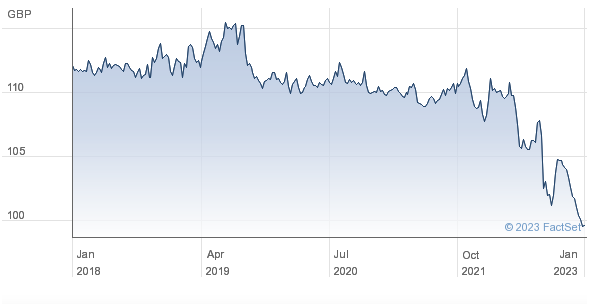 When deciding whether to index link or not, the difference in YTM is all that is really needed. Price is much more important to deciding whether to buy bonds in the first place.0
 -
If an index linked gilt is trading at par (most were last time I looked), then people who lament the unavailability of NS&I index linked bonds should be investing, as the gilt (linked to RPI) is likely to give a better return than an NS&I index linked bond (linked to CPI).
1 -
‘I agree with your analsysis that IL bond prices are to a large extent linked to conventional gilts. However I am not sure about "you'll get the inflation protection anyway" . The problem is the price at which you bought.’Clearly, linkers are not as simple as some of us think they are, but if I understand them correctly it should be possible to help other people do also.
Firstly, be in no doubt that you ‘get inflation protection anyway’ because HM Treasury’s Debt Management Office says you will: ‘Index-linked gilts differ from conventional gilts in that both the semi-annual coupon payments and the principal payment are adjusted in line with movements in the General Index of Retail Prices in the UK’. https://www.dmo.gov.uk/data/gilt-market/index-linked-gilts/
Secondly, when you buy a linker you will know what it’s yield will be (if you hold it to maturity) because it’s listed daily at the close of trading on the tradeweb.com site, and because you can look at the Bank of England bond yield curves, updated daily, and get a good idea from the graph what your linker maturing in x years is yielding. https://www.bankofengland.co.uk/statistics/yield-curves Yesterday, linkers maturing in 5 years were yielding about -0.2%/yr, and 10 year linkers about 0.2%/yr. The negative one means that although you’ll keep up with inflation until it matures in 5 years, you’ll lose spending power by 0.2%/yr (yearly average) because that’s the negative real (after inflation) yield. The positive linker will keep up with inflation for 10 years, and increase your spending power by 0.2%/yr (yearly average) because the real (after inflation) yield is positive.
Thirdly, once you’ve bought your linker, and carry through on your intention to hold it to maturity, it does not matter what happens to the price or yield of your linker because the bond is a contract to pay a certain coupon and a certain principal on certain days, and those are locked in for you. If someone else buys the same linker on a different day from you, if they pay a different price (prices change every day) they’ll get a different yield. The yield could be higher or it could be lower than yours, but both people will received the same coupons.
1 -
Yes. The key question is whether you should you buy an IL bond at all (or come to that any other bond) at the then current price. If you buy an IL bond sufficiently above par you wont get your money back in real terms or possibly in £ terms.JohnWinder said:‘I agree with your analsysis that IL bond prices are to a large extent linked to conventional gilts. However I am not sure about "you'll get the inflation protection anyway" . The problem is the price at which you bought.’Clearly, linkers are not as simple as some of us think they are, but if I understand them correctly it should be possible to help other people do also.Firstly, be in no doubt that you ‘get inflation protection anyway’ because HM Treasury’s Debt Management Office says you will: ‘Index-linked gilts differ from conventional gilts in that both the semi-annual coupon payments and the principal payment are adjusted in line with movements in the General Index of Retail Prices in the UK’. https://www.dmo.gov.uk/data/gilt-market/index-linked-gilts/
Secondly, when you buy a linker you will know what it’s yield will be (if you hold it to maturity) because it’s listed daily at the close of trading on the tradeweb.com site, and because you can look at the Bank of England bond yield curves, updated daily, and get a good idea from the graph what your linker maturing in x years is yielding. https://www.bankofengland.co.uk/statistics/yield-curves Yesterday, linkers maturing in 5 years were yielding about -0.2%/yr, and 10 year linkers about 0.2%/yr. The negative one means that although you’ll keep up with inflation until it matures in 5 years, you’ll lose spending power by 0.2%/yr (yearly average) because that’s the negative real (after inflation) yield. The positive linker will keep up with inflation for 10 years, and increase your spending power by 0.2%/yr (yearly average) because the real (after inflation) yield is positive.
Thirdly, once you’ve bought your linker, and carry through on your intention to hold it to maturity, it does not matter what happens to the price or yield of your linker because the bond is a contract to pay a certain coupon and a certain principal on certain days, and those are locked in for you. If someone else buys the same linker on a different day from you, if they pay a different price (prices change every day) they’ll get a different yield. The yield could be higher or it could be lower than yours, but both people will received the same coupons.
0 -
Ultimately, it can be viewed as an insurance policy. It can be more or less expensive, and what you're willing to pay will depend on how much you feel you need to the protection. Those who paid a high price a couple of years ago might not do so badly out of it, as things have transpired. Those buying today will pay a lower cost, but might not need the protection.Linton said:
Yes. The key question is whether you should you buy an IL bond at all (or come to that any other bond) at the then current price. If you buy an IL bond sufficiently above par you wont get your money back in real terms or possibly in £ terms.JohnWinder said:‘I agree with your analsysis that IL bond prices are to a large extent linked to conventional gilts. However I am not sure about "you'll get the inflation protection anyway" . The problem is the price at which you bought.’Clearly, linkers are not as simple as some of us think they are, but if I understand them correctly it should be possible to help other people do also.Firstly, be in no doubt that you ‘get inflation protection anyway’ because HM Treasury’s Debt Management Office says you will: ‘Index-linked gilts differ from conventional gilts in that both the semi-annual coupon payments and the principal payment are adjusted in line with movements in the General Index of Retail Prices in the UK’. https://www.dmo.gov.uk/data/gilt-market/index-linked-gilts/
Secondly, when you buy a linker you will know what it’s yield will be (if you hold it to maturity) because it’s listed daily at the close of trading on the tradeweb.com site, and because you can look at the Bank of England bond yield curves, updated daily, and get a good idea from the graph what your linker maturing in x years is yielding. https://www.bankofengland.co.uk/statistics/yield-curves Yesterday, linkers maturing in 5 years were yielding about -0.2%/yr, and 10 year linkers about 0.2%/yr. The negative one means that although you’ll keep up with inflation until it matures in 5 years, you’ll lose spending power by 0.2%/yr (yearly average) because that’s the negative real (after inflation) yield. The positive linker will keep up with inflation for 10 years, and increase your spending power by 0.2%/yr (yearly average) because the real (after inflation) yield is positive.
Thirdly, once you’ve bought your linker, and carry through on your intention to hold it to maturity, it does not matter what happens to the price or yield of your linker because the bond is a contract to pay a certain coupon and a certain principal on certain days, and those are locked in for you. If someone else buys the same linker on a different day from you, if they pay a different price (prices change every day) they’ll get a different yield. The yield could be higher or it could be lower than yours, but both people will received the same coupons.
0








Confirm your email address to Create Threads and Reply

Categories
- All Categories
- 354.6K Banking & Borrowing
- 254.5K Reduce Debt & Boost Income
- 455.5K Spending & Discounts
- 247.5K Work, Benefits & Business
- 604.4K Mortgages, Homes & Bills
- 178.6K Life & Family
- 261.9K Travel & Transport
- 1.5M Hobbies & Leisure
- 16.1K Discuss & Feedback
- 37.7K Read-Only Boards