We’d like to remind Forumites to please avoid political debate on the Forum.
This is to keep it a safe and useful space for MoneySaving discussions. Threads that are – or become – political in nature may be removed in line with the Forum’s rules. Thank you for your understanding.
📨 Have you signed up to the Forum's new Email Digest yet? Get a selection of trending threads sent straight to your inbox daily, weekly or monthly!
The Forum now has a brand new text editor, adding a bunch of handy features to use when creating posts. Read more in our how-to guide
Electric wiring help pls
Comments
-
FFHillbilly said:based on the description below I'd say the pictured switch has a neutral, no "probably" about it
DIYhelp76 said:It it has one main cable going into the cord switch and then another cable which leaves the cord switch, runs along the rafters up to the actual light with bulb.I wouldn't make that assumption without doing some tests to confirm polarity and function. Hence my choice to use the word "(probably)".Making assumptions with electrical work can have fatal results. Safety first.0 -
I get that this is a DIY forum, but if you couldn't understand the wiring in the picture you posted (which is pretty straightforward), you probably shouldn't be working on electrics.1
-
Hi
Thanks everyone for the really helpful, detailed and prompt replies.
WhiskersTheWonderCat, thanks - I wouldn't do anything I was unsure of hence seeking this clarification. The wiring wasn't straightforward to me as the only wiring I've seen is in my own house which is older and doesn't look like this. In my own house in any of the fittings I have never seen two cables in a light fitting (coming in and going out), only one cable with three wires and that is what I am basing my experience on.
Following the replies about the older fitting in my house which I previously did myself I am now a bit concerned. I just followed what was there and it has been working fine. Pls could I try to explain further? So the pull cord switch is secured to the ceiling. Opening that up I see just one cable coming in (not the two cables like the above more recent example - so I don't see the cable going out again to the light fitting itself - maybe the difference is because this is a ceiling light and the cabling isn't exposed like it is in the loft area, I don't know).
But in my own fitting, there is just one cable coming in and that has three wires - an earth (green/yellow), a live (red) and a neutral (black). In the switch I was replacing, the red was wired into the COM part of the switch and the black into the L1 part (the earth in a back "earth" terminal in the switch). So I just replicated that and it has been working fine. Is this incorrect in some way? It is an old house which before I owned it I believe was partially re-wired, so does have a mish-mash of wiring/wiring colours. I've never explored a re-wire and I hope to move house so this isn't something I'd like to do now.
Many thx again for everyone's help.
0 -
DIYhelp76 said:
But in my own fitting, there is just one cable coming in and that has three wires - an earth (green/yellow), a live (red) and a neutral (black). In the switch I was replacing, the red was wired into the COM part of the switch and the black into the L1 part (the earth in a back "earth" terminal in the switch). So I just replicated that and it has been working fine. Is this incorrect in some way? It is an old house which before I owned it I believe was partially re-wired, so does have a mish-mash of wiring/wiring colours. I've never explored a re-wire and I hope to move house so this isn't something I'd like to do now.One would normally use a twin brown plus earth for this. But no one (well, maybe just one) is going to tell you what you have needs to be changed.Anyone buying an old house will expect to see wiring that doesn't comply with current regulations.
Any language construct that forces such insanity in this case should be abandoned without regrets. –
Erik Aronesty, 2014
Treasure the moments that you have. Savour them for as long as you can for they will never come back again.1 -
DIYhelp76 said:Following the replies about the older fitting in my house which I previously did myself I am now a bit concerned. I just followed what was there and it has been working fine. Pls could I try to explain further? So the pull cord switch is secured to the ceiling. Opening that up I see just one cable coming in (not the two cables like the above more recent example - so I don't see the cable going out again to the light fitting itself - maybe the difference is because this is a ceiling light and the cabling isn't exposed like it is in the loft area, I don't know).
But in my own fitting, there is just one cable coming in and that has three wires - an earth (green/yellow), a live (red) and a neutral (black). In the switch I was replacing, the red was wired into the COM part of the switch and the black into the L1 part (the earth in a back "earth" terminal in the switch). So I just replicated that and it has been working fine. Is this incorrect in some way?
First - don't worry. Yes, the two switches were/are wired differently, but provided you replaced the switches like-for-like, then it's fine. And the new one will be too. Place one wire in 'com' and the other in L1' or similar - come back on here with your new switch if needed.The only real concern was that you seemed to have misunderstood what the wires in your earlier switch were, having called one of them a 'neutral'.No idea what your level of electrical understanding is, but you'll hopefully appreciate that, say, a 'plug' has a Live, a Neutral, and an Earth inside it, yes? So that's two wires to carry the power, and a safety 'earth'.What would happen if you cut the cable from a plug and joined the Live and Neutral together? I hope you answer 'bang!'?Now think of your first light switch - what would happen if the two wires were a Live and a Neutral, and the switch joined them together?! Ditto-bang. Yes? So that's why the 'blue' wire was not a 'Neutral', but actually a 'switched live'. A 'switched live' is a wire that becomes live when a switch is thrown. The naughty thing about your first wiring is that the blue wire should have been sleeved in a brown collar to indicate that it can be live. Yours wasn't, hence your confusion.Your new wiring is quite different - this one is supplied by a Live and Neutral, just like the cable coming from a plug. If that cable carried on to the light, the light would be on all the time. A switch is required, and this is inserted into the 'Live' wire. That's what you have inside your new switch - the neutrals come in and continue to the lamp (joined by that separate terminal). The live comes in, goes through the switch, and then continues to the lamp (yes, the length that continues to the lamp is a 'switched live').I hope that makes sense?One other way to look at it - in your pic of your current setup, look at the two wires going to the switch, arrowed yellow: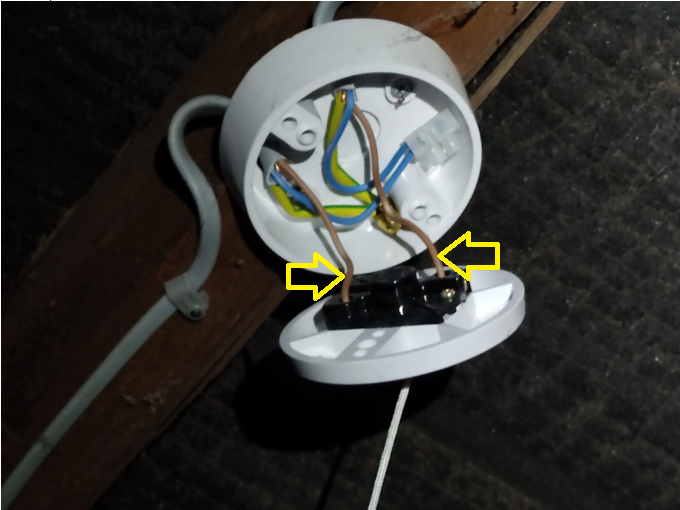 Imagine that all the wiring you see there is actually placed outside - behind - the switch body, and that only the two wires arrowed yellow come in to the switch. That's essentially what you had in your old switch - two wires coming in to the switch. Except in your old switch, one was coloured blue simply because it was easier to use that sort of normal cable. But in both cases, one is Live, and the other the Switched Live - ie becomes live when the switch is on.Your new wiring setup is better in a few ways - the wires are the correct colour for a start*, but also it'll allow you to fit smart switches and stuff if you wanted - ie, there IS a neutral in there too.*For your old type of switch, there is twin-brown wire available to be more correct, but 'sleeving' is considered ok. Not sleeving is very poor practice - and you've shown us why :-)1
 -
Often the wires going into a switch will look like a live and a neutral by colour, but are actually both lives ( one from the live supply, through the switch and then on to the light fitting ), it is just easier and cheaper to use one cable to the actual switch rather than running two down to it. In more modern installations the 'neutral' coloured wire will sometimes have some red tape around the end to indicate it is a live, or a brown sleeve around it
Generally with electrics, if it has always worked before, and you replace like with like, and it still works, then there is nothing to worry about.0 -
Helpful explanation above. It's worth pointing out, in case it's not obvious, that the light controlled by the old switch will still have needed a neutral to work. It's just that with the style of wiring used there the neutral will have been run directly to the light instead of via the switch, so you don't see it there.0
-
ThisIsWeird said:Your new wiring setup is better in a few ways - the wires are the correct colour for a start*, but also it'll allow you to fit smart switches and stuff if you wanted - ie, there IS a neutral in there too.Just to make the same point as I made in my reply to FFHillbilly - it isn't possible to say there "IS" a neutral in the second switch without doing some further tests/checks.Otherwise you could be making the same mistake the OP did in relation to the first switch and seeing "blue" (actually 'black' in the first case) and assuming it is a neutral.Not making assumptions with lighting circuits is absolutely vital, since conductors of different colours are used for different purposes, EPC's can be missing (or incorrectly used as a live conductor), and conventional polarity can (incorrectly) be reversed, along with switches being placed on the neutral side.The second switch probably has a neutral, if certain assumptions are correct. Those assumptions need to be tested before making alterations to the system.1
-
The reason i said it's common to have a neutral in the light switch these days is for "smart" switchesread the topic
0 -
ROY47 said:The reason i said it's common to have a neutral in the light switch these days is for "smart" switchesread the topicIf you read the OP's first post you will see they had a switch which had one cable with "only three wires there were earth, live and neutral".If a light switch has one cable with three conductors, and one of them is a CPC ('Earth'), then (unless the circuit is wired with a switched neutral) none of them should normally be a "neutral".What is done "these days" in terms of providing a neutral for smart switches doesn't appear to be relevant to the OP's post and my reply.You didn't say it was "common to have a neutral in the light switch these days", you only said "Not these days please don't confuse the issue". Any confusing the issue being done here was in your post suggesting what I said was incorrect without saying why.If you were talking about a specific situation with smart switches you should have made that clear. Your suggestion it would be normal "these days" to find a neutral in a switch with two (non-CPC) wires is potentially dangerous, given how common it is to find a blue/black wire in a lighting circuit being used as a 'Line'/'Live'/'Switched Live' conductor.For clarity - it is dangerous to assume a blue/black wire in a switch is a neutral, or should be connected to the supply neutral. Anyone believing a neutral is present at a switch needs to do extra checks to confirm this is the case.0











Confirm your email address to Create Threads and Reply

Categories
- All Categories
- 354.4K Banking & Borrowing
- 254.4K Reduce Debt & Boost Income
- 455.4K Spending & Discounts
- 247.3K Work, Benefits & Business
- 604.1K Mortgages, Homes & Bills
- 178.5K Life & Family
- 261.6K Travel & Transport
- 1.5M Hobbies & Leisure
- 16K Discuss & Feedback
- 37.7K Read-Only Boards