We’d like to remind Forumites to please avoid political debate on the Forum.
This is to keep it a safe and useful space for MoneySaving discussions. Threads that are – or become – political in nature may be removed in line with the Forum’s rules. Thank you for your understanding.
📨 Have you signed up to the Forum's new Email Digest yet? Get a selection of trending threads sent straight to your inbox daily, weekly or monthly!
The Forum now has a brand new text editor, adding a bunch of handy features to use when creating posts. Read more in our how-to guide
Timber cladding issues
Comments
-
We do have a slight half cm gap between the building and the patio. Are you suggesting we silicone that gap? Won't moisture get trapped and have nowhere to escape?mi-key said:Personally I would cut the cladding off an inch or so below the level of the patio ( assuming it has a waterproof membrane behind it ).
Having a 6" gap between the patio and the building would look a bit weird, and probably get full of leaves and debris. If cutting off the cladding doesn's solve it totally ( I can't see a massive amount of rainwater splashing back and causing mould ) you can look at adding something to the lower 6" or so of the cladding to give it more waterproofing ( a sort of splashback for the building )
Could add an extra plank of wood along the bottom, or even a black upvc trim over the bottom 6" which may not look too bad0 -
It may help a bit, but if water is getting trapped down the gap between the patio and the cladding, then I don't think it will do a great deal. And leaves or debris that gets in there and then gets wet will stay wet as its not going to be getting any air. Adding ventilation to the sides of the building isn't going to make a big difference to thatrajanm said:
The garden room company won't cut the cladding back as they say it needs to run to the ground for warranty purposes. They have, however said they'll add sub floor ventilation on either side which may help. Both sides are clad in black uPVC and I wonder if allowing air to circulate will help dry the bottom of the cladding out ?mi-key said:Personally I would cut the cladding off an inch or so below the level of the patio ( assuming it has a waterproof membrane behind it ).
Having a 6" gap between the patio and the building would look a bit weird, and probably get full of leaves and debris. If cutting off the cladding doesn's solve it totally ( I can't see a massive amount of rainwater splashing back and causing mould ) you can look at adding something to the lower 6" or so of the cladding to give it more waterproofing ( a sort of splashback for the building )
Could add an extra plank of wood along the bottom, or even a black upvc trim over the bottom 6" which may not look too bad
0 -
I think its most likely it is water hitting the face of the building or being blown in by the wind, then running down into the gap and getting trapped there. Adding something to stop it getting into the gap would stop more water getting in. It may work better to remove the patio planks closest to the wall, clear out everything you can like leaves, earth, debris etc... then leave to air dry. Hopefully with the drier warmer weather now it should all dry out.rajanm said:
We do have a slight half cm gap between the building and the patio. Are you suggesting we silicone that gap? Won't moisture get trapped and have nowhere to escape?mi-key said:Personally I would cut the cladding off an inch or so below the level of the patio ( assuming it has a waterproof membrane behind it ).
Having a 6" gap between the patio and the building would look a bit weird, and probably get full of leaves and debris. If cutting off the cladding doesn's solve it totally ( I can't see a massive amount of rainwater splashing back and causing mould ) you can look at adding something to the lower 6" or so of the cladding to give it more waterproofing ( a sort of splashback for the building )
Could add an extra plank of wood along the bottom, or even a black upvc trim over the bottom 6" which may not look too bad
Once it is dry, then you can replace the planks and look at sealing the gap. I wouldnt use just silicone on a gap that big, but you could use something like a 1cm wooden quadrant trim, siliconed onto the patio and onto the cladding. This would provide a curved step so any water running down the building would shed off onto the patio and not down into the gap.
Leaving a 150mm gap between the patio and the cladding would just give a bigger area for debris to build up and you would have to spend a lot of time constantly clearing it out0 -
Something like this :
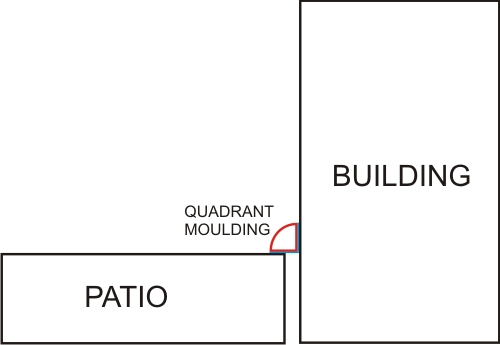
0 -
First of all has this mold been already existent prior the installation process? If yes, maybe it has to do with the plank itself
Besides has this cladding being oiled or lacquered?0 -
Yes so part of the issue is that there isn't a clear gap between the patio and the building. There seems to be some kind of cement between the patio and the building gap which seems to be porous as water does drain down it. Wouldn't a moulding result in splashback?mi-key said:Something like this :0 -
No the mould appeared about 2 months after installation. We have uPVC cladding around the back and the sides. There was a half metre by half metre gap at the back which I asked the builders to close up as I was worried about animals getting in. Literally about 2 weeks after that gap was closed up, the mould started to appear which is why I wondered whether the lack of sub floor ventilation might have been the issuemaydin said:First of all has this mold been already existent prior the installation process? If yes, maybe it has to do with the plank itself
Besides has this cladding being oiled or lacquered?0 -
You are always going to get some rain against the face of a building. Normally this will just run off onto the ground, and then dry out.rajanm said:
Yes so part of the issue is that there isn't a clear gap between the patio and the building. There seems to be some kind of cement between the patio and the building gap which seems to be porous as water does drain down it. Wouldn't a moulding result in splashback?mi-key said:Something like this :
The problem I think you have is that rain that is hitting the building is running down into the gap, then the damp is getting stuck against the cladding. Because the sun and air doesn't get down into the gap, it stays damp.
Moulding would stop this as water would run down the building and onto the patio instead, where it will just dry off
0






Confirm your email address to Create Threads and Reply

Categories
- All Categories
- 354.8K Banking & Borrowing
- 254.5K Reduce Debt & Boost Income
- 455.6K Spending & Discounts
- 247.6K Work, Benefits & Business
- 604.6K Mortgages, Homes & Bills
- 178.6K Life & Family
- 262.2K Travel & Transport
- 1.5M Hobbies & Leisure
- 16.1K Discuss & Feedback
- 37.7K Read-Only Boards