We’d like to remind Forumites to please avoid political debate on the Forum.
This is to keep it a safe and useful space for MoneySaving discussions. Threads that are – or become – political in nature may be removed in line with the Forum’s rules. Thank you for your understanding.
National Insurance contributions -38 years


Comments
-
In 2016 a calculation was done, 35 years is for people starting from that point. Various numbers of years are needed to get the full “new” pension from prior to after 2016, depending when your SP starts.Paddle No 21:wave:0
-
It's because you would have been contracted out at some point in the past. I am also retired with 46 years full contributions and still need 3 years voluntary contributions to get to the maximum amount. Many people are in a similar position. It is still worth paying the voluntary contributions as you will recoup that money within 4 years of taking your State Pension, and after that it is all profit.Dundee4life said:Hi, I am 60 and although I retired at 53, I checked on my NI contributions years and have 38. However, I am being asked for another 6 years in order to get my full state pension at 67. Can anyone shine a light on this? I tried to call the NI helpline, but was waiting for over an hour with no response. I thought you needed 35 to get a full state pension. I am not on any benefits and funded my retirement from 53-60 from investments and now take a private pension.0 -
You will most likely have been in a DB pension scheme which allowed your employer to pay a smaller "stamp". You have not missed out by the changes but it should be highly beneficial to pay the extra years of contributions assuming you are reasonably healthy.Dundee4life said:Hi, I am 60 and although I retired at 53, I checked on my NI contributions years and have 38. However, I am being asked for another 6 years in order to get my full state pension at 67. Can anyone shine a light on this? I tried to call the NI helpline, but was waiting for over an hour with no response. I thought you needed 35 to get a full state pension. I am not on any benefits and funded my retirement from 53-60 from investments and now take a private pension.
I had 49 years of full payments but did not have the time post 2016 to make it to the full pension - you have.0 -
Not necessarily true, as has already been said the 35 years only applies for those starting work in 2016 for the first time. Some will need more and some will need less.Audaxer said:
It's because you would have been contracted out at some point in the past. I am also retired with 46 years full contributions and still need 3 years voluntary contributions to get to the maximum amount. Many people are in a similar position. It is still worth paying the voluntary contributions as you will recoup that money within 4 years of taking your State Pension, and after that it is all profit.Dundee4life said:Hi, I am 60 and although I retired at 53, I checked on my NI contributions years and have 38. However, I am being asked for another 6 years in order to get my full state pension at 67. Can anyone shine a light on this? I tried to call the NI helpline, but was waiting for over an hour with no response. I thought you needed 35 to get a full state pension. I am not on any benefits and funded my retirement from 53-60 from investments and now take a private pension."You've been reading SOS when it's just your clock reading 5:05 "0 -
Did you care for any Grandchildren under 12 at any point from 2012 - pick them up from school etc ?If so you can claim from the parent who got Child benefit. It’s called Specified adult childcare credits and you could get all those missing years for free.0
-
Have a look at this
https://assets.publishing.service.gov.uk/government/uploads/system/uploads/attachment_data/file/181237/single-tier-pension-fact-sheet.pdfFrom what you have said, you ceased employment/paying NI around 2015.What is single tier?
-
A new, simple state pension that provides a firm foundation for workplace saving. If you reach State Pension age before 6 April 2016 you will receive your state pension in line with existing rules.
-
If you contribute entirely to the new single-tier scheme, it will replace today’s complicated state pension with a single amount based on 35 qualifying years of National Insurance contributions. If you have fewer than 35 years when you reach State Pension age you will get a pro-rata amount. However, you will need to have a minimum number of qualifying years when you reach State Pension age (this will be set between 7 and 10 years), otherwise you will not get a single-tier pension.
-
If you have made National Insurance contributions or received credits under the current system they will be converted into a single-tier foundation amount. Providing you meet the minimum qualifying year requirement, you will get no less than the amount calculated using the present scheme rules. There is more detail about this later...............
It would seem that at that point you had 38 qualifying years.
On 6/4/16, two calculations were done to establish your foundation (starting) amount for new state pension.
Old Rules
NI years (max 30)/30 x Full Basic State Pension + (Additional State Pension - (where applicable) Deduction for Contracting Out.
New Rules
(NI years (max 35)/35 x Full New State Pension) - (where applicable) Contracted Out Pension Equivalent (COPE).
Your starting amount was the higher of the two.
In your particular case, your starting amount was less than a full new state pension.
You had several years before you reached State Pension Age.
You were therefore able to improve your starting amount up to (but not exceeding) a full new state pension by making NI contributions/receiving credits for years from 6/4/2016.
You might find this of interest (produced by Royal London at inception of NSP).
https://www.dpf.org.uk/explorer/files/TOPPING-UP-YOUR-STATE-PENSION-GUIDE.pdf
and
https://www.gov.uk/government/publications/new-state-pension-if-youve-been-contracted-out-of-additional-state-pension/the-new-state-pension-transition-and-contracting-out-fact-sheet
0 -
-
I really appreciate the time people have taken to respond. Thank you very much. It makes sense with regard to my DB pension.1
-
OK - just to jump on this topic. I am 49, and according to the Gov UK site, I have 33 years of constant NI contributions, since 1990. Most of it within full-time employment, with the last couple of years as credits, while I was full-time carer for my mother.
Mum passed in the summer, so I am currently unemployed, receiving no NI credits, so expected to see a shortfall in pension forecast.
However, when checking the Gov UK site, I see the forecast below. It looks like I am paid up already. Is this because I have qualified under the old 30 year rule? Even though 7 of those years were post rule change in 2016?
8 of those 33 years were also in a contracted out Final Salary scheme. Is that relevant?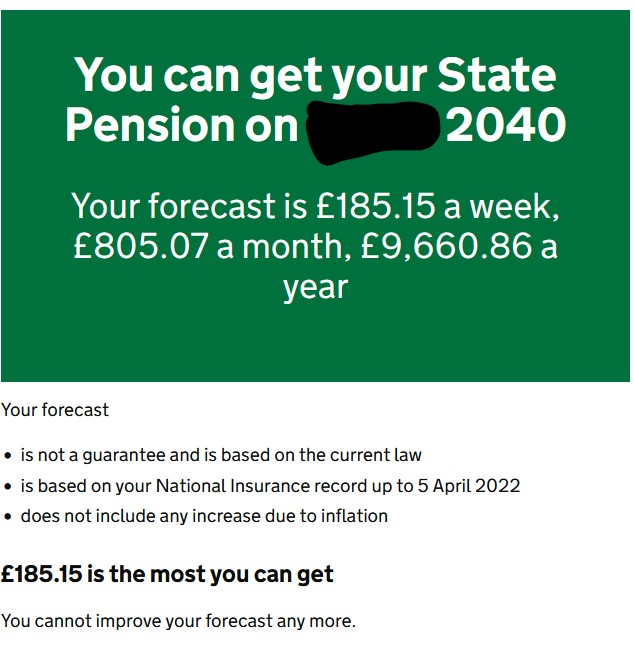
0 -
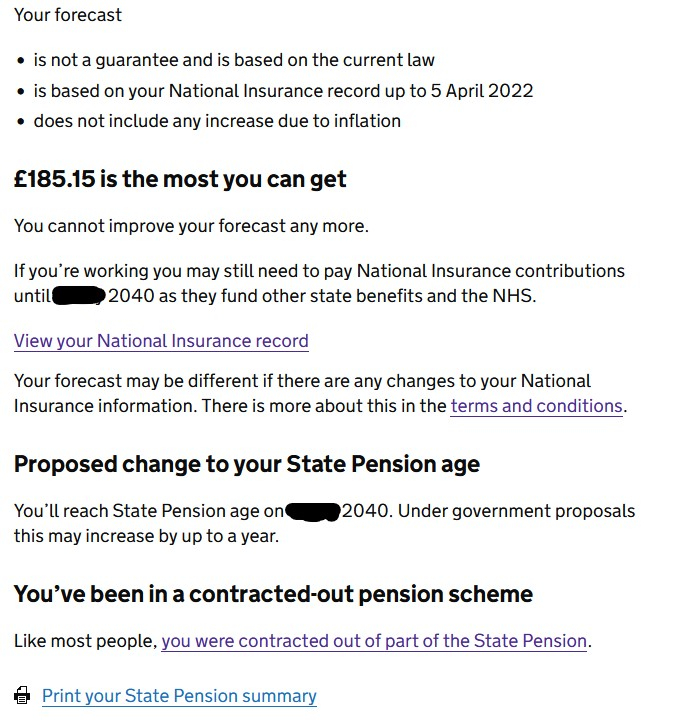
@Chewbecca Nothing much. See below ...
My NI record is unbroken from 1989/90 to 2021/22. I expect to see a break for this year, but hoping to get part -time job in the New Year, so may not show a break in that case
The NI summary says:You have:
- 33 years of full contributions
- 18 years to contribute before 5 April 2040

0













Confirm your email address to Create Threads and Reply

Categories
- All Categories
- 354.3K Banking & Borrowing
- 254.4K Reduce Debt & Boost Income
- 455.4K Spending & Discounts
- 247.3K Work, Benefits & Business
- 604K Mortgages, Homes & Bills
- 178.4K Life & Family
- 261.5K Travel & Transport
- 1.5M Hobbies & Leisure
- 16K Discuss & Feedback
- 37.7K Read-Only Boards