We’d like to remind Forumites to please avoid political debate on the Forum.
This is to keep it a safe and useful space for MoneySaving discussions. Threads that are – or become – political in nature may be removed in line with the Forum’s rules. Thank you for your understanding.
📨 Have you signed up to the Forum's new Email Digest yet? Get a selection of trending threads sent straight to your inbox daily, weekly or monthly!
The Forum now has a brand new text editor, adding a bunch of handy features to use when creating posts. Read more in our how-to guide
Increase in standing charges!
Comments
-
Agree or disagree, you are factually incorrect. The licence condition contains an equation which applies at all consumption levels. It takes parameters from the two caps that you identify, but that’s all they are - two numbers that feed into the continuous equation.Sailbad said:I don't agree. There are two caps for each combination of mpan area, payment method etc. One is for max annual bill for nil units and one for 2900 units. There is a table published by Ofgem which shows this. As long as a supplier does not exceed these caps they can set whatever rates they like, but it is not in their interest to reduce standing charge and increase unit cost to keep within the cap.
These figures are for elec, gas is similar.1 -
Sparkygrad,
I've been looking for clarification on the Ofgem website and found this...
"Suppliers can decide how they structure their standing charges within the cap Ofgem sets, as long as the overall tariff structure does not lead to default tariff customers paying above the relevant cap level."
Can you show me a link to the equation in the licence condition that you mention?
0 -
Sailbad said:Sparkygrad,
I've been looking for clarification on the Ofgem website and found this...
"Suppliers can decide how they structure their standing charges within the cap Ofgem sets, as long as the overall tariff structure does not lead to default tariff customers paying above the relevant cap level."
Can you show me a link to the equation in the licence condition that you mention?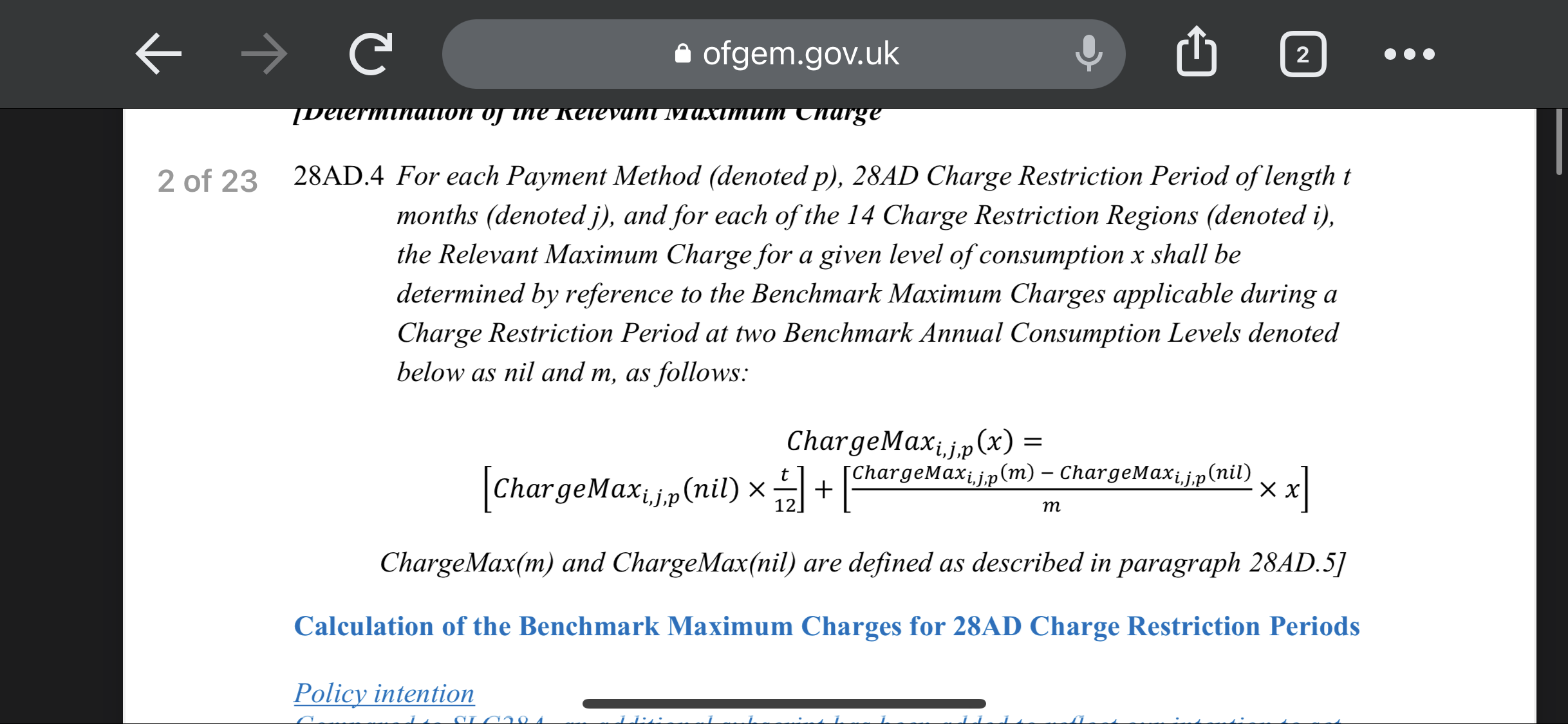 Screenshot of the relevant equation - in the standard licence conditions at para 28.a and 28.ad I think.
Link to the first version of the SLC that I found (it is present in both G & E) - https://www.ofgem.gov.uk/sites/default/files/docs/2018/06/draft_gas_licence_condition_default_tariff_cap_-_28ad_v1.0.pdf4 -
The formula you show merely shows how to calculate a bill for a certain number of months using the cap values for nil units consumption and 12000 units consumption for gas. It does not negate the paragraph I quoted from Ofgem...
"Suppliers can decide how they structure their standing charges within the cap Ofgem sets, as long as the overall tariff structure does not lead to default tariff customers paying above the relevant cap level."
0 -
It doesn't negate that paragraph. The paragraph you quote says people cannot pay above the relevant cap level. The wording for the relevant cap level in the licence condition is Relevant Maximum Charge, or ChargeMax(x) in the equation. There is no point in the equation that limits x to be only 0 or 2900.Sailbad said:The formula you show merely shows how to calculate a bill for a certain number of months using the cap values for nil units consumption and 12000 units consumption for gas. It does not negate the paragraph I quoted from Ofgem...
"Suppliers can decide how they structure their standing charges within the cap Ofgem sets, as long as the overall tariff structure does not lead to default tariff customers paying above the relevant cap level."
The maximum charge at all values of x is determined by the equation. That means that the capped rates, calculated from the two reference values (called Benchmark Maximum Charges) apply at all values of x.3
![[Deleted User]](https://us-noi.v-cdn.net/6031891/uploads/defaultavatar/nFA7H6UNOO0N5.jpg)




Confirm your email address to Create Threads and Reply

Categories
- All Categories
- 353.6K Banking & Borrowing
- 254.2K Reduce Debt & Boost Income
- 455.1K Spending & Discounts
- 246.7K Work, Benefits & Business
- 603K Mortgages, Homes & Bills
- 178.1K Life & Family
- 260.7K Travel & Transport
- 1.5M Hobbies & Leisure
- 16K Discuss & Feedback
- 37.7K Read-Only Boards