We’d like to remind Forumites to please avoid political debate on the Forum.
This is to keep it a safe and useful space for MoneySaving discussions. Threads that are – or become – political in nature may be removed in line with the Forum’s rules. Thank you for your understanding.
📨 Have you signed up to the Forum's new Email Digest yet? Get a selection of trending threads sent straight to your inbox daily, weekly or monthly!
The Forum now has a brand new text editor, adding a bunch of handy features to use when creating posts. Read more in our how-to guide
ETF Index Tracker Lag

fiscoking
Posts: 86 Forumite




Hi,
Has anyone noticed the lag between an ETF Index tracker and the actual index itself?
When I want to invest in the FTSE100, I use an EFT called 'Vanguard FTSE 100 UCITS ETF (VUKG)'. It's traded on the LSE in GBP. One aspect of ETF trackers I've noticed (over a few years) is that while they do eventually match the daily rise or fall in %, they don't do it immediately. There can be a delay of 1 hour give or take, between the underlying index moving and the ETF catching up. It's not delayed pricing either. I've logged in to my trading platform to get a live price on a deal and the ETF hasn't caught up.
The above ETF is an accumulation tracker, so dividends are re-invested over time meaning it will out-perform the index, but in the short term (hours) it shouldn't make any noticeable difference.
The spec sheet for the above ETF has an advisory notice in it that states: 'The Fund may not be appropriate for short-term investment ', so I would guess that this is what they're talking about. Screen shot of the above ETF and the 100 index (2nd from right) below. None of the price figures agree with each other, but that could be because none of the data is live, all is delayed by *at least* 15 minutes, meaning the data could be from any time after opening, and all charts are probably using different data feeds with different delays.The only way to be sure is to use real time (non-delayed) charting for the tracker and index, but I don't have such feeds.
https://images2.imgbox.com/bc/3c/FBCqZk9j_o.jpg
The H&L and MarketWatch charts are out by more then 50% of the daily loss compared to the index (0.3%/0.6%). This figure increases where volatility is higher.
There's no issue or problem. I just wondered if others have noticed this. Just an observation. Not really a problem if you're entering into a long term investment, or is there's not much volatility, but if you're looking for the best price then it's worth knowing.
Regards.
Has anyone noticed the lag between an ETF Index tracker and the actual index itself?
When I want to invest in the FTSE100, I use an EFT called 'Vanguard FTSE 100 UCITS ETF (VUKG)'. It's traded on the LSE in GBP. One aspect of ETF trackers I've noticed (over a few years) is that while they do eventually match the daily rise or fall in %, they don't do it immediately. There can be a delay of 1 hour give or take, between the underlying index moving and the ETF catching up. It's not delayed pricing either. I've logged in to my trading platform to get a live price on a deal and the ETF hasn't caught up.
The above ETF is an accumulation tracker, so dividends are re-invested over time meaning it will out-perform the index, but in the short term (hours) it shouldn't make any noticeable difference.
The spec sheet for the above ETF has an advisory notice in it that states: 'The Fund may not be appropriate for short-term investment ', so I would guess that this is what they're talking about. Screen shot of the above ETF and the 100 index (2nd from right) below. None of the price figures agree with each other, but that could be because none of the data is live, all is delayed by *at least* 15 minutes, meaning the data could be from any time after opening, and all charts are probably using different data feeds with different delays.The only way to be sure is to use real time (non-delayed) charting for the tracker and index, but I don't have such feeds.
https://images2.imgbox.com/bc/3c/FBCqZk9j_o.jpg
The H&L and MarketWatch charts are out by more then 50% of the daily loss compared to the index (0.3%/0.6%). This figure increases where volatility is higher.
There's no issue or problem. I just wondered if others have noticed this. Just an observation. Not really a problem if you're entering into a long term investment, or is there's not much volatility, but if you're looking for the best price then it's worth knowing.
Regards.
0
Comments
-
This is almost certainly an artefact of the delayed quotes. If there was a significant divergence there would be free money and arbitrageurs would close it.
0 -
I'm fairly sure this is going to be because the ETF charts only show actual traded prices. They won't update until the ETF trades. They (probably) don't show the LSE order book bid/offer prices (delayed or not).The charts of the underlying index will be calculated in a way that updates more frequently.0
-
Have you factored in market spread and the effect of large inflows and outflows causing divergence from NAV? All of the underlying assets in the FTSE 100 will also be subject to the same factors.The warning about not being appropriate for short term investments is more about any 100% equities investment not being suitable for holding over a short term.0
-
I'm inclined to believe this also. It makes the most sense. If there was a delay in the ETF replicating the value of the index it's tracking then anyone with a live index feed could buy when the index is rising but before the ETF has caught up. For this to work, you'd need live feeds for both, and the 'gap' would need to be larger than the spread offered by your broker. Without the live feed it's impossible to know.Johnjdc said:This is almost certainly an artefact of the delayed quotes. If there was a significant divergence there would be free money and arbitrageurs would close it.
If liquidity was very low (like some lesser known crypto) then yes this would make sense, but this ETF has a market cap of 55 Billion (according to the spec sheet). It takes a lot of investors to hit that figure. I'm having a hard time believing that there are so few trades on this fund that the price only updates sporadically throughout the day. I would expect there to be many trades on this ETF every hour. I can't prove that though.areader said:I'm fairly sure this is going to be because the ETF charts only show actual traded prices. They won't update until the ETF trades. They (probably) don't show the LSE order book bid/offer prices (delayed or not).The charts of the underlying index will be calculated in a way that updates more frequently.
The spread between open and close through my broker is about 0.1% on this ETF. that's less than the gap I'm seeing on the charts, but as others have pointed out, 'free' charting is about as reliable as a cheap disposable watch.masonic said:Have you factored in market spread and the effect of large inflows and outflows causing divergence from NAV? All of the underlying assets in the FTSE 100 will also be subject to the same factors.The warning about not being appropriate for short term investments is more about any 100% equities investment not being suitable for holding over a short term.
I have a friend with a Bloomberg terminal (25K GBP PA thank you) who might be able to download some accurate charting for the index and ETF. If I can get that then I can overlay the two and find my answer. I've also e-mailed Vanguard with a question on replication speed. If I get a reply, I'll post it here.
0 -
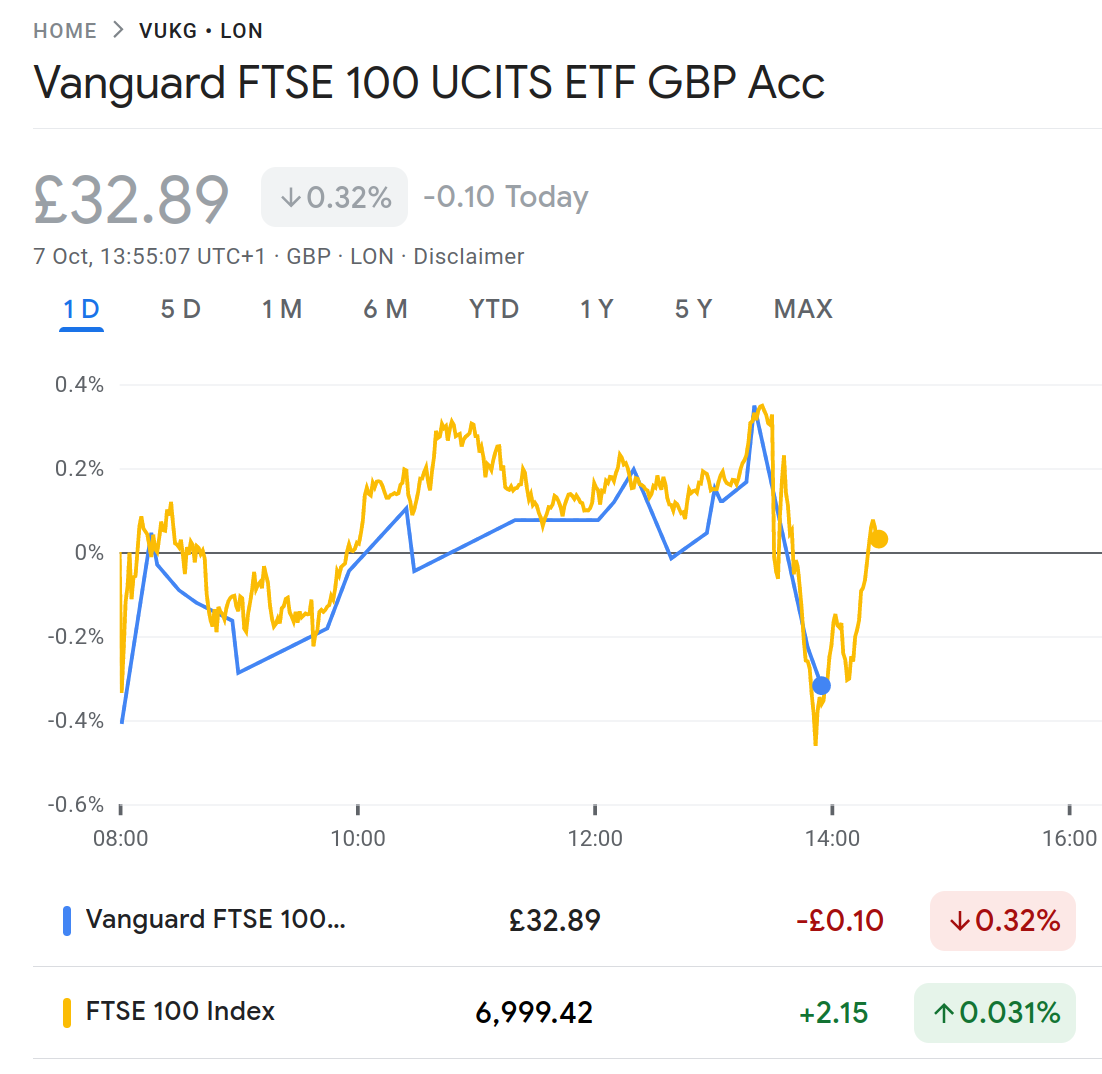
You can get recent (15 minute delayed) trade history from the LSE website.Google Finance has non-delayed prices for the LSE. It uses traded price for its charting. I'm not sure about H&L or MarketWatch. The screenshot shows a comparison of VUKG and the index so far today. As you can see there is a lag in the ETF pricing because it doesn't trade as often as the index is calculated.Not sure if any of this explains what you are seeing but might be of interest.
1 -
Hi areader,
Thanks for the chart. That does tally with what I'm seeing. The charts below are from Google Finance today normalized in %.The 5 day does track, but the intra-day can be out by 0.3% at times. Add 0.2% spread on that and you're looking at a 0.5% loss.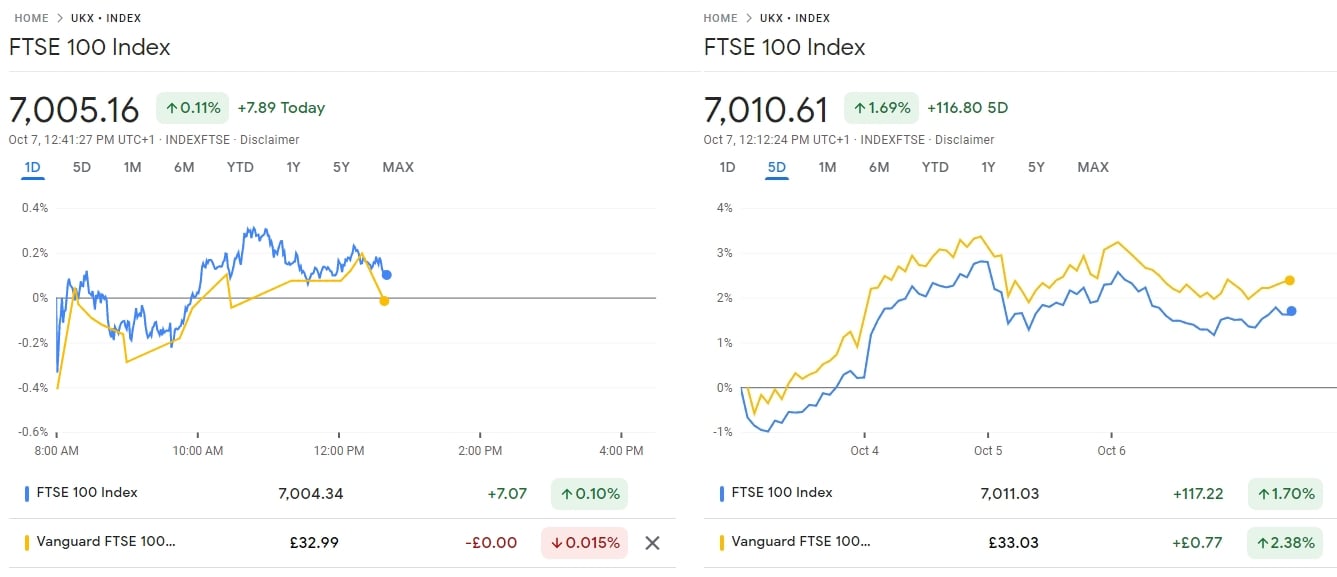
Received a reply back from Vanguard but the answer avoided the replication frequency question. I think they pick their answers from a multiple choice sheet....or are afraid to hand out any hard facts on anything. From the price action, it looks like the ETF corrects/adjusts twice an hour or so.
My friend came back with a chart from his terminal. Taken today. Below. Some divergence there. There 's definitely a tracking gap in places..which is what I've seen when buying and selling through my broker. They don't seem to like publishing this information though. The buyer and seller have to work it out for themselves.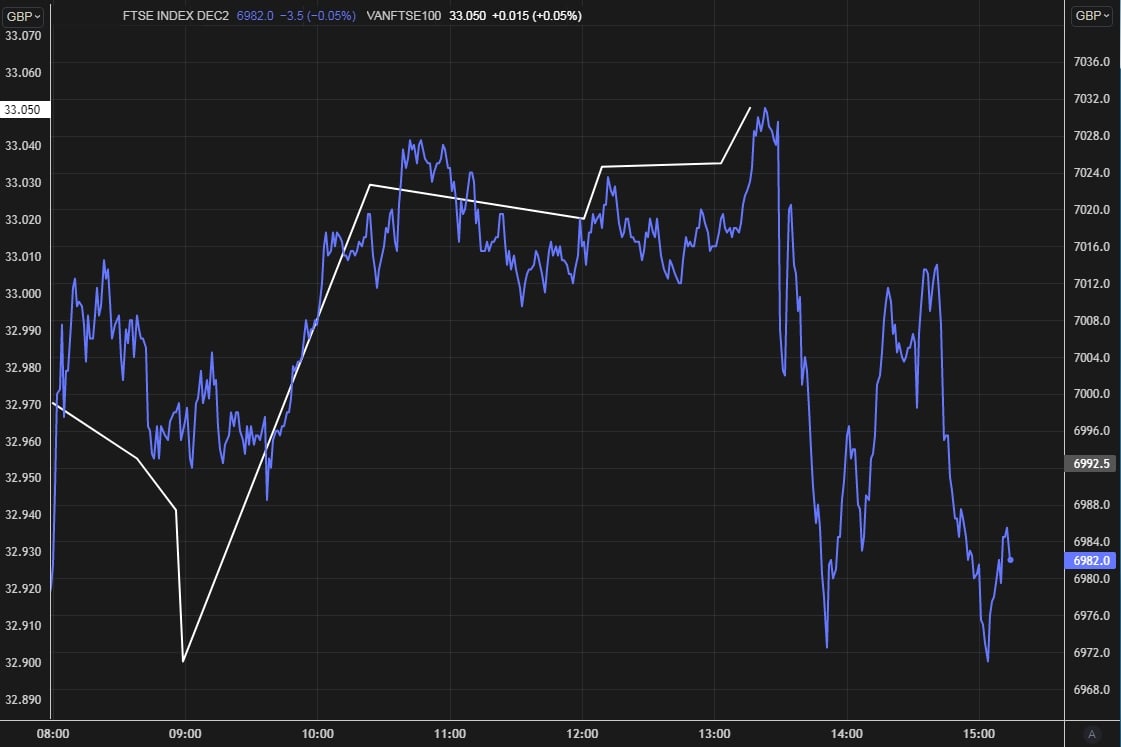
0 -
Perhaps this will help you explain the above: https://www.ft.com/content/f2685757-2639-424f-8f1e-0f4f981dadb9
Presumably the minor fluctuations in the index aren't worth the while of authorised participants to exploit for arbitrage. There will also be times (such as when markets are very volatile) where they will not participate due to the risk of being caught out by rapid price movements, and an ETF can trade at a more substantial premium or discount to NAV. This is one of the risk factors of ETFs.
2 -
I think this is down to a combination of tracking error and bid/offer spreads.
Don’t forget that many ETFs don’t actually hold all the constituents of the index it is tracking but instead holds a sample of stocks within the index that produces a near enough return than of the index. The VUKG ETF you refer to here seems to be fully replicating the FTSE100, however I noticed on its factsheet that it is allowed to use a sampling method if it felt necessary to do so. Also noticed that the ETF holds 102 stocks compared to the 100 in the index, probably just some stocks that have arisen from a corporate action or maybe a stock demoted to FTSE 250 that they haven’t sold yet, probably the former rather than the latter.
https://api.vanguard.com/rs/gre/gls/1.3.0/documents/31332/se
"If you aren’t willing to own a stock for ten years, don’t even think about owning it for ten minutes” Warren Buffett
Save £12k in 2025 - #024 £1,450 / £15,000 (9%)0 -
That's an interesting article. It explains how the open market share price of an ETF (which will be subject to price discovery mechanisms like any other share price) is kept in step with the index it's meant to be tracking. That might also explain why the ETF price is jumpy and looks non-liquid. The 'Authorised Participants' might only be arbitraging when there's enough money in it for them (actual share price v's NAV of the ETF).masonic said:Perhaps this will help you explain the above: https://www.ft.com/content/f2685757-2639-424f-8f1e-0f4f981dadb9
Presumably the minor fluctuations in the index aren't worth the while of authorised participants to exploit for arbitrage. There will also be times (such as when markets are very volatile) where they will not participate due to the risk of being caught out by rapid price movements, and an ETF can trade at a more substantial premium or discount to NAV. This is one of the risk factors of ETFs.0







Confirm your email address to Create Threads and Reply

Categories
- All Categories
- 354.6K Banking & Borrowing
- 254.5K Reduce Debt & Boost Income
- 455.5K Spending & Discounts
- 247.5K Work, Benefits & Business
- 604.4K Mortgages, Homes & Bills
- 178.6K Life & Family
- 262K Travel & Transport
- 1.5M Hobbies & Leisure
- 16.1K Discuss & Feedback
- 37.7K Read-Only Boards