We’d like to remind Forumites to please avoid political debate on the Forum.
This is to keep it a safe and useful space for MoneySaving discussions. Threads that are – or become – political in nature may be removed in line with the Forum’s rules. Thank you for your understanding.
📨 Have you signed up to the Forum's new Email Digest yet? Get a selection of trending threads sent straight to your inbox daily, weekly or monthly!
The Forum now has a brand new text editor, adding a bunch of handy features to use when creating posts. Read more in our how-to guide
Anyone use Guyton-Kinger's sustainable withdrawal rules?
Comments
-
A good method of handling early sequence of returns risk is to start retirement with several years expenditure in cash or very cautious funds so you are able to wait for the upturn. Rather than simply going for a standard 60% equity, 40% fixed interest portfolio I regard my pension pot as 60% long term equity, 40% short/medium term non-equity.GazzaBloom said:
I agree, Timeline is quite a comprehensive tool for forward planning, noted on the cashflow chart, I will look at it a bit closer as it's easy to just see the legacy prediction and think everything is peachy but there could be some lean years with cash running unacceptably low to sustain lifestyle mid way through. I also agree that some transparency on the modelling data used to back test would be helpful.Pat38493 said:
I have played about with Timeline quite a bit - I did find that those type of rules that you can apply seem to throw it for a wobbly if you have put in a combination of DC and DB benefits because in some scenarios your spending gets reduced to the DB amount and therefore never changes from that time on and you end up with x million according to Timeline but living on a pittance for most of your retirement. Make sure to look at the cash flow graph for the median scenarios if you have such combinations as you may get 99% “success” but when you look at the cash flow your available spending is massively less than you assume.
Also there is very little transparency about how Timeline models these x hundred scenarios over x hundred years of history - I would hope that it somehow takes into account recent economic history in some of the models, but if so it obviously would have to loop back around to prior years somehow.
Also I guess since Timeline is quite a new tool there are very few satisfied deceased customers who have managed their full retirement based on it!
However it seems like quite a good tool as long as you pay attention to the different reports coming out of it and understand what it’s telling you.
My biggest challenge may be a poor sequence of returns in the first 9 years until state pensions start to kick in....or early death should that occur sooner
Using Timeline has certainly helped me frame my thinking of a ballpark pot that feels about right to sustain a retirement, no-one knows what the future holds and as is often quoted "no plan survives first contact with the enemy" so some flexibility will certainly be required when leaping into the dark.1 -
"Also there is very little transparency about how Timeline models these x hundred scenarios over x hundred years of history"Pat38493 said:
I have played about with Timeline quite a bit - I did find that those type of rules that you can apply seem to throw it for a wobbly if you have put in a combination of DC and DB benefits because in some scenarios your spending gets reduced to the DB amount and therefore never changes from that time on and you end up with x million according to Timeline but living on a pittance for most of your retirement. Make sure to look at the cash flow graph for the median scenarios if you have such combinations as you may get 99% “success” but when you look at the cash flow your available spending is massively less than you assume.GazzaBloom said:
Thanks for your views, it kind of aligns with my thoughts, I have used my own spreadsheet for cashflow planning for retirement and also created a plan in Timeline that allows you to switch on Guyton's rules which improved the percentage chance of success so it's this that has lead to me looking at them more closely.Linton said:
I see no benefit in Guyton-Klingor as a strategy for actually managing your finances in retirement:GazzaBloom said:
Why not? do you not see any benefit in them?BritishInvestor said:
Hopefully notGazzaBloom said:Is anyone using the Guyton-Klinger rules for annual drawdown adjustments to their starting SWR? If so how is it working out?- The withdrawal rule: Increase withdrawal in line with inflation in the previous years, unless the previous year’s portfolio total return was negative.
- The portfolio management rule: Extract the gains from an asset class that has performed best in the previous year to provide the income, and move excess portfolio gains (beyond what is needed for the withdrawal) into a cash account to fund future withdrawals.
- The capital preservation rule: If the current withdrawal rate rises above 20% of the initial rate, then current spending is reduced by 10%.
- The prosperity rule: Spending in the current year is raised by 10% if the current withdrawal rate has fallen by more than 20% below the initial withdrawal rate.
The data is dodgy:
1) SWR is a very misleading term - there is no guarantee of safety. All there is is a demonstration that a given % withdrawal of initial pot increasing with inflation woulod have been sustainable in barely 100% of cases in the 100-150 years up to the present.
2) It is based on US data in a time when the US was a rapidly expanding economy. Most people in drawdown in the UK would or should be investing globally, largely in mature developed countries.
3) conditions were very different. For example over half of all complete 30 year periods in 1884-2022 include at least one World War.
4) There is a lot of overlap in the data - there are only about 4 non-overlapping 30 year periods in the 1884-2022 time frame..
Dealing with reallity
1) After say 5 years your retirement pot could be sgnificantly larger or smaller than that driving the G-K model. What do you do? Carry on regardles in the confidence that an SWR means it will all work out in the end or recalculate your SWR? The chances that you actually keep the same model through more than one boom/crash cycle must be small.
2) Can you really increase or decrease your spending by 10% on a year to year basis? Do you want to? If you book a world cruise for next year do you cancel it at say 6 months or less notice because G-K tells you that it is no longer affordable? Conversely if you are given 10% extra income for a year can you usefully spend it? Personally I am used to a particular standard of living. Having to scrimp with my usual good wines would upset me whilst having extra income would not make me happier. Stability of income is very important, especially as one ages.
What is G-K good for?
At some point you have to leap into the unknown and stop working. After then you will have to make it work. The purpose of planning as I see it is to give you the confidence to jump. I was happy with a spreadsheet model based on what seemed to be pessimistic assumptions. If a G-K model does that for you, fine. But dont expect to actually use it.
All I'm really getting from my spreadsheet and Timeline is a level of confidence a ballpark pot that should see us OK and I think I have that ballpark in mind now. I do question how these would actually work out in practice hence my post.
A 10% drop in drawdown for us would only really mean a relatively small drop in our discretionary spending "pocket money allowance" after tax and my fixed income DB pension, so would be acceptable. Plus when the state pensions kick in, drawdown should drop off considerably, to less than 1% a year based on a fairly conservative growth, to meet our day to day annual living expenses.
Obviously, as this year has shown, who the hell knows what's going to happen each year?
Also, GK doesn't appear to allow for use of a cash buffer where drawdown could be paused for a couple of years completely or reduced significantly if required.
Also there is very little transparency about how Timeline models these x hundred scenarios over x hundred years of history - I would hope that it somehow takes into account recent economic history in some of the models, but if so it obviously would have to loop back around to prior years somehow.
Also I guess since Timeline is quite a new tool there are very few satisfied deceased customers who have managed their full retirement based on it!
However it seems like quite a good tool as long as you pay attention to the different reports coming out of it and understand what it’s telling you.
They've recently changed some of their data sources, but assuming you are using real historical data and not MC simulation, it runs a starting pot using historical data (or their best attempt at it (a loooooong conversation) to see how the pot fared. Each run has an outcome, and these are used to provide an aggregated success rate.
"I would hope that it somehow takes into account recent economic history in some of the models, but if so it obviously would have to loop back around to prior years somehow."
The most recent history over a 30 year retirement is going to be ~1992 cutoff - anything more recently hasn't had sufficient time.
0 -
Ok but is this really how it works - if you selected a 40 year retirement period, it will only look at scenarios for people that retired up until 1982? So it does not for example run a simulation for someone who retired in 2010, but then somehow loop back to a prior period of time? Also, it claims to simulate "over 500 scenarios over 120 years of history" or something like that. If it was only simulating pure chronological time periods there would only be roughly 80 scenarios to simulate?The most recent history over a 30 year retirement is going to be ~1992 cutoff - anything more recently hasn't had sufficient time.0 -
Pat38493 said:
Ok but is this really how it works - if you selected a 40 year retirement period, it will only look at scenarios for people that retired up until 1982? So it does not for example run a simulation for someone who retired in 2010, but then somehow loop back to a prior period of time? Also, it claims to simulate "over 500 scenarios over 120 years of history" or something like that. If it was only simulating pure chronological time periods there would only be roughly 80 scenarios to simulate?The most recent history over a 30 year retirement is going to be ~1992 cutoff - anything more recently hasn't had sufficient time.
"Ok but is this really how it works - if you selected a 40 year retirement period, it will only look at scenarios for people that retired up until 1982?
if you have access to the "sustainable spending" tab you should see the end point at around that year. (I'm not sure which screens are available by default).
"If it was only simulating pure chronological time periods there would only be roughly 80 scenarios to simulate?"
Don't forget you have monthly sample points - if you hover over the sustainable spending tab, you can see the exact month.
0 -
Depends on whether you are talking from an emotional or genuine portfolio sustainability POV.Linton said:
A good method of handling early sequence of returns risk is to start retirement with several years expenditure in cash or very cautious funds so you are able to wait for the upturn. Rather than simply going for a standard 60% equity, 40% fixed interest portfolio I regard my pension pot as 60% long term equity, 40% short/medium term non-equity.GazzaBloom said:
I agree, Timeline is quite a comprehensive tool for forward planning, noted on the cashflow chart, I will look at it a bit closer as it's easy to just see the legacy prediction and think everything is peachy but there could be some lean years with cash running unacceptably low to sustain lifestyle mid way through. I also agree that some transparency on the modelling data used to back test would be helpful.Pat38493 said:
I have played about with Timeline quite a bit - I did find that those type of rules that you can apply seem to throw it for a wobbly if you have put in a combination of DC and DB benefits because in some scenarios your spending gets reduced to the DB amount and therefore never changes from that time on and you end up with x million according to Timeline but living on a pittance for most of your retirement. Make sure to look at the cash flow graph for the median scenarios if you have such combinations as you may get 99% “success” but when you look at the cash flow your available spending is massively less than you assume.
Also there is very little transparency about how Timeline models these x hundred scenarios over x hundred years of history - I would hope that it somehow takes into account recent economic history in some of the models, but if so it obviously would have to loop back around to prior years somehow.
Also I guess since Timeline is quite a new tool there are very few satisfied deceased customers who have managed their full retirement based on it!
However it seems like quite a good tool as long as you pay attention to the different reports coming out of it and understand what it’s telling you.
My biggest challenge may be a poor sequence of returns in the first 9 years until state pensions start to kick in....or early death should that occur sooner
Using Timeline has certainly helped me frame my thinking of a ballpark pot that feels about right to sustain a retirement, no-one knows what the future holds and as is often quoted "no plan survives first contact with the enemy" so some flexibility will certainly be required when leaping into the dark.0 -
To a point, since surely the objective of retirement investment for most people is to maximise happiness whilst alive rather than maximise wealth at death. That is an emotional objective.BritishInvestor said:
Depends on whether you are talking from an emotional or genuine portfolio sustainability POV.Linton said:
A good method of handling early sequence of returns risk is to start retirement with several years expenditure in cash or very cautious funds so you are able to wait for the upturn. Rather than simply going for a standard 60% equity, 40% fixed interest portfolio I regard my pension pot as 60% long term equity, 40% short/medium term non-equity.GazzaBloom said:
I agree, Timeline is quite a comprehensive tool for forward planning, noted on the cashflow chart, I will look at it a bit closer as it's easy to just see the legacy prediction and think everything is peachy but there could be some lean years with cash running unacceptably low to sustain lifestyle mid way through. I also agree that some transparency on the modelling data used to back test would be helpful.Pat38493 said:
I have played about with Timeline quite a bit - I did find that those type of rules that you can apply seem to throw it for a wobbly if you have put in a combination of DC and DB benefits because in some scenarios your spending gets reduced to the DB amount and therefore never changes from that time on and you end up with x million according to Timeline but living on a pittance for most of your retirement. Make sure to look at the cash flow graph for the median scenarios if you have such combinations as you may get 99% “success” but when you look at the cash flow your available spending is massively less than you assume.
Also there is very little transparency about how Timeline models these x hundred scenarios over x hundred years of history - I would hope that it somehow takes into account recent economic history in some of the models, but if so it obviously would have to loop back around to prior years somehow.
Also I guess since Timeline is quite a new tool there are very few satisfied deceased customers who have managed their full retirement based on it!
However it seems like quite a good tool as long as you pay attention to the different reports coming out of it and understand what it’s telling you.
My biggest challenge may be a poor sequence of returns in the first 9 years until state pensions start to kick in....or early death should that occur sooner
Using Timeline has certainly helped me frame my thinking of a ballpark pot that feels about right to sustain a retirement, no-one knows what the future holds and as is often quoted "no plan survives first contact with the enemy" so some flexibility will certainly be required when leaping into the dark.
However if you are going for a 60/40 portolio it is better to use the 40% for something useful rather than purely as ballast to stop the boat rocking too much.
Of course you could argue that a 100% equity portfolio would provide better restults. Having checked on cfiresim I find that the % success using the default figures with 70% equity and 100% equity is 95.93% compared with 95.12% which is surely the same within any reasonable error limits. On the other hand the 100% equity has a more than 50% higher median return at the end of the simulation. Do those figures lead you to advocate 100% equity in retirement?0 -
This the sustainable spending chart from the model I have built:BritishInvestor said:Pat38493 said:
Ok but is this really how it works - if you selected a 40 year retirement period, it will only look at scenarios for people that retired up until 1982? So it does not for example run a simulation for someone who retired in 2010, but then somehow loop back to a prior period of time? Also, it claims to simulate "over 500 scenarios over 120 years of history" or something like that. If it was only simulating pure chronological time periods there would only be roughly 80 scenarios to simulate?The most recent history over a 30 year retirement is going to be ~1992 cutoff - anything more recently hasn't had sufficient time.
"Ok but is this really how it works - if you selected a 40 year retirement period, it will only look at scenarios for people that retired up until 1982?
if you have access to the "sustainable spending" tab you should see the end point at around that year. (I'm not sure which screens are available by default).
"If it was only simulating pure chronological time periods there would only be roughly 80 scenarios to simulate?"
Don't forget you have monthly sample points - if you hover over the sustainable spending tab, you can see the exact month.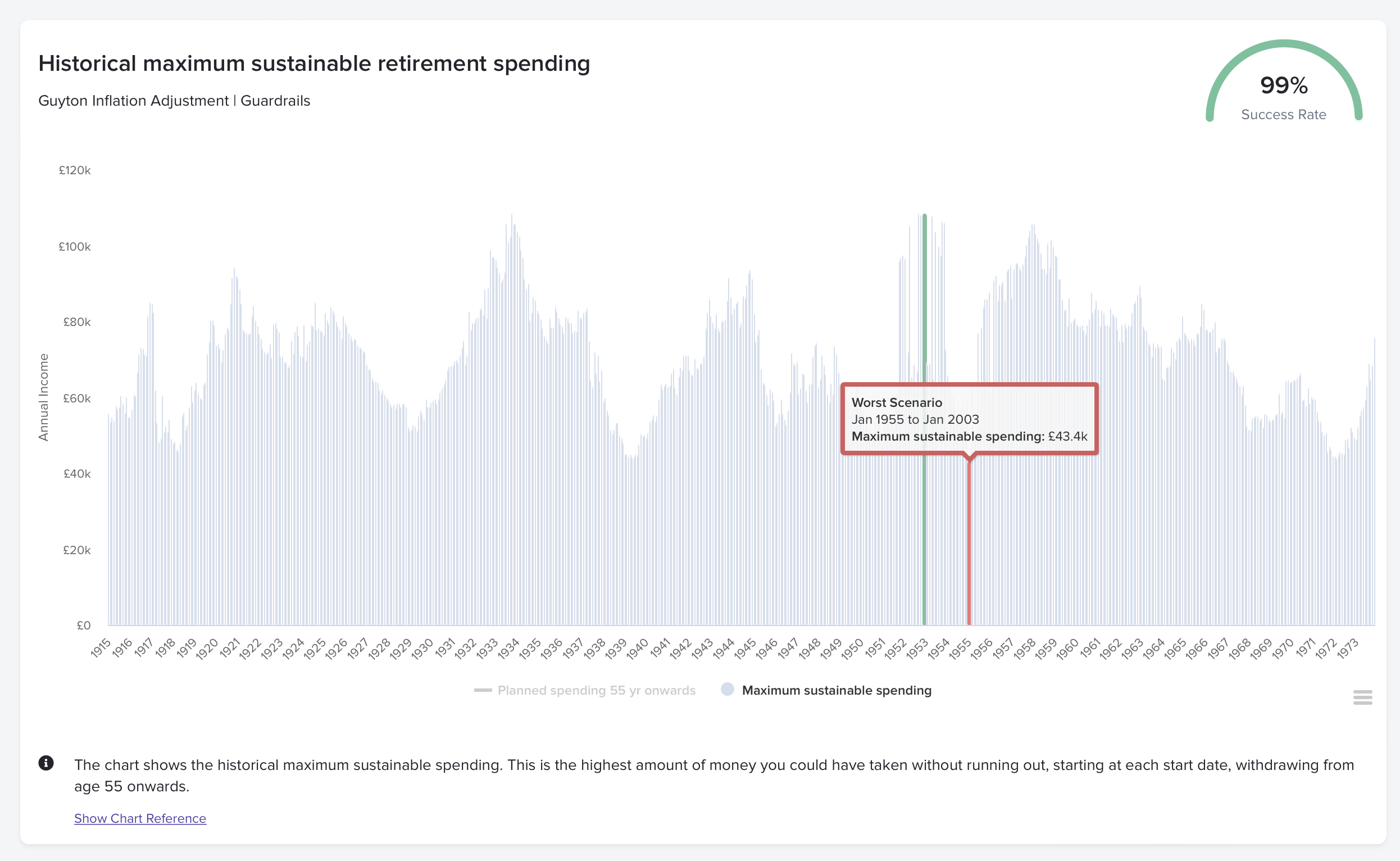
0











Confirm your email address to Create Threads and Reply

Categories
- All Categories
- 354.6K Banking & Borrowing
- 254.5K Reduce Debt & Boost Income
- 455.5K Spending & Discounts
- 247.5K Work, Benefits & Business
- 604.3K Mortgages, Homes & Bills
- 178.6K Life & Family
- 261.9K Travel & Transport
- 1.5M Hobbies & Leisure
- 16.1K Discuss & Feedback
- 37.7K Read-Only Boards