We’d like to remind Forumites to please avoid political debate on the Forum.
This is to keep it a safe and useful space for MoneySaving discussions. Threads that are – or become – political in nature may be removed in line with the Forum’s rules. Thank you for your understanding.
📨 Have you signed up to the Forum's new Email Digest yet? Get a selection of trending threads sent straight to your inbox daily, weekly or monthly!
The Forum now has a brand new text editor, adding a bunch of handy features to use when creating posts. Read more in our how-to guide
Fridge/freezer on Economy 7 possible energy-cost-saving trick?
Comments
-
That's funny, I have a large metal spider my husband made in welding classes about 30 years ago - also Christened Boris at the time and who lives on my chimney breast.
I defrosted my kitchen freezer a couple of weeks ago and not everything in it that I wanted to keep would fit into my cellar overflow freezer, so I turned the fridge down (or is it up?) and popped everything in there. I had several trays of ice cubes, so out of curiosity, I emptied them into a plastic tub and placed them in front of my frozen foods - as a yardstick as to the degree of defrosting that took place. It was none!
After four or five hours when I was ready to return the food, the ice cubes weren't even wet on their surface. They had totally remained as solid ice. So if your fridge were already decently cool, then there probably won't be much defrosting, especially if the cooling packs were really well frozen solid too.
What I did learn from the exercise was that defrosting a badly frosted up and not working well freezer did in fact tangibly reduce my electricity usage.- it looks to be around 1kWh per day. Plus my stuff is really frozen solid and I've been able to turn the freezer to a lower setting and retain the same temperature and solidity of stuff.
0 -
Our large fridge/freezer combination is set to -18c and 5c, doesn't appear to use enough to worth bothering about:
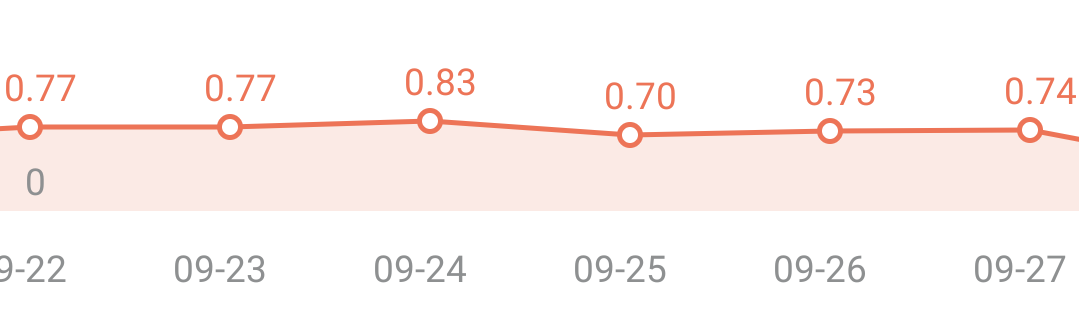 The 0.83 on the 24th was when the fridge/freezer was open for an extended duration to see what we had/needed for shopping.0
 -
Thanks but . . not quite sure of your figures. I make your 'scenario 2' result a daily cost of 27.9p - i.e. a saving of 11.5p, or £42 per year.victor2 said:BIt of quick arithmetic, with a few assumptions:My fridge/freezer is rated at 431kWh/year.Using an E7 rate of 43p/kWh peak and 14p/kWh offf-peak (rounded numbers from the EPG)That is 1.18kWh per day.If 2/3 of that is daytime use and 1/3 nighttime, the daily cost would be 33.9p plus 5.5p, or 39.4p in total per day.If the usage could be reversed so that 2/3 is at the off-peak rate and 1/3 peak, the total daily cost would be 33.9pSo a potential saving of 5.5p per day, or £20 per year.
Still only pennies to most people but scaled up to multiple households this could be quite significant. Especially when considering lowering peak grid demand.
And if industry could be persuaded to design appliances around this principle we could be looking at zero peak rate usage and fridges running on stored 'coldness' during these periods. Especially if using the Phase Change Material principle - https://www.sciencedirect.com/topics/engineering/phase-change-material.I'd rather be a disappointed optimist than a self-satisfied pessimist0 -
But which would be better - needing to replace every appliance in the country with some clever new model using "phase change technology" (and don't capitalise that, it just means melting/freezing/evaporating/condensing, nothing special about it, it's already in condensing boilers), or building a few large energy storage sites as part of the national grid?devondiver said:
Thanks but . . not quite sure of your figures. I make your 'scenario 2' result a daily cost of 27.9p - i.e. a saving of 11.5p, or £42 per year.victor2 said:BIt of quick arithmetic, with a few assumptions:My fridge/freezer is rated at 431kWh/year.Using an E7 rate of 43p/kWh peak and 14p/kWh offf-peak (rounded numbers from the EPG)That is 1.18kWh per day.If 2/3 of that is daytime use and 1/3 nighttime, the daily cost would be 33.9p plus 5.5p, or 39.4p in total per day.If the usage could be reversed so that 2/3 is at the off-peak rate and 1/3 peak, the total daily cost would be 33.9pSo a potential saving of 5.5p per day, or £20 per year.
Still only pennies to most people but scaled up to multiple households this could be quite significant. Especially when considering lowering peak grid demand.
And if industry could be persuaded to design appliances around this principle we could be looking at zero peak rate usage and fridges running on stored 'coldness' during these periods. Especially if using the Phase Change Material principle - https://www.sciencedirect.com/topics/engineering/phase-change-material.0 -
Sorry, - but not correct. Not my capitals - read the reference, and many others.- using "phase change technology" (and don't capitalise that, it just means melting/freezing/evaporating/condensing, nothing special about it, it's already in condensing boilers), - I'd rather be a disappointed optimist than a self-satisfied pessimist0
 -
Sorry, but the first line of that "reference" that you quote:devondiver said:
Sorry, - but not correct. Not my capitals - read the reference, and many others.- using "phase change technology" (and don't capitalise that, it just means melting/freezing/evaporating/condensing, nothing special about it, it's already in condensing boilers), -
"PCM-based thermal energy storage might be the oldest form of energy storage known to humanity, as our ancestors valued ice for exactly that purpose."
They even then say "All this is possible using the best and most abundant PCM: water."
You're going to have to do some serious explaining if you think that freezing water and thawing ice is a new and special technology.
Even they don't capitalise it in most of the book chapter abstracts on the page.0 -
devondiver said:
Thanks but . . not quite sure of your figures. I make your 'scenario 2' result a daily cost of 27.9p - i.e. a saving of 11.5p, or £42 per year.victor2 said:BIt of quick arithmetic, with a few assumptions:My fridge/freezer is rated at 431kWh/year.Using an E7 rate of 43p/kWh peak and 14p/kWh offf-peak (rounded numbers from the EPG)That is 1.18kWh per day.If 2/3 of that is daytime use and 1/3 nighttime, the daily cost would be 33.9p plus 5.5p, or 39.4p in total per day.If the usage could be reversed so that 2/3 is at the off-peak rate and 1/3 peak, the total daily cost would be 33.9pSo a potential saving of 5.5p per day, or £20 per year.
Still only pennies to most people but scaled up to multiple households this could be quite significant. Especially when considering lowering peak grid demand.Apologies, you are correct. Guess I got my figures muddled up on my fag packet!But given the other assumptions made, it still illustrates we are talking about pennies per day at best.I’m a Forum Ambassador and I support the Forum Team on the In My Home MoneySaving, Energy and Techie Stuff boards. If you need any help on these boards, do let me know. Please note that Ambassadors are not moderators. Any posts you spot in breach of the Forum Rules should be reported via the report button, or by emailing forumteam@moneysavingexpert.com.
All views are my own and not the official line of MoneySavingExpert.
1 -
"Many a mickle doth a muckle maketh" I'd rather be a disappointed optimist than a self-satisfied pessimist0 -
Steve_79_P said:"Citation required, unless you're referring to the fridge light!"
Why do fridges and freezers bother with doors if opening them makes no difference? Tried out of interest and usage went up 150w on IHDThat's an anecdote, not a citation for your claim. I can open my freezer door, remove a couple of items and close it again without the compressor cutting in.Consider a 100 litre freezer, full of air at -20C, in a kitchen at 20C. If you exchange all the air in the freezer with kitchen air, that's 100 litres of air you need to cool by 40 degrees from 20C to -20C.Air has a heat capacity of around 1300 J / m3 / deg C, so the amount of energy you neeed to remove from the air to cool it by 40 degrees is (1300 x 0.1 x 40) which is 5200J - less than 1.5 watt-hours. The amount of additional cooling needed to remove that much heat from the freezer will be tiny.N. Hampshire, he/him. Octopus Intelligent Go elec & Tracker gas / Vodafone BB / iD mobile. Kirk Hill Co-op member.Ofgem cap table, Ofgem cap explainer. Economy 7 cap explainer. Gas vs E7 vs peak elec heating costs, Best kettle!
2.72kWp PV facing SSW installed Jan 2012. 11 x 247w panels, 3.6kw inverter. 35 MWh generated, long-term average 2.6 Os.1 -
@QrizB Thanks for explaining - must admit I just assumed that as the ultimate reason a freezer uses energy is to cool things down, letting warmer things in would result in using more energy.
What I don't get is (f it makes such little difference opening and taking items in and out of) how does a freezer that's on all day without being opened and keeping everything inside it at -20 use 0.6 - 2 kWh a day. Is it because the items within have a different heat capacity?
0















Confirm your email address to Create Threads and Reply

Categories
- All Categories
- 354.6K Banking & Borrowing
- 254.5K Reduce Debt & Boost Income
- 455.5K Spending & Discounts
- 247.5K Work, Benefits & Business
- 604.3K Mortgages, Homes & Bills
- 178.6K Life & Family
- 261.9K Travel & Transport
- 1.5M Hobbies & Leisure
- 16.1K Discuss & Feedback
- 37.7K Read-Only Boards