We’d like to remind Forumites to please avoid political debate on the Forum.
This is to keep it a safe and useful space for MoneySaving discussions. Threads that are – or become – political in nature may be removed in line with the Forum’s rules. Thank you for your understanding.
📨 Have you signed up to the Forum's new Email Digest yet? Get a selection of trending threads sent straight to your inbox daily, weekly or monthly!
The Forum now has a brand new text editor, adding a bunch of handy features to use when creating posts. Read more in our how-to guide
Energy Price Guarantee (EPG) 16%, not 6%

tonybolony745
Posts: 1 Newbie
in Energy
New to this site. Thought it worth posting that currently, the £400 grant has not been promised for 23/24 therefore the figures that are being announced are misleading to householders. MSE are particularly good at getting the whole truth out there however they have played into the government's hands and confirmed a 6% increase. Without the second £400 23/24, the average household will pay an average of 16% over two years. The price cap this quarter for an average household is £3550 78% increase, however the EPG replaces this with £2500 25% increase. After £400 grant 22/23 average user 16%, only after £400 grant 23/24 (not yet promised) 6%. For me, as a high electricity user of 5000kWh p/a, my £2620p/a rate for Mar 22 is increasing to the EPG £3450 32% increase. After £400 grant 22/23 high user 24%, only after £400 grant 23/24 (not yet promised) 16%. I suspect the 23/24 grant will not be received due to "extortionate government borrowing".
0
Comments
-
Welcome to the site.
As several of us will point out on a regular basis - almost none of the published figures have any relevance to reality.
The only things that matter are the standing charges and unit rates. These don't take account of the £400 either in this year or in any other year, so it avoids any other confusion.7 -
The joys of the use of the word average. Average can mean three things, and no one - including Government statisticians - specify which average.
One has to assume they are using mean - and mean just means a figure to give a reasonable representation for each number in a set of data. The trouble with using mean is that outliers mess up the reasonable representation.
However, as in the main, no energy company has zero standing charges, then you cannot say "they say x% increase, but my percentage increase is y." You can only compare like for like figures. And even for the companies that do have zero standing charges, like Utilitia, you still cannot directly compare figures.
As #2 stays, look at the rates and work out your annual cost, as I have never seen a government (no matter which party) who will look after number 1. As the saying goes, "there are lies, damn lies and statistics."
1 -
Interestingly, they actually use the median as their typical usage - after excluding extremely low values (to exclude vacant and second homes according to the documentation).1
-
I stand corrrected on my assumption - but using any form of average cannot give a true representational figure for the whole population (zero usage and holiday homes excluded) as there are too many external factors to consider. Somebody, a while back, posted a link to average figures for different types of houses and even those were laughable.
0 -
We agree on that - the 'typical' doesn't represent anyone very well.
I've struggled to come up with a sensible alternative for headline writers and soundbite fans to use though. Any suggestion?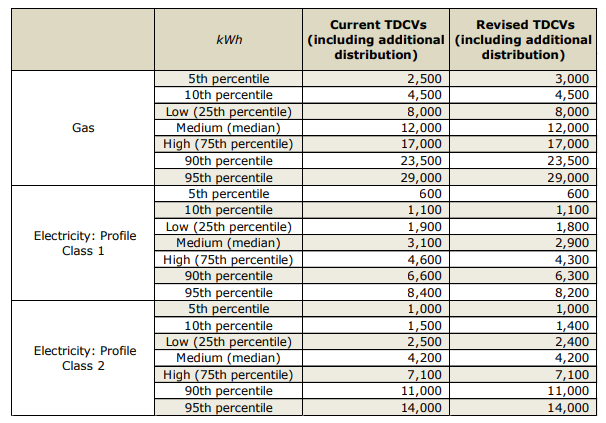
This is the summarised source data - 'Current' is 2017, 'Revised' is 2019. Class 1 is single-rate meter and Class 2 is multi-rate meter (roughly).1



Confirm your email address to Create Threads and Reply

Categories
- All Categories
- 354.5K Banking & Borrowing
- 254.4K Reduce Debt & Boost Income
- 455.4K Spending & Discounts
- 247.4K Work, Benefits & Business
- 604.2K Mortgages, Homes & Bills
- 178.5K Life & Family
- 261.7K Travel & Transport
- 1.5M Hobbies & Leisure
- 16K Discuss & Feedback
- 37.7K Read-Only Boards