We’d like to remind Forumites to please avoid political debate on the Forum.
This is to keep it a safe and useful space for MoneySaving discussions. Threads that are – or become – political in nature may be removed in line with the Forum’s rules. Thank you for your understanding.
📨 Have you signed up to the Forum's new Email Digest yet? Get a selection of trending threads sent straight to your inbox daily, weekly or monthly!
The Forum now has a brand new text editor, adding a bunch of handy features to use when creating posts. Read more in our how-to guide
Making holes in oversized joists

Gavin83
Posts: 8,757 Forumite



So I have a span of joists in my house that are hugely oversized for the space. The joists are 45x195 and the span around 2m, so roughly half the distance these joists are capable of supporting. I also appreciate there are rules governing where and how big holes/notches can be in a joist.
Do the rules allow for bigger holes if the joists are oversized? The smallest joist I could get away with for that span is 44x120. So would I be allowed a bigger hole in the 195 thick joist than if I had a 120 joist there?
To give a bit of context this is in a bathroom. Ideally I need to take a shower waste pipe through this joist, so 40mm odd. The shower itself (by far the heaviest item in the room, probably several hundred kilos) would be supported by another set of joists. I could go over this joist if I had to but it's not ideal.
I'm probably overthinking this given there's likely plumbers cutting holes big enough for soil pipes through joists on bigger spans than this but figured I'd ask the question for reassurance anyway.
Thanks.
Do the rules allow for bigger holes if the joists are oversized? The smallest joist I could get away with for that span is 44x120. So would I be allowed a bigger hole in the 195 thick joist than if I had a 120 joist there?
To give a bit of context this is in a bathroom. Ideally I need to take a shower waste pipe through this joist, so 40mm odd. The shower itself (by far the heaviest item in the room, probably several hundred kilos) would be supported by another set of joists. I could go over this joist if I had to but it's not ideal.
I'm probably overthinking this given there's likely plumbers cutting holes big enough for soil pipes through joists on bigger spans than this but figured I'd ask the question for reassurance anyway.
Thanks.
0
Comments
-
I'd just use my common sense and not think in terms of 'allowed' or not.If you are sure that 44x120 is fine, then IMO at least 75mm notch is fine or even a bigger hole.Also, the rules are usually a huge overkill. E.g. they are the same for any position of a notch/hole and ignore the fact that middle part of a joist is far more loaded than ends.
0 -
Is this going to be a notch, or a hole through the middle? The middle of a joist is less loaded than the top and bottom.
No reliance should be placed on the above! Absolutely none, do you hear?0 -
grumbler said: Also, the rules are usually a huge overkill. E.g. they are the same for any position of a notch/hole and ignore the fact that middle part of a joist is far more loaded than ends.Guidance for notches limits the distance from a wall to no more than 0.25 of the span. Holes on the centre line can be up to 0.4 pf the span. There are tables & diagrams published that give min/max distances & diameters - https://www.labc.co.uk/news/how-get-it-right-notches-holes-solid-timber-joists - For a 195 deep joist, just shy of 50mm would be permissible as long as it is on the center line. A right angle head is going to be useful - https://www.toolstation.com/keyless-angle-driver/p40354Notching of the joist, you would be limited to a maximum of 35mm regardless of the size of joist - If you want to go deeper, that is your decision, just keep it as close to the wall as practical.
Any language construct that forces such insanity in this case should be abandoned without regrets. –
Erik Aronesty, 2014
Treasure the moments that you have. Savour them for as long as you can for they will never come back again.3 -
Just to give a little more information I was leaning more towards a hole than a notch. I could do either quite easily but obviously a hole is preferable anyway.It’ll be close to the end of the joist. It’s not actually imbedded in the wall if that makes a difference. The load bearing wall below actually sits about a third of the way into the room so it just sits on top of it.0
-
Gavin83 said:It’ll be close to the end of the joist. It’s not actually imbedded in the wall if that makes a difference. The load bearing wall below actually sits about a third of the way into the room so it just sits on top of it.What does happen at the end then? Is there a hanger, or is the end just left free?The other thing to note is that the section required for a joist doesn't just depend on the span - the spacing between the joists is also a factor in that the wider they are spaced, the more load each joist has to carry.Because most of the time people want level floors and ceilings, the typical method for housebuilding was to use joists of constant depth, but then vary the spacing or width (or double-up) to deal with different spans and/or additional loads.The weight of a full bath (and probably your shower) could be considered as a point load, rather than a typical UDL, so therefore the house designer may have specified the joists as they are knowing that they will be carrying larger loads than the standards for normal rooms.I'd also be cautious if the support points are not at the ends of the joist - if the end is acting as a cantilever for 1/3 of the length then the standard load tables may not be applicable.0
-
As I said it just sits on top of the wall. As they say a picture paints a thousand words:Section62 said:Gavin83 said:It’ll be close to the end of the joist. It’s not actually imbedded in the wall if that makes a difference. The load bearing wall below actually sits about a third of the way into the room so it just sits on top of it.What does happen at the end then? Is there a hanger, or is the end just left free?The other thing to note is that the section required for a joist doesn't just depend on the span - the spacing between the joists is also a factor in that the wider they are spaced, the more load each joist has to carry.Because most of the time people want level floors and ceilings, the typical method for housebuilding was to use joists of constant depth, but then vary the spacing or width (or double-up) to deal with different spans and/or additional loads.The weight of a full bath (and probably your shower) could be considered as a point load, rather than a typical UDL, so therefore the house designer may have specified the joists as they are knowing that they will be carrying larger loads than the standards for normal rooms.I'd also be cautious if the support points are not at the ends of the joist - if the end is acting as a cantilever for 1/3 of the length then the standard load tables may not be applicable.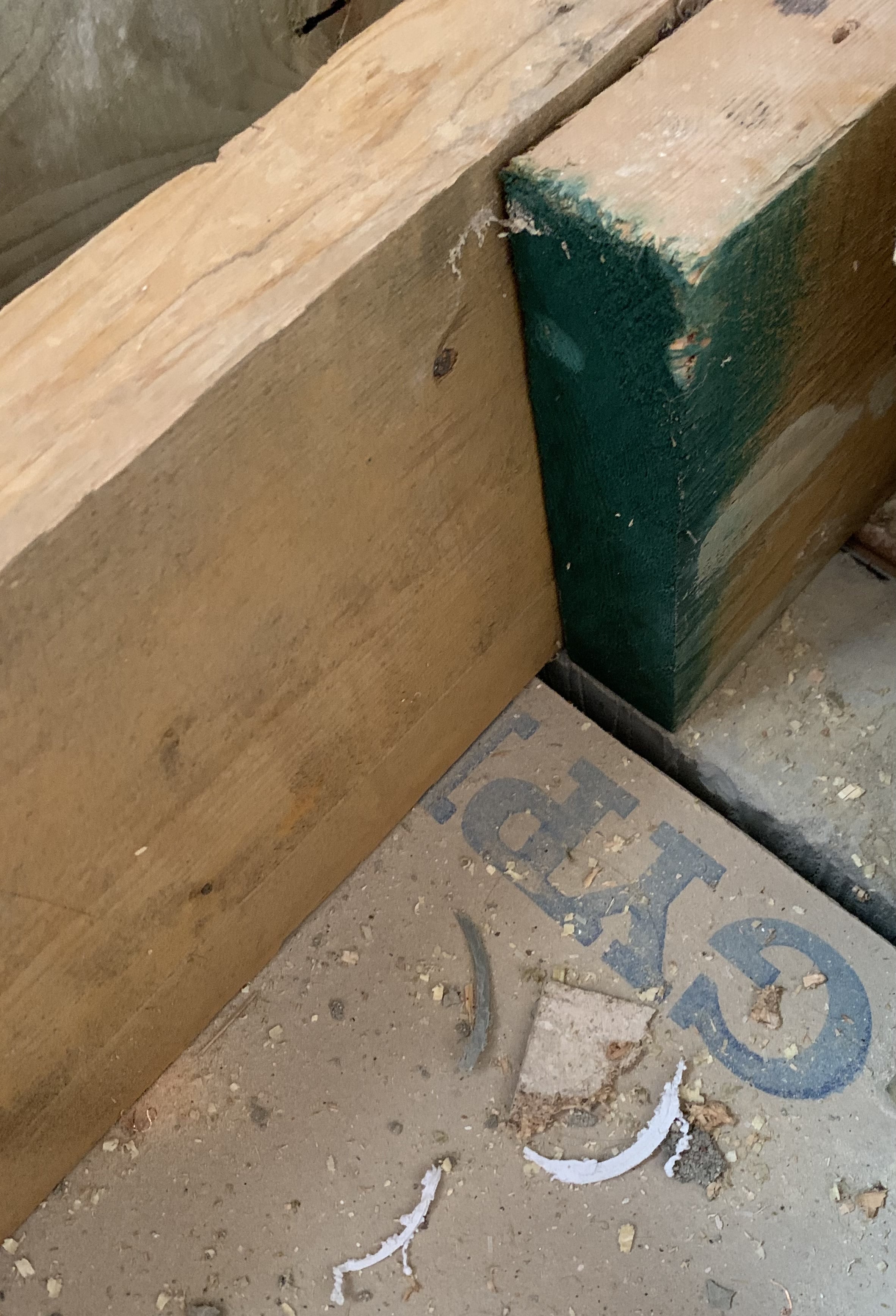 That’s the load bearing block wall from the ground floor that those joists are sitting on.The one I’m interested in putting the hole in is on the left. As mentioned it has a span of around 2m and will partially carry the toilet and sink, with another joist also underneath. The one on the right (with the green end) will support the shower among other things.
There’s 400mm between the joists.0



Confirm your email address to Create Threads and Reply

Categories
- All Categories
- 354.8K Banking & Borrowing
- 254.5K Reduce Debt & Boost Income
- 455.6K Spending & Discounts
- 247.6K Work, Benefits & Business
- 604.5K Mortgages, Homes & Bills
- 178.6K Life & Family
- 262.1K Travel & Transport
- 1.5M Hobbies & Leisure
- 16.1K Discuss & Feedback
- 37.7K Read-Only Boards